The trucks always arrived before sunrise.
Their engines groaned down the service road behind the Wren family farm while the Louisiana sky was still gray and wet. Backup alarms cut through the darkness, followed by the metallic slam of tailgates and the heavy rush of black cane waste striking the ground. By breakfast, the sour smell of boiled sugar, diesel, and rot had already worked its way through the farmhouse windows.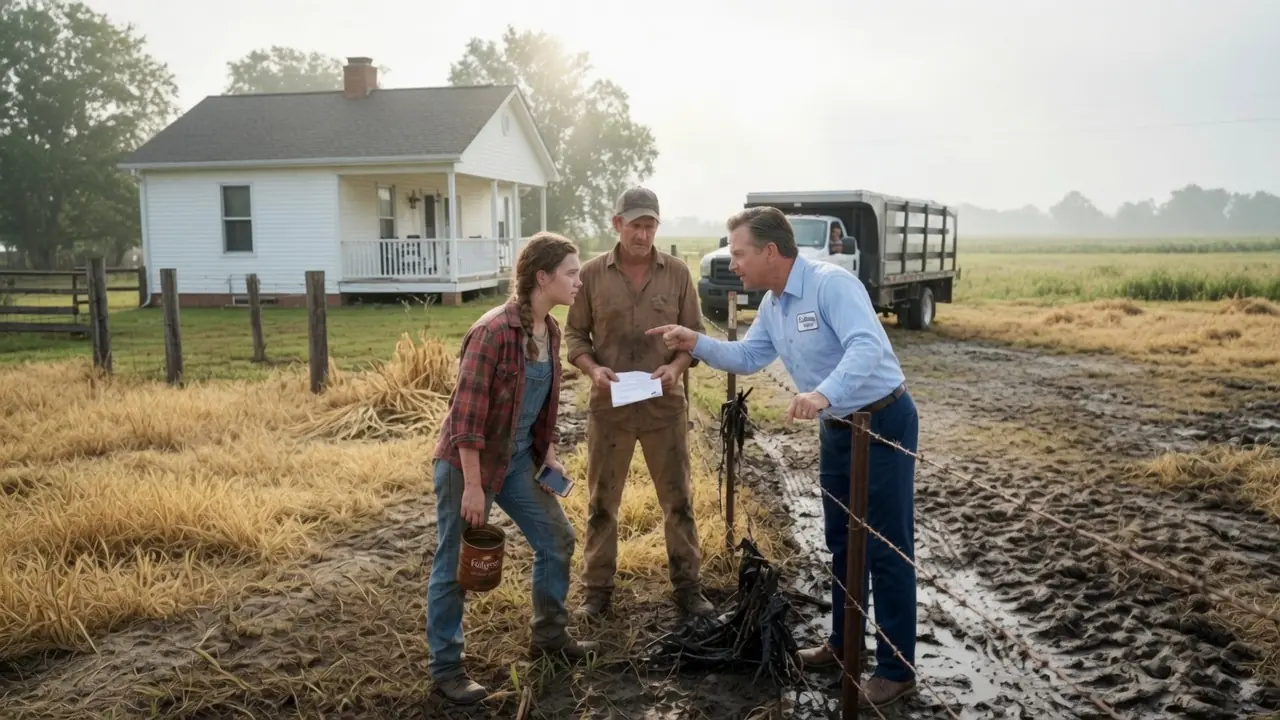
For six years, Callaway Sugar Refining had used the land beyond the Wrens’ southern fence as an unofficial dumping ground. The company called it temporary industrial storage, though the piles had become small hills stretching along the service road. Heavy rain washed dark liquid through broken fencing and into the family’s drainage ditch. Every season, the contaminated strip reached farther into their pasture.
Thomas Wren had fought from the beginning.
He sent photographs to the county, carried jars of brown well water into public meetings, and wrote formal complaints until the folders filled an entire kitchen drawer. Inspectors arrived occasionally, stood near the least damaged part of the property, and left after speaking privately with Callaway representatives. Their reports always concluded that no immediate regulatory violation could be confirmed.
The words changed nothing.
The Wrens’ sweet corn grew thin and yellow near the southern field. Grass died around the runoff ditch, cattle refused to drink from one trough, and the family’s well developed a sour metallic taste. Thomas borrowed money for filters, fencing repairs, and trucked-in water while Callaway Sugar Refining reported another profitable year.
The refinery employed nearly four hundred people around Bellweather. That made Hal Brennan, its operations manager, one of the most protected men in the parish. Farmers criticized him quietly but smiled when he entered the diner because their brothers, daughters, and neighbors depended on Callaway paychecks. In a small town, power did not always silence people with threats.
Sometimes it simply paid enough people to look away.
Sixteen-year-old Clara Wren had grown up watching her father become smaller after every failed complaint. Thomas was still strong enough to repair tractors and carry feed sacks, but disappointment had bent something inside him. He stopped speaking during dinner whenever another Callaway truck passed behind the farm. Eventually, he began folding the county’s rejection letters without reading them twice.
Clara’s mother, Elena, worked long shifts as a nurse at Bellweather Community Hospital. Her wages kept electricity running and food inside the refrigerator, but they could not cover the failing harvest and Thomas’s growing debt. Elena urged her husband to sell the southern acreage before the entire farm became worthless. Thomas always answered that no honest buyer would purchase poisoned soil.
One humid August morning, another truck crossed through the broken service gate.
Clara followed her father toward the fence carrying a rusted coffee can filled with discolored well water. Hal Brennan arrived in a spotless white pickup as though he had been expecting the confrontation. His pale-blue company shirt was pressed, his boots were clean, and the Callaway badge clipped to his belt shone beneath the early light.
“Mr. Wren,” Hal said, “this material is not classified as hazardous.”
Thomas handed him a letter from the agricultural extension office. “Then explain why my corn dies wherever the runoff reaches.”
“That field underperformed before our expansion.”
“My father grew corn there for forty-one years.”
Hal glanced across the ruined rows. “Sentiment doesn’t change soil chemistry.”
Clara felt her father’s humiliation before she saw it. Thomas looked down at the letter in Hal’s hand, as if the document had betrayed him by failing to matter. The manager then noticed Clara standing beside the broken wire, her side braid damp with morning mist and her boots sunk into black mud.
“Your farm is already dead, sweetheart,” Hal told her. “The only thing left back there is garbage.”
Clara imagined throwing the contaminated water across his clean shirt.
Instead, she looked at the license plate on his pickup. She photographed the company truck, the broken fence, the fresh tire tracks, and the dark stream crossing onto their property. When Hal demanded that she put away the phone, she raised it higher.
“Every illegal dump is recorded now,” she said.
Hal stepped closer. “Be careful what story you think those pictures tell.”
“They tell the time, date, location, and company name.”
“You’re a child playing investigator.”
Clara looked toward the steaming pile behind him. “Then you shouldn’t be afraid of me.”
Hal’s expression changed for the first time.
He returned to his pickup without answering, but Clara understood the warning in his silence. Callaway had spent six years teaching the Wren family that complaints produced paperwork while dumping produced profit. Hal believed the pattern would continue because everyone involved had already accepted it.
Clara had not.
That afternoon, she walked the southern boundary with her old phone. She photographed healthy grass in the northern pasture, damaged corn beside the ditch, flies over fresh waste, and the exact point where runoff crossed the fence. At the county library, she uploaded every file to three separate accounts because the farmhouse internet failed whenever storms reached Bellweather.
Mrs. Penhalligan, the elderly librarian, watched from behind the circulation desk.
“School project?” she asked.
“Yes, ma’am,” Clara replied.
The answer was not a lie.
For the next month, Clara read everything she could find about sugarcane processing. She learned that factories produced several kinds of leftover material, some relatively harmless when managed correctly and others capable of damaging soil and water when dumped untreated. Fresh cane residue could consume oxygen as it decomposed, while concentrated wash sludge could change acidity and carry compounds plants could not tolerate in large amounts.
She also learned something Hal had never mentioned.
Properly stabilized sugarcane residue could become valuable soil amendment.
The discovery did not mean the black piles were secretly safe. Callaway’s fresh waste was damaging the Wren property because the company dumped it in uncontrolled heaps where rain carried concentrated runoff into fields and groundwater. But the oldest material had changed after years of weathering, decomposition, and exposure to air.
Clara found evidence beside the oldest pile in late September.
A tomato plant had grown through the dark, crumbly surface near the abandoned corner of the dump. Its stem was thick, its leaves were deep green, and its branches carried fruit larger than anything in Elena’s garden. Nothing else near the southern fence looked healthy.
Clara crouched beside the plant and pressed the aged material between her fingers.
It no longer smelled sharply sour. The texture resembled rich compost rather than wet industrial sludge. Beneath the surface, earthworms moved through soil that had once been lifeless.
For the first time in six years, Clara did not feel trapped.
She felt curious.
She collected small samples from several areas, labeling each by date and distance from the newest piles. She included ordinary farm soil, damaged runoff soil, fresh Callaway waste, and old decomposed residue. Then she mailed the samples to an independent laboratory using money she had saved from repairing neighbors’ fences.
The results arrived two weeks later.
The fresh waste showed conditions unsuitable for direct agricultural use. The oldest stabilized material, however, contained organic matter and plant nutrients capable of improving poor soil after proper treatment and testing. It still required controlled processing, blending, and safety verification, but it was not worthless.
Clara spread the reports across the kitchen table.
Thomas read them twice. “This doesn’t fix what they did.”
“No.”
“It doesn’t make the dumping legal.”
“No.”
“Then what are you thinking?”
Clara placed one finger beside the old material’s nutrient analysis. “I’m thinking Hal Brennan has been paying to throw away something farmers might buy.”
Thomas leaned back. “You are sixteen.”
“The laboratory didn’t ask my age.”
“He will crush us in court if we touch anything on the factory side.”
“We don’t have to. Years of it crossed onto our land.”
Elena entered after her hospital shift and found them still arguing. She listened as Clara explained the difference between fresh waste and stabilized residue, the possibility of controlled composting, and the need for expert guidance. When Thomas warned that another experiment could cost money they did not have, Elena removed her shoes and sat at the table.
“How much for a small test?” she asked.
Clara opened her notebook.
She had already calculated it.
The first trial occupied an unused concrete pad behind the barn. Clara did not attempt to process the fresh black sludge alone. She worked only with older residue already deposited on Wren property and followed written guidance from agricultural publications, measuring moisture and temperature while blending it with clean plant material from the farm.
Thomas helped reluctantly.
He built a simple covered area to protect the trial from heavy rain and repaired an old thermometer Clara found in the barn. Elena recorded observations after returning from the hospital. What began as Clara’s secret project slowly became the first thing the family had worked on together without discussing debt.
The initial batch failed.
It remained too wet, smelled worse after several days, and attracted flies. Thomas wanted to end the experiment before it contaminated another part of the property. Clara agreed to dismantle the batch only after documenting exactly why it failed.
The second batch overheated and lost much of its useful structure.
The third stabilized unevenly.
Clara filled pages with mistakes.
She did not hide them, because failure became useful once it explained what needed to change. She compared moisture levels, different ages of residue, and how often each pile received air. Every unsuccessful trial narrowed the distance between curiosity and understanding.
Mrs. Penhalligan introduced Clara to Dr. Lena Morales, a soil scientist from the state university’s extension program. Lena initially agreed only to review the laboratory reports. After seeing Clara’s records, photographs, and careful distinction between untreated waste and stabilized material, she drove to the Wren farm.
Lena inspected the dump, runoff ditch, well, and trial area.
“This company created a serious management problem,” she said. “Do not let anyone twist your work into proof that the original dumping was acceptable.”
Clara nodded. “Fresh waste poisoned the field. Treated waste might repair it.”
“Exactly.”
Lena helped the family design safe, limited trials and connected them with a certified laboratory capable of screening the final product before agricultural use. She also recommended protective equipment and boundaries Clara had not considered. Thomas respected her because she never promised a miracle.
By January, the fifth batch passed its initial safety testing.
Clara placed the dark soil amendment into twelve planting containers. Four received damaged farm soil alone, four received commercial compost, and four received a carefully measured amount of her stabilized blend. She planted the same variety of winter greens in each container and kept the water, light, and seed count identical.
The difference appeared within weeks.
Plants grown in the damaged soil remained pale. The commercial compost improved them noticeably. Clara’s blend produced stronger stems, darker leaves, and better moisture retention than either comparison group.
Thomas stood beside the containers one evening after sunset.
“Your grandfather used to say our bottom land could grow anything,” he said.
Clara touched one leaf gently. “Maybe it still can.”
The family expanded the trial to one damaged corn row the following spring. They used only laboratory-approved material and left neighboring rows untreated for comparison. Clara installed simple markers, kept watering records, and photographed growth every three days.
By June, the treated row stood higher and greener than the surrounding field.
Word spread.
The first neighbor to visit was Louis Baptiste, a cane farmer who had laughed at Thomas during a county meeting years earlier. He walked the test row, rubbed soil between his fingers, and asked how much Clara would charge for enough material to treat a small vegetable plot.
“It isn’t for sale yet,” she said.
“When will it be?”
“When I know it works safely outside our field.”
Louis looked toward Thomas. “Your girl talks like a businesswoman.”
Thomas’s answer carried quiet pride. “She talks like someone who keeps records.”
Clara named the product Wren Black Gold.
She registered a small agricultural business with Elena’s help and used a school entrepreneurship grant to pay for packaging tests. The first bags were plain brown paper with black printed labels explaining that the product was made from recovered agricultural residue processed under controlled conditions.
Every batch carried a testing number.
Clara refused to sell anything without documentation.
By the end of summer, local gardeners, two nurseries, and six farmers were testing Wren Black Gold. Their results varied by crop and soil, but the pattern remained strong enough to attract interest. Fields that struggled with low organic matter held moisture longer and produced more consistent growth after treatment.
Then Hal Brennan returned.
His white pickup stopped beside the southern fence at seven one morning. This time, he brought Callaway’s attorney and two security employees. Clara stood beside Thomas holding her phone while Hal displayed a cease-and-desist letter.
“You have been stealing company property,” he said.
Thomas looked toward the black hills Callaway had dumped beside their farm for six years. “You called it waste.”
“Ownership does not disappear because material lacks immediate value.”
“The residue crossed our boundary.”
“Industrial material accidentally displaced by weather remains Callaway property.”
Clara opened the letter. It demanded that the Wrens stop collecting, processing, marketing, or selling any sugarcane residue originating from Callaway Refining. It also claimed the company owned all formulas derived from its byproducts.
Hal smiled when he saw her reading.
“Hand over your process records,” he said. “Callaway may be willing to resolve this without destroying your family financially.”
Clara held up a sealed bag of fertilizer. “Your trucks poisoned us, and every illegal dump is recorded.”
“Your videos prove nothing.”
“My soil tests do.”
“We have lawyers.”
“We have six years of waste on private land.”
Hal stepped closer. “Give us the formula, or Callaway will bury your family in court.”
Clara raised the sample between them. “Try it. Tomorrow the county learns your trash is worth more than your sugar mill.”
Hal laughed.
He stopped laughing the next afternoon.
The county environmental board meeting began at two o’clock in a crowded public chamber. Clara expected fifty people. Nearly two hundred arrived, including farmers who used her product, reporters from Baton Rouge, university researchers, and former Callaway employees.
Hal sat beside three attorneys.
He opened by accusing the Wren family of trespassing, theft, unsafe product development, and a publicity campaign designed to extort the refinery. Callaway presented photographs of Clara near the waste piles and argued that her fertilizer business depended on company-owned raw material.
Then Clara spoke.
She showed photographs documenting runoff crossing the Wren property line. Every image included a date, location, truck number, and weather condition. She presented independent soil tests comparing healthy land, damaged fields, fresh residue, and aged material already deposited on Wren property.
Lena explained the science in plain language.
“The original dumping was harmful because the material was unmanaged and concentrated,” she testified. “The Wren process does not justify the dumping. It demonstrates that responsible recovery is possible where irresponsible disposal caused damage.”
Clara then displayed the six years of complaints her father had filed.
Callaway’s responses repeatedly described the residue as unwanted waste with no commercial value. One letter signed by Hal stated that removal would create an unreasonable burden because the material was “economically useless.”
The room turned toward him.
Clara read the sentence aloud. “You told the county it was useless when we asked you to remove it. Now you call it valuable because I found a way to use it.”
Hal whispered to his attorney.
Clara continued.
She revealed that every successful batch used only material located legally on Wren property or supplied by independent cane growers who signed recovery agreements. Her process records, brand, and business registration belonged to Wren Agricultural Renewal LLC.
Callaway did not own them.
The final evidence came from former truck driver Mason Greene.
Mason testified that Hal ordered crews to dump beyond approved storage boundaries whenever the official site became full. Drivers were instructed to arrive before sunrise and avoid routes visible from the main road. Internal logs were altered to show smaller volumes than the trucks actually carried.
“Did Mr. Brennan know runoff entered the Wren property?” the board attorney asked.
“Yes.”
“What did he say?”
Mason looked directly at Hal. “He said they were too broke to sue.”
The chamber erupted.
The board imposed an emergency order stopping Callaway’s dumping operation. State environmental officials opened a larger investigation, and the company was required to fund water testing, soil restoration, and removal of unstable waste piles. Hal was suspended before the week ended.
Callaway’s attorneys withdrew the claim against Clara.
Three months later, the company fired Hal after internal messages confirmed he concealed dumping volumes and misled regulators. Criminal charges were considered, though the legal process moved slowly. Clara cared less about watching him fall than she expected.
She had work to do.
Wren Black Gold grew rapidly after the hearing. Cane farmers who once paid to transport residue to disposal sites offered the Wrens clean byproducts under formal agreements. Clara and Lena developed a standardized recovery system with laboratory oversight, while Thomas converted an abandoned equipment shed into a small processing facility.
The business hired local workers.
That mattered in Bellweather.
Callaway had once protected itself by making the town afraid of lost jobs. Clara built a competing kind of loyalty by creating income from responsible recovery. Former refinery drivers, mechanics, and farmhands found work transporting and processing material legally instead of hiding it before dawn.
Within two years, Wren Black Gold supplied nurseries, vegetable farms, soil-restoration projects, and regional agricultural cooperatives. The company did not claim its product worked everywhere or for every crop. Clara’s packaging explained limitations, application guidance, and batch testing more clearly than many larger manufacturers.
Trust became part of the brand.
At eighteen, Clara received an offer from a national agricultural company. It wanted exclusive rights to her process and brand for one million dollars. Thomas nearly dropped the letter when he read the number.
Elena asked the question that mattered most.
“What happens to Bellweather?”
The agreement would move production to a larger facility in another state. Local suppliers would lose their contracts, and Wren employees would receive no guarantee of continued work. Clara refused.
Six months later, she negotiated a different deal.
A regional agricultural cooperative invested $1.4 million in Wren Agricultural Renewal while allowing the family to retain control. The money expanded the Bellweather facility, funded university research, and created a legal defense reserve for small farms facing industrial dumping.
The fertilizer had officially become a million-dollar business.
Hal Brennan appeared once more before construction began.
He looked older, his expensive boots replaced by ordinary work shoes and his Callaway badge gone. He stood near the southern fence where he had once told Clara the farm was dead.
“They ruined me,” he said.
Clara looked across the restored cornfield. “You mean your records exposed you.”
“You turned the town against the refinery.”
“I showed them what you buried behind our farm.”
Hal watched workers clear the last unstable pile. “Do you think this makes you better than me?”
“No.”
The answer seemed to surprise him.
Clara continued. “It means when I found something valuable, I didn’t have to poison anyone to profit from it.”
He left without another word.
The Wren farm recovered slowly. Some of the southern acreage required years of restoration, and the original well was permanently closed as a precaution. Yet corn returned to fields Thomas believed he would never plant again.
He kept the first successful bag of Wren Black Gold on a shelf inside the barn.
Clara eventually left for university to study soil science and sustainable agriculture, though she returned every weekend she could. Thomas managed farm operations, Elena handled employee health and safety, and Lena remained the company’s scientific adviser.
Mrs. Penhalligan framed Clara’s first library research request.
She hung it beside the computer where a sixteen-year-old girl had once uploaded photographs because powerful adults expected evidence to disappear.
Years later, reporters often told the story incorrectly.
They described Clara as a girl who discovered treasure inside trash, as though the fertilizer had been waiting fully formed in the black piles. Clara always corrected them. Untreated waste had damaged her family’s land, and curiosity alone had not made it safe.
Records, testing, expert help, repeated failures, and controlled work had transformed it.
The distinction mattered.
On the fifth anniversary of the county hearing, Clara stood beside the southern fence during a community open house. Children toured the processing building, farmers attended soil workshops, and former Callaway workers demonstrated recovery equipment.
Thomas joined her carrying two cups of coffee.
“You remember what Hal said here?” he asked.
“That our farm was dead.”
Thomas looked toward rows of healthy corn moving beneath the Louisiana wind. “You never answered him.”
“I was busy remembering.”
He smiled.
Beyond them, trucks still traveled the service road before sunrise. But they no longer arrived secretly, and their loads no longer vanished into uncontrolled piles. Every shipment was weighed, documented, tested, and processed beneath permits open to public review.
Clara had not saved the farm by screaming louder than Callaway.
She had watched, measured, learned, and built something the refinery’s executives were too arrogant to imagine.
They called it garbage while it poisoned her land.
They called it company property once it became valuable.
By then, the farmer girl they had dismissed was already selling it for more money than their lies could protect.