“When did you get this?” Chelsea Morgan asked, holding the check between two manicured fingers as if it smelled bad.
Dr. Evelyn Carter stood quietly at the marble counter, her hands folded around the worn leather handbag she had carried for nearly fifteen years. She was seventy-one years old, with silver-streaked hair pinned into a neat bun and a navy cardigan buttoned over a simple gray dress. She looked tired because she was tired, not from weakness, but from forty-eight straight hours at Chicago Children’s Hospital. The check in Chelsea’s hand was for fifty thousand dollars, issued after a private medical donor dinner where Evelyn had spoken about a little boy whose surgery had changed an entire family’s life.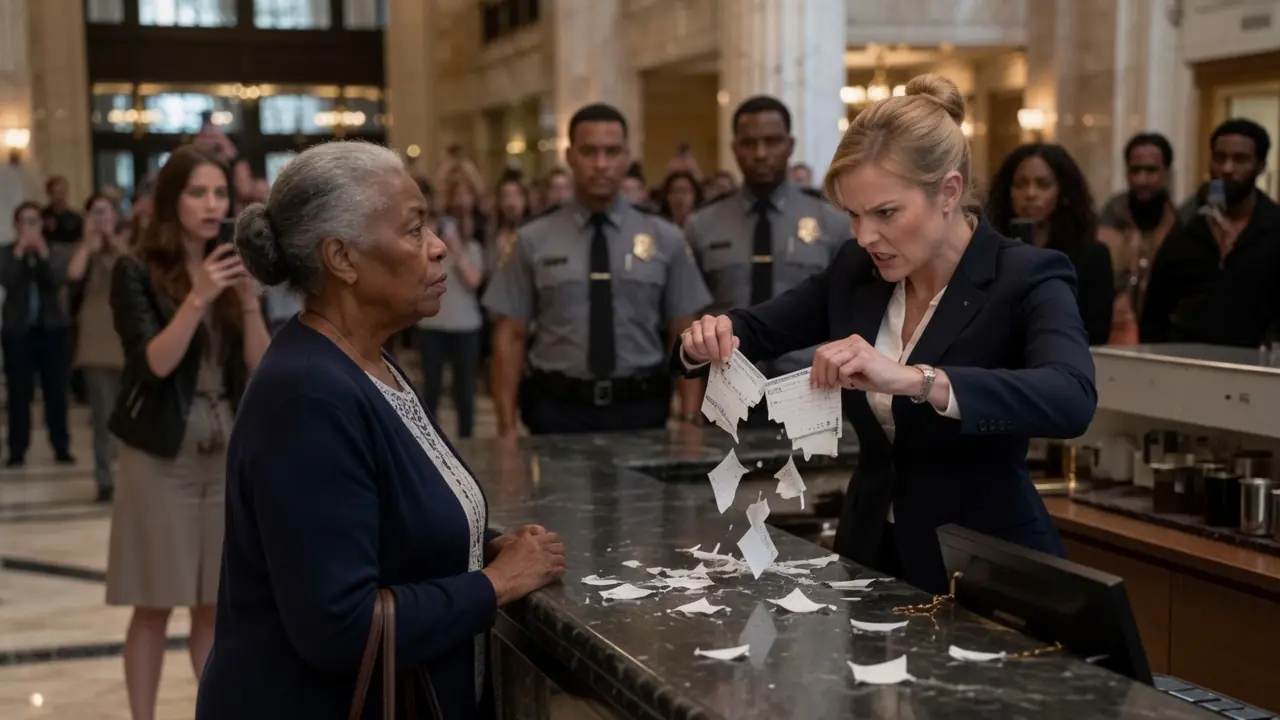
Chelsea’s eyes moved from the check to Evelyn’s face, then to the older woman’s sensible shoes. The lobby around them glittered with polished stone, gold trim, chandeliers, and quiet wealth. Customers stood in careful lines near velvet ropes, whispering into phones and signing forms with expensive pens. Chelsea’s counter sat beneath a discreet sign that read private banking, and she clearly believed that sign gave her permission to decide who deserved dignity.
“I received it this morning,” Evelyn said calmly.
Chelsea laughed once, sharp and thin. “This morning?”
“Yes.”
“And you expect me to believe someone just handed you a fifty-thousand-dollar check?”
Evelyn’s eyes narrowed slightly, not from fear, but from disappointment. “I expect you to verify it properly.”
Chelsea leaned back, her expression hardening with public confidence. “People like you come in here with stories all the time.”
The words floated into the lobby and changed the air. A man at the next counter stopped signing his deposit slip. A young woman near the entrance lifted her phone halfway, then lowered it, unsure whether she was witnessing a mistake or something worse. Two tellers glanced toward Chelsea, then quickly looked down at their screens.
Evelyn had spent most of her life in rooms where people underestimated her before they learned her name. She had been the only Black woman in lecture halls where professors assumed she was lost. She had been called “nurse” while wearing a surgeon’s coat with her name stitched plainly on the chest. She had learned, over decades, that outrage could exhaust a person faster than hard work.
So she breathed once and kept her voice level. “My name is Dr. Evelyn Carter. The check is from the Maxwell Pediatric Foundation. If you call the issuing office, they will confirm it.”
Chelsea did not move toward the phone. “Doctor?”
“Yes.”
“You?”
A few customers shifted at that. Even the first security guard near the elevator looked up.
Evelyn held Chelsea’s gaze. “Yes.”
Chelsea smiled as though Evelyn had made the lie more entertaining. “Of course.”
“May I speak with your manager?” Evelyn asked.
Chelsea’s smile widened. “Honey, I am management.”
The sentence landed loudly enough for the lobby to hear. Someone near the back whispered, “Oh no.” Another phone lifted. Then another. Chelsea seemed to enjoy the attention, mistaking an audience for approval.
Evelyn looked at the check again. “Then please process the deposit, or return it to me.”
Chelsea tapped the check against the counter. “No.”
Evelyn blinked once. “Excuse me?”
“This is suspicious.” Chelsea raised her voice slightly. “And I’m not risking my branch because someone walked in here with a fake hospital check and a nice little story.”
A wave of murmurs moved through the room.
Evelyn’s expression did not change, but inside, something old and cold stirred. She thought of the little boy whose parents had cried into her hands that morning. She thought of the nurses who had not slept, the residents who had stayed late, the donors who had entrusted that money to help children who could not wait. That check was not vanity. It was medicine, transport, family lodging, and hope written in ink.
“Do not damage that check,” Evelyn said.
Chelsea’s eyebrows rose. “Are you threatening me?”
“I am warning you.”
That was Chelsea’s last chance to stop.
Instead, she held the check higher so the people around them could see it. Her manicured fingers tightened at the top edge. For one brief second, the entire lobby seemed to lean forward without moving.
Then Chelsea ripped it straight down the middle.
The sound was small, but it cut through the room like glass breaking.
Evelyn stayed still.
Chelsea ripped it again, then again, tearing the paper into smaller pieces while customers gasped and phones rose fully now. Scraps drifted onto the black marble counter, then down to the polished floor near Evelyn’s shoes. A young woman near the entrance began recording openly, her hand shaking as she whispered to someone watching online.
Chelsea dropped the last pieces in front of Evelyn. “People like you don’t belong here with fake checks.”
The lobby went silent.
Evelyn looked down at the torn paper, then back at Chelsea. “You have made a serious mistake.”
Chelsea folded her arms. “Security.”
One of the tellers behind her whispered, “Chelsea, maybe you should verify—”
Chelsea turned sharply. “I said security.”
Two guards stepped forward from near the private elevator. Neither looked eager. The older guard, Mr. Willis, had worked at the bank for twelve years and had seen enough wealthy people behave badly to know confidence did not equal truth. He looked at Evelyn’s calm face, then at the torn paper, then at Chelsea.
“What seems to be the issue?” he asked carefully.
Chelsea pointed at Evelyn. “Possible fraud. She came in with a fake fifty-thousand-dollar check and refused to leave.”
“I did not refuse to leave,” Evelyn said. “I asked for proper verification.”
Chelsea snapped, “Do not interrupt me.”
That was when the livestream began spreading faster. The young woman filming near the entrance had thousands of viewers within minutes. Comments flew across her screen faster than she could read them.
Why is the older lady so calm?
That teller is doing too much.
Did she just tear up evidence?
Someone call corporate.
This feels wrong.
Chelsea did not notice the warning signs. Pride had put blinders over her judgment.
Evelyn slowly opened her handbag and removed a small leather card case. Chelsea smirked, clearly expecting a weak attempt at proof. But when Evelyn slid one card out, its platinum edge caught the chandelier light. It was not a debit card. It was a private client identification card issued only to the bank’s highest-tier legacy families and board-level accounts.
Chelsea missed the meaning completely.
Mr. Willis did not.
His posture changed. “Ma’am,” he said to Evelyn, softer now, “may I see that?”
Evelyn handed it to him.
Chelsea scoffed. “You’re not seriously falling for this.”
Mr. Willis read the name. His face tightened. “Dr. Evelyn Carter.”
Chelsea rolled her eyes. “She already said that.”
The second guard leaned closer, saw the card, and went pale. “Chelsea.”
“What?” Chelsea snapped.
Before he could answer, Chelsea reached across the counter and pressed the intercom button. “Security escalation to the main lobby. Possible fraud in progress.”
Mr. Willis whispered, “You should not have done that.”
Chelsea looked offended. “I’m doing my job.”
“No,” Evelyn said quietly. “You are doing something else.”
Chelsea stepped around the counter now, as if she needed the entire lobby to witness her authority. She walked near Evelyn and kicked one torn piece of the check aside with the tip of her heel. “Maybe next time, try a bank that serves people like you.”
Several customers gasped.
The young woman filming whispered, “She really said that.”
Evelyn’s eyes moved toward the private elevator at the far side of the lobby. The clock above the entrance read 2:47 p.m. Upstairs, on the twenty-third floor, a board meeting was scheduled to begin in thirteen minutes. Evelyn knew because she had been invited to attend.
She had not come to the bank by accident.
Her son, Marcus Carter, had insisted she stop by before the meeting to deposit the foundation check safely. Marcus was the CEO of Carter Dominion Bank, the youngest chief executive in the institution’s history and the first Black man to hold the position. He had begged his mother to use the private entrance, but Evelyn had refused.
“I have walked through front doors my whole life,” she had told him. “I am not starting side doors now.”
Now she stood beneath chandeliers while a woman young enough to be her granddaughter tried to throw her out.
Evelyn leaned forward just slightly. “Remember that sentence.”
Chelsea laughed. “I will.”
The private elevator opened with a soft chime.
Every head turned.
A tall man in a charcoal suit stepped into the lobby, followed by board members, senior executives, and legal counsel. Conversations died instantly. Employees straightened as if strings had pulled their backs upright. The guards moved aside without being told.
Chelsea’s face lit with relief. “Mr. Carter.”
For one terrible second, she seemed to believe rescue had arrived for her.
Marcus Carter did not look at Chelsea first. His eyes swept over the raised phones, the frozen customers, the torn scraps on the floor, the security guards, and then landed on Evelyn. The change in his face was immediate and devastating.
He stepped forward. “Mom?”
The word broke Chelsea’s confidence in half.
The entire lobby seemed to inhale at once.
Evelyn’s expression softened for the first time. “Hello, Marcus.”
Marcus looked at the torn pieces of paper on the floor. “What happened?”
Chelsea’s mouth opened, but no sound came out.
Evelyn looked at her son, then at the crowd. “Ms. Morgan refused to verify a foundation check, accused me of fraud, tore it apart, called security, and advised me to try a bank that serves people like me.”
Marcus went completely still.
That stillness frightened the room more than shouting would have.
Chelsea found her voice in fragments. “Mr. Carter, I didn’t know—”
Marcus turned to her. “You didn’t know what?”
Chelsea swallowed. “I didn’t know she was your mother.”
The mistake became even worse as soon as she said it.
Marcus’s face hardened. “So you would have treated another elderly woman this way if she were not connected to me?”
“No, I mean—”
“You mean her value changed only when you learned who her son was.”
Chelsea’s eyes filled with panic. “I thought the check was fake.”
“Did you verify it?”
“I was going to—”
“You tore it up.”
The legal counsel, a severe woman named Patricia Long, stepped forward and crouched to examine the scraps without touching them. “We need photographs of the check pieces and surveillance preserved immediately.”
Marcus looked at Mr. Willis. “Secure the lobby footage from every angle. No deletions. No internal edits.”
“Yes, sir,” Mr. Willis said.
Chelsea looked around, suddenly aware of the phones, the witnesses, and the young woman still livestreaming. “Please stop recording,” she said weakly.
No one stopped.
Marcus turned toward Natalie, the branch operations director who had rushed down from the mezzanine. “Was Ms. Morgan acting as floor manager today?”
Natalie’s face was pale. “Yes, sir.”
“Then she had authority to verify the check properly.”
“Yes.”
“And instead she destroyed it in public.”
Natalie lowered her eyes. “Yes, sir.”
Marcus looked back at Chelsea. “You are suspended effective immediately pending investigation.”
Chelsea gripped the edge of the counter. “Suspended?”
“Escort her to the employee office. Collect her badge. She is not to access the system.”
Chelsea began to cry. “Mr. Carter, I made a mistake.”
Evelyn spoke before Marcus could. “No, child. A mistake is entering the wrong number. What you made was a choice.”
Chelsea looked at her then, really looked at her, perhaps for the first time. She saw not a poor old woman, not a nuisance, not someone she could shame for sport. She saw Dr. Evelyn Carter, exhausted physician, mother of the CEO, honored guest of the board, and the woman whose calm had outlasted her cruelty.
“I’m sorry,” Chelsea whispered.
Evelyn’s voice remained gentle, but it did not soften the truth. “You are sorry because the elevator opened.”
The words struck harder than anger.
Marcus stepped beside his mother. “Are you all right?”
Evelyn looked down at the torn check. “I am tired.”
His jaw clenched. “I know.”
“No,” she said softly. “Not from this.”
He understood.
The lobby began moving again only when Marcus lifted one hand and addressed the room. “Ladies and gentlemen, we apologize for what you witnessed today. Anyone who recorded this incident may be contacted by our legal team as a witness, not to silence you. This bank will not ask the public to forget what happened before we understand why it happened.”
That statement changed everything. Customers who had expected corporate damage control now looked surprised. The young woman filming lowered her phone slightly, then whispered to her viewers, “He just said they’re not going to silence us.”
Marcus turned to Patricia. “Contact the Maxwell Pediatric Foundation and have the check reissued immediately. Carter Dominion will advance the full amount to the fund today, before close of business, from the executive reserve. No child waits because of our failure.”
Evelyn looked at him with quiet pride.
For the first time all afternoon, she touched his arm. “That is the right thing.”
Marcus looked down at her hand. He was fifty-one years old, powerful, respected, feared in boardrooms, and still that small gesture from his mother nearly broke him. “You should never have been treated this way here.”
“No one should.”
He nodded. “Then we fix it for more than you.”
Chelsea was led away through the side hall, crying into her hands. The lobby watched, not with pleasure exactly, but with the sober attention people give consequences when they arrive publicly. Mr. Willis remained near Evelyn, his face heavy with shame.
“Dr. Carter,” he said quietly, “I should have stepped in sooner.”
Evelyn looked at him. “Yes.”
He flinched.
Then she added, “But you can still step in next time.”
His eyes lifted. “I will.”
The board meeting upstairs was delayed. Not canceled. Delayed because Marcus insisted the incident be addressed before anyone discussed quarterly numbers. Evelyn sat at the long conference table beside him, a cup of tea in front of her and her handbag resting near her chair. The torn check had been photographed, logged, and secured.
Board members who had once praised diversity in polished reports now had to watch actual harm enter the room. Marcus did not let them hide behind vague language. He replayed the lobby footage, including Chelsea’s words, including the moment she tore the check, including the sentence that made several directors lower their eyes.
Maybe next time, try a bank that serves people like you.
When the video ended, silence filled the room.
Marcus stood at the head of the table. “This happened in our flagship lobby. Not in a forgotten branch. Not in an outdated training video. Here. Under our cameras. Under our brand.”
One director cleared his throat. “Marcus, it was one employee.”
Evelyn looked at him. “One employee felt safe enough to do it.”
The room went still again.
Marcus nodded slowly. “That is the point.”
The investigation that followed reached deeper than Chelsea. It found complaint patterns dismissed as misunderstandings. It found lower approval rates for certain clients when staff used “appearance-based concern” flags. It found employees who had reported disrespectful treatment but were told to focus on sales. Chelsea had not created the culture alone. She had simply revealed it in the brightest possible room.
Marcus responded with force. Chelsea was terminated after formal review. Two supervisors were removed from leadership roles for ignoring prior complaints. The bank launched mandatory verification procedures that required documented steps before fraud accusations could be made. A client dignity policy was written not by consultants alone, but with input from community advocates, older clients, disabled clients, and customers who had previously felt dismissed.
Evelyn insisted on one more thing.
She wanted Chelsea to receive a letter.
Not a legal letter. Not a threat. A personal one.
Marcus resisted at first. “She humiliated you.”
“Yes.”
“She tore up a check that was meant to help children.”
“Yes.”
“She does not deserve your labor.”
Evelyn smiled sadly. “Marcus, I am not writing for what she deserves. I am writing because someone should tell her exactly what she broke.”
So she wrote.
Chelsea,
The check you tore was not mine in the way you imagined. It belonged to children whose parents count miracles in hospital bills and sleepless nights. It belonged to nurses who hold families together at three in the morning. It belonged to a little boy who woke up today because many people did not give up on him. You saw paper. You saw my clothes. You saw an old woman you thought could be shamed. I hope one day you learn to see people before consequence forces you to.
She signed it Dr. Evelyn Carter.
Months passed, and the video became one of the most discussed banking scandals in the city. News outlets replayed the moment Marcus stepped out of the elevator and said, “Mom?” Commentators argued about bias, power, accountability, and whether public shame could force private institutions to change. Evelyn disliked the attention, but she endured it because the foundation received more donations than ever before.
The $50,000 check was reissued. Carter Dominion had already advanced the money, so the foundation used the duplicate funds to create the Evelyn Carter Patient Dignity Grant. It helped families pay for transportation, hotel rooms, meals, and emergency needs while their children received care. Evelyn cried when the hospital surprised her with the announcement.
“You shouldn’t have named it after me,” she told the director.
The director smiled. “We named it after what you protected.”
One year later, Evelyn returned to Carter Dominion Bank. This time, not to deposit a check, but to speak at the opening of the bank’s new public service training center. The lobby had changed. The velvet ropes were gone, replaced by open desks and clearer service stations. A sign near the entrance read: Every client deserves verification before suspicion and dignity before judgment.
Evelyn stood at the same marble counter where Chelsea had torn the check. Marcus stood beside her, hands folded, quieter than usual. Employees filled the lobby, along with community leaders, hospital staff, and clients invited to share their experiences.
Evelyn touched the counter gently. “I remember every sound from that day,” she began. “The paper tearing. The phones lifting. The silence after someone decided I was small enough to insult.”
No one moved.
“But I also remember what happened after. My son stepped out of an elevator, and suddenly the room recognized me. That should trouble us. Because I was already myself before he arrived.”
Marcus lowered his eyes for a moment.
Evelyn continued, “The question is not whether I deserved respect because I was a CEO’s mother. The question is why anyone waited for that fact to matter.”
A few employees wiped their eyes.
“I have been a doctor for more than forty years,” she said. “I have learned that people often arrive in front of us tired, afraid, embarrassed, or dressed for survival rather than approval. Our duty is not to decide their worth by how they look. Our duty is to serve with care until the truth is known.”
She paused, looking across the lobby.
“And even then, care should not depend on status.”
The applause began softly, then grew until it filled the marble room. Evelyn did not smile widely. She only nodded, accepting not praise but the possibility that pain had been turned into something useful.
After the ceremony, Mr. Willis approached her. He had been promoted to client safety coordinator after helping redesign the response policy. He looked nervous, almost like the guard from that day again.
“Dr. Carter,” he said, “we had an elderly man last week with a check that looked unusual. New teller got worried.”
“What happened?”
“She called for verification privately. Offered him water. Sat with him until the issuing office confirmed it.” He smiled faintly. “It was real.”
Evelyn’s eyes softened. “Good.”
“He left smiling.”
“Better.”
Marcus joined her near the entrance as the crowd began to thin. Outside, Chicago moved in its usual rush beyond the glass doors. Inside, the bank felt less like a palace and more like a place where human beings might actually be seen.
“I still think about that day,” Marcus said.
“So do I.”
“I should have had systems in place before it happened.”
“Yes,” Evelyn said.
He looked at her, accepting the answer because his mother had never raised him on easy comfort. “I’m trying to make it right.”
“I know.”
“Are you proud of me?”
Evelyn turned to him fully. She saw the CEO the world feared, the boy she had raised, and the man still learning that leadership was less about reputation than repair. She reached up and straightened his tie, as she had done when he was young.
“I was proud when you said ‘Mom’ in front of that lobby,” she said. “But I am prouder that you understood the problem was bigger than me.”
His eyes glistened. “You taught me that.”
“I tried.”
They stood together for a quiet moment, mother and son beneath chandeliers that had once watched humiliation fall like torn paper. Then Evelyn looked toward the service desk, where a young teller was kneeling beside an elderly woman, speaking gently while helping her organize documents.
Evelyn smiled.
The check had been torn.
The insult had been recorded.
The teller had fallen.
But the lesson had not ended with punishment. It had become policy, training, grants, and one sign by the entrance reminding every employee what should have been obvious from the beginning.
No one should need a powerful son to be treated with dignity.
And no quiet woman standing at a counter should ever again have to wait for an elevator to open before the room learns her name.