"If you came to laugh at the fat spinster, get in line,” Martha Hale said, leaning one powerful arm against the mule fence.
Caleb Rowan stood opposite her beneath the brutal Red Bluff sun, holding three lead ropes in one weathered hand. At forty-four, he looked as though the mountain had carved him from its own stone—tall, broad, gray beginning to thread through his tangled brown hair and thick beard. His buckskin coat was scarred by thorns, weather, and old blood, while his hazel eyes studied Martha without the pity she had learned to expect from men. Behind her, three mules shifted restlessly as flies circled their ears.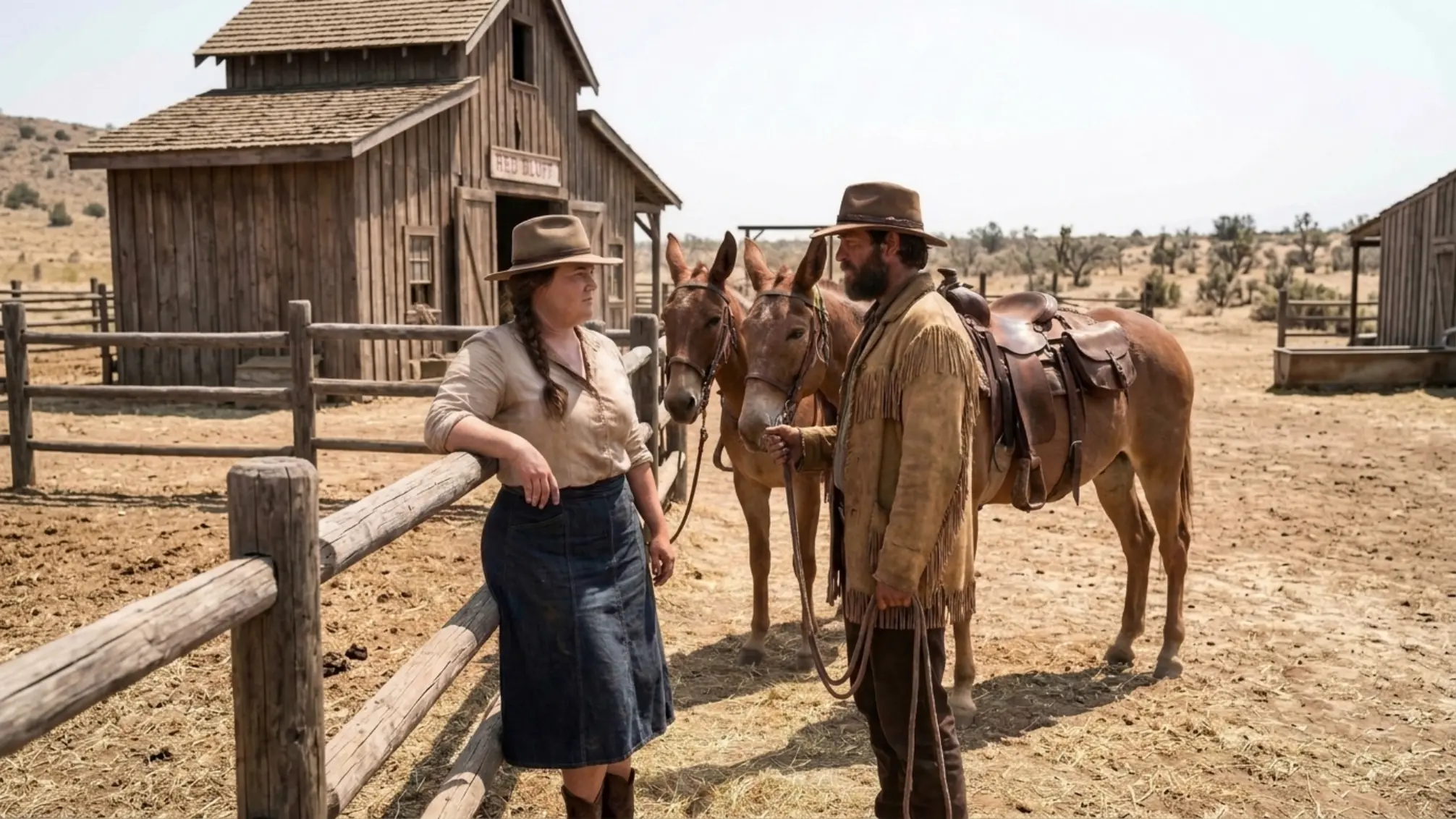
“I came because you know more about survival than every man in this town,” Caleb said.
Martha pushed herself away from the fence. She was twenty-eight, broad-shouldered and heavy through the hips, with thick brown hair braided over one shoulder and pale blue eyes sharpened by years of insults. Her beige work blouse was dark with sweat beneath the arms, and mud marked the hem of her denim skirt. “Choose me, and Red Bluff will mock you until spring.”
Caleb held out the mule reins. “Then come to the mountain, and let spring decide which of us was foolish.”
For several seconds, Martha heard nothing but the creak of leather harness and the distant hammering from the blacksmith’s shed. Men had proposed crueler things to her as jokes, often in front of crowds eager to watch her face change. One drunk miner had once offered marriage if she agreed to pull his ore wagon instead of his mule. She had broken his nose and spent two nights locked in the sheriff’s storage room for disturbing the peace.
“You asking me to be your wife?” she said.
“I’m asking if you want out of Red Bluff.”
“That wasn’t my question.”
Caleb’s eyes never left hers. “Yes.”
Martha laughed once, without humor. “You don’t know me.”
“I know you can shoe a frightened horse without beating it. I know you noticed a hoof problem I nearly missed. I know you work while your brother drinks away the profit, and I know you didn’t lower your eyes when I looked at you.”
“That’s enough for marriage?”
“It’s more than most people learn before one.”
A snort came from the livery doorway. Martha’s older brother, Jeb, stood there holding a bottle despite the hour. He was narrow-faced and sunken around the eyes, with his shirt partly untucked and his suspenders hanging loose. Two ranch hands had followed him, eager for whatever entertainment his laughter promised.
“You buying the mules or the whole stable?” Jeb called. “Because if you mean to haul Martha uphill, you’ll need all three.”
The ranch hands laughed. Martha’s expression did not change, but Caleb saw her fingers curl against her skirt. She had lived inside that laughter so long she knew better than to fight every man who offered it.
Caleb handed the mule ropes back to her and walked toward Jeb.
The laughter stopped when the mountain man came close. Caleb did not reach for the revolver at his hip or raise his voice. He merely stood before Jeb until the drunk had to tilt his head back to meet his eyes.
“Forty dollars for the mules,” Caleb said. “Another twenty for Martha’s unpaid share of the work she’s done here.”
Jeb blinked. “Her share?”
“You heard me.”
“She sleeps under my roof.”
“She keeps your business alive.”
Jeb’s face reddened. “You don’t tell me how to run my livery.”
Caleb removed a leather purse from beneath his coat and counted out sixty dollars. It was more money than Jeb usually saw in two months. He placed it on the barrel between them, then looked back toward Martha.
“The money is yours if she leaves with me freely,” Caleb said. “If she says no, I take the mules and you get forty.”
Jeb stared at the coins. Greed defeated pride almost immediately. “Take her. I’ve been feeding her long enough.”
Martha’s face went white.
Caleb turned slowly. Something dangerous entered his eyes, but Martha stepped between the two men before he could move. She did not protect Jeb out of love. She protected Caleb from committing violence that would give Red Bluff another reason to own part of their future.
“I’ll go,” she said.
The ranch hands began laughing again, but less confidently this time. Jeb swept the coins into his palm and demanded that Martha leave her room empty before sundown. She owned little enough to pack quickly: two dresses, one wool coat, a sewing basket, her mother’s iron skillet, three books, and a small wooden box containing every dollar she had hidden from Jeb.
By the time she returned to the yard, word had spread through Red Bluff.
Townspeople lined the boardwalk as though waiting for a parade. Women whispered behind gloved hands, men shouted advice about reinforcing Caleb’s cabin floor, and boys ran alongside the mules asking whether the mountain man had purchased a bride by the pound. Martha walked beside the gray mule with her jaw locked and her eyes fixed on the road.
Caleb stopped at the edge of town.
He turned toward the crowd and rested one hand on the pommel of his saddle. The gesture silenced several men who had mistaken his restraint for weakness. “Any man who wants to laugh closer can step into the road.”
Nobody moved.
Caleb looked toward the women. “Any woman who thinks cruelty makes her beautiful should find a better mirror.”
The boardwalk fell quiet.
Martha stared at him, stunned. No one had ever defended her without making her feel helpless. Caleb had not called her delicate, beautiful, or misunderstood. He had simply demanded that they treat her as human.
He mounted his horse, but Martha remained beside the mule.
“You can ride,” he told her.
“I can walk.”
“It’s twelve miles to the lower ridge.”
“I said I can walk.”
Caleb studied her, then dismounted. He led his horse beside her for the entire first day.
They camped near a creek where cottonwoods leaned over the water. Caleb built the fire while Martha unpacked the skillet and cooked salt pork with onions she had taken from the livery garden. Neither spoke much until darkness settled and coyotes began calling from the hills.
“You regret it yet?” Martha asked.
“No.”
“You might when the trail steepens.”
“You might when you see the cabin.”
She glanced at him across the flames. “That bad?”
“The roof leaks near the chimney.”
“I can patch a roof.”
“The north wall bows inward.”
“I can brace a wall.”
“There’s one bed.”
Martha’s hand stopped above the skillet.
Caleb added another branch to the fire. “You can take it. I’ll sleep by the stove until we decide what this marriage is.”
“What do you expect it to be?”
“A partnership.”
“That all?”
“For now.”
Martha had prepared herself for blunt demands, rough hands, or the unspoken assumption that being unwanted in Red Bluff meant she should accept anything offered elsewhere. Instead, Caleb gave her distance. The absence of pressure made her more uneasy than pressure would have.
They reached his cabin late the next afternoon. It stood high in a narrow valley between pine-covered ridges, with a smokehouse behind it and an animal pen built from thick logs. The structure was rough but solid, and beyond it the mountains rose in blue-gray layers toward snow already clinging to the highest peaks.
Caleb watched Martha take in the isolation. “Still want out of Red Bluff?”
She looked at the valley, the creek, and the long sweep of sky untouched by chimneys or stamp-mill smoke. “More than ever.”
The first weeks were awkward. Caleb had lived alone for eleven years and placed everything according to habits no other person understood. Martha moved jars, sharpened knives he considered sharp enough, and opened the shutters each morning even when the cold entered with the light.
She repaired the leaking roof before the first autumn rain. She reinforced the bowed wall with timber cut from the lower slope and reorganized his food stores so the flour no longer sat where mice could reach it. Within a month, the cabin smelled less like smoke and animal hides and more like bread, wool, and spruce soap.
Caleb did not praise her often, but he noticed everything.
He noticed that she fed the gray mule a separate grain mixture because of its hoof condition. He noticed how she spoke softly to nervous animals and loudly to stubborn men. He noticed she could carry sacks most town laborers lifted in pairs, yet she handled injured birds as gently as glass.
Martha noticed things too. Caleb never raised his voice inside the cabin. He always left the larger portion of meat on her plate without commenting. When nightmares woke him, he went outside rather than allowing her to see him shaking.
One evening, she found him sitting behind the smokehouse with his back against the wall. Moonlight revealed sweat across his face despite the cold. His right hand gripped his left forearm where an old scar disappeared beneath his sleeve.
“War?” she asked.
Caleb looked away. “Men who wanted my traps and furs.”
“How many?”
“Enough.”
“You kill them?”
“Enough.”
Martha sat beside him without touching him. “Jeb used to wake screaming after our father beat him. By morning, he’d act like nothing happened. Then he started drinking.”
“I don’t drink.”
“No. You disappear.”
Caleb gave her a hard look.
She shrugged. “Same cowardice. Different direction.”
No one had spoken to him that way in years. Anger flashed across his face, then faded because he recognized truth before pride could bury it.
“What do you suggest?” he asked.
“Next time, wake me.”
Winter came early.
By November, snow covered the upper trail, and the valley narrowed beneath white silence. Martha learned to set rabbit snares, preserve meat in the smokehouse, and read the sky for storms. Caleb taught her to fire his long rifle from kneeling and prone positions until she could strike a tin cup at two hundred yards.
In return, she taught him that biscuits did not need to be hard enough to patch a wall.
Their marriage remained unconsummated. They shared the bed only after the first true freeze made sleeping near the stove dangerous, but Caleb kept a careful space between them. Some nights Martha lay awake listening to his breathing, wondering whether his restraint meant respect or lack of desire.
She finally asked during a storm in December.
“Do you find me ugly?”
Caleb looked up from repairing a trap. “No.”
“You answered too quickly.”
“You asked a simple question.”
“Men don’t usually see women like me.”
“I see you.”
“That isn’t what I meant.”
He set the trap aside. “Red Bluff taught you that desire belongs only to women who look weak enough to carry. I’ve spent my life hauling what matters uphill. I don’t need weakness beside me.”
Martha’s face warmed. “That still isn’t an answer.”
Caleb rose and crossed the cabin. He stopped close enough for her to feel the heat from his body, then lifted one hand slowly, giving her time to step away. His fingers touched the side of her face.
“I have wanted you since the livery,” he said. “I was waiting until you believed you could say no.”
Martha kissed him first.
Afterward, nothing became magically easy. Caleb still withdrew when fear reached him, and Martha still heard Red Bluff’s laughter inside every silence. But they began learning the shape of each other’s wounds and the patience required not to press them merely because they were visible.
By January, the valley had accepted Martha as though it had been waiting for her.
She repaired harnesses, helped Caleb skin and stretch pelts, and built a wider sled for hauling wood. When a mountain lion came near the mule pen, she fired a warning shot, then tracked it far enough to ensure it had moved away rather than killing it without need.
Caleb watched her return through the snow, cheeks bright with cold and rifle over one shoulder. “Town thought I was foolish.”
Martha brushed snow from her coat. “Town was right about many things.”
“Not about you.”
The storm that changed everything arrived in February.
The morning began clear, but by noon, clouds smothered the ridge and wind drove powder across the valley. Caleb had left before sunrise to inspect traps three miles north, where the trail crossed a steep ravine. He promised to return by midday.
At two o’clock, Martha stood in the doorway staring into white emptiness.
At three, she saddled the gray mule.
The animal fought the wind but moved steadily through deepening snow. Martha followed the line of marked trees Caleb had shown her, though several signs were already buried. Each breath burned her lungs, and ice formed along her lashes.
She found the first clue near the ravine: a broken snowshoe half-covered by powder.
Farther down the slope, Caleb’s rifle lay beside a blood-marked drift.
Martha dismounted and shouted his name. The wind tore it away. She searched downhill until she saw a dark shape beneath a fallen pine.
Caleb lay trapped with one leg twisted beneath the trunk. Blood soaked his trousers near the thigh, and his face had turned gray with cold. His eyes opened when Martha slapped his cheek.
“You shouldn’t be here,” he muttered.
“Good to see you too.”
“Storm’s worsening.”
“So is your stupidity.”
She examined the leg. It was not broken, but a jagged branch had driven deep into the muscle. Caleb had tied a strip of cloth around the wound, yet blood continued seeping through.
The pine was too heavy to lift outright. Martha dug beneath it with her hands until her fingers went numb, then used a fallen branch as a lever. The wood shifted barely an inch.
Caleb groaned. “Leave me. Bring help when the storm breaks.”
“No.”
“You can’t carry me three miles.”
Martha looked at him with a fury that frightened even him. “Red Bluff spent twenty-eight years telling me what this body was too large to deserve. You will not spend your last minutes telling me what it is too weak to do.”
She worked the lever again.
The trunk rose enough for Caleb to drag his leg free. Martha packed the wound with clean cloth from beneath her coat, then cut the saddle cinch and used it to bind his thigh. The gray mule had disappeared into the storm after a branch cracked nearby, leaving them alone.
Caleb tried to stand and collapsed.
Martha pulled the wide hauling sled from beneath the pine where he had left it with his trap line. She rolled him onto it despite his protests and tied him in place with rope.
“You’ll kill yourself,” he said.
“Then we’ll argue about it at home.”
The first mile was downhill, though the snow erased any advantage. Martha wrapped the sled rope around her waist and leaned forward until every step became an act of refusal. Caleb drifted in and out of consciousness behind her.
Halfway across the creek, the ice cracked.
Martha threw herself forward, dragging the sled as black water rose through the break behind it. One runner plunged into the gap, jerking her backward. She dug both knees into the snow, seized the rope with bleeding hands, and pulled until the sled tore free.
Caleb woke long enough to see her fall.
“Martha.”
She pushed herself upright.
“Stop,” he whispered.
She turned toward him, breath tearing from her chest. “You chose me because I could survive the mountain.”
“I chose you because I wanted you.”
“Then live long enough to prove it.”
The final mile climbed toward the cabin. Wind erased their tracks within seconds, and darkness began swallowing the trees. Martha could no longer feel her feet.
She thought of Red Bluff.
She remembered every woman who had looked at her with relief because cruelty had chosen another target. She remembered men measuring her worth by the width of her waist while depending on her to shoe their horses, repair their harnesses, and save their livestock. She remembered Jeb saying she would die in the back room of his livery.
Martha leaned harder into the rope.
Behind her, Caleb stopped speaking.
Fear gave her strength anger could no longer supply.
She sang because silence felt too much like death. It was an old hymn her mother had used while kneading bread, though Martha remembered only half the words. She repeated the same verse until the cabin appeared through the snow like a dark shape rising from another world.
She dragged Caleb across the threshold and collapsed beside him.
The fire had nearly died. Martha fed it kindling with hands that barely obeyed her, then heated water and cut away Caleb’s frozen trousers. The wound was deep, but the bleeding slowed after she cleaned and stitched it.
For two nights, fever held him.
Martha remained beside the bed, melting snow for water and forcing broth between his lips. When his breathing weakened, she struck his chest and ordered him back. When he spoke Jessica’s name—someone from a past he had never shared—she did not become jealous; she simply held his hand until the ghost released him.
On the third morning, Caleb opened his eyes clearly.
Martha sat asleep in a chair with her head against the mattress. Her palms were wrapped in bloodstained cloth, and frostbite had darkened two toes beneath the blanket around her feet.
He touched her hair.
She woke instantly and reached for the rifle before recognizing him.
“You’re alive,” she said.
“You dragged me home.”
“You’re heavy.”
A laugh escaped him, weak and rough.
Caleb’s eyes filled. “I told you I wanted a partner.”
“You got one.”
“I didn’t know what that meant.”
Martha looked at him for a long moment. “Neither did I.”
When the storm cleared, they could not travel. Caleb’s wound needed weeks to heal, and Martha’s damaged feet made walking painful. They survived because she had prepared the stores, reinforced the roof, and protected the animals.
In April, the snow began to retreat.
By May, Caleb could ride again, though Martha insisted he stop whenever the leg stiffened. They loaded the mules with winter pelts and began the descent to Red Bluff.
The town noticed them before they reached the main street.
Jeb came from the livery with his bottle still in hand. Miners gathered near the saloon, and women appeared along the boardwalk. The laughter began quietly when they saw Martha riding beside Caleb in a heavy coat stretched across her broad shoulders.
Then someone noticed Caleb’s limp.
At the trading post, word spread faster than spilled whiskey. A trapper from the lower ridge had found the place where Caleb had been pinned and followed the remains of the sled trail after the thaw. By the time Martha entered the livery yard, everyone knew she had dragged him three miles through the storm.
The same ranch hand who had laughed at her the previous summer removed his hat.
A woman Martha remembered from church stared at her hands, still scarred from rope burns. “Is it true?”
Martha began unloading pelts. “Which part?”
“That you pulled him all that way alone.”
“He wasn’t much help.”
A few people laughed, but the sound carried admiration now.
Jeb approached. “You always were strong.”
Martha turned slowly. “You used to call me an ox.”
“I was joking.”
“No. You were cruel because you thought I had nowhere else to go.”
Jeb glanced around, aware the town was listening. “You came back, didn’t you?”
“To sell pelts.”
“This is still your home.”
Martha looked toward Caleb. He stood beside the gray mule, watching without interfering. He would defend her if asked, but he understood this victory belonged to her.
“My home is three miles beyond the place where weaker people would have left him to die,” Martha said.
Jeb’s face tightened. “You think you’re better than us now?”
“No. I finally stopped believing I was less.”
Silence settled over the yard.
Caleb sold the pelts for enough money to buy supplies, new tools, and two additional mules. Before leaving, he entered the county office with Martha and filed a legal partnership deed granting her equal ownership of the cabin, land claim, livestock, and trapping business.
The clerk raised his eyebrows. “Most husbands don’t divide property this way.”
Caleb placed the document on the desk. “Most husbands didn’t get dragged out of a killing storm by their wives.”
Martha signed beside him.
They returned to the mountain before sunset. Red Bluff watched them leave without laughter this time.
Years later, travelers crossing the northern ridge would stop at the larger cabin built beside the original one. They found a warm meal, honest trade, and a broad frontier woman who could set a broken bone, repair a harness, or pull a frightened horse from floodwater.
Caleb’s limp never fully disappeared. On cold mornings, Martha caught him studying the scars across her palms, and he would kiss each one as though they were sacred.
The people of Red Bluff continued telling the story, though most changed the beginning to make themselves sound kinder. They spoke admiringly of the powerful woman who defeated the snow and saved the mountain man.
But Caleb remembered the truth.
Martha had not become worthy when she dragged him home.
She had been worthy when she stood inside a filthy livery, holding a terrified horse with patient hands while an entire town refused to see her. The storm had not transformed her into someone extraordinary. It had only made everyone else witness what Caleb had recognized from the beginning.
The mountain did not care how narrow a woman’s waist was or whether perfume clung to her skin. It asked only whether she could stand when the wind rose, work when hope thinned, and refuse to abandon the person tied to her life.
Martha had answered every question.
And when spring finally decided which of them had been foolish, Red Bluff learned the mountain man’s only mistake had been believing he was the strong one.