“Three dollars for the older girl.”
Harlen Fitch raised one thick hand above the crowd as though he were bidding on a lame mule. His butcher’s apron was stained dark near the waist, and flies circled the leather straps crossing his shoulders. He never looked at four-year-old Rosie clinging to her sister’s dress. He wanted only Nora because an eight-year-old could scrub floors, carry wood, and work until her hands split.
The auctioneer glanced toward the church steps. Elder Silas Pruitt gave a small nod, and the gavel rose above the county ledger.
Nora stepped in front of Rosie. Her torn brown dress fluttered against her thin legs while coal smoke rolled over the roofs behind them. “You are not selling her.”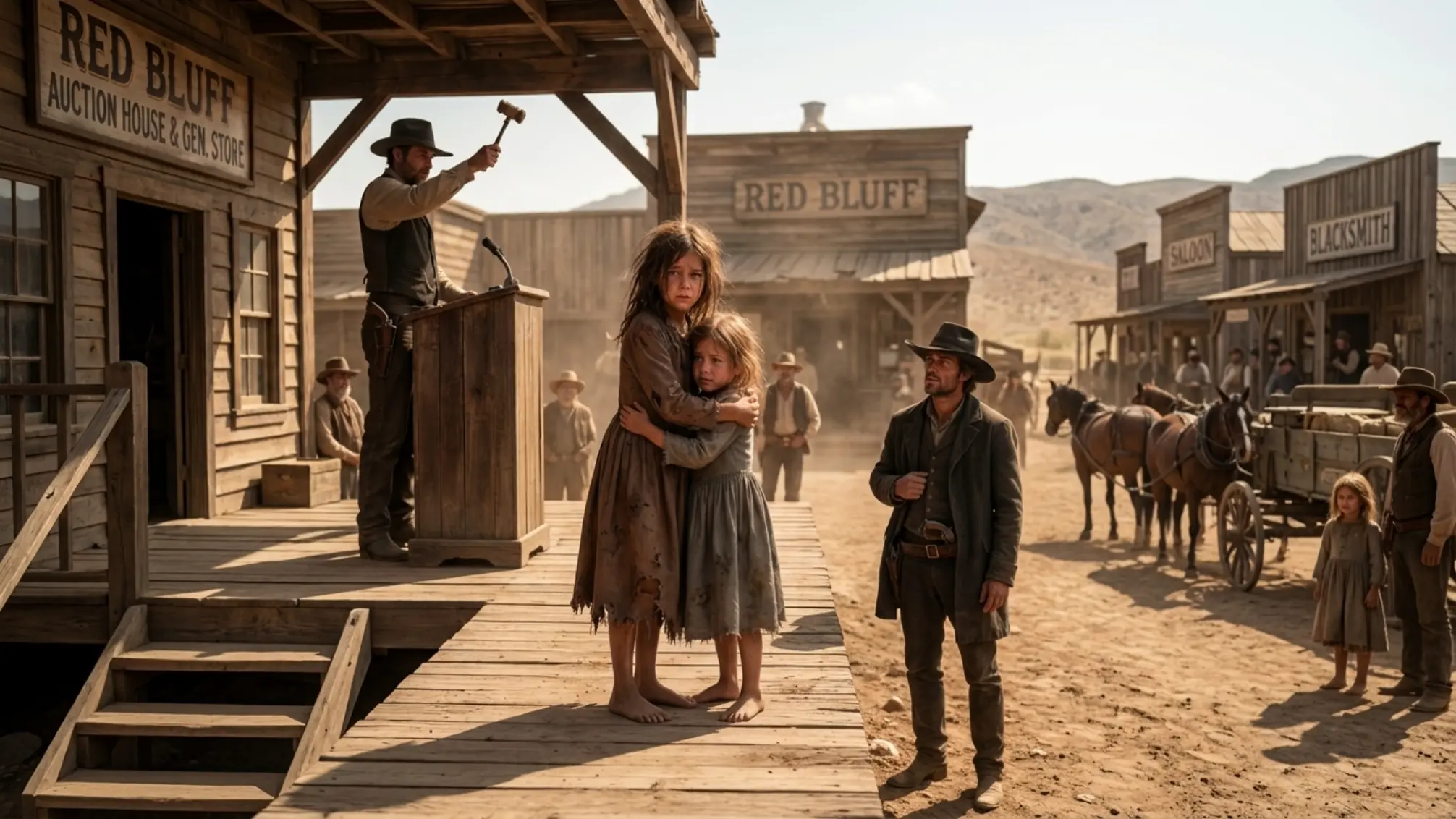
Laughter moved across Red Bluff’s square.
It came from miners leaning against hitching rails, shopkeepers standing beneath canvas awnings, and women who had once accepted bread from Nora’s mother when sickness passed through town. Some laughed because a child challenging the county looked absurd. Others laughed because joining cruelty felt safer than opposing it.
Rosie locked both arms around Nora’s waist. Her bare feet were gray with dust, and tears had left pale tracks down her cheeks.
“Don’t let them take you,” she whispered.
Nora’s throat burned. “They won’t.”
The auctioneer lowered his eyes toward her. “You are a territorial ward. You will go where the county places you.”
“The county put us on a block beside broken wagons and old tools.”
His mouth tightened. “Control your tongue.”
Harlen Fitch climbed one step toward the platform. “Three dollars is generous. She looks half-starved.”
Nora stared down at him. “I would rather starve.”
The crowd laughed again, louder this time.
Fitch smiled. “You do not get a vote, sweetheart.”
Elder Pruitt descended from the church steps with his black coat buttoned despite the heat. His silver beard made him look gentle from a distance, which was why strangers trusted him. Nora knew better. He had refused her mother medicine unless she signed away the small strip of land behind their cabin.
“Child,” he said, “your mother died owing this town.”
“My mother died because you would not send the doctor.”
A hush cracked through the square.
Pruitt’s expression hardened. “That is enough.”
A deputy grabbed Nora’s arm. She remembered her mother teaching her how to escape a grip before fever made her too weak to rise from bed. Nora stepped toward the hand, dropped her weight, and twisted sharply.
The deputy lost his hold.
Nora stumbled backward, striking Rosie with her shoulder. Both girls reached the edge of the platform, where nothing waited behind them except a six-foot fall onto hard-packed dirt.
The crowd gasped.
Nobody moved to help them.
Not the church women.
Not the farmers.
Not the men who had eaten at their mother’s table during winter storms.
Then boots sounded across the square.
Slow.
Heavy.
Certain.
Cole Whittaker emerged from beside the hardware store wearing a low black hat and a dust-covered charcoal coat. At thirty-eight, he had the weathered face of a man who had lived through violence and learned not to advertise it. A revolver rested against his thigh, but his right hand remained nowhere near the grip.
Every head turned as he crossed the road.
Cole had come to Red Bluff six months earlier and rented an abandoned ranch beyond the northern creek. He spoke little, paid in silver, and carried scars along his jaw that invited questions no sensible person asked. Rumors claimed he had been a lawman, soldier, bounty hunter, or outlaw.
The laughter died before he reached the platform.
He stopped below Nora and looked directly at her.
“You got her?” he asked.
Nora tightened her arms around Rosie. “Yeah. I got her.”
“Step back from the edge.”
Something in his voice made obedience feel different from surrender.
Nora stepped forward.
Only then did Cole turn toward the auctioneer.
The gavel remained raised. “This is county business.”
Cole reached inside his coat.
Rosie buried her face against Nora’s ribs.
When Cole’s hand emerged, it did not hold a gun.
It held a folded document sealed with red wax.
“Nobody touches those girls,” he said. “Now bring me every man who signed that auction paper.”
Elder Pruitt’s face changed first.
It was only a flicker, but Nora saw it.
The auctioneer lowered the gavel. “Who are you to issue orders in Red Bluff?”
Cole unfolded the document. “United States Deputy Marshal assigned to investigate illegal guardianship sales across the western territories.”
The square went silent enough for Nora to hear flies striking the butcher’s apron.
Cole held the badge beneath his coat open for everyone to see. It was scratched, plain, and undeniable. The auctioneer took one step backward.
Pruitt recovered quickly. “These children are not being sold. They are being placed with responsible households under territorial authority.”
Cole looked toward Fitch. “The responsible household offered three dollars for one child and refused the other.”
Fitch’s confidence faltered. “I was offering reimbursement for county expenses.”
“You called her labor worth three dollars.”
“That is not what I meant.”
Cole climbed onto the platform. He moved between the deputy and the girls, placing his body where anyone reaching for them would have to pass through him.
“Show me the placement warrant,” he told the auctioneer.
The man pulled a folded paper from beneath the ledger.
Cole read it once, then turned it over. “No judge’s seal.”
Pruitt lifted his chin. “Judge Kellerman authorized the church board to manage orphan placements during his absence.”
“Then where is his signature?”
“He is three counties east.”
Cole’s eyes returned to the elder. “Judge Kellerman has been dead for eleven days.”
A murmur rolled through the crowd.
Pruitt’s face lost its color.
Cole held up the paper. “This order was dated yesterday.”
The auctioneer glanced at Pruitt as if expecting rescue. None came.
Nora understood only part of what was happening, but she recognized fear. The men who had spoken about her like property were suddenly measuring the distance to the nearest road.
Cole knelt before the girls. “Are either of you hurt?”
Rosie refused to look at him.
Nora shook her head. “Not yet.”
His expression tightened at the answer. He removed his coat and placed it around Rosie’s narrow shoulders. The garment nearly swallowed her.
“What is your name?” he asked Nora.
“Nora Whitlock.”
“And hers?”
“Rosie.”
“Where did you sleep last night?”
“In the church storage room.”
“Were you fed?”
Nora hesitated.
Cole looked toward the church women. “Answer me.”
A woman near the steps twisted her handkerchief. “They were offered supper.”
“We got one biscuit,” Nora said. “Rosie gave me half.”
The woman lowered her eyes.
Cole stood. “Deputy, close every road out of town.”
The local deputy stared at him. “You cannot command me.”
Cole displayed the federal warrant beneath the sealed document. “I can arrest you for obstructing an investigation involving child trafficking.”
The word struck the crowd harder than the badge.
Trafficking.
Suddenly the auction did not resemble charity, church business, or county necessity. It looked like what it was: two children standing on a platform while adults assigned prices to their bodies.
The deputy swallowed. “What roads?”
“All of them.”
Pruitt turned toward the church. Cole’s voice stopped him.
“Stay where I can see you.”
The elder slowly faced him again. “You are making a grave accusation against respected citizens.”
“I am reading a forged order beside an auction ledger.”
Cole lifted the book from the table. The auctioneer reached for it instinctively, then froze when Cole’s hand moved near his holster.
The ledger contained names, dates, ages, prices, and destinations.
Nora saw lines of writing she could not fully read. Cole’s jaw hardened as he turned page after page.
“These are not the first children,” he said.
Nobody answered.
He pointed to one entry. “Samuel and Thomas Bell. Ages nine and six. Separated last October.”
A farmer near the trough removed his hat.
Another line followed.
“Mary Ellis. Age twelve. Placed with a mining camp for eight dollars.”
Someone whispered that the girl had disappeared before Christmas.
Cole read another.
“Jacob Wren. Age seven. Sent to the Fitch slaughterhouse.”
Every eye turned toward Harlen Fitch.
The butcher stepped backward. “The boy ran away.”
“Did he?”
“I gave him food and a bed.”
“Where is he now?”
“I said he ran.”
Cole descended from the platform and walked toward him. “You will show me the bed.”
Fitch’s face twisted. “You come into our town and speak to me like a criminal?”
Cole stopped within arm’s reach. “A criminal usually objects to the name before anyone uses it.”
For a moment, Nora thought Fitch might strike him.
Instead, the butcher looked toward Pruitt.
The gesture told Cole everything.
He turned to the deputy. “Arrest Fitch.”
The deputy hesitated. “On what charge?”
“Start with conspiracy to purchase a child under a forged county order.”
Fitch lunged for his revolver.
Cole moved first.
His left hand trapped Fitch’s wrist before the weapon cleared leather. One hard turn sent the butcher to his knees. Cole drew the revolver, emptied its cartridges into his palm, and struck Fitch behind the ear with the grip.
The butcher collapsed in the dirt.
Rosie screamed.
Nora covered her sister’s eyes.
Cole returned the empty gun to Fitch’s holster and faced the deputy. “Do your job before I decide you are part of this.”
The deputy finally pulled out his handcuffs.
Elder Pruitt raised both hands. “This spectacle proves nothing. The church saved these children from starvation.”
Nora stepped forward before Cole could respond.
“You took our cabin.”
Pruitt looked at her. “Your mother owed the church.”
“She signed nothing.”
“She placed her mark on the debt paper.”
“My mother could write.”
Another murmur spread through the square.
Nora remembered her mother filling pages each evening beside the lamp. She had taught both daughters letters by tracing them in flour spilled across the kitchen table. The elder expected an eight-year-old to know less.
Cole heard the contradiction.
“Bring the debt paper,” he said.
Pruitt remained still.
Cole nodded toward the deputy. “Search the church office.”
The deputy had found courage now that federal authority stood between him and local power. He sent two men inside.
They returned with a tin strongbox.
Pruitt objected that church records were sacred. Cole broke the lock with the auctioneer’s gavel.
Inside were deeds, debt notes, guardianship orders, and letters from families asking what had happened to their children. Many had never been opened.
Cole found the Whitlock deed near the bottom.
The signature beneath the supposed debt was an uneven cross.
“Nora,” he said, lowering the document. “Can you write your mother’s name?”
She nodded.
Cole handed her a pencil from the ledger table and turned over one of the forged orders.
Nora wrote slowly.
ELIZABETH WHITLOCK
The letters were imperfect but clear.
“My mama taught me using her own name,” she said. “She never signed with a cross.”
Cole held both papers before the crowd.
Several women began to cry.
Nora did not feel comforted by their tears. They had watched when the gavel rose. They had remained silent until silence became dangerous for them.
Cole faced Pruitt. “Fraud, theft of land, falsification of territorial orders, conspiracy, and illegal sale of minors.”
The elder’s calm finally broke. “You cannot destroy this church because of one vindictive child.”
Nora’s hands curled.
Cole’s voice became quieter. “She is not destroying anything. She is telling the truth about what you built.”
Pruitt looked past him toward the crowd. “You all agreed these placements were necessary.”
Nobody met his eyes.
His fear turned to rage. “Every one of you signed the church resolution.”
Cole opened the ledger again. “Good. That saves me time.”
The townspeople reacted at once.
A shopkeeper insisted he believed the children were going to proper homes. A rancher said he signed without reading. A church woman claimed her husband made the decisions. One after another, they searched for excuses large enough to hide behind.
Cole climbed back onto the platform.
“You laughed while a four-year-old begged not to lose her sister,” he said. “Do not tell me you misunderstood.”
The square became still.
“You may not all be criminals,” Cole continued. “But every person who stood here and treated this like entertainment helped the criminals believe no one would stop them.”
Nora looked across the faces.
The blacksmith who had repaired her mother’s stove.
The grocer who once slipped Rosie a peppermint.
The teacher who stopped visiting after the fever worsened.
Every one of them had known the Whitlock girls.
Knowing had not been enough.
Cole ordered Pruitt, Fitch, the auctioneer, and two church-board members detained inside the county jail. He confiscated the ledger and strongbox, then sent riders to neighboring settlements with the names of every child listed.
By sunset, Red Bluff’s square was empty except for the abandoned platform.
Nora and Rosie sat on its edge beneath Cole’s coat, sharing a bowl of stew brought by the hotel cook. Rosie ate too quickly and burned her tongue. Nora cooled each spoonful before allowing her another.
Cole stood several feet away, speaking with a telegraph operator.
When he returned, Nora watched him carefully. “Where are they taking us?”
“Nowhere tonight.”
“Tomorrow?”
“That depends.”
“On what?”
“Whether you trust me enough to hear the options.”
Nora drew Rosie closer. “People say options when they already chose.”
Cole crouched so he was not towering over her. “Then I will say them plain. The federal court can place you with a licensed family in another territory. You can remain together at a children’s home in Santa Fe. Or you can stay temporarily at my ranch while the investigation continues.”
“Why would we go with you?”
“You do not have to.”
“Do you have a wife?”
“No.”
“Children?”
His eyes changed slightly. “Not anymore.”
Nora sensed a closed door behind the answer. “Then why would you want us?”
“I did not say I wanted anything from you.”
“That is not an answer.”
Cole glanced toward Rosie, asleep against her shoulder despite the noise around them. “My daughter would have been ten this year.”
Nora waited.
“Fever took her and her mother within the same week,” he said. “I was serving a warrant two days away.”
His voice remained steady, but pain lived inside every word.
“I came back to two graves.”
Nora looked down at Rosie.
Cole continued. “I cannot promise I know how to raise two girls. I can promise nobody at my ranch will put a price beside your names.”
They left Red Bluff the next morning.
Cole rode beside a small wagon carrying the girls, their belongings, and the strongbox of evidence. Nora refused to sit with her back toward town until the final rooftops disappeared.
Rosie slept most of the journey beneath Cole’s coat.
The Whittaker ranch stood beyond a creek where cottonwoods bent over clear water. The cabin was larger than Nora expected, with two bedrooms, a stone fireplace, and a barn needing repairs. Dust covered the smaller bedroom, but a faded wooden horse remained on the windowsill.
Cole stopped in the doorway.
“My daughter’s room,” he said.
“We can sleep somewhere else,” Nora replied.
“No. Rooms are for the living.”
That first night, Rosie woke screaming.
She believed men had come to separate them. Nora tried to calm her, but the child kicked against the blankets and called for their mother.
Cole appeared at the doorway holding a lamp.
Nora placed herself between him and the bed.
He did not enter.
“What does she need?” he asked.
“I don’t know.”
Cole sat outside the room with his back against the wall. He began speaking softly about an injured mare he had once found during a blizzard. His story had no lesson and almost no ending, but his voice remained steady.
Rosie’s cries gradually weakened.
By the time she slept, Cole was still sitting there.
The investigation lasted through winter.
Federal deputies found three children from the ledger alive at distant farms. Two had been beaten badly. Another had been working underground in a mine since the age of nine. Several others could not be found.
Jacob Wren’s body was discovered beneath the floor of Fitch’s old smokehouse.
He had not run away.
When Cole returned from the search, he stood beside the barn for a long time before entering the cabin. Nora saw mud on his boots and something hollow in his face.
“You found him,” she said.
Cole nodded.
Rosie was asleep beside the fire.
Nora walked to him. “Was he alone?”
“No.”
“Were you there when they buried him?”
“Yes.”
“Good.”
Cole looked at her.
“Someone should have stayed,” Nora said.
By spring, trials began in the territorial capital.
Elder Pruitt insisted every signature and sale had been performed for the children’s welfare. The prosecutor placed the auction ledger, forged deeds, unread family letters, and Jacob’s recovered clothing before the jury.
Nora testified.
Her feet did not reach the courtroom floor from the witness chair, but her voice carried to every corner. She described the platform, the laughter, Fitch’s three-dollar bid, and Rosie begging not to be taken.
Pruitt’s attorney asked whether a grieving child might misunderstand adult arrangements.
Nora looked straight at the jury.
“Adults kept saying we were confused,” she said. “But Rosie knew they were taking me. I knew they were taking her. The only people pretending not to understand were the ones making money.”
Pruitt was convicted of conspiracy, fraud, unlawful imprisonment, and trafficking of territorial wards. Fitch was convicted of Jacob Wren’s murder and sentenced to hang. The auctioneer and two church officials received long prison terms.
Judge Kellerman’s forged authorization exposed officials in three neighboring counties.
The Red Bluff network collapsed.
Yet punishment did not return the missing children, erase Rosie’s nightmares, or make Nora trust adults again.
Healing came more slowly.
Cole taught Nora to ride, shoot, read maps, and keep financial accounts. She taught him that children needed answers rather than orders. Rosie planted wildflowers beside the cabin and named every chicken after someone she disliked from town.
One evening, Cole found Nora sitting near the creek with the auction paper in her lap. He had kept it as evidence, but the trial had ended months earlier.
“You want me to burn it?” he asked.
Nora looked at the three-dollar entry beside her name. “No.”
“Why keep it?”
“Because someday someone will say it never happened.”
Cole sat beside her.
She folded the paper. “I want to remember they were wrong before you came. Not because you came.”
He understood.
The girls had not become valuable when a federal marshal defended them. Their worth had existed while the crowd laughed, while the gavel rose, and while Rosie’s bare feet trembled against rough boards.
Cole had not given them value.
He had only forced the town to answer for refusing to see it.
A year after the auction, Red Bluff held a public meeting inside the rebuilt county hall. The new judge invited Nora and Rosie to attend the opening of a home for orphaned and displaced children.
The building stood on land recovered from Pruitt’s stolen deeds.
Nora returned reluctantly.
When the wagon entered the square, people stopped speaking. Several removed their hats. Others looked away, ashamed.
The auction platform was gone.
In its place stood a water trough and a young cottonwood tree.
The hotel cook approached first. “Nora, I should have helped you.”
Nora looked at her. “Yes.”
The woman’s eyes filled, but Nora did not offer forgiveness merely because regret had become public.
A blacksmith came next. “I was afraid of Pruitt.”
“So was I.”
“You were a child.”
“I still stood up.”
He lowered his head.
Cole remained several steps behind the girls. He did not answer for them or tell them how to feel. This reckoning belonged to Red Bluff and the children it had failed.
The new judge unveiled a wooden plaque beside the entrance.
It carried the names of every child listed in the auction ledger.
Some had been found.
Some remained missing.
Some, like Jacob, had come home only to be buried.
At the bottom were words Nora had chosen herself:
NO CHILD’S LIFE MAY BE PRICED, DIVIDED, OR SOLD. SILENCE DOES NOT EXCUSE THOSE WHO WATCH.
Rosie traced the first carved letters with one finger.
“Is our name there?” she asked.
“No,” Nora said.
“Why?”
“Because we came back.”
Rosie considered that and nodded.
Cole stood beneath the cottonwood, hat low over his eyes. Nora crossed the square and stopped in front of him.
“You said the ranch was temporary.”
“I did.”
“It has been more than a year.”
“I noticed.”
“Do you still want us there?”
Cole looked toward Rosie chasing a yellow butterfly around the trough. “The place is yours whether I am there or not.”
“That is not what I asked.”
His jaw tightened. He had faced armed men with less fear than this thin child demanding honesty.
“Yes,” he said. “I want you both there.”
“As wards?”
“As family, if you choose it.”
Nora studied him for a long moment.
“Rosie already calls it home.”
“And you?”
She looked around the square where the town had once priced her life at three dollars. The storefronts were familiar, but they no longer owned any piece of her. She turned toward the road leading north.
“Home is where nobody can sell us.”
Cole nodded.
Nora slipped her hand into his.
It was the first time she had done so without fear.
They left Red Bluff before dusk.
Rosie slept in the wagon with her head against Cole’s coat, and Nora held the reins while he rode beside them. The cottonwood tree disappeared behind the rooftops, but the plaque remained.
In later years, people would tell the story of the stranger who stopped the Whitlock auction and destroyed a network that had sold children across the territory. They described Cole as fearless, Nora as brave, and Rosie as the little girl whose tears awakened a town’s conscience.
Nora always corrected the final part.
The town had possessed a conscience before the auction.
It simply chose not to use it until a stranger arrived with a badge and made silence dangerous.
That was why she kept the original auction paper inside a wooden box at the ranch. Beside it lay Cole’s first federal report, Rosie’s tiny blue dress, and the bent nail from the platform where Nora had gripped the boards while grown men laughed.
Years later, when Nora helped establish legal protections for territorial wards, she carried that paper into every meeting.
Whenever officials spoke about unfortunate necessities, limited resources, or respectable men making difficult decisions, she unfolded it.
Three dollars.
That number ended every excuse.
Rosie grew into a gifted teacher who refused to let poor children sit at the back of her classroom. Cole repaired the ranch, added two bedrooms, and never again rode away without telling the girls where he was going or when he would return.
Nora eventually stopped sleeping with a knife beneath her pillow.
Not because the world became harmless.
It did not.
She stopped because she finally believed that if danger entered the house, she would not face it alone.
The day adults weighed her life like scrap metal had begun with laughter.
It ended with a stranger opening his coat, exposing a badge, and asking for every name written beneath a forged order.
But the badge was not what saved Nora.
The badge gave Cole authority.
What saved her was that he looked at two frightened girls and saw people before he saw evidence, wards, debts, or laws. He asked whether Nora had Rosie, and he trusted the answer.
She had her.
She always had.
Cole merely stepped onto the platform and made certain the whole town understood that they would have to pass through him before either sister was taken again.