Daniel Whitmore only wanted one steak.
At least, that was what he wanted everyone inside the Fort Smith location to believe when he stepped through the front door on a slow Wednesday afternoon. He wore a faded gray cap, a brown leather jacket with scuffed sleeves, dark denim, and boots that had seen enough road dust to make most people stop looking for wealth. Nothing about him suggested boardrooms, private audits, or the seventeen restaurants that carried his name across five states.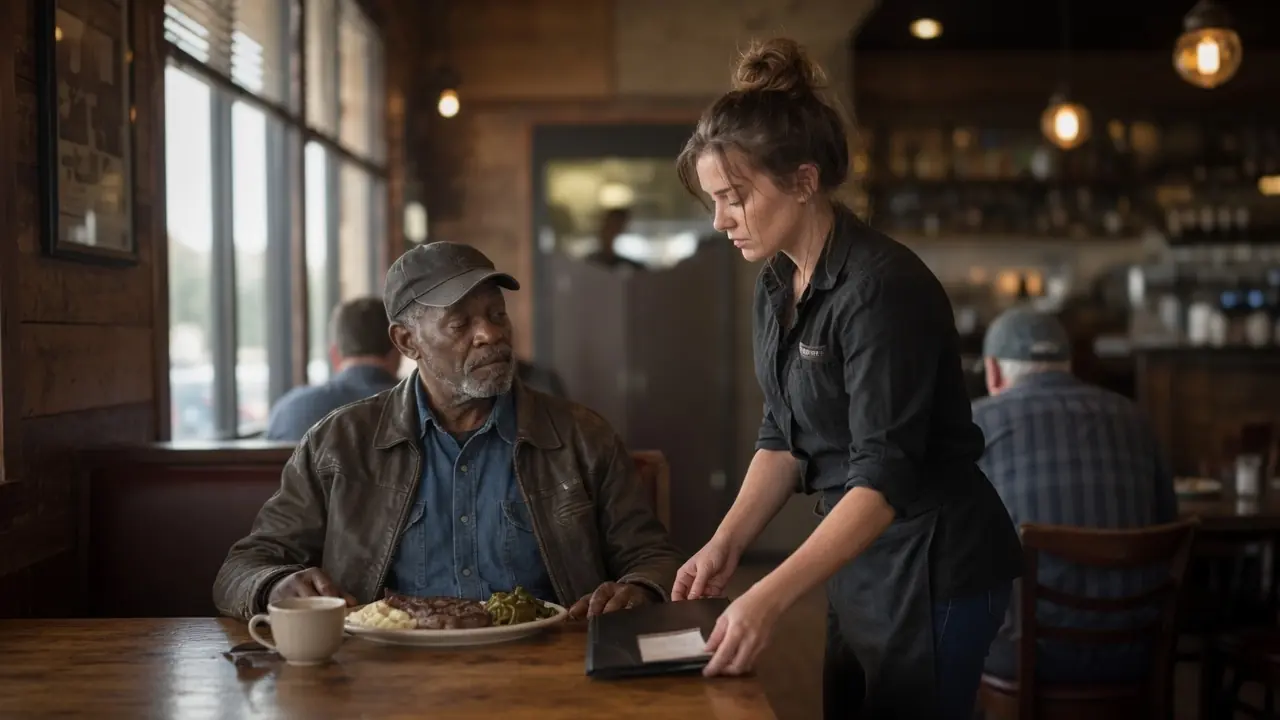
That was the point.
Whitmore’s Chop House had started in Tulsa, Oklahoma, in 1996 with six tables, one grill, and Daniel’s stubborn belief that good food should make people feel respected. The ribeye had built the reputation, but respect had built the company. For years, families came for smoked butter, collard greens, peppered potatoes, and the feeling that the person carrying the plate knew the meal mattered. Daniel had protected that standard the way other men protected land.
But the Fort Smith restaurant was failing.
The numbers had been wrong for eighteen months. Sales were slipping, staff turnover had doubled, customer complaints had turned colder, and the reviews kept repeating the same quiet accusation: the food was still good, but the place had become ugly. Daniel’s regional team blamed the location, the economy, the staff, the customers, and a dozen other things that sounded polished enough to hide fear. Daniel did not trust polished excuses.
So he came alone.
No announcement. No suit. No assistant.
Just a quiet Black man in a worn cap walking into his own restaurant to see what happened when no one knew he owned it.
The dining room was half full, but it felt tired. A couple near the window ate without speaking. Two men at the bar watched a muted basketball game without much interest. The smell of grilled meat still carried through the room, rich and familiar, but something beneath it felt sour.
Daniel paused near the host stand.
A young waitress leaned there, scrolling through her phone with one hand and tapping a pen against the counter with the other. Her name tag read Chelsea. She was white, maybe twenty-six, with blonde hair pulled into a high ponytail and a sharpness in her face that made beauty feel less like softness and more like a blade. She looked up at Daniel and measured him in one quick glance.
“Can I help you?” she asked.
“Table for one,” Daniel said.
Chelsea’s eyes moved over his jacket, cap, and boots. “You sure you’re in the right place?”
Daniel held her gaze. “This is Whitmore’s Chop House, isn’t it?”
“It is,” she said, smiling without warmth. “Prices are on the menu before you sit down.”
A man at the bar glanced over.
Daniel kept his voice even. “Then I’d like a table.”
Chelsea sighed as if his presence had interrupted something important. She grabbed a menu and led him through the dining room, walking too fast, not once checking whether he followed. She placed him at Table 7 near the front window, the same table Daniel had chosen years ago when the restaurant first opened because it gave a clean view of the kitchen doors, service station, bar, and manager’s office hallway.
Chelsea dropped the menu in front of him.
“Someone will be with you.”
Daniel looked up. “Aren’t you my server?”
Her mouth curved. “Lucky me.”
She walked away before he could answer.
Daniel did not react. He had spent too much of his life inside rooms where people underestimated him to give every insult the privilege of a response. When he was young, anger had come quickly. Age had taught him to let people speak long enough to reveal the shape of their character.
He opened the menu, though he knew every item by heart.
Across the room, a middle-aged man in a white shirt and black vest stepped out from the hallway beside the kitchen. Daniel recognized him immediately: Robert Ellis, general manager of the Fort Smith location. Robert had been hired six months earlier after the previous manager quit abruptly. Daniel had approved him on paper but never met him in person.
Robert moved through the restaurant carefully, checking tables, speaking to a cook at the kitchen window, adjusting a crooked chair without making a show of it. He looked tired, but not careless. Daniel watched the way employees reacted to him. Most seemed calmer when he passed.
That mattered.
Chelsea returned with a water glass and set it down hard enough for it to splash. “You ready?”
“I’ll have the ribeye,” Daniel said. “Medium rare. Mashed potatoes and collard greens.”
Chelsea stared at him. “The ribeye is thirty-eight dollars.”
“I read the menu.”
“Just making sure.”
Daniel folded his hands. “Do you tell every customer the price twice?”
Her expression cooled. “Only the ones who look surprised at the end.”
The couple near the window went silent.
Daniel leaned back slightly. “Bring the steak, please.”
Chelsea wrote nothing down. “Coffee?”
“Yes.”
“Sugar?”
“Black.”
She walked away, and Daniel watched her stop near the service station, where another server whispered something to her. Chelsea rolled her eyes and said loudly enough for Daniel to hear, “Relax. If he skips the bill, Robert can chase him down.”
A small laugh came from the bar.
Daniel looked out the window. Cars passed on the strip mall road beyond the glass. Heat shimmered off the pavement, bending the world slightly, making everything outside look unsteady. Inside, Daniel felt the old familiar weight of being judged before being known.
He had not built Whitmore’s so people could feel that weight inside his doors.
The steak arrived twenty minutes later.
Chelsea placed it in front of him without speaking. The plate looked right. The ribeye had a clean sear, the potatoes were smooth, and the collard greens still carried the smoke Daniel remembered from the original Tulsa kitchen. He cut into the meat and found it medium rare. The cook had done his job.
That almost made Daniel sadder.
A failing restaurant with bad food was simple. A failing restaurant with good food and bad treatment was betrayal. It meant the heart was still beating while the hands were poisoning the body.
Chelsea returned after two bites. “Everything okay?”
“The steak is good.”
She looked faintly annoyed by the compliment. “Great.”
Daniel studied her. “How long have you worked here?”
“Long enough.”
“That’s not an answer.”
Chelsea gave a thin smile. “About a year.”
“You like it?”
She laughed once. “It pays sometimes.”
“Sometimes?”
Her face closed. “You want dessert later or just the check?”
Daniel set down his fork. “I’m still eating.”
“Take your time,” she said, but her tone meant the opposite.
She disappeared again, and Daniel continued watching. He saw Chelsea ignore one older couple’s empty glasses while joking with two men at the bar. He saw her snap at a dishwasher who brought out clean silverware. He saw a younger server step around her the way people step around a dog they are not sure will bite.
Robert noticed too.
Daniel saw the manager watching from near the kitchen, face tightening slightly. Robert approached Chelsea and spoke in a low voice. Chelsea’s posture stiffened. She said something back, quick and defensive. Robert glanced toward Daniel’s table.
Their eyes met.
For one second, Robert froze.
Daniel saw recognition move across the manager’s face.
Not full shock yet. Just uncertainty. The look of a man who has seen a photograph in company material and suddenly wonders if the person in front of him is impossible. Daniel gave no signal. Robert did not move closer.
Good, Daniel thought. Let it play out.
Chelsea returned with the check folder before Daniel asked for it. She set it beside his plate though half the steak remained.
“No rush,” she said.
Daniel opened the folder and looked at the bill. It was correct. Then he looked up at Chelsea.
“I’m not finished.”
“We close between lunch and dinner soon.”
Daniel looked around at the open restaurant. “In forty-five minutes.”
Chelsea placed one hand on the table and leaned closer. “Look, I’m going to save us both trouble. If you need to call somebody to cover the bill, do it now. If not, there’s a cheaper diner three doors down.”
The dining room went quiet again.
Daniel’s face did not change. “Why do you assume I can’t pay?”
Chelsea’s eyes hardened. “Because men dressed like you don’t come in here for thirty-eight-dollar ribeye unless they’re trying to prove something.”
Daniel wiped his mouth slowly with the napkin. “Men dressed like me?”
She glanced at his cap and jacket. “You know what I mean.”
“No,” Daniel said. “Say it clearly.”
Chelsea smiled, cruel now because she thought silence from the room meant permission. “Fine. This isn’t a charity counter. People like you don’t belong in a place like this unless someone else is paying.”
A man at the bar looked down into his drink.
Daniel stood slowly.
He was not tall in a dramatic way, but he carried stillness like authority, and the air around Table 7 changed when he rose. Chelsea took half a step back, then recovered her pride and lifted her chin.
“Don’t make a scene,” she said.
Daniel’s voice was quiet. “You already did.”
Robert Ellis was moving now.
He came from the kitchen hallway fast enough that two servers turned to watch. His face had lost all uncertainty. He knew. Maybe he had recognized Daniel from the framed founder photograph in the back office. Maybe he had checked the employee portal. Maybe he had simply seen enough to understand the disaster unfolding.
“Chelsea,” Robert said sharply.
She turned, relieved at first, thinking he had come to protect her authority. “Robert, this customer is giving me a hard time.”
Robert stopped beside the table and looked at her like she had just kicked open the wrong door. “No. You are giving the owner of this restaurant a hard time.”
Chelsea blinked.
“What?”
Robert’s voice carried across the dining room. “This is Daniel Whitmore. Founder and owner of Whitmore Hospitality Group. He owns this restaurant, every table in it, and the name on your paycheck.”
The silence was so complete the kitchen printer sounded loud behind the doors.
Chelsea’s face drained of color. “That’s not funny.”
Daniel reached into his jacket and placed his corporate identification card on the table.
Chelsea looked at it.
Daniel Whitmore. Founder and Owner.
Her mouth opened, then closed.
Robert turned to Daniel, his face tight with embarrassment. “Mr. Whitmore, I am deeply sorry. I didn’t know you were coming today.”
“That was intentional,” Daniel said.
Robert swallowed. “I understand.”
Daniel looked at Chelsea. “Do you?”
She stared at the card, then at him. “Mr. Whitmore, I didn’t mean—”
“You meant every word,” Daniel said.
Her eyes flicked around the room, searching for sympathy and finding none.
“I was just trying to protect the restaurant,” she said. “We get people who come in and—”
Daniel cut her off. “You were not protecting my restaurant. You were humiliating a customer because you thought he was poor, powerless, and beneath you.”
Chelsea’s lips trembled. “I didn’t know who you were.”
“That is the only honest thing you’ve said.”
Robert lowered his eyes.
Daniel turned slightly toward him. “How long has this been happening?”
Robert took a breath. “I’ve documented three complaints involving Chelsea in the last two months. I issued warnings. I was preparing a termination recommendation.”
Chelsea snapped, “That’s not true.”
Robert looked at her. “It is. You refused service to a truck driver last week because he smelled like diesel. You told a grandmother using coupons that she should try fast food. And today, you insulted the owner to his face because you thought he was just another Black customer you could shame without consequence.”
Chelsea went red. “Don’t make this about race.”
Daniel’s voice turned colder. “You made it about race the moment you said people like you.”
She looked down.
The younger server near the station began crying silently. Daniel noticed. So did Robert.
Daniel pointed gently toward her. “Your name?”
The young server startled. “Maya, sir.”
“Has this happened before?”
Maya looked at Chelsea, then at Robert, then at Daniel. Fear fought with relief on her face. “Yes, sir.”
Chelsea hissed, “Maya.”
Daniel’s tone sharpened. “Chelsea, if you say one more word to her, you will leave before this conversation finishes.”
Chelsea shut her mouth.
Maya wiped her cheek. “She talks like that to people she thinks won’t complain. Older people, delivery drivers, Black customers, Latino families, anyone with work clothes. If they look wealthy, she smiles. If they don’t, she treats them like dirt.”
Robert’s jaw tightened. “Maya, why didn’t you tell me all of it?”
“I tried once,” Maya whispered. “Chelsea said if I kept talking, she’d make sure I got only weekday lunch shifts.”
Robert closed his eyes briefly, then opened them. “That’s on me. I should have seen more.”
Daniel looked at him. “Yes. You should have.”
Robert accepted it without defending himself. That told Daniel something important.
Chelsea’s voice shook. “Mr. Whitmore, please. I need this job.”
Daniel looked at her for a long moment. “Then you should have respected the people who kept it open.”
“I can apologize.”
“You can. But an apology is not a shield from consequence.”
She started crying then, but Daniel had learned long ago that tears after exposure were not always remorse. Sometimes they were only grief over being caught. He did not mock her tears. He simply refused to let them erase what had happened.
“Robert,” Daniel said.
“Yes, sir.”
“Remove her from the floor. Now. Full investigation, written statements from staff, review of complaints, and HR on the phone within the hour.”
Chelsea’s head snapped up. “You’re firing me?”
Daniel held her gaze. “I’m removing you from my customers before you mistake one more table for a place to practice contempt.”
Robert gestured toward the office. “Chelsea.”
She looked around again, desperate now. Nobody moved to defend her. The couple near the window avoided her eyes. The men at the bar looked uncomfortable, perhaps because they had laughed earlier and now understood what kind of laugh they had joined.
Chelsea walked toward the back office with Robert beside her.
Daniel remained standing at Table 7.
For several seconds, no one spoke.
Then the older man at the bar stood and removed his cap. “Sir, I should’ve said something when she talked to you that way.”
Daniel looked at him. “Yes. You should have.”
The man nodded, ashamed. “I’m sorry.”
Daniel accepted the apology with a slight nod but did not soften it into comfort. Silence had helped Chelsea feel safe. The entire room needed to understand that.
He turned toward the host stand. “Maya.”
“Yes, sir?”
“Please bring me a fresh cup of coffee.”
She blinked. “Of course.”
“And bring one for yourself if Robert allows breaks.”
A small, startled smile touched her face. “Yes, sir.”
Daniel sat back down and finished his steak.
That mattered. He wanted everyone watching to understand he had not been chased from his own table. He would not leave with half a plate abandoned because someone thought humiliation could shrink him. He cut the ribeye, took another bite, and found that it was still cooked perfectly.
The kitchen deserved to be saved.
The service culture did not.
Robert returned twenty minutes later, pale but steady. Chelsea was no longer with him. He sat across from Daniel only after Daniel gestured for him to do so.
“She’s in the office waiting for HR,” Robert said. “I took her badge and removed her from the schedule.”
“Good.”
“I failed you today.”
Daniel looked at him. “You failed the customers before you failed me.”
Robert nodded. “Yes, sir.”
“You recognized me before you came over.”
“I did.”
“Why didn’t you come sooner?”
Robert’s answer came quietly. “Because for about ten seconds, I was afraid of what it would mean if I was right.”
Daniel studied him. “That is honest.”
“It isn’t good enough.”
“No,” Daniel said. “It isn’t.”
Robert’s shoulders dropped. “I’ve been trying to fix this place from the kitchen outward. Food quality, ticket times, inventory. Chelsea was a problem, but I thought I could document properly and handle it clean.”
“You were managing paperwork while she was damaging people.”
Robert looked down. “Yes.”
Daniel leaned back. “A restaurant can survive a bad server. It cannot survive a room where cruelty becomes normal.”
Robert nodded.
Daniel glanced toward Maya, who was now helping an elderly couple with visible care. “Promote her to full-time if she wants it. Review every shift Chelsea influenced. Anyone who lost hours because of retaliation gets made whole.”
“Yes, sir.”
“Every customer complaint tied to discrimination or humiliation comes to me.”
“Yes, sir.”
“And Robert?”
The manager looked up.
“If I ever hear that someone walked into one of my restaurants and was measured by their clothes, skin, accent, age, or wallet before they were treated like a guest, I will not come undercover next time. I will come with a termination letter already signed.”
Robert’s face tightened. “Understood.”
By closing time, the story had already begun moving through the staff. Not loudly. Not in gossiping excitement. More like people passing around oxygen after a room had been too tight for too long. The cooks heard that Chelsea was gone. The dishwasher heard that Maya had spoken the truth. The host heard that Daniel had finished the steak after being insulted, which somehow became the detail everyone repeated.
Daniel stayed until the last customer left.
Then he called the entire staff together.
They stood near the bar, uncertain and stiff. Some had seen the confrontation. Others had only heard pieces. Robert stood beside them, not apart from them, which Daniel noted.
Daniel removed his cap and placed it on the table.
“My name is Daniel Whitmore,” he said. “I built this company because I believed a restaurant should feed people without making them prove they deserve dignity first.”
No one moved.
“What happened today was not only about one waitress. It was about a culture that allowed her to believe certain customers could be shamed safely. That ends tonight.”
Maya wiped her eyes again.
Daniel continued, “If someone comes in wearing a suit, you serve them with respect. If someone comes in wearing work boots, you serve them with respect. If someone comes in tired, old, young, Black, white, Latino, broke-looking, wealthy-looking, local, lost, loud, quiet, scared, proud, or hungry, you serve them with respect.”
Robert looked down, taking every word.
“Because the food is not the first thing people taste here,” Daniel said. “They taste the way you look at them.”
The room stayed silent, but it was no longer the silence of fear. It was the silence of people hearing something they had needed someone powerful to say.
Chelsea was terminated after the HR review. The investigation showed she had bullied staff, manipulated shifts, and driven away customers who did not fit her idea of what a steakhouse guest should look like. Daniel personally called three customers who had left complaints and apologized. Two said they would never return.
He accepted that.
Trust lost through humiliation does not return just because the owner is sorry.
But some customers did return. Slowly. They noticed the difference before they knew what had changed. Maya greeted people with warmth at the host stand. Robert moved through the room with sharper attention. The cooks kept sending out good food, and this time the dining room did not ruin it before the first bite.
Three months later, Daniel returned again.
This time he wore the same faded cap.
Maya saw him first. She smiled, not because he was the owner, but because she remembered him as the man who had asked for coffee after being insulted and had not let the room pretend it was nothing.
“Table for one, Mr. Whitmore?” she asked.
“Somewhere quiet, if it’s not too much trouble.”
She led him to Table 7.
Robert came over personally, but Daniel waved him away after a brief greeting. “Let the staff work,” he said.
He ordered the ribeye again. Medium rare. Mashed potatoes. Collard greens. Black coffee.
The food came out right.
The service came out better.
Near the end of the meal, an older Black couple entered the restaurant. The man wore overalls and a church hat. The woman carried a worn purse and looked around cautiously, as if trying to decide whether they belonged. Maya greeted them with the same warmth she had given Daniel.
“Welcome to Whitmore’s,” she said. “We’re glad you’re here.”
Daniel watched the couple relax.
That was the moment he knew the restaurant had started healing.
Not because Chelsea was gone. Removing cruelty is only the first repair. Healing begins when the next person arrives expecting judgment and receives welcome instead.
Robert stopped by Daniel’s table after the couple was seated. “Better?”
Daniel looked across the dining room. “Better.”
“Not finished.”
“No,” Daniel said. “But better.”
Robert nodded. “Thank you for not giving up on the location.”
Daniel picked up his coffee. “I wasn’t testing the location. I was testing whether the people inside it still knew how to change.”
“And?”
Daniel took a sip. “Some did.”
Robert accepted the answer for what it was: not praise, but a chance.
Later, Daniel had the corporate team add one sentence to every training handbook across all seventeen restaurants.
The guest does not have to look important to be treated as important.
He did not include the story behind it. He did not need to. Every manager heard it eventually anyway, whispered from Fort Smith to Tulsa to Little Rock and beyond. They heard about the waitress who insulted a Black man in a faded cap. They heard about the manager who came over too late but told the truth. They heard about the owner who finished his steak before changing the restaurant.
And at Table 7 in Fort Smith, people kept sitting down.
Some wore suits.
Some wore uniforms.
Some wore dusty boots.
Some counted bills before ordering.
All of them were greeted the same way.
Welcome to Whitmore’s.
We’re glad you’re here.