The storm hit at 9:00 p.m.
Rain lashed the streets outside Ruby’s Diner, turning the sidewalks black and shining under the streetlights. Wind shoved water against the glass windows, and every passing car threw dirty waves across the curb.
People hurried past with umbrellas tilted low, shoulders hunched, faces hidden from the weather and from each other.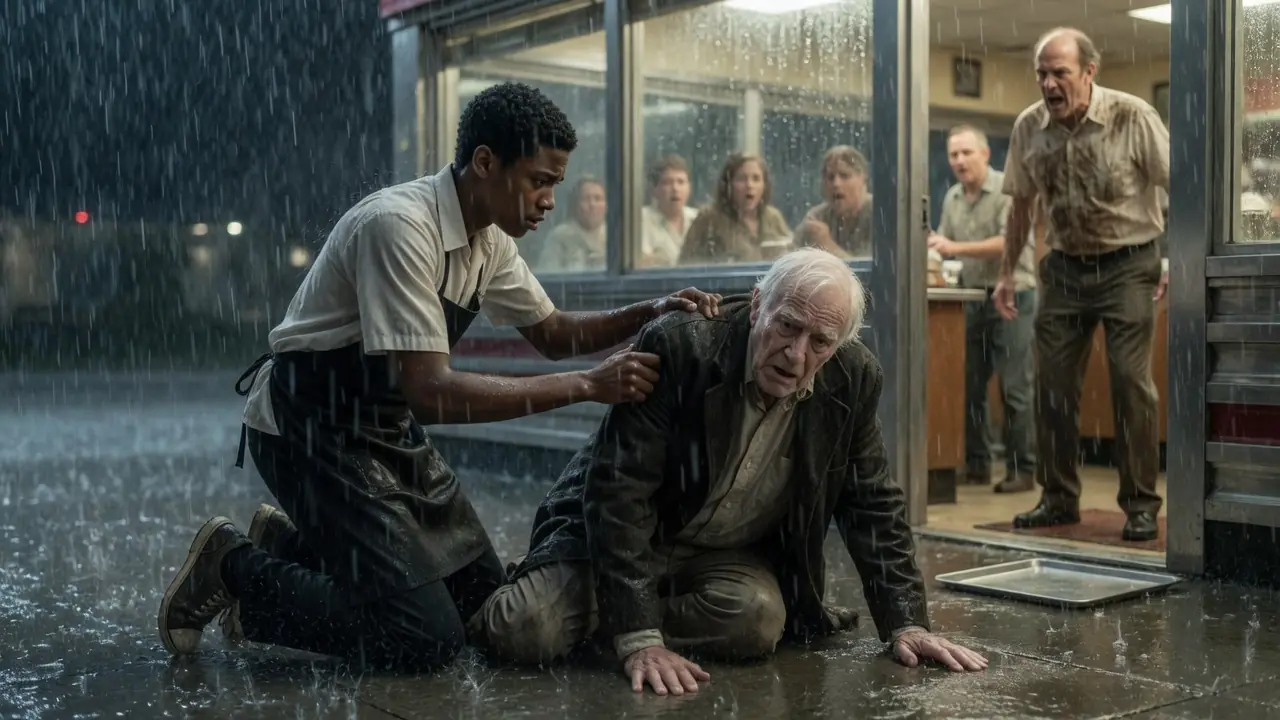
An elderly man stumbled on the sidewalk outside the diner.
His white hair was plastered to his face. His hands shook. His knees buckled once, then again. He reached for the brick wall beside him, missed, and fell hard onto the wet pavement.
A businessman stepped around him without slowing down.
A young couple crossed to the other side of the street.
A taxi splashed past, soaking the old man’s back in cold gutter water.
Inside Ruby’s Diner, Malik Monroe, a seventeen-year-old waiter in a worn black uniform, glanced through the window while carrying a tray of coffee refills. His sneakers were old, his sleeves were damp from wiping tables, and his face had the exhausted focus of a kid trying to act older than he was because life had not given him much choice.
His manager barked from behind the counter, “Table 6 needs refills now.”
But Malik did not move.
He saw the old man trying to stand.
He saw him slip.
He saw him collapse again, alone and forgotten in the rain.
Malik lowered the tray onto the nearest counter, grabbed his coat from the hook by the door, and ran outside.
“Sir,” he called, dropping to his knees beside him, “let me help you.”
He stripped off his coat, his only coat, and wrapped it around the old man’s frail shoulders. The rain soaked Malik’s waiter uniform in seconds, but he ignored the cold and slid one arm under the man’s back.
From the doorway, Rick, the manager, screamed over the storm.
“You walk out that door, Monroe, you’re fired.”
Malik did not look back.
He did not know this one choice would change everything.
Twenty minutes earlier, Malik’s shift had started like every other night.
Exhausting.
The diner was packed with tired office workers, truck drivers, college students, and families trying to escape the storm. Orders piled up faster than the kitchen could finish them. Coffee cups emptied. Plates clattered. The bell above the pass-through window rang again and again.
Malik moved between tables with practiced speed.
He had been working at Ruby’s Diner for almost a year, ever since his mother’s health got worse and the bills started arriving faster than they could be paid. He was still in high school, but most nights, after class, he came straight to the diner, tied on his apron, and worked until his feet felt like they belonged to someone else.
Table 3 complained their coffee was cold.
Table 6 wanted extra ketchup.
Table 9 snapped his fingers at Malik like he was calling a dog.
Malik forced a smile.
Tips paid for his mother’s oxygen tanks.
His manager, Rick, was in his fifties, balding, permanently scowling, and proud of treating every employee like they were one mistake away from being replaced. He leaned against the counter with a stained towel over one shoulder, watching Malik like he was waiting for failure.
“You’re falling behind, Monroe,” Rick said. “Pick up the pace, or I’ll find someone who can.”
“Yes, sir.”
Malik grabbed three plates, balanced them carefully along his arm, and delivered them without spilling a drop. It was a dance he had perfected because mistakes cost money, and money was something his family never had enough of.
Through the window, the rain began to fall harder.
At first, it was a drizzle.
Then a downpour.
Then the kind of storm that made the whole street look like it was being erased.
That was when Malik saw him.
The elderly man appeared out of nowhere, stumbling along the sidewalk. His white hair was soaked flat. An expensive watch glinted on his wrist, but his clothes were rumpled, mismatched, and completely wrong for the weather. No umbrella. No coat. No one beside him.
He walked like he was lost.
Malik watched as the man stopped under a streetlight and looked around, confusion written across his face. He patted his pockets frantically, searching for something. His hands shook so badly that Malik could see it from inside the diner.
A woman in a business suit hurried past him, heels clicking, phone pressed to her ear.
She did not even glance his way.
A group of college students laughed under a shared umbrella and sidestepped him without breaking stride.
The old man swayed.
His knees buckled.
He collapsed onto the wet pavement.
Malik’s heart lurched.
“Table 6,” Rick barked. “They’ve been waiting ten minutes.”
Malik did not hear him.
His eyes stayed locked on the window.
The old man was trying to stand, slipping on the rain-slicked concrete. His palms scraped against the ground. No one stopped. No one bent down. No one even looked guilty.
A taxi roared past, splashing dirty water across his back.
The old man curled into himself, shivering.
He’s someone’s father, Malik thought.
Someone’s grandfather.
“Monroe.” Rick slammed his hand on the counter. “Are you deaf?”
Malik turned to him.
“There’s a man outside. He needs help.”
“Not our problem.”
“He collapsed.”
“And you think I’m running a charity?” Rick crossed his arms. “You’ve got six tables waiting. Do your job or get out.”
Malik looked back at the window.
The old man was still on the ground, head bowed, rain hammering down on him.
Malik made his choice.
The coat came off first.
It was his only winter coat, bought secondhand three years ago, the sleeves slightly too short now because he had grown since then. He grabbed it from the hook by the door and pushed outside.
“Malik,” Rick roared behind him. “You walk out that door, you’re fired.”
The rain hit him like a wall.
Cold.
Brutal.
Immediate.
He ran to the old man and dropped to his knees beside him.
“Sir, let me help you.”
He draped the coat over the man’s shoulders and lifted him gently. The man weighed almost nothing. His eyes met Malik’s, cloudy and confused.
“I... I don’t know where I am.”
“It’s okay,” Malik said. “I’ve got you.”
He pulled the old man’s arm around his shoulders and took his weight.
“There’s a church shelter a few blocks from here. Can you walk?”
The man nodded weakly.
They moved together through the storm.
Every step was slow.
Malik’s black waiter uniform soaked through. His teeth chattered. Rain ran down his face and into his collar. But he did not let go.
He had told the old man the shelter was two blocks away.
It was six.
By the time they reached the church basement, Malik’s fingers were numb and his legs were shaking. A volunteer opened the door and hurried them inside, shocked by the sight of the soaked teenager holding up a trembling old man.
“Please,” Malik said, breathing hard. “He needs help. He was outside in the storm.”
The volunteer wrapped a blanket around the old man and led him toward a cot. The old man looked back at Malik, his mouth forming words Malik could not hear over the rushing blood in his ears.
Then he was gone behind a row of folding screens.
Malik stood there dripping onto the church basement floor.
“Do you need a blanket too?” the volunteer asked.
Malik shook his head.
“I have to go back to work.”
But by the time he walked back to Ruby’s Diner, he already knew there would be no work waiting for him.
No coat.
No umbrella.
No job.
He returned shivering so hard his vision blurred.
Rick was waiting outside, arms crossed.
“Don’t bother clocking out,” he said. “You’re done.”
“Rick, please,” Malik said, his voice shaking from cold and fear. “I just need this job for another month until—”
“You should have thought about that before you played hero.”
Rick tossed Malik’s apron at his feet.
“Get lost.”
The door slammed.
For a few seconds, Malik stood alone outside the diner, rain running down his face.
Then he picked up his apron from the wet sidewalk, folded it once, and walked home.
The apartment was smaller than most people’s closets.
Peeling wallpaper.
A hot plate instead of a stove.
One window that did not close all the way.
And in the corner, a hospital bed.
Lorraine Monroe, forty-three, thin and tired, with an oxygen tube in her nose, turned her head as Malik entered, dripping wet.
“Baby,” she said, struggling to sit up, “you’re soaked. What happened?”
Malik peeled off his wet shirt and hung it over the back of a chair.
“Nothing, Mama. Just rain.”
Her eyes moved to the door.
“Where’s your coat?”
“Left it at work. I’ll get it tomorrow.”
The lie tasted bitter.
“How was your shift?”
Malik crawled into the sleeping bag on the floor beside her bed.
“Fine, Mama,” he whispered. “Just fine.”
Lorraine watched him for a long moment.
A mother always knows when her child is lying to protect her.
But she also knew when he was too tired to survive questions.
So she only reached down and touched his hair.
“Get some sleep.”
Malik closed his eyes.
He did not know that the old man’s coat pocket held a notebook.
He did not know the man’s name was Theodore Hartwell.
He did not know that by morning, everything would change.
Morning light sliced through the broken blinds.
Malik woke to the sound of paper sliding under the door. Every muscle in his body ached from sleeping on the cold floor. His uniform was still damp, hanging from a nail on the wall. His head throbbed, and for three seconds, he forgot he had lost his job.
Then he remembered.
He sat up slowly and crawled to the door.
An envelope lay on the floor.
Official letterhead.
Red stamped letters across the top.
Final Notice.
His hands shook as he read.
Dear tenant, you have 72 hours to vacate the premises. Failure to comply will result in forced eviction and legal action.
Hartwell Properties Management.
Seventy-two hours.
Three days.
Malik’s chest tightened.
He looked at his mother, still sleeping, the oxygen machine humming steadily beside her. Where would they go? Lorraine could not be moved easily without medical transport. Medical transport cost money. Everything cost money.
Money he no longer had coming in.
He read the notice again, searching for options, loopholes, anything.
At the bottom was a phone number.
He grabbed his phone and dialed.
“Thank you for calling Hartwell Properties. Your call is important to us. Please hold.”
Elevator music.
Five minutes.
Ten.
“All representatives are currently assisting other customers. Please call back during business hours.”
Click.
Malik stared at the phone.
Business hours.
It was 7:00 in the morning.
He pulled on dry clothes, trying to think, trying not to panic.
That was when he noticed it.
His coat.
The same coat he had given the old man.
It was folded neatly by the door with a note pinned to the sleeve.
Left behind at the church. Thought you might need this back.
Malik picked it up and pressed it to his chest for one second.
Then he felt something hard inside the pocket.
He reached in and pulled out a leather notebook.
It was worn, expensive, and definitely not his.
It had to belong to the old man.
Malik opened it carefully.
Page after page of architectural drawings filled the notebook. Blueprints. Building facades. Street layouts. Precise handwriting. Dates in the corners: 1987, 1989, 1992.
Then he saw it.
His street.
His building.
Drawn in perfect detail.
Dated March 1987.
At the bottom of the page was a signature.
T. Hartwell, Founder, Hartwell Properties.
Malik’s blood ran cold.
Hartwell.
The same company trying to evict him.
The old man he helped last night shared their name.
He flipped through more pages.
The entire neighborhood was mapped out.
Every building.
Every storefront.
Every street corner.
Notes filled the margins.
Historic district.
Preserve original architecture.
Community center proposal.
Affordable housing initiative.
This was not a demolition plan.
It was a preservation plan.
Malik grabbed his phone again and searched online.
T. Hartwell.
Hartwell Properties.
Results flooded the screen.
Theodore Hartwell, founder and former CEO, built the company forty years ago.
Known for historic restoration projects and affordable housing developments.
Retired eight years ago after his daughter, Victoria Hartwell, took over as CEO.
More searches.
More articles.
Victoria Hartwell announces luxury condo development in historic downtown district.
Residents protest Hartwell Properties demolition plans.
Community leaders accuse Hartwell Properties of displacing low-income families.
The company had changed.
Theodore had built it.
Victoria had transformed it into something else.
A knock sounded at the door.
Malik jumped and clutched the notebook.
“Who is it?”
“Mr. Monroe,” a calm voice said from the hallway. “My name is Theodore Hartwell. I believe you have something of mine.”
Malik opened the door slowly.
The old man from last night stood in the hallway.
But he was different now.
Clean clothes.
Combed hair.
Eyes sharp and focused.
He looked ten years younger.
“I’m sorry to bother you so early,” Theodore said. “You helped me last night. I wasn’t myself. I have Alzheimer’s. Some days are better than others.”
“You left your notebook in my coat,” Malik said quietly.
“Yes. I realized that this morning.” Theodore glanced at the coat in Malik’s hand. “I came to retrieve it and to thank you properly. You showed me kindness when no one else would.”
Malik should have handed it over, closed the door, and focused on his own crisis.
But something stopped him.
He held up the eviction notice instead.
“Do you know about this?”
Theodore took the paper and read it.
His face changed.
The sharpness in his eyes hardened into something else.
Anger.
“This is your address?” he asked.
“Yes.”
“How long have you lived here?”
“Two years. My mother and me. She’s sick. We can’t move.”
Theodore looked from the notice to the notebook in Malik’s hands.
He stepped closer and lowered his voice.
“May I come in? There is something you need to know about my daughter and what she is planning to do to your home.”
Malik hesitated.
Then he opened the door wider.
Theodore walked in and saw Lorraine sleeping in the hospital bed. He saw the peeling walls, the hot plate, the sleeping bag on the floor. He saw everything Malik had spent years trying not to be ashamed of.
His jaw tightened.
“I built Hartwell Properties to help people like you,” Theodore said. “My daughter is using it to destroy you. And I am going to help you stop her.”
Theodore sat at the small table in the center of the cramped apartment.
Malik poured him water in a chipped mug. Lorraine was awake now, propped up on pillows, oxygen tube in place, watching the stranger with cautious eyes.
“Who is this man, Malik?” she asked softly.
“The man I helped last night, Mama,” Malik said. “He says he can help us.”
Theodore set down the mug.
“Mrs. Monroe, my name is Theodore Hartwell. I founded Hartwell Properties forty years ago. I built this building you’re living in.”
Lorraine’s eyes widened.
“You’re the landlord.”
“I was,” Theodore said. “Not anymore.”
His voice carried a weight that filled the small room.
“I retired eight years ago when Alzheimer’s started. My daughter Victoria took over as CEO. She is the one trying to evict you.”
“Your own daughter?” Malik asked.
“Yes.”
The word came out like a confession.
“I built this company on one principle: create affordable housing in historic neighborhoods. Preserve the past while giving people a future. Victoria saw a different opportunity. Demolish the old. Build luxury condos. Maximize profit.”
He pulled the notebook from Malik’s hands and flipped to a page showing the building.
“This structure was built in 1923. It qualifies for historic protection. Victoria cannot legally demolish it if the original records are properly recognized.”
“Then why is she trying?” Malik asked.
Theodore’s jaw tightened.
“Because she is lying to the city. She hired surveyors to create false reports claiming this building does not meet historic criteria.”
Lorraine whispered, “She can do that?”
“She is trying.” Theodore reached into his coat and pulled out a thin briefcase Malik had not noticed before. “I found documents three days ago in her office.”
He opened the briefcase on the table.
Inside were stacks of papers, blueprints, photographs, and USB drives.
“I was not supposed to be there,” Theodore continued. “Most days, Alzheimer’s keeps me confused and disoriented. But I have moments of clarity. Tuesday was one of them. I went to the office looking for old project files. Victoria’s assistant thought I was lost and left me alone in the conference room.”
His hands gripped the notebook tighter.
“That is when I saw them. Two sets of survey reports. The original from 1987 showing this block qualifies for historic protection, and a new one dated last month with altered measurements and false structural assessments.”
“She faked government documents,” Lorraine said.
“Yes,” Theodore replied. “To get demolition permits approved.”
Malik stared at the evidence.
“Why didn’t you go straight to the police?”
“Because I am an old man with Alzheimer’s. Who would believe me? My own daughter has medical power of attorney. She could have me declared incompetent with one phone call. These documents would disappear, and two hundred families would lose their homes.”
“Then why come to me?” Malik asked.
Theodore looked at him, and his eyes glistened.
“Because last night, when I was lost and afraid, you were the only person who treated me like I still mattered. Not as a sick old man. Not as a burden. As a human being worth saving.”
His voice cracked.
“You gave me your coat. You gave up your job. You asked for nothing in return.”
Lorraine reached out and touched Malik’s hand.
Theodore closed the briefcase.
“So I am giving you this. All of it. The truth about what my daughter is doing. Use it. Save your home. Save your neighbors. I cannot stop her alone. But maybe you can.”
Malik looked at the briefcase, then at his mother, then at the eviction notice on the table.
He was seventeen years old.
He had sixty-three dollars in his bank account.
He had just lost his job.
But now he was holding a weapon.
The basement of Mount Zion Church smelled like coffee and old hymnals.
Folding chairs were arranged in crooked rows. A chipped podium stood at the front, and fluorescent lights buzzed overhead. Nearly two hundred people were packed into a space meant for half that number.
Malik walked in with Theodore, and every head turned.
He recognized his neighbors.
Mrs. Carter from 3B with her twin toddlers.
Marcus, the mechanic who fixed Malik’s mother’s oxygen stand last winter for free.
The Rodriguez family, all six of them squeezed onto one bench.
Old Mr. Patterson, who had lived in the neighborhood since 1965.
All of them held the same red stamped eviction notice.
At the podium stood Jasmine Williams, forty years old, wearing a Housing Is a Human Right T-shirt and carrying herself like someone who had learned how to turn fear into volume. She had been organizing the community for five years, fighting every rent increase, every code violation, every threat.
“All right, people, listen up,” Jasmine said. “Hartwell Properties wants us gone in seventy-two hours. They’re offering buyouts. Five thousand per family. That’s an insult. That won’t cover first month’s rent anywhere else in this city.”
Angry murmurs rippled through the crowd.
“We need a lawyer,” someone shouted.
“Lawyers cost money we don’t have,” another voice replied.
“Then we take the buyout and leave.”
“And go where? The shelters are full.”
Jasmine slammed her hand on the podium.
“We are not giving up without a fight. I’ve reached out to legal aid, but they’re backlogged for months. We need—”
“Excuse me.”
Malik’s voice was quiet, but something in it made people turn.
“I have information about Hartwell Properties. About why they’re really trying to demolish this building.”
Jasmine narrowed her eyes.
“Who are you?”
“Malik Monroe. I live in unit 2A.” He gestured to Theodore beside him. “This is Theodore Hartwell.”
The room went silent.
Then erupted.
“Did he say Hartwell?”
“That’s the company owner.”
“What is he doing here?”
“Get him out.”
A man stood up, pointing at Theodore.
“You’ve got some nerve showing your face here, old man. You’re destroying our lives.”
Theodore did not flinch.
He simply waited.
Jasmine raised both hands.
“Everybody calm down.” Then she glared at Malik. “You better have a good explanation for bringing him here.”
Malik stepped forward.
His hands shook, but his voice did not.
“Theodore Hartwell founded the company forty years ago. He built this building. He retired eight years ago, and his daughter Victoria took over. She’s the one trying to evict us, not him.”
“So what?” Jasmine snapped. “He’s still a Hartwell. Still part of the problem.”
“No,” Malik said.
He took the briefcase from Theodore and set it on the podium.
“He’s part of the solution.”
He opened it.
Documents spilled out across the wood.
Blueprints.
Survey reports.
Legal memos.
Photographs.
“Theodore found evidence that Victoria Hartwell is committing fraud. She falsified land surveys to get demolition permits. This building is protected under historic preservation laws. She lied to the city to bypass those protections.”
The room stirred.
People leaned forward, squinting at the papers.
Jasmine picked up one survey report and compared it to another. Her eyes widened.
“These numbers don’t match.”
“Because one is real and one is fake,” Theodore said quietly. “I have the original surveys from 1987. This block qualifies for historic designation. Victoria altered the reports to make it appear that these buildings are structurally unsound and historically insignificant.”
Mrs. Carter stood with her twins clinging to her legs.
“Why would she do that?”
“Money,” Theodore said. “Luxury condos sell for far more than affordable housing earns. She saw an opportunity to maximize profit. She forgot that real people live here.”
Marcus crossed his arms.
“And why should we trust you? You could be lying to cover for your daughter.”
“I could be,” Theodore said. “But I am not. I am here because I was taught that integrity is not what you build. It is who you refuse to bury. My daughter is burying you. I refuse to let that happen.”
Malik spoke again.
“Two nights ago, I found him collapsed in the rain. He was confused and lost. I helped him. I didn’t know who he was. I only knew he needed help.”
His voice cracked.
“He could have disappeared with this evidence. He could have stayed silent. But he came to my apartment this morning and gave me everything. He’s risking his own family to save ours.”
Silence settled over the room.
Jasmine studied the documents again, flipping through pages, checking signatures, dates, and measurements.
Finally, she looked up.
“If this is real, if we can prove Victoria Hartwell committed fraud, we can stop the evictions.”
“We can do more than that,” Theodore said. “We can have the demolition permits revoked permanently. We can force the city to grant historic protection status. Your homes will be safe.”
“But we need a lawyer,” Jasmine said. “A good one. And we still don’t have money.”
An older white man in the back stood up. Malik recognized him from the neighborhood, always walking his dog, always nodding hello.
“My name is Martin Brennan,” he said. “I’m a civil rights attorney. I’ve been retired for three years, but I still have my license.”
He stepped forward and looked at the documents on the podium.
“If what you’re saying is true, this is the kind of case I spent my whole career fighting. I’ll represent you. Pro bono.”
The room erupted in gasps, whispers, and hope.
Jasmine stared at him.
“Are you serious?”
“Dead serious.” Martin picked up the survey reports and examined them with a lawyer’s eye. “This is fraud. Clear as day. We file for an emergency injunction tomorrow morning.”
Mrs. Carter started crying.
Marcus grinned.
Mr. Patterson punched the air with his fist.
Jasmine looked at Malik, then at Theodore, then at the two hundred frightened faces staring back at her.
“All in favor of hiring Mr. Brennan and fighting this eviction, say aye.”
“Aye.”
The sound shook the walls.
Jasmine slammed the podium.
“Then we fight.”
Three days later, they stood in a courtroom.
Judge Lawson, a Black woman in her sixties with sharp eyes and no patience for nonsense, reviewed Martin’s emergency petition. She compared the original surveys to Victoria’s altered versions side by side on a projector screen.
The evidence was undeniable.
“Ms. Hartwell’s legal team will have an opportunity to respond,” Judge Lawson said. “But until this matter is investigated, I am granting a thirty-day hold on all demolition activity. These residents will not be evicted pending further review.”
The gavel fell.
Malik grabbed Theodore’s hand.
Jasmine hugged Martin.
Mrs. Carter sobbed with relief.
They had won.
Not the war.
But the first battle.
Outside the courthouse, Malik looked at Theodore.
“Thank you.”
Theodore shook his head.
“You gave me back my purpose. I should be thanking you.”
Malik did not know that in Victoria’s office, twenty blocks away, a phone was ringing.
He did not know that Victoria was reading news alerts about the court decision.
He did not know that the real fight was about to begin.
Three weeks passed like a held breath.
Malik found work at Marello’s, an upscale Italian restaurant downtown. White tablecloths. Quiet music. Customers who wore watches worth more than his rent. He was not allowed to serve alcohol because of his age, but the manager placed him on food service, water refills, table resets, and dessert orders.
It was more respectful than Ruby’s Diner had ever been.
He wore a clean black uniform now, his hair neatly trimmed, his shoes polished as best as he could manage. The manager, Sophia, did not ask too much about his past. She handed him a section and said, “Make them feel welcome.”
Malik was good at that.
The irony did not escape him.
Half the customers worked in finance, law, real estate, or development. They talked about investments and zoning changes while Malik poured water, delivered plates, and saved every dollar.
Theodore rented a small apartment in Malik’s building, unit 1C on the first floor.
The community fund covered the deposit.
He insisted on paying rent.
“I will not take charity,” Theodore said. “I am still a Hartwell. We pay our debts.”
Most afternoons, he visited Lorraine, sat beside her bed, and read aloud from old novels. Lorraine’s favorite was Their Eyes Were Watching God. Theodore’s voice was steady and warm. On good days, he remembered every word. On bad days, he forgot the page number and started over.
Lorraine did not mind.
“You remind me of my late husband,” she told him once. “He used to read to me too.”
Theodore smiled.
“Then I am in good company.”
The building felt different now.
Neighbors chatted in hallways. Mrs. Carter’s twins drew pictures for Theodore. Marcus fixed a leaky pipe in his bathroom for free. Mr. Patterson shared tomatoes from his rooftop garden.
It felt like hope.
But hope is fragile.
One evening, Martin called Malik.
His voice was tight.
“Victoria’s legal team filed a motion to dismiss. They’re bringing expert witnesses claiming our evidence is circumstantial. They are going after Theodore’s credibility, Alzheimer’s diagnosis, medical records, everything.”
Malik gripped the phone.
“Can they do that?”
“They can try, and they will. Victoria’s lawyers are vicious. They don’t just want to win. They want to destroy anyone who challenges them.”
Martin paused.
“Be ready, Malik. This fight is about to get ugly.”
Malik hung up and looked out the window at the street below.
Kids playing.
Neighbors talking.
Life moving forward.
He did not know the storm was already here.
The press conference happened on a Tuesday morning.
Victoria Hartwell stood behind a podium at Hartwell Properties headquarters, forty-seven floors above the city. Floor-to-ceiling windows framed her like a portrait. She wore a steel-gray suit, her hair pulled back tight, her face composed and practiced.
Twenty reporters filled the room.
Cameras flashed.
“Thank you all for coming,” Victoria began, her voice smooth as ice. “I am here to address recent allegations against Hartwell Properties, allegations that are both false and deeply painful for my family.”
She paused.
A calculated pause.
“My father, Theodore Hartwell, is a man I love and respect. He built this company with integrity and vision. But years ago, he was diagnosed with Alzheimer’s disease. It is a cruel illness. It takes memory, judgment, and eventually the person you knew.”
A reporter raised her hand.
“Ms. Hartwell, your father claims you falsified survey reports.”
“My father is sick,” Victoria said, her voice sharpening. “He wanders. He forgets where he is. Last month, police found him trying to enter our old family home, a house we sold fifteen years ago. He thought he still lived there.”
She reached below the podium, pulled out a folder, and held it up for the cameras.
“These are his medical records, signed by three independent neurologists. Severe cognitive decline, paranoid delusions, inability to distinguish the past from the present.”
She set the folder down gently.
“The accusations he is making are not real. They are symptoms of a dying mind, and it breaks my heart.”
Victoria dabbed at her eye.
No tears fell.
But the gesture was enough.
“I am trying to protect my father’s legacy, and I am asking the court to dismiss this case so my family can focus on his care. Thank you.”
She walked off without taking questions.
By noon, the story was everywhere.
News websites.
Social media.
Local television.
Alzheimer’s Patient at Center of Housing Controversy.
Daughter Defends Company Against Sick Father’s Claims.
Experts Question Reliability of Evidence from Dementia Patient.
Malik watched the press conference on his phone during his break at Marello’s.
His hands shook so hard he nearly dropped the phone.
Theodore was not lying.
Malik knew he was not.
But the world did not.
Two days later, a man in a cheap suit appeared at Marello’s during dinner service. He asked for Malik by name. Sophia, the manager, pulled him aside near the kitchen.
“There’s someone here to see you,” she said. “He says it’s important.”
The man sat at a corner table with a briefcase open.
He slid a folder across to Malik.
“My name is Richard Crane. I’m a private investigator hired by the Hartwell Properties legal team. I’ve been asked to verify background information on individuals involved in the current lawsuit.”
Malik’s stomach dropped.
“What does that mean?”
“It means I did my job.”
Crane tapped the folder.
“Malik Monroe, age seventeen. Detained at sixteen for trespassing and vandalism. Charges dismissed after community service, but the record exists.”
“That was last year,” Malik said. “I was protesting the closure of our school library. Twenty of us sat inside and refused to leave.”
“Doesn’t matter why.”
“It was peaceful.”
“Doesn’t matter how.” Crane leaned back. “What matters is the headline. Teen activist tied to Hartwell lawsuit has juvenile record. Makes people wonder what else you’re lying about.”
“I’m not lying about anything.”
“Sure.”
He stood and left a business card on the table.
“Just wanted to give you a heads-up. This information goes public tomorrow morning. You might want to prepare a statement.”
He walked out.
Malik stared at the folder.
His juvenile record.
Photos of his sixteen-year-old self being escorted out of the school library by police. He remembered that day clearly. They had been protesting because the district planned to close the library and turn it into administrative offices. Twenty students sat on the floor between bookshelves, reading out loud until officers came.
They got community service.
Not jail.
But that was not how it would look in the news.
Sophia approached, concern written across her face.
“Malik, is everything okay?”
“I need to go,” he said. “I’m sorry.”
“Wait. Your shift isn’t—”
“I know. I’m sorry.”
Malik grabbed his coat and ran out.
The next morning, the story broke.
Teen at Center of Hartwell Lawsuit Has Troubled Past.
Young Housing Activist’s Record Raises Questions.
The article included an old photo of Malik at sixteen, frightened and angry, being led out of the library.
By 10:00 a.m., Sophia called.
“Malik, I’m so sorry,” she said. “Corporate saw the news. They’re worried about the restaurant’s reputation. I fought for you, but they’re insisting. I have to let you go.”
Malik sat on his apartment floor, phone pressed to his ear, unable to speak.
“You’re a good worker,” Sophia continued, her voice breaking. “This isn’t fair, but my hands are tied.”
“I understand.”
He hung up.
He had lost another job.
That afternoon, Theodore collapsed.
He was in Lorraine’s room reading aloud when the words began to blur. The book fell from his hands. His chest tightened. His breath came in short gasps.
Lorraine screamed for help.
Malik called 911.
The ambulance took twelve minutes.
Theodore was conscious but pale, clutching his chest.
“I’m sorry,” he whispered to Malik as they loaded him onto the stretcher. “I am so sorry.”
“It’s not your fault,” Malik said, gripping his hand. “None of this is your fault.”
But Theodore’s eyes said he did not believe it.
At the hospital, the doctor explained stress-induced heart palpitations. Not a heart attack, but a warning. His body was under extreme strain. He needed rest. No stress. No conflict.
How was that possible when his daughter was destroying everything he had tried to protect?
That evening, there was another community meeting.
But the energy was different now.
People were scared.
“Maybe we should take the buyout,” Mrs. Carter said, holding her twins close. “Five thousand isn’t much, but it’s something. We can start over somewhere else.”
“There is nowhere else,” Jasmine argued. “Rents are double in every other neighborhood. We’ll end up in shelters.”
“Better than being dragged through the media like Malik,” someone muttered.
Malik felt every eye turn toward him.
Marcus stood.
“Hold on. Malik didn’t do anything wrong. He helped us. Hartwell’s lawyers are destroying his reputation because they’re scared.”
Another voice said, “What happens when they come after the rest of us? You think they won’t dig up dirt on everybody?”
Jasmine slammed her hand on the podium.
“They’re trying to divide us. That is the whole point. They attack Malik so we get scared and back down.”
But fear had already taken root.
Mr. Patterson, who had lived there since 1965, stood slowly.
“I fought in Vietnam. I marched with Dr. King. I’ve been fighting my whole life.”
His voice cracked.
“I’m tired. Maybe it’s time to let go.”
The room fell silent.
Jasmine looked at Malik helplessly.
Malik walked out before anyone saw him cry.
He sat on the church steps outside, head in his hands. His phone buzzed with a text from an unknown number.
Stop now or it gets worse. You can’t win.
Victoria Hartwell.
Malik stared at the message.
He thought about his mother, who needed medical care they could barely afford. He thought about Theodore lying in a hospital bed because of the stress. He thought about the community fracturing under pressure.
Maybe Victoria was right.
Maybe a seventeen-year-old waiter with no job and no money could not win.
Malik visited Theodore at the hospital the next morning.
Theodore was sitting up in bed, the oxygen monitor beeping steadily. His face was pale, but his eyes were clear.
Lucid.
He saw Malik and reached out his hand.
“I saw the news,” he said quietly. “What they are doing to you. I am sorry.”
Malik sat beside the bed.
“It’s not your fault.”
“It is. I gave you this fight. I should have known Victoria would strike back like this.”
His grip tightened on Malik’s hand.
“But you cannot stop now. Please do not let her win.”
“Theodore, look at you. You’re in the hospital because of this stress. The community is falling apart. I lost another job. Maybe it’s time to—”
“No.”
His voice was stronger than Malik had heard in weeks.
“Listen to me. My daughter needs to be stopped. Not for me. For them. For your mother. For Mrs. Carter’s twins. For every family she is trying to crush under her heel.”
He pointed to a small bag on the bedside table.
“Open it.”
Malik reached for the bag and pulled out a small digital recorder.
“Three months ago, I had a good day,” Theodore explained. “I went to Victoria’s office. She was meeting with her CFO, a woman named Diane Lawson. They did not know I was in the next room. I recorded their conversation.”
Malik pressed play.
Victoria’s voice came through cold and clear.
“The surveys are obviously fake, but the city inspectors won’t look too closely if we grease the right palms.”
Another voice, hesitant and female, answered.
“Victoria, this is fraud. If we get caught—”
“We won’t. Who’s going to challenge us? A bunch of poor tenants with no lawyers? Please.”
“Your father built this company on integrity.”
“My father built this company forty years ago. Times change. Either you’re with me or you’re out.”
Silence.
Then the other woman said, “I’m with you.”
The recording ended.
Malik stared at the device.
“This is evidence. Real evidence.”
“It is more than that,” Theodore said. “It is proof Victoria knew exactly what she was doing. Martin can use this.”
That afternoon, Malik brought the recorder to Martin’s office.
Martin listened three times, taking notes, his lawyer’s mind already building the case.
“This changes everything,” Martin said. “But we need Diane to testify. A recording alone might not be enough. We need her to confirm it under oath.”
“Will she?” Malik asked.
“I don’t know. But I’m going to find out.”
Two days later, Martin called Malik.
“I met with Diane Lawson. She is terrified. Victoria is threatening her job, her reputation, everything. But she is also drowning in guilt. She has a daughter your age. She keeps thinking, what if it was her child being evicted?”
“So she’ll testify?”
“If the district attorney grants cooperation protection. I’ve already contacted the office. They’re willing to make a deal if her testimony is solid.”
Hope flickered in Malik’s chest for the first time in days.
That same evening, Jasmine called an emergency meeting.
The church basement was half empty.
Only sixty people showed up instead of two hundred.
But it was enough.
Jasmine stood at the podium, fierce and unbroken.
“I know you’re scared. I know Hartwell is trying to break us. But here’s what you need to know. We have new evidence, a recorded confession, and a witness willing to testify against Victoria Hartwell.”
Murmurs spread through the crowd.
“Malik didn’t give up on us,” Jasmine continued. “Even when they dragged his name through the mud, even when he lost his job, even when he had every reason to walk away, he kept fighting. So I’m asking you, are we going to abandon him now, or are we going to stand together?”
Marcus stood.
“I’m staying.”
Mrs. Carter stood, her twins clinging to her legs.
“Me too.”
One by one, people rose.
Mr. Patterson stood last.
“I said I was tired,” he said. “I am. But I’m not a quitter.”
Jasmine opened her laptop and projected a screen on the wall.
“We’re starting a crowdfunding campaign. Legal fees, back rent for Malik and Lorraine, medical bills for Theodore. If we all chip in what we can, we keep this fight going.”
By midnight, the campaign had raised eight thousand dollars.
By the end of the week, fifteen thousand.
Small donations from neighbors.
Larger ones from strangers who saw the news and wanted to help.
Five dollars here.
Twenty there.
One hundred from an anonymous donor.
Martin filed an amended complaint with the district attorney’s office. Diane’s testimony was attached, sworn, and notarized. The recording was submitted as evidence.
Judge Lawson reviewed the new materials, then scheduled an emergency public hearing.
Seven days away.
Malik sat in his apartment, his mother sleeping peacefully beside him, and for the first time in weeks, he believed they might actually win.
The city hall hearing room was packed.
Every seat was filled. People stood along the walls. Reporters with cameras lined the back row. The air hummed with tension, anticipation, and the weight of two hundred futures hanging in balance.
Malik sat at the plaintiff’s table beside Martin.
Theodore was in a wheelchair next to them, hands folded in his lap, breathing steady.
Across the aisle, Victoria Hartwell sat surrounded by four lawyers in expensive suits.
She did not look at her father.
She did not acknowledge his presence.
Judge Lawson entered.
Everyone stood.
She adjusted her glasses and reviewed the file in front of her.
“This is an emergency hearing regarding the complaint filed by residents of 1247 Ashford Street against Hartwell Properties,” she said. “Mr. Brennan, you may present your case.”
Martin stood and walked to the center of the room.
“Your Honor, Hartwell Properties obtained demolition permits through fraudulent means. They submitted falsified survey reports to bypass historic preservation laws. We have evidence proving this fraud, including original documents, expert review, sworn testimony, and a recorded confession.”
Victoria’s lead attorney, a man named Phillips with silver hair and a shark’s smile, stood.
“Your Honor, the so-called evidence comes from a man with severe Alzheimer’s disease. His credibility is questionable at best.”
“Then let us examine the evidence,” Judge Lawson said. “Mr. Brennan, proceed.”
Martin nodded to his assistant, who set up a projector.
Two images appeared on the screen side by side.
The first was an architectural survey from 1987, signed by Theodore Hartwell and certified inspectors. It showed measurements, structural analysis, historic designation criteria, clear details, professional notes.
The second was a survey from three months ago, signed by Victoria’s hired team. Different measurements. Different structural assessments. Conclusions stating the building did not meet preservation standards.
“These surveys describe the same building,” Martin said. “But the measurements do not match. Column width, foundation depth, exterior materials, all changed.”
Judge Lawson leaned forward.
“Mr. Phillips, can you explain this discrepancy?”
Phillips stood smoothly.
“Survey methods have evolved over forty years, Your Honor. Modern equipment provides more accurate readings.”
“Modern equipment does not shrink columns by eight inches,” Martin said. “It does not change limestone to concrete. It does not erase history.”
Murmurs rippled through the crowd.
“We also have testimony,” Martin continued. “Diane Lawson, chief financial officer of Hartwell Properties, has agreed to testify under oath regarding these falsified documents.”
The door at the back opened.
Diane Lawson walked in.
She was fifty years old, with gray streaks in her brown hair and trembling hands. She looked at Victoria once, then looked away.
She took the witness stand.
Martin approached gently.
“Ms. Lawson, how long have you worked for Hartwell Properties?”
“Twelve years,” she said.
“And during that time, did you become aware of irregularities regarding survey reports for the Ashford Street properties?”
Her hands gripped the armrests.
“Yes.”
“Can you describe those irregularities?”
She took a breath.
“Victoria Hartwell hired a surveying company to create reports that would support demolition permits. When the first survey came back showing the buildings qualified for historic protection, she rejected it. She paid a different company to alter the findings.”
“Did you object?”
“I did. She told me it was necessary for the company’s growth and that if I didn’t support her decisions, I should find another job.”
“Did she ever acknowledge that the reports were false?”
Diane closed her eyes.
“Yes. I recorded a conversation where she explicitly stated the surveys were fake.”
Martin played the recording.
Victoria’s voice filled the room.
“The surveys are obviously fake, but the city inspectors won’t look too closely if we grease the right palms.”
The courtroom erupted.
Judge Lawson banged her gavel.
“Order.”
Phillips jumped to his feet.
“Your Honor, this recording could be doctored or taken out of context.”
“It is not,” Diane said, her voice stronger now. “I was there. I participated, and I regret it every single day.”
She looked at Malik.
“I have a son his age. I kept thinking, what if it was my child being evicted? What if I had looked away while someone destroyed his home?”
Tears streamed down her face.
Victoria stared straight ahead, jaw clenched, face unreadable.
Phillips changed tactics and turned toward Theodore.
“Mr. Hartwell, you are the source of these allegations, correct?”
Theodore nodded.
“And you have Alzheimer’s disease?”
“Yes.”
“Severe memory loss, confusion, paranoid delusions?”
“Some days, yes.”
Phillips turned to the judge.
“Your Honor, we cannot trust the testimony of a man who may not remember what he had for breakfast.”
Theodore’s voice cut through the room.
“Do you remember what you had for breakfast, Mr. Phillips?”
Phillips blinked.
“Excuse me?”
“This morning,” Theodore said. “What did you eat?”
“I don’t see how that is relevant.”
“I do not remember either,” Theodore said. “But I remember the day I signed the original surveys for 1247 Ashford Street. March 12th, 1987.”
He paused.
“I remember the inspector’s name, Gerald Moore. I remember the column measurements. Sixteen-inch limestone, original 1923 construction. I remember thinking this building would stand for another hundred years if we took care of it.”
The room fell silent.
“I have Alzheimer’s,” Theodore continued. “It takes pieces of me every day. But it has not taken my integrity. It has not taken my ability to know right from wrong. And it has not taken away my memory of what my daughter is doing to innocent people.”
He gripped the wheelchair armrests and pushed himself up.
Malik reached to help him, but Theodore waved him off.
Theodore stood, shaky but upright, and faced Victoria across the courtroom.
“I taught you something when you were young,” he said, voice thick with emotion. “I told you that integrity is not what you build. It is who you refuse to bury.”
His eyes glistened.
“You forgot that lesson. You are burying these people, and I will not let you.”
He sat back down, exhausted.
The room remained silent.
Reporters scribbled frantically.
Several people in the audience wiped their eyes.
Judge Lawson removed her glasses and cleaned them slowly. When she spoke, her voice was measured and deliberate.
“I have reviewed the evidence. The discrepancies between these survey reports are not subtle. They are deliberate and significant. Ms. Lawson’s testimony corroborates the allegations. The recording speaks for itself.”
She looked at Victoria.
“Ms. Hartwell, did you authorize the submission of falsified documents to obtain demolition permits?”
Victoria stood.
Her lawyer whispered urgently in her ear, but she ignored him.
“I did what was necessary to move this company forward,” she said.
“That is not an answer. Did you knowingly submit false documents?”
Victoria’s jaw tightened.
“Yes.”
The courtroom exploded.
Judge Lawson banged her gavel repeatedly.
“Order. Order.”
When the room settled, she continued.
“This court finds sufficient evidence of fraud. The demolition permits for 1247 Ashford Street are hereby revoked pending permanent administrative review. The building will be submitted for official historic designation. Hartwell Properties is fined two million dollars, payable into an affected-residents fund. Furthermore, I am referring this case to the district attorney for criminal investigation.”
The gavel fell.
Malik grabbed Theodore’s hand.
Jasmine screamed with joy.
Mrs. Carter hugged her twins.
Martin closed his briefcase and allowed himself a small smile.
Outside the courthouse, reporters swarmed.
Victoria pushed through the crowd, face stone.
Malik stood near the steps.
Victoria stopped when she saw him.
They faced each other.
“You destroyed everything,” Victoria said quietly.
Malik met her eyes.
“No. You did. I just helped him remember who he used to be.”
Victoria walked away without another word.
Theodore appeared beside Malik, Jasmine supporting his arm.
“We won,” Malik whispered.
“You won,” Theodore corrected. “I gave you the tools. You did the rest.”
The crowd surrounded them.
Cameras flashed.
Questions were shouted.
But all Malik could think about was going home to tell his mother.
They were safe.
Three months later, the scaffolding came down on a Tuesday morning.
Malik stood on the sidewalk watching workers remove the last metal beams. Underneath, the limestone gleamed, original 1923 architecture restored. New windows. Repaired brickwork. Fresh paint on the trim.
The building looked like it was always meant to look.
The courtyard now held a community garden.
Raised beds full of tomatoes, peppers, and herbs.
Mrs. Carter’s twins chased each other between the rows. Mr. Patterson taught neighborhood kids how to tell when a tomato was ripe. Marcus repaired a loose gate while pretending not to enjoy being thanked.
Malik was now a youth coordinator for the Ashford Community Land Trust.
Not a huge salary, but steady.
Part-time during the school year.
Full-time in summer.
Health assistance for his mother.
And a purpose he had never known he needed.
He coordinated with residents, city officials, and volunteers, helping make sure the block became what Theodore always envisioned.
Theodore still lived on the first floor.
Some days were good.
Some days he forgot.
Sometimes he asked why the buildings looked different.
Today was a good day.
He sat in the garden beside Lorraine, who was stronger now. The community trust helped arrange better medical support and reliable transportation to appointments. She still used oxygen, but she could sit in the sun and smile.
Theodore read to her, his voice steady.
She listened with her eyes closed.
That afternoon, Jasmine hosted a block party.
Tables were covered with food.
Music played.
A banner was strung between buildings.
Our Homes, Our Future.
Two hundred people celebrated. Children ran wild. Elders watched the neighborhood come alive again.
Theodore called Malik over and handed him an envelope.
“What’s this?” Malik asked.
“Open it.”
Inside was a certificate.
The Theodore Hartwell Scholarship Fund, established to support young people fighting housing injustice.
First recipient: Malik Monroe. $5,000.
“Theodore,” Malik said, stunned, “I can’t.”
“You gave me your coat that night,” Theodore said. “Now I am giving you this. Use it for school. For whatever future you want.”
Malik hugged him, tears streaming down his face.
Movement appeared at the edge of the party.
A woman standing alone.
Expensive coat.
Victoria.
She did not come closer at first.
She only stood there watching.
Her eyes found Theodore.
He saw her and nodded once.
Victoria hesitated, then stepped forward.
“Dad,” she said quietly. “I’m sorry.”
Theodore’s face softened, but his voice remained steady.
“Then prove it. Come help us rebuild.”
Victoria looked at Malik, at the community, at everything she had almost destroyed.
“Okay,” she whispered. “I’ll try.”
It was not forgiveness.
Not yet.
But it was a beginning.
People asked Malik later if he would do it again.
Give up his job, his coat, his safety, for a stranger in the rain.
His answer was always the same.
Yes.
Every single time.
One act of kindness rippled outward.
Malik spoke at schools about housing justice and youth organizing. Theodore’s story was featured in newspapers. City councils in other places began studying community land trust models based on Ashford Street.
Months later, Malik walked past Ruby’s Diner.
A new sign hung in the window.
Under New Management.
He smiled and kept walking.
His phone rang.
“Hello,” he said. “Yes, this is Malik. Another community facing eviction? Send me the details. We’ll help.”
He hung up, looked at the sky, and kept moving forward.
Because sometimes saving one stranger in the rain does not only change one life.
Sometimes it opens the door to saving a whole neighborhood.