In the late afternoon of 1891, outside the grand log-and-riverstone ranch house overlooking the wind-scoured plains near Medicine Bow, Wyoming, a desperate single father stood at the foot of the wide wooden porch while a wealthy widow decided whether he was strong enough to protect her land. Elias Vance was thirty-six, a former cavalryman with a weathered face, tired gray-blue eyes, and a tall muscular body weakened by weeks of walking beneath the frontier sun. His six-year-old daughter, Maybel, clung to his left side in a faded rose-pink dress, resting her dusty cheek against his shoulder. Above them, Margaret Sterling stood in a midnight-blue gown, her golden hair pinned into a flawless bun and her pale-gray eyes colder than the mountain streams.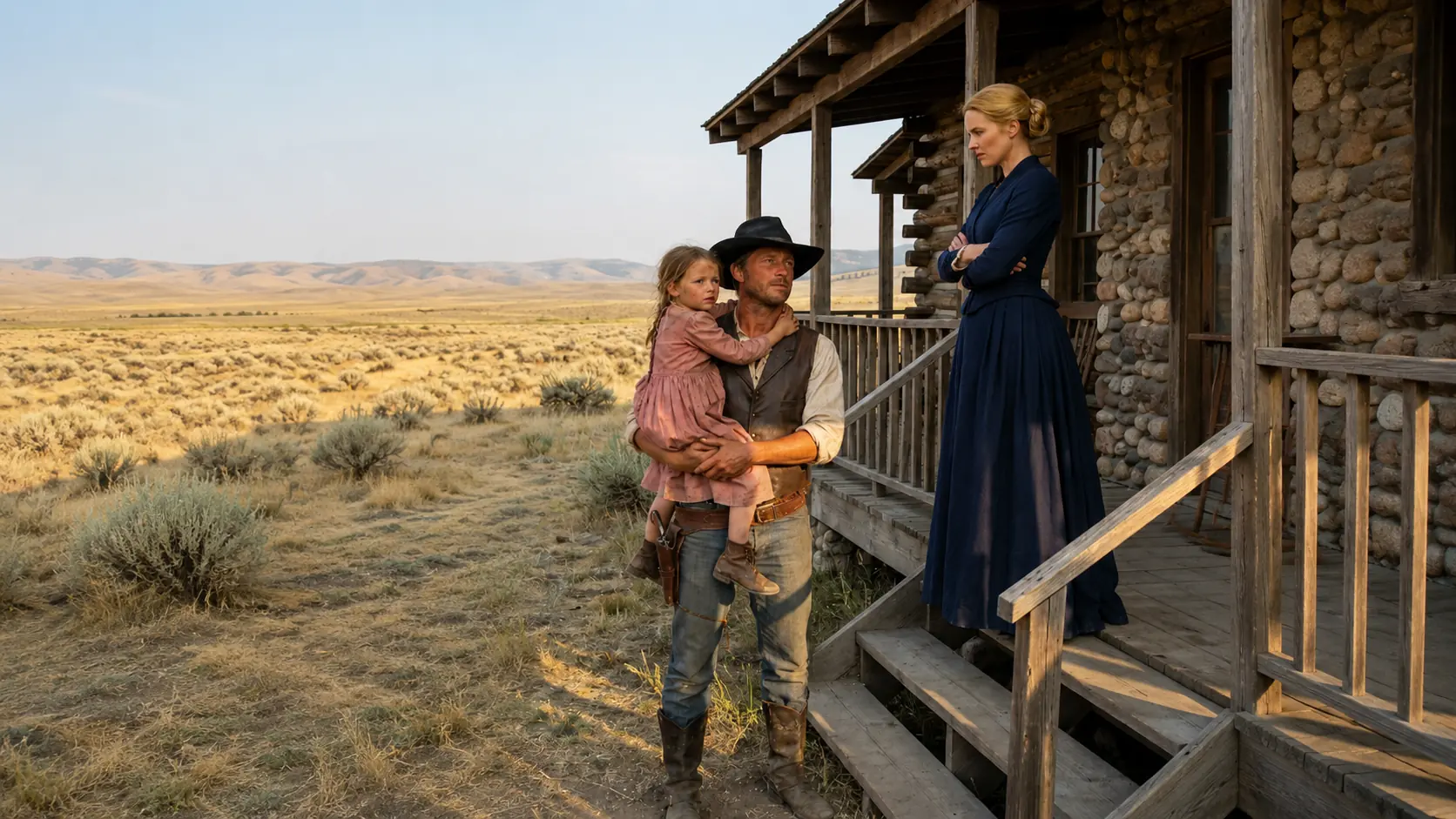
“You’re late,” the wealthy widow said, crossing her arms.
“I didn’t know I was expected, ma’am,” the single dad replied, holding his daughter closer.
“I need a man who can ride, shoot, and keep his mouth shut.”
“I’m not a hired killer, ma’am. I’m a father looking for honest work to feed my girl.”
The Wyoming wind moved through the dry grass behind Elias, carrying dust around his worn boots. He had no horse, no wagon, and almost no money left after traveling west from Missouri. Everything he owned fit inside a heavy canvas rucksack resting against the porch steps. Everything he still loved was trembling quietly in his arms.
Margaret looked at Maybel before returning her attention to Elias. The hardness in her expression remained, but something changed behind her eyes when she noticed the child’s cracked lips and exhausted posture. Margaret had dealt with drifters, thieves, and armed men who smiled while discussing how much of her land they intended to steal. This stranger looked dangerous enough to survive them, yet too proud to beg.
“Where is the girl’s mother?” Margaret asked.
“Gone two years,” Elias answered. “Winter fever.”
Maybel tightened her arms around his neck. Elias felt the familiar pain of remembering the small grave beneath an oak tree outside the Missouri town they had abandoned. He had buried his wife, Sarah, during the coldest week of the year, then watched every remaining opportunity disappear beneath medical debts and failed harvests. The journey west had been less a search for fortune than an attempt to stay ahead of hunger.
Margaret stepped closer to the edge of the porch. Her late husband had left her thousands of cattle, vast pastures, and more enemies than one woman could count. Powerful cattlemen wanted her northern grazing land and the water flowing through it. They had already cut sections of fence, scattered her herds, and spread rumors that she purchased stolen livestock from settlers.
“I placed an advertisement in the Cheyenne Leader,” Margaret said. “I need someone at the north gate who knows how to use a Winchester.”
“I served in the cavalry.”
“That does not answer my question.”
“I can use one.”
Margaret studied the steadiness of his gaze. “The cabin is isolated. Men have been seen riding the fence after dark, and they may not stop at threats. Bringing a child there would be dangerous.”
“Leaving her somewhere else would be worse.”
Maybel lifted her head and looked at Margaret with wide blue eyes. There was fear in the child’s face, but no complaint. Margaret knew adults who collapsed under discomfort far smaller than what the girl had endured. Against the caution that had governed every decision since her husband’s death, she opened the door wider.
“The cabin has flour, coffee, blankets, and a stove,” Margaret said. “You begin at first light.”
Elias nodded. “My daughter stays with me.”
“I understood you the first time, Mr. Vance.”
Margaret turned toward the house, then paused. “Keep her away from my prize flower beds.”
For the first time that day, Maybel smiled.
The north-gate cabin was small, drafty, and dark, but Elias treated it like a palace. He lit the stove, warmed beans in an iron pot, and washed the dust from Maybel’s face with water from a chipped basin. The bed was narrow, so he spread his coat across the floor and gave the mattress to his daughter. That night, Maybel fell asleep holding his hand and whispering that the stern lady had beautiful eyes.
Before sunrise, Elias reported to the main barn. Margaret’s foreman gave him a gray gelding, a rifle, and a map of the ranch perimeter. The other hands watched him with open suspicion, having seen many armed men arrive with promises and disappear when danger became real. Elias ignored them and rode north without wasting a word.
The Sterling Ranch stretched across more land than he could see from any single ridge. Golden grass rolled toward distant hills, broken by streams, cottonwoods, and miles of wire fencing. Elias found three cut sections before noon and boot tracks leading toward neighboring cattle territory. He repaired the fence, marked the tracks, and reported every detail to Margaret that evening.
“You work quickly,” she said.
“I work the hours I’m paid for.”
“Most men I hire spend half those hours telling me how fortunate I am to have them.”
“Then you hired the wrong men.”
Margaret almost smiled, but she caught herself. Elias saw it anyway.
During the first week, Maybel spent her mornings inside the cabin practicing letters on scraps of paper. In the afternoons, she followed Elias near the barns, carrying nails or holding lengths of wire while he worked. The ranch hands gradually accepted her presence, especially after she learned the names of every horse and remembered which men preferred sugar in their coffee. Margaret remained distant, observing the child from the porch as though affection were a gate she did not know how to open.
One afternoon, Elias saw Margaret seated beneath the porch roof with a large quilt across her lap. She wore a plain wool skirt instead of silk, and her hands moved carefully as she guided a needle through layers of fabric. The quilt contained dozens of colored squares arranged around bright red centers. In that quiet moment, she looked less like the feared widow of Sterling Ranch and more like a woman trying to preserve something fragile.
Maybel approached her while carrying a ginger kitten. Elias began to call her back, remembering Margaret’s warning about the flowers, but Margaret lifted a piece of red cloth. She asked Maybel what the color reminded her of. The girl said it looked like a cardinal standing against winter snow.
Margaret’s face softened into a genuine smile. “The red center represents the warm hearth of a home,” she explained. “Everything else is built around it.”
“Can a home move?” Maybel asked.
Margaret looked toward Elias. “Sometimes it must.”
“Can it become warm again?”
The question left Margaret silent. She finally patted the empty space beside her, inviting Maybel to sit. By sunset, the child had learned how to push a needle through fabric without pricking her fingers.
Elias watched from the fence line, unsettled by how deeply the sight affected him. He had spent two years believing Maybel would never again know a woman’s gentle guidance. Margaret had spent three years hiding behind wealth and authority, yet one child had reached a tenderness the adults around her never saw. The scene felt almost like a family, which made Elias immediately remind himself that he was only a hired guard.
That evening, Maybel told him Margaret had promised to teach her the entire log-cabin pattern. Elias warned her not to become a burden and explained that the wealthy widow had many responsibilities. Maybel listened patiently, then asked why Margaret always ate alone in a house containing so many chairs. Elias had no answer.
The following Sunday, Sheriff Miller arrived with three men associated with the territory’s most powerful cattle interests. They approached the main house on expensive horses, carrying rifles and the confidence of men accustomed to obedience. Elias met them at the gate with his Winchester resting across his arm. Sheriff Miller spat tobacco into the dirt and demanded to speak with Margaret.
“She’ll decide whether she wants to see you,” Elias said.
“You’re a hired hand, Vance. Open the gate.”
“I’m the man guarding it.”
Before the confrontation could escalate, Margaret stepped onto the porch. She wore a dark green riding dress and held herself with the same authority other ranch owners displayed from horseback. The sheriff accused her of harboring rustlers and purchasing cattle carrying altered brands. Margaret called the allegations lies intended to force her into surrendering the northern pastures.
One of the cattlemen laughed. “A woman shouldn’t own this much good land. Find yourself another husband and let him make the decisions.”
Elias raised the rifle slightly. “You’ve said enough.”
The man turned toward him. “You’re nothing but her hired dog.”
“A dog knows when a snake enters the yard.”
The cattleman reached toward his holster, but Sheriff Miller stopped him. Elias’s expression did not change, and that calmness made the threat more dangerous. The visitors finally turned their horses and rode away, promising that Margaret’s pride would cost her everything.
When the dust settled, Elias found Margaret gripping the porch rail. Her face remained controlled, but the color had drained from it. He asked whether she was all right, and for the first time, she admitted that the men frightened her. They had enough political influence to make lies appear official and violence look lawful.
“They will not stop until they break me,” she said. “They believe a widow must eventually surrender.”
“You’re stronger than any man who rode through that gate.”
“Strength does not make a person invulnerable.”
“No,” Elias said. “It only means you remain standing while afraid.”
Margaret looked at him for a long moment. “Thank you, Elias.”
That night, a basket arrived at the north cabin. It contained warm bread, plum jam, dried meat, and a small hand-sewn doll wearing a blue silk dress. Maybel recognized the fabric as part of the gown Margaret had worn when they first arrived. She slept holding the doll against her chest.
Autumn faded quickly, and the plains became gray beneath a hardening sky. Elias patrolled through freezing wind, often finding cattle crowded beside ravines for shelter. Margaret continued managing contracts, wages, and threats without revealing fatigue to the ranch hands. Yet she began inviting Maybel to the main house several afternoons each week for reading lessons and sewing.
Elias would arrive at sunset and find them together near the parlor fire. Maybel sounded out words from old storybooks while Margaret corrected her gently. The massive room no longer seemed quite as empty when the child’s voice filled it. Sometimes Elias remained for supper, though he always sat stiffly at the long table as though expecting someone to remind him he did not belong.
The first blizzard struck in early November. Wind battered the cabin walls throughout the night, forcing Elias to feed wood into the stove every few minutes. He wrapped Maybel in blankets and held her near the fire while snow forced itself through gaps between the logs. By morning, drifts had buried the fence and transformed the ranch into a white wilderness.
Elias left Maybel with the foreman’s wife and fought his way toward the main house. The front door stood partly open, allowing snow to blow across the polished floor. He called Margaret’s name, but no answer came from the silent rooms. He followed a trail of broken matches into the dark parlor.
Margaret lay slumped beside the cold fireplace. Her hands were blue with cold, and her entire body shook beneath a thin shawl. The servants had become trapped in town before the storm, leaving her alone when the heating system failed. She had tried repeatedly to start a fire until the cold stole the strength from her fingers.
Elias lifted her and carried her into the kitchen. He wrapped her in a bearskin rug, rebuilt the stove fire, and heated water while rubbing warmth back into her hands. Margaret slowly regained consciousness, her eyes filling with tears of frustration rather than weakness. She whispered that she had believed she could manage everything alone.
“No one can,” Elias said.
“I have managed for three years.”
“You survived for three years. That isn’t the same as living.”
Margaret stared at him from inside the heavy rug. “Why did you come through the storm?”
“You gave my daughter a home when we had none.”
“I gave you employment.”
“You gave Maybel a reason to laugh again. That means more than wages.”
The storm trapped them inside the house for the rest of the day. They sat near the kitchen stove while the wind struck the windows, speaking more honestly than either had intended. Margaret revealed that her late husband had not been the admired cattle king described in town stories.
He had been controlling, cold, and obsessed with building an empire. He married Margaret for her family’s political connections and treated affection as a weakness. The mansion, the jewels, and the fine clothes had concealed a marriage in which she had felt more like property than a wife.
Elias told her about Sarah, the woman he had loved before war and poverty changed him. They had dreamed of owning a small Oregon farm where Maybel could grow beneath fruit trees. Sarah’s fever destroyed the dream within a week, leaving Elias afraid to imagine another future. Margaret reached across the table and placed her hand over his.
Neither moved away.
Their growing closeness did not remain unnoticed. Ranch hands saw the way Margaret searched the horizon when Elias was late returning from patrol. Maybel began drawing pictures containing three figures beside a cabin and several horses. Elias tried to resist the hope developing inside him, knowing Margaret belonged to a world that would never accept a landless veteran as her equal.
The crisis arrived inside a black carriage carrying attorney Samuel Whitaker. He entered Margaret’s study with a court order bearing a red seal. Elias stood near the door while the lawyer explained that a woman claiming to be the lawful first wife of Margaret’s late husband had contested the estate. Until the court investigated, Margaret’s control of the ranch, cattle, and accounts would be frozen.
“You are giving my property to strangers based on an accusation?” Margaret demanded.
“The court has placed it under temporary administration.”
“For how long?”
“I cannot say.”
The order gave Margaret seven days to leave the main house. Her enemies moved immediately, taking control of the accounts and refusing to release wages for the ranch employees. Margaret sold the few jewels that had belonged personally to her and paid every worker from the proceeds. She kept nothing for herself.
The people of Medicine Bow responded with cruel satisfaction. Those who once envied Margaret now mocked the widow who had lost her fortune. Cattlemen moved herds onto her northern pastures before the court issued a final decision. Sheriff Miller ignored every complaint.
Margaret called Elias into the study while packing her dresses into a single trunk. She told him to take Maybel and leave before the conflict became violent. Without access to the ranch accounts, she could no longer pay him or guarantee their safety. Elias looked at the woman who had sold her jewelry rather than allow her workers to go hungry.
“I’m not leaving,” he said.
“There is nothing left for you to guard.”
“You hired me to guard the ranch and its owner.”
“I no longer own it.”
“That court paper doesn’t change who you are.”
Margaret closed the trunk. “I may return to Missouri and open a sewing shop.”
“Where will you stay tonight?”
“I’ll find somewhere.”
“Stay in the north cabin.”
Margaret stared at him. “The cabin barely holds you and Maybel.”
“It has a roof, a stove, and people who want you there.”
“You would share the little you have with a woman who has lost everything?”
Elias stepped closer. “You haven’t lost everything that matters.”
For the first time since he had known her, Margaret stopped trying to remain composed. She leaned against his chest and wept while he held her. Years of loneliness, fear, and humiliation escaped in broken breaths. Elias did not offer empty assurances; he simply remained there until she could stand again.
Margaret’s move into the north cabin scandalized the town. A once-wealthy widow living under the same roof as a hired guard became the subject of every saloon conversation. Some claimed she had always been immoral, while others suggested Elias had manipulated her for money that no longer existed. Inside the cabin, none of those voices mattered.
Margaret learned to cook over the iron stove and wash clothes in a dented basin. She repaired drafts with cloth, taught Maybel to read each evening, and transformed the narrow room with small touches of beauty. A blue quilt covered the bed, dried flowers appeared beside the window, and the lonely cabin gradually became warmer than the mansion had ever felt.
Elias took additional work hauling lumber and repairing fences for nearby settlers. He returned exhausted each evening, often finding Margaret and Maybel asleep beside the fire. Sometimes Margaret waited awake with hot coffee and quietly rubbed the ache from his injured shoulders. Their affection grew through these ordinary acts rather than grand declarations.
One night, Margaret added a square of rough brown wool to her quilt. Elias recognized it as fabric from an old coat he had discarded. He asked why she would place such an ugly piece beside silk and velvet.
“It represents the foundation,” Margaret said. “Strong enough to hold everything else together.”
She looked directly at him. Elias understood she was no longer speaking about cloth.
Their fragile peace ended when armed riders attacked shortly after midnight. Elias woke to the smell of smoke and found the barn burning beyond the window. Four men circled the cabin carrying torches and firing rifles into the air. He pulled up a section of floorboards and ordered Margaret to take Maybel into the root cellar.
“Come back to us,” Margaret whispered.
Elias kissed her before he could stop himself. “I will.”
He stepped outside with the Winchester while bullets struck the cabin walls. The attackers shouted that Margaret and her hired man had until dawn to leave the land. Elias fired a warning shot and declared that women and a child were inside. The riders answered with gunfire.
A bullet tore through Elias’s left shoulder, spinning him against a rain barrel. He nearly dropped the rifle, but the thought of Margaret and Maybel beneath the floor forced him upright. He shot one attacker from his saddle and wounded another man’s horse. The remaining riders fled when lights appeared from neighboring farms.
Margaret climbed from the cellar and ran through smoke toward Elias. She tore her apron into strips and pressed them against his wound while Maybel stood nearby clutching the blue silk doll. Elias’s blood soaked Margaret’s hands, but she refused to release him.
“You cannot leave us,” she sobbed.
“I’m still here.”
“Promise me.”
“I’m never leaving you again.”
The attack changed the territory. Neighboring farmers who had remained silent realized the same hired riders could come for their homes next. They arrived at the cabin carrying food, lumber, and weapons. Men helped rebuild the barn, women cared for Elias, and families took turns watching the road at night.
Even Sheriff Miller’s position became impossible once witnesses identified two attackers connected to the cattlemen. State investigators arrived from Cheyenne and began examining the disputed will, the armed intimidation, and the forged ownership records. The men who believed Margaret’s poverty had made her powerless discovered that it had made her part of a community.
Winter passed slowly. Elias’s wound healed, though cold mornings left his shoulder stiff. Margaret remained beside him through fever and pain, changing bandages and reading aloud when he could not sleep. Maybel began calling her Aunt Margaret, then accidentally called her Mama one evening and burst into tears.
Margaret gathered the child into her arms. “You may call me whatever makes your heart feel safe.”
Five months after the estate was frozen, Samuel Whitaker returned to the cabin. He removed his hat and placed a stack of documents on the rough wooden table. Investigators had proven that the supposed first wife was an impostor paid by men connected to the railroad and cattle interests. The forged marriage records had collapsed under examination, and several conspirators had been arrested.
“The ranch and every account have been restored to you,” Whitaker said. “You are once again one of the wealthiest women in the territory.”
Margaret looked around the cabin. Maybel played beside the stove, and Elias stood near the window with his injured arm held close to his body. The news should have filled her with triumph, but she appeared almost troubled.
After the lawyer departed, Elias began gathering his belongings. Margaret asked what he was doing. He explained that she could return to the mansion, hire professional guards, and resume the life she had lost.
“You don’t need a poor father in your cabin anymore,” he said.
Margaret walked toward him and took his scarred hands. “I am not returning to the mansion.”
“It belongs to you.”
“It was never my home.”
“You have silk curtains, servants, and more rooms than you can count.”
“And I was alone in every one of them.”
Margaret looked toward Maybel. The child rose and placed one hand in each of theirs. Margaret announced that she would convert the mansion into a school for the children of ranch workers and struggling settlers. The restored money would rebuild burned farms, defend water rights, and support families threatened by the cattle interests.
“And where will you live?” Elias asked.
“Here.”
“In this cabin?”
“With you.”
Elias searched her face, afraid to believe what he heard. “You would choose this life after getting everything back?”
Margaret touched his cheek. “I would choose you in any life, Elias Vance.”
They married the following spring beneath an arch covered in wild prairie roses. Nearly every family in Medicine Bow attended, including many who had once whispered about them. Maybel wore a white dress sewn by Margaret and scattered petals along the path. The cabin remained their private home even after repairs made it larger and safer.
The mansion became a school as Margaret promised. Children of settlers, ranch hands, widows, and laborers studied inside rooms once reserved for wealthy guests. Margaret used her fortune not to rebuild the lonely prison of her past, but to protect people who had never possessed her advantages. Elias managed ranch security and ensured no armed man again treated a family’s home as something easily taken.
Margaret completed the quilt years later. At its center lay a piece of midnight-blue silk from the gown she wore when Elias first climbed her porch. Beside it rested a square of rough brown wool from his old coat. Around them, she added rose-pink cloth from Maybel’s childhood dress.
The wealthy widow had hired a single father because she needed someone to guard her ranch. She never expected him to protect the frightened woman behind her fortune. Elias had arrived seeking honest work and food for his daughter, never imagining that the stern widow on the porch would become the heart of their home.
What shocked him most was not that Margaret recovered her land or defeated the men who tried to destroy her. It was that when every mansion, dollar, and acre belonged to her again, she chose the little cabin where she had finally learned what it meant to be loved.