The single father had only one bowl of stew for himself and his seven-year-old son.
Yet every time Silas Thorne lifted the spoon, he gave the larger portion to the boy.
Eliza Montgomery watched from the wooden boardwalk of Abilene, Kansas, in the summer of 1874. The sun was a white hammer beating against the dry plains.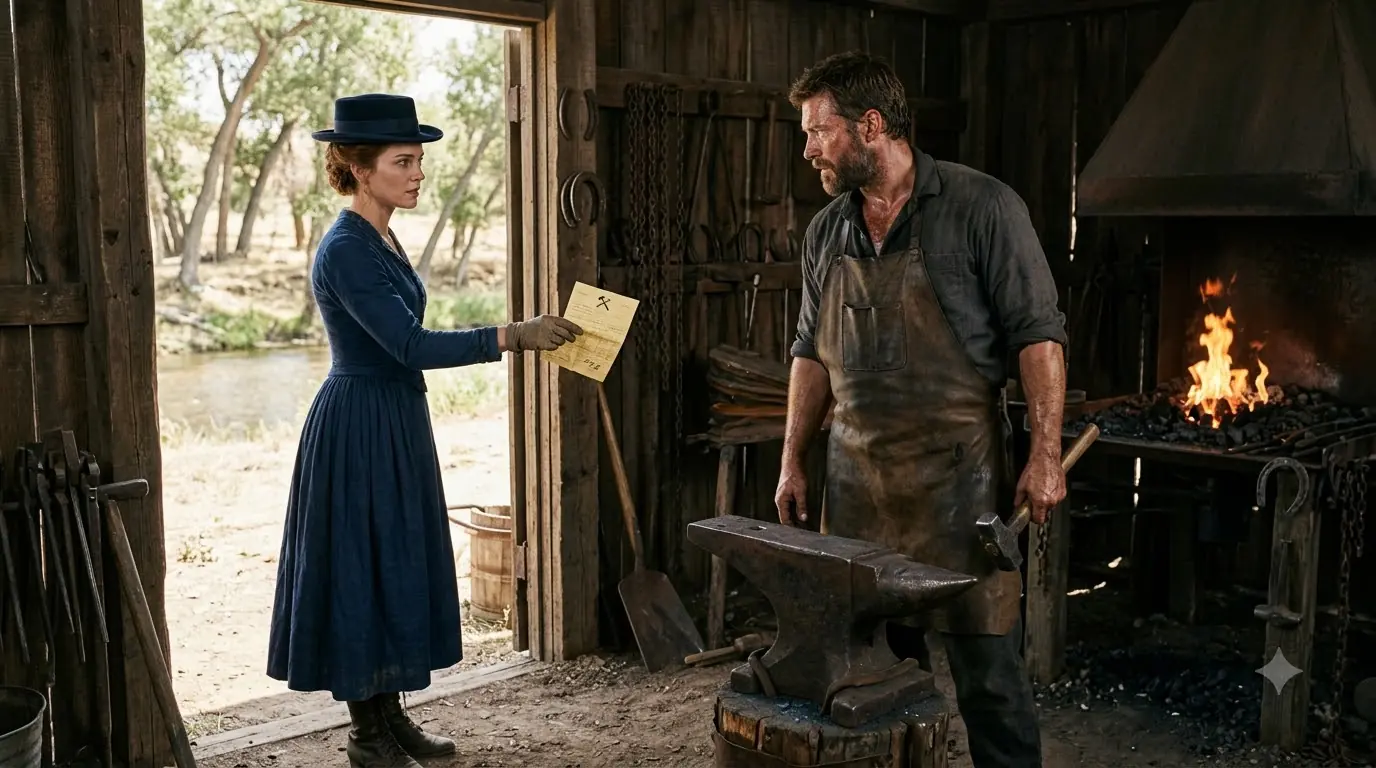
She had arrived wearing a deep blue morning dress that marked her as an outsider in the rough cattle town.
Eliza possessed enough wealth to buy half of Abilene, yet none of it had filled the emptiness inside her. At that moment, she would have traded every dollar she owned for the tenderness she saw at that poor man’s table.
Silas wore a faded work shirt. His vest had been darkened by years beside the forge. His hands were large and scarred, burned and permanently stained by black grease that never entirely washed away.
Beside him sat Leo, a quiet boy with patched sleeves and tired eyes. There was only one bowl between them.
Silas took a small and careful spoonful for himself. He barely tasted the thin broth before filling the spoon again and giving Leo a full, overflowing portion.
The simple act stopped Eliza in her tracks. It reminded her of her father and carried her back to the years before wealth and high society shaped her life. Now, she lived among grand rooms that had never felt like home.
Around them, Abilene carried the fading scars of its cattle-town years. Wagons rattled along the dusty street, and the dry boards of the buildings creaked in the wind. Railroad whistles echoed beyond rooftops distorted by the heat, while dust drifted through the suffocating summer air.
Yet the small table seemed untouched by the noise around it.
Eliza stepped closer. The silk of her dress whispered against the rough boards beneath her feet.
Silas tore the softer portion from a piece of bread and placed it gently beside his son’s bowl. He kept the hard crust for himself.
Then Leo noticed her.
His wide eyes moved from her fine blue dress to the empty chair beside them.
Silas finally looked up. His gray eyes held no greed and no expectation. He regarded her as though she were simply another tired traveler searching for a place in the shade.
Eliza placed one gloved hand on the back of the empty chair.
“May I sit with you?” she asked.
Her voice was soft, barely carrying above the wind.
Silas studied her for a moment. His gaze was steady and honest, and he seemed to notice the sadness concealed behind her expensive veil.
“It is a public table, ma’am,” he said. “But you are welcome to the company.”
Leo leaned closer to his father and whispered loudly enough for Eliza to hear.
“Is she a princess?”
For the first time in years, Eliza smiled without forcing herself. The tension inside her chest loosened.
“No,” she answered softly. “I am only a woman who would rather not eat alone.”
Silas had seen many faces in Abilene. He had seen desperate gamblers and exhausted pioneers, hard-eyed lawmen and hollow-eyed families without enough food.
The woman standing before him was a mystery. She was clearly a lady of high standing in a town of low spirits.
Silas moved the bowl slightly toward the center of the table.
“We do not have much,” he said. “But what we have, we share.”
From the careful way Silas measured each spoonful, Eliza suspected it was the only meal he and Leo would eat that day.
The Panic of 1873 had emptied banks throughout the nation. It closed businesses and left working families struggling across Kansas.
At that table, the hardship had a face.
Heat shimmered above the street and made the distant cattle pens look like a mirage. The smell of manure and dry earth hung heavily in the air.
The silence between the three of them was not uncomfortable. It was a shared moment of rest.
“I am Silas Thorne,” the man said, breaking the silence. “And this is Leo.”
“I am Eliza,” she replied.
She did not offer her surname. Eliza did not want the shadow of her late husband’s shipping empire falling across the humble table.
Silas watched his son eat. Leo was meticulous, careful not to lose a single crumb of the precious bread. His hands were small but already calloused from helping his father.
“This town has seen plenty of men chasing easy money,” Silas continued. “Not many stop long enough to notice what it costs them.”
His eyes seemed to see through every layer of her fine blue silk.
“But you do not look as though you came here searching for money,” he said. “You look like you lost something it could not buy back.”
Eliza felt a sharp sting behind her eyes.
The truth of his words cut through defenses she had spent years carefully constructing. She lowered her gaze to the scarred wooden table.
Its surface was covered with knife marks and old stains. It reminded her of the Illinois farm where she had grown up.
She remembered the smell of rain falling on dry soil. She remembered her father’s laughter before the world became complicated, before the great city swallowed the quiet countryside and the pressures of wealth drained the color from her mother’s face.
There had once been a time when a single loaf of bread felt like a feast.
After the Great Chicago Fire destroyed her father’s warehouses, Eliza’s entire world changed.
The fire had been a monster of orange and black. It consumed almost everything her family owned in one terrifying night and nearly ruined her father’s business.
The family was forced to sell their precious land. During the crisis, no ordinary buyer would touch the property.
Speculators circled like vultures, offering pennies for a heritage that had taken generations to build. Eliza’s family was only days away from living on the street.
Then an anonymous stranger paid twice what the land was worth.
The money prevented her family from losing everything. It kept her father from the cold and gave him enough capital to rebuild from the ashes.
In ways Eliza had never fully understood, that unknown buyer made every later chapter of her life possible.
Years afterward, Eliza married into wealth. She moved into a home containing twenty rooms, but comfort never erased the memory of the stranger who saved her family.
She spent thousands of dollars and hundreds of hours trying to identify him. She wanted to offer her gratitude and understand why a stranger had chosen to show such extraordinary kindness.
“The past is a heavy pack to carry,” Silas said quietly.
He seemed to read her thoughts without effort.
“Sometimes you have to set it down for a while just to keep walking.”
Leo reached into his pocket and removed a small, hand-carved wooden horse. It had been polished smooth by years inside his hands.
He began making it gallop across the table toward Eliza.
“He likes you,” Silas said, a faint smile touching his eyes. “The boy is a better judge of character than any lawman I know.”
Suddenly, a shadow crossed the table.
A man in a sharply tailored and expensive suit stepped onto the porch.
It was Mr. Sterling.
Eliza knew him from the predatory business circles of the city. He was the type of man who became richer while everyone around him grew thinner.
He smelled of imported tobacco and costly cologne. He carried himself with the confidence of someone who believed money excused every form of cruelty.
“Mrs. Montgomery!” Sterling exclaimed.
His voice dripped with false concern.
“What on earth are you doing at this sordid arrangement?”
He looked at Silas with open disgust and stared at the bowl of stew as though it were poison.
Eliza’s spine turned to cold steel. She felt the weight of her family’s history behind her.
“I am having a meaningful conversation, Mr. Sterling,” she said. “A concept I am quite certain is foreign to your nature.”
Sterling sneered at Silas and adjusted his silk tie with one manicured hand.
“You there, blacksmith,” he barked. “She could purchase your miserable little life and forget she owned it before dinner.”
Silas did not flinch.
He did not even rise to meet Sterling’s gaze. He kept one hand resting on the table near his son.
“I know she is a woman who asked for a place at my table,” Silas replied. “In my world, that is all I need to know about a person.”
Sterling laughed.
It was a sharp and ugly sound that echoed against the dry wooden walls of the store.
“She is a benefactor, you fool. She throws crumbs toward the poor to ease her own conscience.”
Leo moved closer to his father. The boy was visibly unsettled by Sterling’s harsh voice and looming presence.
Silas’s jaw tightened. The muscles built by years of swinging a heavy hammer coiled beneath his clothing.
His hand moved onto Leo’s shoulder, protecting him.
“You have insulted a good man in front of his child,” Eliza said.
Her voice was low and dangerous. It was the voice of a woman who had survived both the fire and everything that followed.
“Leave this porch, Mr. Sterling.”
His expression changed.
“If you speak to either of them that way again, every investor in St. Louis will learn exactly what kind of man you are.”
Eliza held his eyes.
“I will make certain your credit becomes as dry as this Kansas dust.”
Sterling’s smile disappeared.
He understood the power Eliza possessed inside corporate offices and boardrooms.
He tipped his hat stiffly and walked away. His boots struck the boardwalk loudly, but the damage to the moment had already been done.
The fragile peace around the table had shattered. The heat felt stronger, and the drifting dust more invasive.
Silas looked down at his rough and stained hands.
“Men like Sterling will use you to wound anyone standing beside you,” he said quietly. “I can endure his contempt, but I will not let Leo grow up believing he deserves it.”
Silas rose slowly.
His movements appeared heavy and exhausted. The weight of the world settled again across his shoulders.
“Thank you for treating my boy with kindness,” he told Eliza. “He will not forget it.”
Silas took Leo by the hand and led him away.
Eliza remained alone beside the table.
The Kansas sun burned her silk-covered shoulders while she watched them disappear into the dusty crowd.
A hollowness opened inside her chest, one no bank account could fill.
Eliza reached into her embroidered silk bag for a handkerchief.
For years, she had carried an old, folded receipt. She kept it near her whenever she traveled, a reminder of the kindness that had saved her father.
As Eliza pulled out the handkerchief, the yellowed document slipped to the floor.
The wind lifted it briefly before she placed one shoe over it.
She picked it up and studied the faded writing. The ink had turned brown and brittle with age.
At the bottom were two initials she had traced a thousand times.
S. T.
Beneath them was a small mark she had never understood.
It was the outline of a blacksmith’s hammer.
Eliza stopped breathing.
Her heart struck hard against her ribs.
Silas Thorne.
A blacksmith.
The initials were not absolute proof, but for the first time, they appeared to form a path toward the truth.
It seemed impossible.
The man who had just shared one bowl of stew with his son could barely afford a single meal. How could an impoverished blacksmith have once paid enough money to save her family?
Where had that fortune gone?
Why was he now living with so little?
Eliza needed more than matching initials. She needed the truth from Silas himself.
She spent the night in the finest hotel Abilene offered. The velvet curtains and soft bed felt like the walls of a prison.
She could think only of the blacksmith and his son.
For three days, Eliza searched the roads outside Abilene.
She hired a small carriage and drove through the relentless heat. She questioned stable hands, wagon drivers, and anyone familiar with the land beyond town.
Eliza visited every blacksmith shop within ten miles.
She ignored the dust ruining her expensive dresses. She also ignored the whispers of townspeople wondering why a wealthy widow was searching the countryside.
Eventually, a stable boy directed her toward a small forge beside a creek, hidden behind a grove of thirsty cottonwood trees.
Before Eliza left the town limits, the sheriff offered one quiet warning.
“Silas does not speak much about his past,” he said. “But when something in this town breaks, he is the man people trust to repair it.”
The sheriff glanced toward the distant creek.
“He has a heart of gold, but a life made of iron.”
Eliza guided her carriage toward the edge of the wilderness.
She found the forge near a winding creek. The water was low, barely trickling across the exposed stones.
The rhythmic sound of metal echoed through the air.
Clang.
Clang.
It was the heartbeat of the frontier.
Eliza approached the orange glow of the forge. The heat inside the small building was intense, and the air smelled of coal, sulfur, and hot metal.
Silas stood inside the wide doorway.
His sleeves had been rolled above his elbows, and his work shirt clung to his back with sweat. His muscles moved as he lifted the heavy hammer and brought it down with practiced precision.
Each strike sent sparks into the air.
Leo sat nearby on a pile of fresh hay, reading an old and damaged book.
The boy looked up and saw Eliza. Recognition immediately brightened his face.
“Dad, the princess came back!”
Silas stopped with the hammer raised.
He lowered it slowly, wiped his forehead with a dirty cloth, and turned toward her.
He looked surprised, but his eyes remained calm.
Eliza held out the old receipt with a trembling hand.
She could not speak.
Silas looked at the faded initials.
His expression changed.
The hardness of the blacksmith disappeared, replaced by deep and ancient recognition.
Then he looked directly into Eliza’s eyes.
“I was very young then,” he said softly.
The roar of the forge seemed to fade behind them.
“I had recently returned from the silver mines in Nevada. I found a small vein and came away fortunate.”
Silas placed the cloth beside the anvil.
“I had money, but no family and no understanding of what to do with either my grief or my fortune.”
Eliza stepped closer, ignoring the soot touching her dress.
The condition of the blue silk no longer mattered.
“Why my family, Silas?” she asked. “Why did you pay twice the value of a failing farm?”
Her voice trembled.
“You did not even know us.”
Silas drew a slow and unsteady breath.
He placed the hammer onto the anvil. The metal landed with a soft sound.
“Your father probably did not remember me,” he said. “But I never forgot him.”
Eliza waited.
“Years before that, I was ten years old and hungry on a street in Chicago. My mother had died, and my father was gone.”
Silas lowered his eyes.
“I tried to steal a loaf of bread from a shop on the corner. The baker caught me and called for the police.”
The forge crackled behind him.
“I was terrified. I thought my life would end before it had even begun.”
He looked at Eliza again.
“Your father was standing nearby. He paid the baker for the loaf.”
Silas paused.
“Then he purchased three more loaves and gave me a silver dollar.”
Eliza covered her mouth with one gloved hand.
She could see her father’s face inside her memory. She could almost hear his voice.
“Before he walked away, he told me, ‘Do not let a hard world turn your heart to stone.’”
Silas looked toward Leo.
The boy listened with wide and curious eyes.
“I built my life around those words,” Silas continued. “When I returned from Nevada with the silver, I learned about the Chicago fire.”
He rested one hand against the anvil.
“I heard that the man who once helped me was losing everything.”
Silas shook his head.
“I could not allow that to happen. I did not want him to know the buyer was me. I only wanted to repay the debt.”
Eliza looked around the humble forge.
It was a place filled with difficult work and very little profit.
“What happened to the rest of the money?” she asked. “You should be a wealthy man, Silas.”
He placed both hands on the edge of the anvil.
“Most of it went into land, tools, and helping several families who had nowhere else to turn.”
Silas shrugged faintly.
“I did not need very much.”
His eyes moved toward Leo with heartbreaking tenderness.
“Then my wife, Clara, became ill. She was the light inside this shop.”
Eliza remained silent.
“I spent everything that remained trying to save her. I brought doctors from the East and purchased every medicine they recommended.”
The memory tightened his face.
“After she died, I placed my final savings inside a local bank. I wanted to ensure Leo would have a future.”
He looked around the forge.
“Then the Panic of 1873 closed its doors. The bank disappeared overnight.”
Silas’s hand touched the old hammer.
“All I had left were my tools, this forge, and my son.”
Eliza’s voice softened.
She felt a connection to him that extended beyond gratitude.
“And you never regretted helping my father, even when you were reduced to your final bowl of stew?”
“Not once,” Silas answered.
He held her gaze.
“Losing money hurts. Losing the man you chose to become hurts more.”
Silas looked at the iron cooling near the fire.
“Money is only metal, Eliza. Kindness is the one thing that does not rust.”
The tears finally escaped her eyes.
Eliza had spent her life believing her father’s salvation had been luck, an accidental turn of fate.
Now she understood that her entire life rested upon one act of kindness, which had inspired another. The circle had finally closed.
“I have spent so much time being Mrs. Montgomery,” she said. “I have been a name written on bank accounts and a guest at parties I hated.”
She wiped her cheek.
“I believe I forgot how to be only Eliza.”
Silas walked toward her and stopped only inches away.
He smelled of smoke, iron, and the forge.
“You have not forgotten,” he said. “You only needed a quiet place to sit and remember who you were.”
A faint warmth entered his expression.
“You found it beside a table with one bowl of thin stew.”
Neither of them yet knew that the shared meal had already changed the direction of both their lives.
During the following weeks, Eliza returned to the forge repeatedly.
She spent less time inside the hotel.
At first, the town described her visits as curiosity. Soon, people began calling them a scandal.
The wealthy widow and the poor blacksmith.
Eliza did not care about their whispers.
Some mornings, she arrived carrying breakfast. She brought fresh eggs, thick bacon, and enough bread to last several days.
Eliza sometimes remained only long enough to listen while Leo read one page aloud from his book.
On other days, she sat quietly as Silas worked.
She watched him shape heated iron and repair objects other people would have discarded.
The rhythm of his hammer became the heartbeat of her days.
Eliza brought fruit, bread, and meat from the market. She made certain there was always enough food for two bowls and, eventually, enough for three.
Their affection did not arrive through one dramatic declaration.
It grew through shared meals and small kindnesses. It grew from the comfort of being understood without explanation.
Eliza told Silas about the riverboats of St. Louis and the whistles along the Mississippi. She described crowded streets she no longer missed.
One afternoon, several prominent ladies visited Eliza’s hotel.
They were led by Mrs. Gable, a woman who defended social rules far more fiercely than she defended kindness.
Mrs. Gable wore a hat resembling a bird’s nest and a frown that never disappeared.
“Eliza, darling,” she said while fanning herself. “The entire town is discussing your associations.”
Eliza waited.
“You are seen at that dirty forge nearly every day. It is causing irreparable harm to your reputation.”
Mrs. Gable lowered her voice.
“Think of your late husband’s name.”
Eliza studied the women with a sense of pity.
She saw the judgment concealed behind polite smiles. She also saw the boredom inside their eyes.
“My husband was a man of immense honor,” Eliza said. “If he were alive today, he would be at that forge working beside Silas.”
Mrs. Gable stopped fanning herself.
“Silas Thorne is a better man than any of the cowards I have encountered inside your parlors.”
Eliza’s voice remained calm.
“He understands what it means to give when he possesses nothing.”
She looked at each of the women in turn.
“If my reputation is damaged because I associate with a man of character, then it was never a reputation worth keeping.”
Eliza showed them the door.
She did not look back.
For the first time, she understood what her wealth was meant to accomplish.
It was not intended solely for silk dresses or luxurious hotels.
It was meant to create something that lasted.
Perhaps this was the blessing she had been too lonely to recognize.
Life on the American frontier, however, was never easy. The wind could change without warning.
Near the end of summer, illness spread through several homes near the creek.
It was a heavy fever that settled inside the lungs.
One morning, Leo awakened weak and burning with fever. His face was flushed, and even sitting upright exhausted him.
Silas became frantic.
He could battle fire and bend iron. Against an invisible illness attacking his son, all his strength felt useless.
The local physician had more patients than beds and very little medicine remaining. The shelves of the apothecary were nearly empty.
Eliza did not hesitate.
She used her wealth as a shield.
Eliza sent an urgent telegram to a physician in Junction City. She paid the railroad to place him aboard the earliest westbound train.
Then she moved Leo into the coolest room of her hotel suite. She hired an experienced local nurse to assist with his care.
Eliza purchased every block of ice available in town to help reduce the boy’s fever.
For three long days, she and Silas slept only in brief turns.
They alternated holding Leo’s small, burning hand.
Silas sat inside the luxurious hotel room looking entirely out of place. His soot-stained clothing stood in sharp contrast to the white linens.
He did not care about the disapproving stares from hotel employees. His attention remained entirely on the rise and fall of his son’s chest.
“I should have given him a better home,” Silas whispered one night.
The room was dim and illuminated by only one lamp.
“A room away from the heat of the forge. A proper bed.”
He looked toward Leo.
“I failed him, Eliza.”
She placed one hand on his broad shoulder.
“You gave him unconditional love, Silas. That is the only foundation that matters.”
Silas closed his eyes.
“You gave him a father he can be proud of,” she continued. “Now allow me to help with the things money can actually purchase.”
At dawn on the fourth day, Leo’s fever broke.
The moisture on his forehead became cool.
He slowly opened his tired eyes and looked at the elaborate ceiling before turning toward his father.
“Do we have any bread?” he whispered.
Silas lowered his head against the bed and wept.
The sound of his relief filled the quiet room.
Eliza turned toward the window, unable to conceal her own tears.
She watched the rising sun.
It was a new day for all three of them.
When Leo became strong enough to walk again, Silas approached Eliza.
They stood on the hotel’s high balcony while Abilene awakened below them. Wagons moved along the road, and the town returned to its daily life.
“I cannot remain inside your world forever, Eliza,” Silas said.
She turned toward him.
“I am a man of the forge. I belong beside fire, earth, and the hammer.”
Silas looked through the open balcony doors toward the elegant room.
“I cannot become a man who sits inside parlors discussing interest rates.”
Eliza looked at him and knew he meant every word.
He was as solid and honest as the iron he shaped.
“Then I will come to your world,” she answered.
Silas blinked.
For a moment, his voice failed him.
He looked at her jewelry and soft hands.
“You would surrender all of this? The silk, the servants, and the comfort of the city?”
Eliza smiled.
It was the most beautiful thing Silas had ever seen because it was a smile of true freedom.
“I will use part of my wealth to build a school for Leo and the other children. I want to see books placed inside every hand.”
She looked across the town.
“One day, I also want Abilene to have a proper clinic. I want a place where no father has to feel helpless again.”
Eliza turned back toward Silas.
“But I do not need the rest of it for myself.”
Her voice softened.
“I only need my place at your table, Silas, even if there is only one bowl.”
Silas slowly reached toward her.
He gave Eliza enough time to step away if she wished.
She did not move back.
Eliza moved into his arms.
Silas smelled of charcoal, soap, and the open Kansas air.
His embrace was the first place that had felt like home to her in years.
“It is a difficult life,” he warned. “The winters are bitter, and the dust never truly disappears.”
“But there will always be enough for anyone who knocks at our door,” Eliza said. “As long as we keep our hearts soft.”
They married one month later.
The summer heat began fading into autumn. The air grew crisp, and leaves along the creek turned gold.
Not everyone accepted Eliza’s decision.
The social circles of St. Louis were horrified.
Two businessmen withdrew their offers to manage her investments. Several families stopped inviting her into their homes.
They called her the blacksmith’s bride with contempt.
Eliza signed every letter acknowledging the broken agreements without regret.
She no longer required their approval.
Silas offered more than once to step aside. He did not want Eliza to lose her position in society because of him.
Every time, she gave the same response.
“A life that requires me to be ashamed of you is not a life I want.”
They stood beneath the shade of a massive oak beside the creek for their wedding.
It was a simple ceremony joining the blacksmith and the widow.
Mr. Sterling did not attend.
Neither Silas nor Eliza noticed his absence.
Together, they built a life that eventually became a legend throughout Kansas.
They built the Thorne house.
It was not a mansion, but it was a home with a broad porch.
Its doors were never locked, and a fire always burned inside the hearth.
Anyone who was hungry could find a bowl of hot stew.
Anyone who was lost could find a helping hand.
Eliza exchanged her fine silk dresses for sturdy cotton.
She learned to cultivate a garden and prepare simple remedies. She became the woman she had always been meant to become.
Eliza assisted the town physician whenever families required care. Among the pioneers, she became a source of hope.
Silas continued working at the forge.
The sound of his hammer rang through the mornings.
He was no longer a man eating in silence beside his child. He became a man helping build an entire community.
Together, Silas and Eliza helped struggling families throughout Abilene keep their property.
They remembered the Panic of 1873.
They became the secret buyers.
Whenever a family approached the point of losing its farm, the outstanding debt sometimes vanished without explanation.
Silas and Eliza became the anonymous hands reaching through the darkness.
They passed the seed of kindness forward, just as Eliza’s father once taught Silas to do.
They worked to prevent other families from losing hope.
Leo grew into a beloved schoolteacher.
He became a man of books and quiet wisdom.
Inside his classroom, he kept the small wooden horse on his desk.
It reminded him of the day he pushed it across a rough table toward a lonely woman wearing a blue dress.
Leo taught his pupils that wealth could disappear during a single night.
He taught them that fire could consume everything a person owned.
Most importantly, he taught them that character remained.
Years later, Silas and Eliza continued spending summer evenings together on the broad porch.
Kansas sunsets remained a wonder.
They shared simple meals while the sky turned purple and gold.
Sometimes, Eliza glanced at the empty chair beside them.
She remembered the first question she had asked Silas.
“May I sit with you?”
Silas would reach for her hand.
His grip remained strong, although his skin had become thin like parchment.
Eliza once believed she had only been asking for a chair.
In truth, she had been asking for a home.
Beside a blacksmith who had kept his heart soft, she finally found one.
Silence settled across the porch as the sun disappeared beneath the horizon.
Stars began appearing inside the enormous Kansas sky.
Silas gently squeezed Eliza’s hand.
“Ready to go inside?” he asked.
“Yes,” she whispered. “I am finally home.”