“This land’s dead, old man,” Kenneth Pace said, sweeping one dusty hand toward the three empty boreholes. “Quit throwing money at dirt.”
Coy Gentry stood beneath the brutal Ozark sun with both fists clenched beside his faded denim overalls. Behind Kenneth, the drilling rig sat silent, its long steel mast towering over the red farmyard like a monument to everything Coy had already lost. Three holes had been drilled, three invoices had been signed, and not one drop of usable water had risen from the ground.
“You drilled holes,” Coy said, staring directly at him. “Not truth.”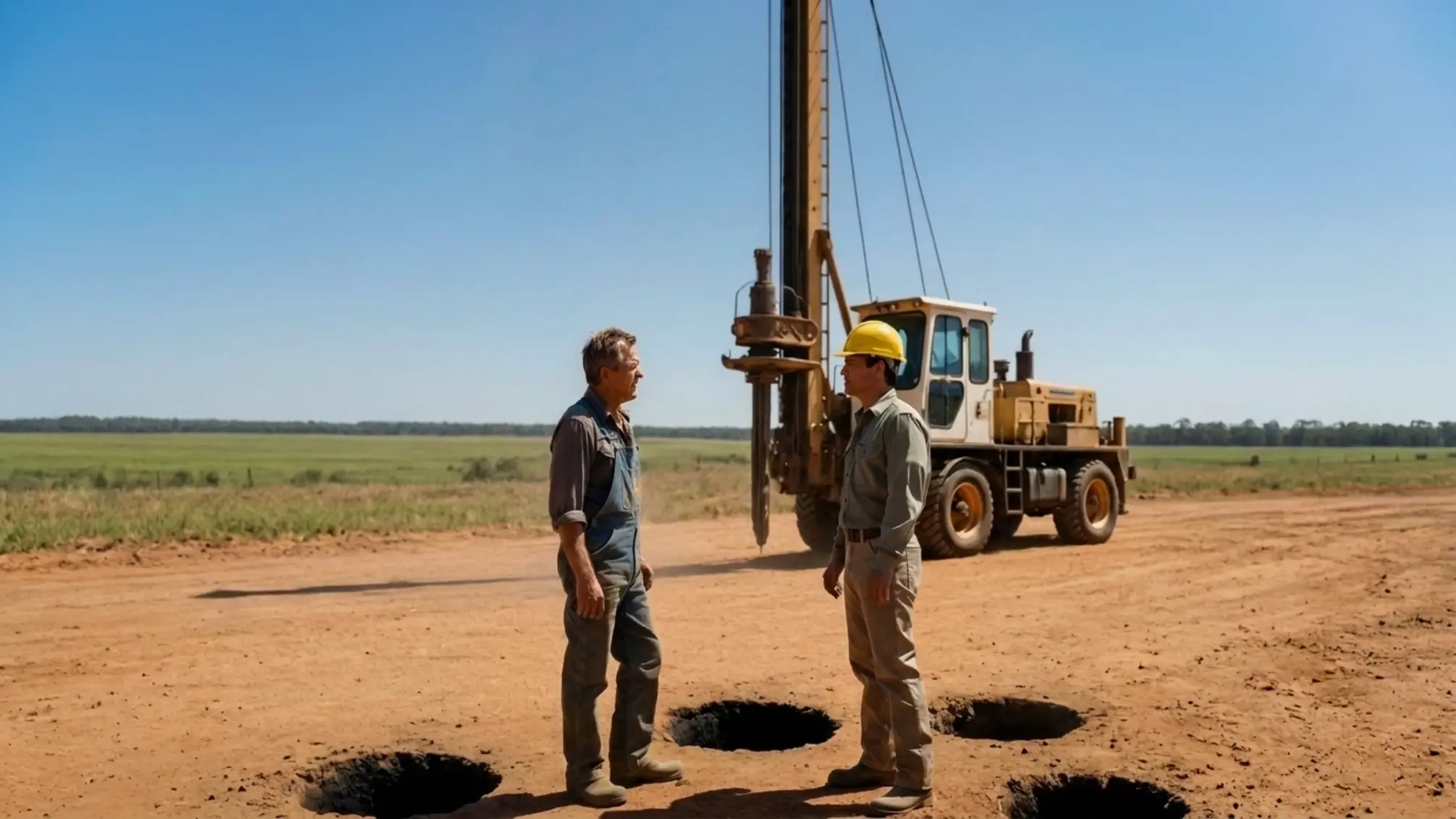
Kenneth stepped closer, his heavy boots grinding into the dry soil. “Keep digging like a fool, and this farm will bury you with it.”
Coy reached for the old shovel leaning against the barn wall. “Then stand back—and watch me pull water from the ground you gave up on.”
Kenneth laughed once, but it was not an amused laugh. It was the sharp, impatient sound of a man whose professional judgment had been challenged by someone he considered too desperate to think clearly.
“Suit yourself,” he said. “But don’t call me when that shovel breaks.”
He climbed into his truck, signaled to the rig operator, and drove away in a cloud of red dust. Coy remained in the yard long after the vehicles disappeared beyond the eastern ridge. The abandoned boreholes stood around him like open graves.
The Gentry farm occupied one hundred twenty acres outside a small community in the Missouri Ozarks. The land was uneven, rocky, and beautiful in a hard way, with oak-covered ridges rising above narrow pastures and shallow valleys. Coy’s grandfather had purchased the original sixty acres in 1938 and built the first barn from local timber and stone.
Coy had lived there for all fifty-eight years of his life.
He knew where the soil stayed soft after spring rain, where deer crossed the north fence at dawn, and where wild blackberries appeared beside the creek bed every June. He knew which hills could support cattle and which would punish any tractor foolish enough to climb them after rain. Yet knowing the land had not protected him from the drought.
The trouble began during a dry spring and deepened into the hottest summer anyone in the county could remember. The shallow creek stopped running first. Then the farm pond dropped until muddy banks surrounded a dark pool barely deep enough for the remaining cattle.
Coy hauled water in a borrowed tank every second day.
The work cost fuel, time, and money he did not have. Each trip into town reminded him that his farm could not survive without a reliable source. If the pond disappeared completely, he would have to sell the cattle before prices fell under the pressure of every other desperate farmer doing the same thing.
His wife, Martha, had died three years earlier after a long illness. Medical bills had consumed most of their savings, and Coy still sometimes caught himself turning toward the kitchen doorway expecting to see her carrying coffee.
The farm had felt larger since her death.
Their only son, Aaron, lived in Springfield with his wife and young daughter. He called twice a week and offered repeatedly to help Coy move closer to the city. Coy always refused.
He did not remain because he feared change. He remained because Martha was still everywhere—in the yellow roses near the porch, in the worn cutting board beside the stove, and in the maple tree they planted the year Aaron was born. Leaving the farm would mean abandoning more than land.
The first well company drilled near the barn after examining county maps and studying the slope. They reached two hundred eighty feet before declaring the formation dry. The second hole went deeper and produced only a weak seep contaminated by sediment.
Coy paid both invoices.
Kenneth Pace arrived after a neighbor recommended him as the most experienced well driller in three counties. He had worked across the Ozarks for twenty-five years and carried the confidence of a man who had watched hundreds of farmers celebrate when water finally surged through a pipe.
He also knew how to deliver bad news without hesitation.
Kenneth studied geological records, walked the property with metal rods and measuring equipment, and selected a third site near the equipment shed. He promised nothing, but his quiet certainty persuaded Coy to spend nearly all the money remaining in the farm account.
The rig drilled for two days.
At three hundred forty feet, the bit entered dense limestone. At four hundred, the crew found nothing but dust and fractured rock. Kenneth stopped the operation before the cost climbed beyond Coy’s ability to pay.
“There’s no productive water beneath this yard,” he said.
Coy asked whether another location might work.
Kenneth looked toward the hills. “Not without gambling money you don’t have.”
That was the moment their argument began.
After Kenneth left, Coy carried the shovel toward the south pasture.
He did not choose the location randomly. At the lower edge of the pasture, beneath a line of sycamore trees, the grass had remained green longer than anywhere else on the farm. The surrounding ground was dry enough to crack, yet a narrow patch near the roots still felt cool beneath his boots.
Coy had noticed it for years.
Martha once told him that her grandmother remembered a spring somewhere on the property. According to the story, early settlers had collected drinking water from a shallow stone basin before a landslide changed the slope. Coy had always treated it as family folklore.
Now he had nothing left except folklore and a shovel.
He began near the largest sycamore.
The first layer was powdery red soil. Beneath it, the shovel struck packed clay mixed with flat stones. Coy removed each rock by hand and stacked them beside the growing hole.
Within an hour, sweat soaked his gray shirt. The sun pressed against his neck, his back ached, and the muscles in his arms began to tremble. He stopped only long enough to drink from the final jug of water inside his truck.
By evening, the hole was four feet wide and nearly three feet deep.
It was completely dry.
Coy climbed out, looked down into it, and felt foolish.
Kenneth had used professional equipment, county records, and decades of experience. Coy had an old story and a patch of green grass. He considered filling the hole before anyone saw it.
Instead, he covered it with boards and returned the next morning.
For six days, Coy dug.
The soil became harder as he descended. He used a pickaxe to break clay and a crowbar to move stones too large for the shovel. A rope and metal bucket allowed him to lift loosened dirt from the hole.
His neighbor, Calvin Reed, stopped beside the fence on the third afternoon.
“What are you building?” Calvin called.
“A well.”
“With a shovel?”
“That’s what it looks like.”
Calvin removed his hat and scratched his head. “Pace drilled four hundred feet.”
“He drilled somewhere else.”
“You think water’s hiding five feet below a tree?”
“I think the grass knows something.”
Calvin looked toward the green patch. “Grass doesn’t pay drilling bills.”
“Neither did Kenneth’s holes.”
Calvin wanted to laugh, but concern stopped him. “Coy, you’re going to collapse in there.”
“Then bring a stronger rope tomorrow.”
Calvin returned with a rope, a ladder, and his sixteen-year-old grandson. He insisted that the sides be widened and reinforced before Coy continued downward. Together, they built a rough wooden frame to reduce the danger of loose soil collapsing.
Word spread through the community.
At the feed store, people discussed Coy’s hand-dug well with the kind of sympathy normally reserved for someone behaving strangely after a loss. Some believed Martha’s death and the drought had finally pushed him beyond reason.
Kenneth heard the story within a week.
He drove back to the farm on a Sunday morning and found Coy standing waist-deep in the excavation. The hole had reached nearly seven feet and now exposed a layer of pale limestone.
Kenneth walked to the edge and looked down.
“You’re still doing this?”
Coy leaned against the shovel. “You came back just to confirm it?”
“I came because someone said you’re digging beneath unstable rock.”
“The walls are braced.”
“Not well enough.”
“You worried about me now?”
“I’m worried someone will blame me when they find you buried.”
Coy climbed the ladder slowly. His hands were blistered, and dried blood marked one knuckle. “You said there was no water.”
“There isn’t.”
“Then you have nothing to worry about.”
Kenneth stepped toward the exposed stone. “This is solid limestone. Even if water moves through it, you won’t reach a reliable source with hand tools.”
Coy pointed toward a thin dark line crossing the rock. “What’s that?”
“A mineral stain.”
“The soil above it was damp this morning.”
“Condensation.”
“It hasn’t been cool enough for condensation in a month.”
Kenneth’s expression hardened. “You want me to tell you what you want to hear?”
“I want you to admit you might have missed something.”
“I drilled three holes.”
“And none of them were here.”
Kenneth stared at him for several seconds. “When this fails, don’t tell people I approved it.”
“When it works, don’t tell people you found it.”
Kenneth left without replying.
Coy returned to the hole.
The limestone layer slowed him considerably. He struck it with a heavy sledgehammer until cracks appeared, then drove steel wedges into the openings. Each piece required dozens of blows before breaking loose.
Aaron arrived from Springfield that evening.
He walked across the pasture wearing office shoes completely unsuited for the red dust and stopped when he saw the excavation. “Dad, what are you doing?”
“Digging.”
“I can see that.”
“Then why ask?”
Aaron climbed down carefully and examined the bracing. “Calvin called me. He thinks you’re going to get hurt.”
“Calvin worries professionally.”
“He said you’ve been doing this from sunrise until dark.”
“I take lunch.”
“You’re fifty-eight, not twenty-eight.”
“I noticed.”
Aaron placed both hands on his hips. “Sell the cattle. Let the pasture recover. We can figure something out next year.”
“There may not be a next year for the farm.”
“Then sell the farm.”
Coy turned away.
Aaron lowered his voice. “Mom wouldn’t want you killing yourself to save this place.”
“Don’t use your mother to win an argument.”
“I’m not trying to win.”
“Then help me move that stone.”
Aaron stood still for a moment. Anger moved through his face, followed by resignation. He removed his good shirt, found an old pair of gloves in Coy’s truck, and climbed into the hole.
They worked until dark.
The following morning, Aaron postponed his return to Springfield. He called his office, borrowed work clothes from Calvin, and helped his father break through the limestone.
They uncovered a narrow seam of darker rock beneath it.
Water did not flow, but the seam felt cool and slightly damp. Coy pressed his palm against it, then held his hand up for Aaron to see.
Mud darkened his fingertips.
Aaron’s expression changed. “Is that water?”
“It’s moisture.”
“That’s not the same thing.”
“No. But it’s more than we had yesterday.”
They widened the hole along the seam.
By the ninth day, it had reached almost eleven feet. Coy installed additional supports while Aaron raised buckets of fractured stone. Calvin brought food, and his grandson helped remove debris.
Other neighbors began appearing.
Some came from genuine concern. Others came because the story had become more interesting than anything else happening during the drought. They stood beyond the safety rope and watched Coy descend each morning.
Brad Willis, a cattle farmer from the next road, shook his head. “Even if you find a seep, it won’t supply livestock.”
Coy tightened the rope around a bucket. “Then don’t water your cattle from it.”
“You always this stubborn?”
“Only when people keep explaining why I should quit.”
On the twelfth morning, the damp seam became a slow trickle.
A single clear drop formed against the rock, trembled, and fell into the dust. Then another appeared.
Coy knelt inside the hole and watched the drops collect in a shallow depression.
Aaron climbed down beside him. “How long has it been doing that?”
“I don’t know.”
“You didn’t see it yesterday?”
“No.”
They waited.
The drops became a thin thread no wider than a piece of string. It ran over the stone and disappeared into loose gravel at the bottom.
Aaron smiled cautiously. “You found water.”
Coy shook his head. “I found a leak.”
“What’s the difference?”
“A leak might stop.”
They continued digging.
The trickle strengthened as they removed gravel from beneath the seam. By afternoon, enough water collected to form a shallow puddle. Coy scooped it into a glass jar and held it toward the sunlight.
It looked clear.
He did not drink it. Instead, Aaron drove the sample to a laboratory in town for testing. The results would take several days.
Kenneth returned before they arrived.
Someone had sent him a photograph of the water appearing in the hole. He parked near the barn and walked across the pasture faster than usual.
Coy stood beside the excavation with mud covering his boots.
Kenneth looked down and saw the small pool.
“That could be surface infiltration.”
“It hasn’t rained.”
“Water can move laterally through shallow soil.”
“It’s coming through limestone.”
Kenneth descended the ladder, examined the seam, and pressed two fingers against the wet rock. He followed the fracture around the wall, then studied the gravel at the bottom.
For the first time, he said nothing.
Coy folded his arms. “Mineral stain?”
Kenneth ignored the insult. “How fast is it filling?”
“About three gallons an hour.”
“That’s not enough.”
“It was one drop yesterday.”
Kenneth looked toward the slope above them. “This may be a perched spring.”
Coy waited.
“A pocket of groundwater trapped above a less permeable layer,” Kenneth explained. “It could be seasonal.”
“Or permanent?”
“Possibly.”
“You said there was no water.”
“I said there was no deep productive well where we drilled.”
“No. You said the land was dead.”
Kenneth climbed out of the hole. Dust streaked his khaki shirt. “I was wrong about this location.”
The admission surprised everyone standing nearby.
Coy looked at him carefully. “Say it again.”
Kenneth’s jaw tightened. “Don’t enjoy it too much.”
“Just making sure the drought didn’t damage my hearing.”
Kenneth walked toward the rig access road and studied the slope. “If the fracture continues beneath the gravel, there may be a stronger source. But digging blindly is dangerous.”
“You volunteering?”
“I’m telling you not to go deeper without proper reinforcement.”
“That sounds almost useful.”
Kenneth looked back at him. “I’ll bring equipment tomorrow.”
Coy laughed. “I thought there was no water.”
“I thought you wanted truth.”
“I do.”
“Then stop acting like being right once makes you immortal.”
Kenneth returned the following morning with a small pump, steel casing sections, and two workers. He did not bring the large drilling rig. Instead, he helped stabilize the shaft and remove loose gravel without destroying the natural fracture Coy had exposed.
They worked carefully for several hours.
At thirteen feet, the gravel suddenly shifted.
A burst of cold water pushed upward from beneath the stones, flooding around Coy’s boots. He grabbed the ladder while Kenneth shouted for the pump.
Within seconds, the shallow puddle became moving water.
The workers lowered the pump and began removing it, but the level continued rising. Clear water poured through a widened opening in the limestone seam and surged from beneath the gravel floor.
Coy climbed out as the shaft filled.
Everyone stepped back.
Water rose to three feet, then five. The pump struggled to keep pace. Kenneth shut it down and watched the level stabilize several feet below the surface.
No one laughed.
Coy stood at the edge, breathing heavily. His hands shook from exhaustion and shock.
Aaron arrived from town carrying the laboratory report. He crossed the pasture at a run when he saw the crowd.
“The sample passed,” he said. “No bacterial contamination. Minerals are within safe limits.”
Then he looked into the filled shaft. “What happened?”
Coy’s voice broke slightly. “We found the spring.”
Kenneth removed his cap.
The water continued entering through the fractured limestone, cold and clear despite the heat. He estimated the flow at more than fifty gallons per hour, possibly higher after the spring stabilized.
It was not an enormous underground river. It would not support heavy irrigation or supply hundreds of cattle. But with a holding tank and controlled pumping, it could provide drinking water for Coy’s reduced herd, household use after treatment, and enough reserve to survive the drought.
It was exactly what the farm needed.
Kenneth helped design a protected spring box around the opening. They lined the shaft, sealed it against surface contamination, and installed a pump connected to a large storage tank near the barn.
Coy insisted on paying him.
Kenneth refused payment for the final work.
“You already paid me for three dry holes.”
“I paid you to drill them.”
“And I told you to give up.”
“That advice was free.”
“It was still wrong.”
Coy looked toward the water tank slowly filling beside the barn. “Then call this your correction.”
Kenneth nodded.
The spring produced steadily through the remainder of the summer.
Coy stopped hauling water from town. The cattle regained weight, and the farm pond was reserved for pasture use instead of being drained further. He sold part of the herd, not from panic, but as part of a plan to reduce pressure on the land.
Neighbors began visiting to see the spring.
Some asked Coy how he had known where to dig. They expected a secret method, perhaps a forgotten map or a piece of equipment no one else possessed.
Coy always gave the same answer.
“I didn’t know,” he said. “I paid attention.”
He explained the green grass, the sycamore roots, Martha’s old family story, and the dark mineral line. None of those clues guaranteed water. Together, they had justified one more attempt.
Kenneth also changed.
He began spending more time walking properties before positioning his rig. He asked older landowners about former springs, vegetation patterns, collapsed stone structures, and stories dismissed as folklore. He still relied on geological records and professional equipment, but he stopped treating local memory as ignorance.
Several months later, he spoke at a regional gathering of well contractors.
He showed photographs of the three dry boreholes and the hand-dug spring. He described how deeper drilling had missed a shallow perched source trapped within fractured limestone.
Then he displayed a photograph of Coy standing beside the completed spring box.
“I told this farmer his land was dead,” Kenneth said. “The land wasn’t dead. My certainty was.”
The following spring, rain returned to the Ozarks.
It arrived gradually, first as soft showers and then as a week of steady weather that restored the creek and filled the pond. Grass rose across the south pasture, and water moved again through the rocky channels beneath the trees.
The hand-dug spring did not disappear.
Its flow increased.
Aaron brought his wife and daughter to the farm one Saturday. Coy’s granddaughter leaned over the stone enclosure and listened to the water moving below.
“Grandpa found this?” she asked.
“He did,” Aaron said.
“With a shovel?”
“With a lot of shovels.”
Coy smiled. “Mostly the same one.”
She looked up at him. “How did you know it was there?”
Coy glanced toward the farmhouse, where Martha’s yellow roses had begun blooming beside the porch.
“Your grandmother told me to look,” he said.
Aaron turned toward him but said nothing.
Years later, people in the county continued telling the story as though Coy had defeated the drought through stubbornness alone. They described the three failed holes, Kenneth’s warning, and the moment water surged around Coy’s boots.
But Coy knew stubbornness was only part of it.
Blind stubbornness could ruin a person as easily as fear. What saved the farm was not simply refusing to quit. It was noticing the one patch of grass that behaved differently, remembering an old story everyone else dismissed, and continuing only when each new layer offered another reason.
The first day gave him cool soil.
The sixth gave him damp stone.
The twelfth gave him a drop.
Each sign was small, but each was enough to earn one more day of work.
Kenneth’s drilling rig had reached four hundred feet and found nothing.
Coy’s shovel reached thirteen.
The difference was not that the farmer knew more about wells than the driller. He did not. The difference was that Kenneth searched where experience told him water should be, while Coy searched where the land had quietly suggested it already was.
The spring remained part of the Gentry farm long after the drought ended.
Its water filled the cattle tanks, fed a small garden beside the house, and ran through a stone channel Aaron built with his daughter. A brass plaque was eventually attached to the spring box.
Coy objected when Aaron ordered it, but he installed it anyway.
The plaque did not mention records, drought, or the three failed wells.
It carried only one sentence:
The ground is not empty simply because someone stopped looking.