“You paid good money for that pile of rust?”
The farmer’s boot struck the crawler track with a dull metallic thud.
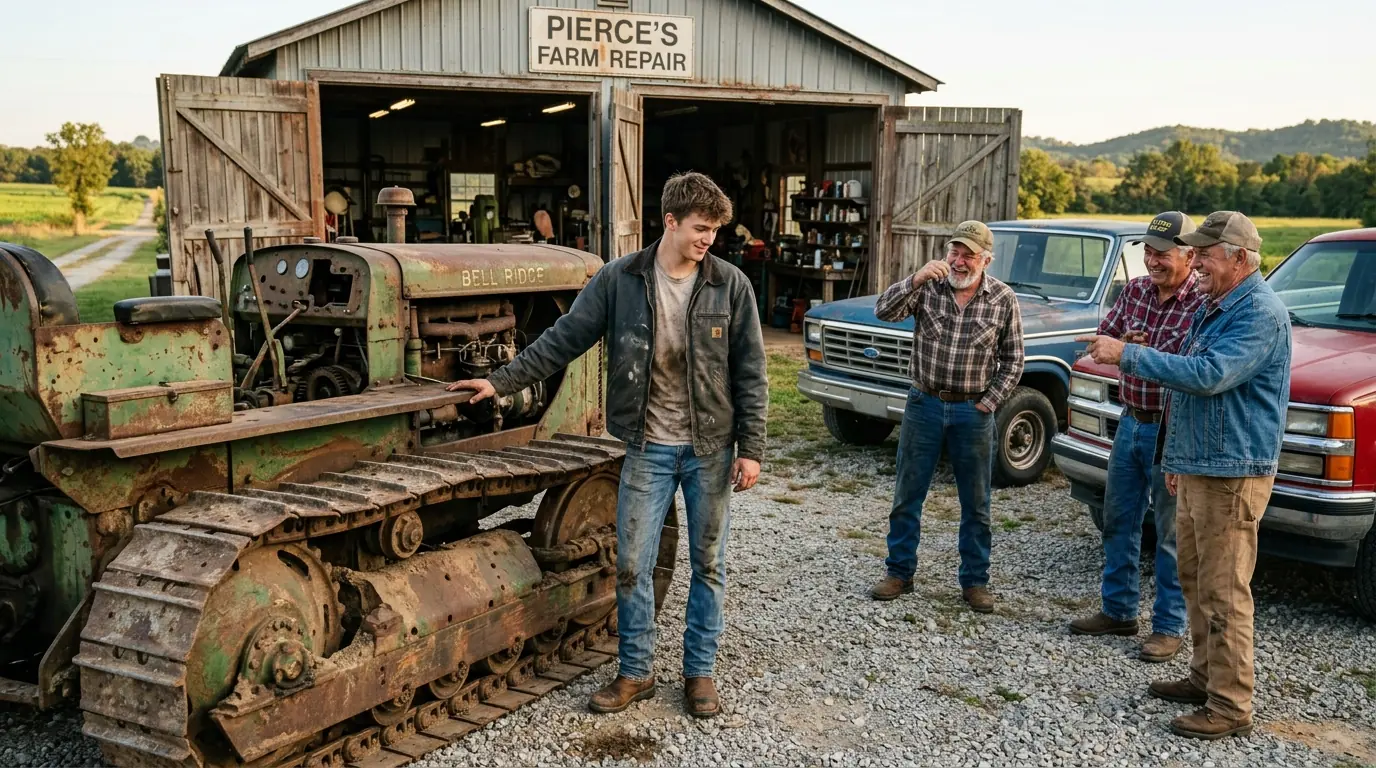
Rust flakes dropped into the dirt.
Three men laughed.
Landon Pierce did not.
He stood beside the massive Bell Ridge prototype crawler tractor with one grease-stained hand resting on the frame.
Eighteen years old.
Faded dark work jacket.
Worn jeans.
Oil-blackened boots.
Less than five months into running the repair garage his father had left behind.
And now nearly every dollar he had managed to keep in the business was sitting in front of him disguised as twenty-six years of rust.
A second farmer pointed through the gap where a side panel should have been.
“That thing hasn’t worked in twenty years.”
“More than that,” another man said.
“That helps.”
More laughter.
Behind them sat three pickup trucks.
Old Fords.
A Chevrolet with a dented tailgate.
A Ram that had probably never seen a car wash.
News traveled quickly in Millstone Ridge, Tennessee.
By the time the flatbed carrying Landon’s auction purchase reached the south side of town, half the farming community seemed to know the kid mechanic had spent $6,500 on a prototype nobody else wanted.
One farmer shook his head.
“You really think you can fix what the factory couldn’t?”
Landon finally looked at him.
Small smile.
“I’m not fixing what they built.”
The laughter softened.
Landon looked back at the exposed transmission housing.
“I’m finishing what they never figured out.”
Nobody laughed for a second.
Then someone snorted.
“You sound just like your father.”
Landon’s smile disappeared.
That one hit differently.
He climbed onto the old crawler.
The engine did not run.
The transmission did not move.
A rented recovery winch did most of the work as Landon guided the machine slowly toward the two-bay workshop.
The farmers continued talking behind him.
Scrap.
Waste.
Kid.
Mistake.
Landon heard all of it.
He said nothing.
The tractor disappeared beneath the workshop roof.
Landon looked back once.
Then pulled the wooden doors closed.
Inside, the laughter vanished.
Only silence.
And machinery.
Landon switched on the overhead lights.
The Bell Ridge crawler looked even worse indoors.
Cracked hydraulic lines.
Corroded fittings.
Missing covers.
Old grease hardened around joints.
Faded green paint surviving in irregular islands across the frame.
The machine looked exactly like what the auction bidders had seen.
Dead weight.
Landon walked to the workbench.
Old Bell Ridge technical drawings were spread across it.
Patent copies.
Photocopied catalog pages.
Handwritten notes.
Engineering diagrams he had printed from a library database two nights before the auction.
He picked up a flashlight.
Put it between his teeth.
Removed another access cover.
Then reached inside the transmission housing.
Slowly.
One greasy finger traced the central gear assembly.
Input shaft.
Transfer stage.
Load bearing.
Secondary transfer.
Then his finger stopped.
He brought the flashlight closer.
Looked at the geometry.
Looked at the old diagram.
Back to the gears.
His eyes narrowed.
“So that’s where you failed.”
He reached for a wrench.
Bell Ridge Farm Equipment had not built bad machines.
That was important.
The company had operated for more than fifty years.
Its tractors and farm implements worked across Tennessee, Kentucky, northern Georgia, and parts of Missouri.
It was never large enough to compete directly with Deere or Case.
But farmers knew the name.
They trusted the machines.
Then Bell Ridge tried something ambitious.
A crawler tractor designed specifically for soft clay and wet farmland.
Tracked machines already existed.
That was not the innovation.
The transmission was.
Traditional farm tractors used fixed ratios.
When conditions changed, the operator reacted.
Shift.
Increase throttle.
Reduce load.
Try again.
Bell Ridge wanted the machine to react before the operator had to.
Their prototype used a two-stage torque-transfer system.
The engine stayed within a relatively stable operating range.
The second stage redistributed pulling force according to actual resistance at the tracks.
Soft ground.
Heavy implement.
Sudden load increase.
Instead of simply demanding more RPM and fuel, the transmission was supposed to redirect torque more efficiently.
The concept was clever.
On paper.
The problem lived in the center of the assembly.
Landon had seen it in the patent drawings.
He was seeing it again in metal.
The load path narrowed too aggressively around one central gear interface.
At moderate force, probably fine.
Under sustained maximum torque?
Too much stress through too little contact area.
Maybe Bell Ridge had discovered that during testing.
Maybe they had planned a redesign.
Nobody knew.
Before the project reached production, the company changed management.