“Have you eaten?”
The cowboy stopped beneath the doorway of Clara Whitlow’s sewing shop as if the question had struck him harder than a fist. Rainwater streamed from the brim of his battered black hat, ran down his weathered face, and disappeared beneath the collar of his soaked leather coat. One scarred hand held the broken strap of an old saddlebag, while the other pressed tightly against his ribs, hiding an injury that had already begun staining his shirt. For several seconds, he could not bring himself to look at her.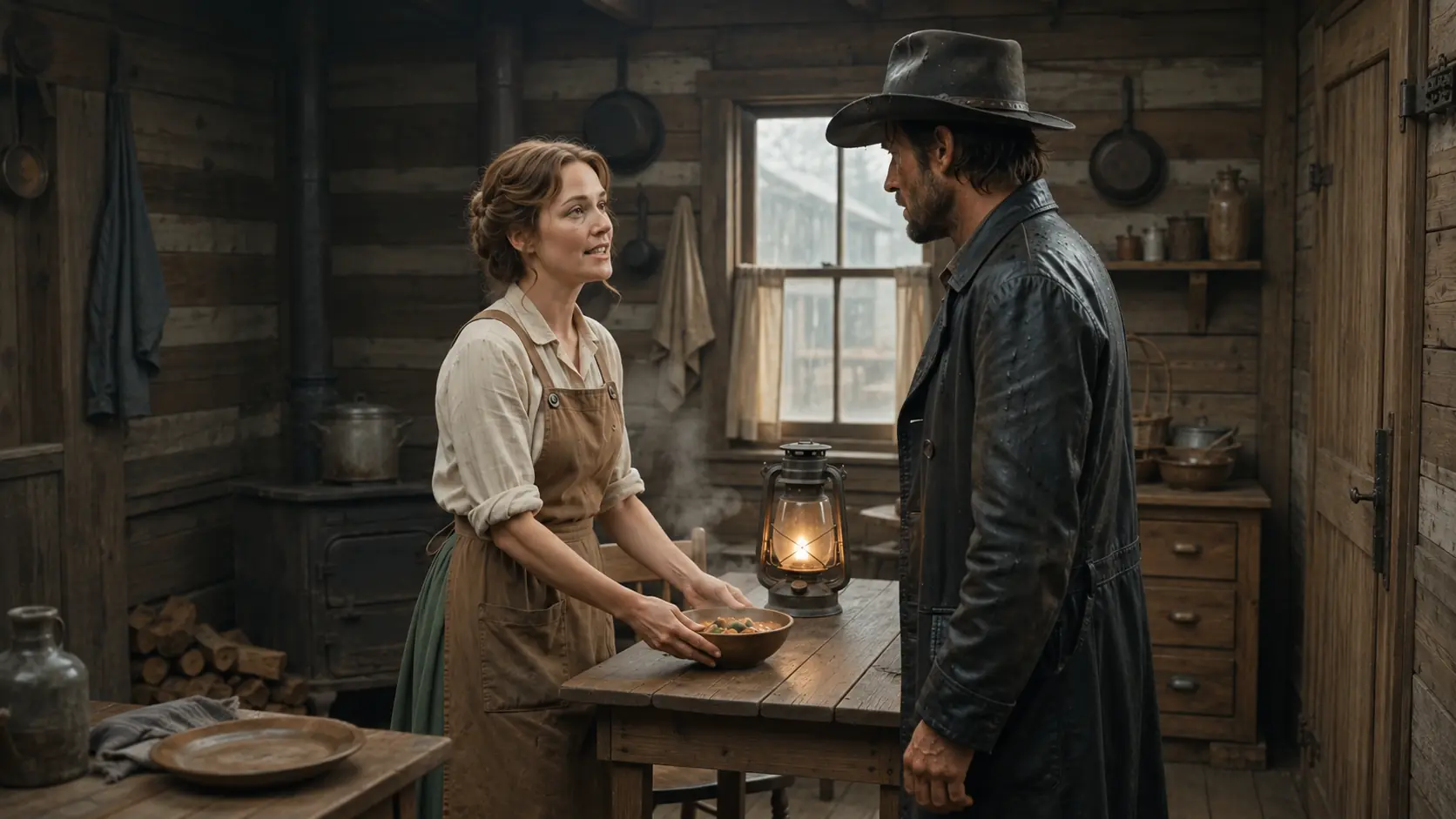
“I only came to have the strap repaired, ma’am,” he said. “I can pay.”
Clara set her needle beside the sewing machine and glanced toward the pot of stew simmering over the iron stove. “I didn’t ask about your money. Sit down before that wound puts you on my floor.”
The cowboy removed his hat with a trembling hand. His gray-blue eyes lifted toward hers, carrying so much exhaustion that Clara suddenly understood he had not merely been traveling alone—he had been living alone for years. “My wife asked me those exact words the night she died,” he whispered. “You’re the first person who has said them since.”
Outside, the storm hammered Mercy Ridge until the street disappeared behind a curtain of rain. The mercantile had closed before sundown, the saloon piano had fallen silent, and every sensible resident had already gone home. Yet the stranger remained near the door as though he feared that stepping into the warmth would create a debt he could never repay. Clara pulled out the chair beside her worktable and placed a bowl in front of it.
“Then perhaps it is time someone asked again,” she said.
He stood motionless for another moment before crossing the threshold. Mud fell from his boots onto the wooden floor, and he looked down with immediate embarrassment. Clara told him she had cleaned worse things than rainwater, though the truth was that no customer had ever entered her shop looking so completely abandoned.
The cowboy lowered himself carefully into the chair. Pain tightened his face when his injured side touched the wooden back, but he did not complain. Clara filled a bowl with beef stew, added two potatoes, and placed a thick slice of bread beside it. He stared at the meal as if she had set down something priceless.
“What is your name?” she asked.
“Elias Reed.”
“I’m Clara Whitlow.”
“I know,” he said. “Your name is painted on the window.”
The faded letters read WHITLOW’S REPAIRS AND ALTERATIONS, though part of the final word had peeled away during the previous winter. Clara had meant to repaint it, but thread, flour, lamp oil, and property taxes always demanded the little money she managed to save. The shop had belonged to her husband before his death, when it had been a harness-repair business. Clara had added dresses and household sewing afterward because broken saddles alone could not keep the bank away.
Elias lifted the spoon but hesitated before taking the first bite. Clara pretended to inspect the damaged saddlebag so he would not feel watched. The old leather was cracked but carefully maintained, and several uneven rows of hand stitching showed where he had repaired it himself. A small silver thimble hung from one of the inner straps.
Elias noticed her looking at it. “It belonged to my wife.”
Clara lowered her eyes. “You don’t have to explain.”
“She was better with a needle than I ever was.”
The stew was still steaming when he finally tasted it. His eyes closed briefly, not from pleasure alone but from the shock of receiving something he had not earned through labor. He ate slowly at first, then with the quiet urgency of a man who had been pretending not to be hungry. Clara tore another piece of bread and placed it beside his bowl without asking.
She returned to his saddlebag and began replacing the broken strap with stronger cord. “You said you were working at Barrow Ranch.”
“For now.”
Those two words told Clara more than a long explanation could have. Silas Barrow hired wandering cowboys whenever his regular men refused dangerous work, then dismissed them before payday over some invented mistake. Everyone in Mercy Ridge knew it, but Barrow owned more cattle than any rancher in the county and supplied meat to the army posts. Men who challenged him soon discovered that no other ranch would employ them.
“What happened to your side?” Clara asked.
“Horse slipped near a washout.”
“That is not an answer.”
Elias looked toward the rain. “Barrow ordered six of us to move cattle across Miller Creek before the storm reached the ridge. The water came faster than expected. One of the younger hands fell beneath his horse, so I pulled him out.”
“And the horse kicked you?”
“The river threw me against a rock.”
Clara studied the dark stain spreading beneath his coat. “You need a doctor.”
“Doctor Hale charges two dollars just to open his door.”
“You nearly spent that much repairing this bag.”
“The bag carries everything I own.”
Clara stood and reached for the medical box beneath her counter. Elias immediately straightened, saying the wound was not her concern. She replied that she had not asked whether it was, then pointed toward the curtain separating the front shop from the small storage room. He reluctantly followed her behind it.
The injury was worse than she had expected. A long cut crossed his ribs, packed with mud and partially closed by a strip of torn cloth. Purple bruising covered his side, and every breath appeared painful. Clara cleaned the wound while Elias gripped the edge of a shelf and stared straight ahead.
“You should have had this stitched yesterday,” she said.
“Barrow said injured men do not earn wages.”
“So he refused to pay you?”
“He said the cattle lost in the creek cost more than my work was worth.”
Clara’s hands stopped. “You saved one of his men.”
“He said that boy’s life was not on the account book.”
Silas Barrow’s cruelty surprised no one, but hearing the words still filled her with anger. Clara finished cleaning the wound and wrapped Elias’s ribs with a strip of linen. She told him he could sleep in the rear storage room until the storm passed, though there was only a narrow cot and several boxes of fabric.
“I cannot accept that,” he said.
“You can barely stand.”
“I have slept in worse places.”
“That does not make them better.”
Elias looked at her for a long moment. “Why are you doing this?”
Clara replaced the lid on the medical box. “Because you are hurt, hungry, and standing in front of me.”
He seemed unable to understand an explanation so simple. For years, every meal had been attached to labor, every bed to obedience, and every kind word to an expectation he had not yet discovered. Clara could see him searching her expression for the hidden price. When he found none, distrust gave way to something more painful—hope.
The storm continued through the night. Clara lived in two small rooms above the shop, but sleep would not come while the rain rattled the windows. Shortly after midnight, she descended the narrow stairs and found Elias repairing the broken leg of her storage cot instead of resting on it. His bandage had already spotted red.
“You are supposed to be sleeping,” she said.
“I broke the cot.”
“It was broken before you touched it.”
“Then I made it worse.”
Clara sat on a wooden crate and watched him secure the leg with a strip of scrap leather. His hands moved with surprising care for someone built to wrestle cattle and lift fence posts. He explained that his father had taught him carpentry before losing their farm during a drought. Since then, Elias had learned whatever work allowed him to survive another season.
“What happened to your wife?” Clara asked softly.
His hands became still.
“You do not have to tell me,” she added.
“No. You fed me. You deserve the truth.”
Elias had married a schoolteacher named Rose when he was twenty-six. They rented a small cabin outside Red Bluff, where he worked cattle and she taught twelve children in a one-room schoolhouse. They had little money, but Rose filled the cabin with books, dried flowers, and the stubborn belief that their lives were only beginning.
During their third winter, fever swept through the settlement. Elias was away delivering horses when Rose became ill. By the time he returned, snow had closed the road, the doctor was trapped in another town, and Rose could barely breathe. He sat beside her for two days, feeding the fire and begging her to hold on.
“On the last night, she opened her eyes and asked whether I had eaten,” Elias said. “She was dying, and she was worried about me.”
Clara felt tears rise but did not interrupt.
“I told her I was not hungry. She smiled because she knew I was lying.” His voice roughened. “She died before morning.”
After Rose’s burial, Elias could not remain in the cabin. Every wall carried her voice, and every object reminded him of a future that had disappeared. He placed her silver thimble inside his saddlebag, gave the cabin to a family who had lost their home, and began riding west.
He never stayed anywhere longer than a season. Whenever people became familiar, he found another ranch, another trail, or another reason to leave. He told himself that movement was freedom, but after seven years he understood that it was only grief wearing different clothes.
Clara folded her hands in her lap. “My husband died in that chair.”
Elias looked toward the front of the shop.
Thomas Whitlow had been repairing a cavalry saddle when his heart failed. Clara had found him leaning across the workbench as if he had simply fallen asleep. They had been married for eight years, and although theirs had not been a grand romance, Thomas had been steady, gentle, and kind.
After his death, several men advised Clara to sell the shop and move in with relatives. Others offered marriage before the funeral flowers had withered, expecting that a frightened widow would be grateful for any protection. Clara refused them all and taught herself enough leatherwork to keep the business open.
“The town calls me brave,” she said. “Most days I am simply too busy to be afraid.”
Elias glanced at the repaired cot. “Loneliness can look like courage from a distance.”
“Yes,” Clara said. “And wandering can look like freedom.”
Neither spoke after that.
By morning, the storm had passed, but Miller Creek had flooded the western road. Elias could not return to Barrow Ranch, and Clara would not let him travel with his injury. He offered to work in exchange for food and shelter until the road reopened.
Clara reluctantly agreed, though she made it clear he would receive wages as soon as she could afford them. Elias repaired the leaking porch roof, reset the crooked front steps, and strengthened the shelves along the shop wall. He also repainted the missing letters on Clara’s window using a small brush she had forgotten she owned.
Customers began arriving after the roads dried. They stared when they saw the imposing cowboy behind the counter, but Elias greeted everyone politely and returned to his work. Children were the first to stop fearing him. Within three days, they were bringing him broken toys, loose wagon wheels, and wooden animals missing their legs.
Clara watched him kneel beside a little girl whose doll carriage had cracked. His large hands handled the tiny pieces as carefully as glass. The girl left smiling, and Elias followed her to the doorway with an expression Clara had not seen before.
“You are good with children,” she said.
“I used to think Rose and I would have some.”
The words carried sadness, but not the same hopelessness as before.
At the end of the week, Silas Barrow entered the shop with two ranch hands behind him. He was a broad, silver-haired man who wore polished boots even when visiting cattle pens. His gaze moved from Elias to the newly repaired shelves, and irritation tightened his mouth.
“You walked away from my ranch,” Barrow said.
“The creek washed out the road,” Elias replied.
“You were paid to return.”
“You never paid me at all.”
Barrow placed a folded document on Clara’s counter. It claimed Elias owed thirty-two dollars for lost cattle, medical supplies, meals, and damage to ranch property. Until the debt was settled, Barrow said Elias’s saddle, horse, and remaining wages belonged to the ranch. The two men behind him watched Elias as though hoping he would object physically.
Clara picked up the account. “You charged him for the rope he used to save your ranch hand.”
“That rope was lost.”
“You also charged him for three meals on the day he was injured.”
“He was provided access to the bunkhouse.”
Elias reached for the document, but Clara pulled it away. “This is theft written in neat columns.”
Barrow’s expression hardened. “Widows should be careful before accusing respectable men.”
“And respectable men should pay those who make them rich.”
He stepped closer to her, but Elias moved between them. The action was calm and silent, yet both ranch hands immediately shifted backward. Barrow looked up at Elias and promised that no ranch within a hundred miles would hire him again.
Elias met his eyes. “Then I will find work that does not require stealing from hungry men.”
After Barrow left, Clara discovered her hands were shaking. Elias apologized for bringing trouble to her door. She told him Barrow had brought the trouble himself, though she could not ignore the danger.
That evening, three ranch workers arrived quietly at the shop. One was the young cowboy Elias had pulled from Miller Creek. His name was Matthew, and he carried a ledger taken from Barrow’s bunkhouse.
The book listed years of invented debts charged against temporary workers. Barrow deducted money for blankets never provided, meals never served, tools workers supplied themselves, and cattle lost before they were hired. Men who protested were beaten, blacklisted, or handed to the sheriff on accusations of theft.
Matthew placed twelve dollars on the table. “That is all the boys could collect from our wages. It belongs to Elias.”
Elias pushed the money back. “Keep it.”
“You saved my life.”
“That does not put you in my debt.”
Clara watched Matthew’s face and suddenly understood that Elias had spent years believing himself invisible while leaving proof of his goodness everywhere he went. Men remembered him. Families remembered him. The problem was not that he had never belonged anywhere, but that he had always left before anyone could tell him he mattered.
The ledger gave them a way to fight Barrow. Clara took it to Judge Amos Bell, an elderly territorial magistrate who held court twice a month above the mercantile. Barrow’s attorney argued that the accounts were legal contracts accepted by wandering laborers.
Judge Bell asked whether the men could read.
Most could not.
He then asked whether Barrow had provided copies of the agreements or explained the charges before employment.
He had not.
The judge froze Barrow’s claims and summoned thirty former workers to testify. News traveled across the territory, and men began arriving from neighboring ranches. They carried receipts, letters, scarred backs, and stories nearly identical to Elias’s.
Barrow responded by trying to destroy the ledger. Two nights before the hearing, someone broke into Clara’s shop and overturned the worktables. The intruder poured lamp oil across the floor, but Elias, sleeping in the rear room, woke before the fire caught.
He chased the man into the alley and discovered Barrow’s foreman waiting with a horse. During the struggle, the foreman drew a knife and reopened the wound along Elias’s ribs. Elias disarmed him but refused to kill him, holding the man until the sheriff arrived.
The foreman confessed before morning. Barrow had ordered the fire and promised him fifty dollars to destroy the records. The sheriff arrested Barrow inside his ranch house as workers gathered outside the gate.
At the hearing, Judge Bell declared Barrow’s labor contracts fraudulent. More than two thousand dollars in stolen wages were recovered through the sale of his private cattle herd. Several workers received enough money to buy land, tools, or safe passage home.
Elias received forty-six dollars and the return of his horse, saddle, and personal belongings. It was more money than he had possessed in years. Clara expected him to leave once his wound healed.
Instead, he placed twenty dollars on her counter.
“What is this?” she asked.
“Payment for food, lodging, medicine, and repairing the saddlebag.”
Clara pushed the money toward him. “I did not charge you.”
“I cannot remain here owing you.”
“You do not.”
His jaw tightened. “Everyone owes something.”
Clara reached beneath the counter and removed the saddlebag. The strap had been repaired with strong braided cord, the cracked edges treated with oil, and the uneven stitches reinforced without erasing them. She had also sewn a small inner pocket to protect Rose’s silver thimble.
“You came here carrying everything you owned,” Clara said. “But you have repaired my roof, my porch, my shelves, my stove, and half the children’s toys in Mercy Ridge. You protected my shop and helped expose a thief. Tell me honestly which one of us owes the other.”
Elias looked at the bag for a long time. “I do not know how to stay.”
“Then begin by not leaving today.”
He remained through the autumn.
Together, they expanded the shop into a repair house for clothing, harnesses, saddles, wagons, and farm tools. Elias built a second workbench beside Clara’s sewing machine. The sound of her needle and his hammer filled the building from sunrise until evening.
People began calling the place Whitlow and Reed Repairs, though neither had officially changed the sign. Ranchers brought tack from miles away because Elias refused careless work, and women trusted Clara with wedding dresses, mourning clothes, and children’s coats. Their earnings finally allowed Clara to pay the overdue property taxes.
Elias rented a small room above the stable rather than sleep in the shop. He said it was proper, but Clara suspected the real reason was fear. Staying in Mercy Ridge had become easy; admitting why he stayed was harder.
Winter arrived early. One evening, Clara found Elias standing beneath the porch roof while snow fell across the silent street. He carried the repaired saddlebag over one shoulder, and his horse waited nearby.
Her heart tightened. “Where are you going?”
“The northern road.”
“You have work here.”
“I finished the Henderson saddle and repaired the schoolhouse stove.”
“That was not what I meant.”
Elias stared toward the white hills. He admitted that each morning in the shop felt more like home. Clara’s voice, the smell of stew, the children at the door, and the quiet evenings had become things he expected to find. That expectation terrified him because everything he had once loved had been taken away.
“So you will abandon it first?” Clara asked.
“I know how to survive losing a home.”
“No,” she said. “You know how to avoid having one.”
He lowered his eyes.
Clara stepped onto the porch without her coat. “Thomas died, and I could not stop it. Rose died, and neither could you. But we are not honoring them by punishing ourselves for still being alive.”
Elias’s grip tightened around the saddlebag. “What are you asking me?”
Clara remembered the rainstorm, the trembling hands, and the way four ordinary words had made a hardened man look as though the ground beneath him had shifted. She understood now that kindness had not saved him in a single night. It had merely opened a door he still had to choose to enter.
She looked at the horse, then at him. “Have you eaten?”
For a moment, Elias said nothing.
Then he slowly removed the saddlebag from his shoulder. “Not yet.”
“There is stew inside.”
“Enough for two?”
“There always is.”
He led the horse back to the stable.
The following spring, Elias repainted the shop sign. This time, the window read WHITLOW & REED — SEWING, LEATHER, AND HONEST REPAIRS. Beneath the main lettering, he added a smaller line Clara did not notice until he had finished.
A WARM MEAL FOR ANYONE WHO NEEDS ONE.
Travelers began stopping beneath the same porch where Elias had once stood in the rain. Some were cowboys searching for work, widows traveling between settlements, families whose wagons had broken, or children who had not eaten since morning. Clara never asked whether they could pay before placing food on the table.
Elias repaired whatever they carried.
Two years after the storm, Mercy Ridge gathered behind the shop beneath strings of white cloth and wildflowers. Clara wore a cream dress she had sewn herself, and Elias wore a dark coat with Rose’s silver thimble secured inside the breast pocket. Judge Bell stood before them while half the town crowded into the yard.
Before speaking his vows, Elias looked at Clara and smiled. “You asked me four words when every other person had learned to look past me.”
Clara took his scarred hands. “You stepped through the door.”
He had once believed his life had ended beside Rose’s deathbed. Clara had believed survival meant asking nothing more from the world than another month of paid bills. Neither had expected a storm, a broken saddlebag, and a bowl of stew to lead them back toward hope.
Their marriage did not erase the people they had lost. Rose’s thimble remained in the shop, and Thomas’s old harness tools hung above Elias’s workbench. Clara and Elias spoke their names without jealousy because love did not require forgetting what came before.
Years later, travelers still repeated the story of the lonely cowboy who arrived in Mercy Ridge during the worst storm anyone could remember. Some claimed Clara had saved him with a meal, while others insisted he saved her shop and gave her courage to build a new life. The people who knew them best understood that both versions were incomplete.
Clara had offered food without demanding payment, and Elias had answered kindness by staying long enough to become known. She gave him a place at her table, but he made the choice to return to it every evening. Together, they learned that a home was not simply a roof, a deed, or a town where a person stopped traveling.
It was the place where someone noticed when your chair was empty.
And in the Whitlow and Reed household, no matter how difficult the day had been or how loudly the winter wind struck the windows, one question was always asked before the lamp was lowered.
“Have you eaten?”