The auctioneer’s hammer struck the wooden crate like thunder.
“Three dollars for the tall one!”
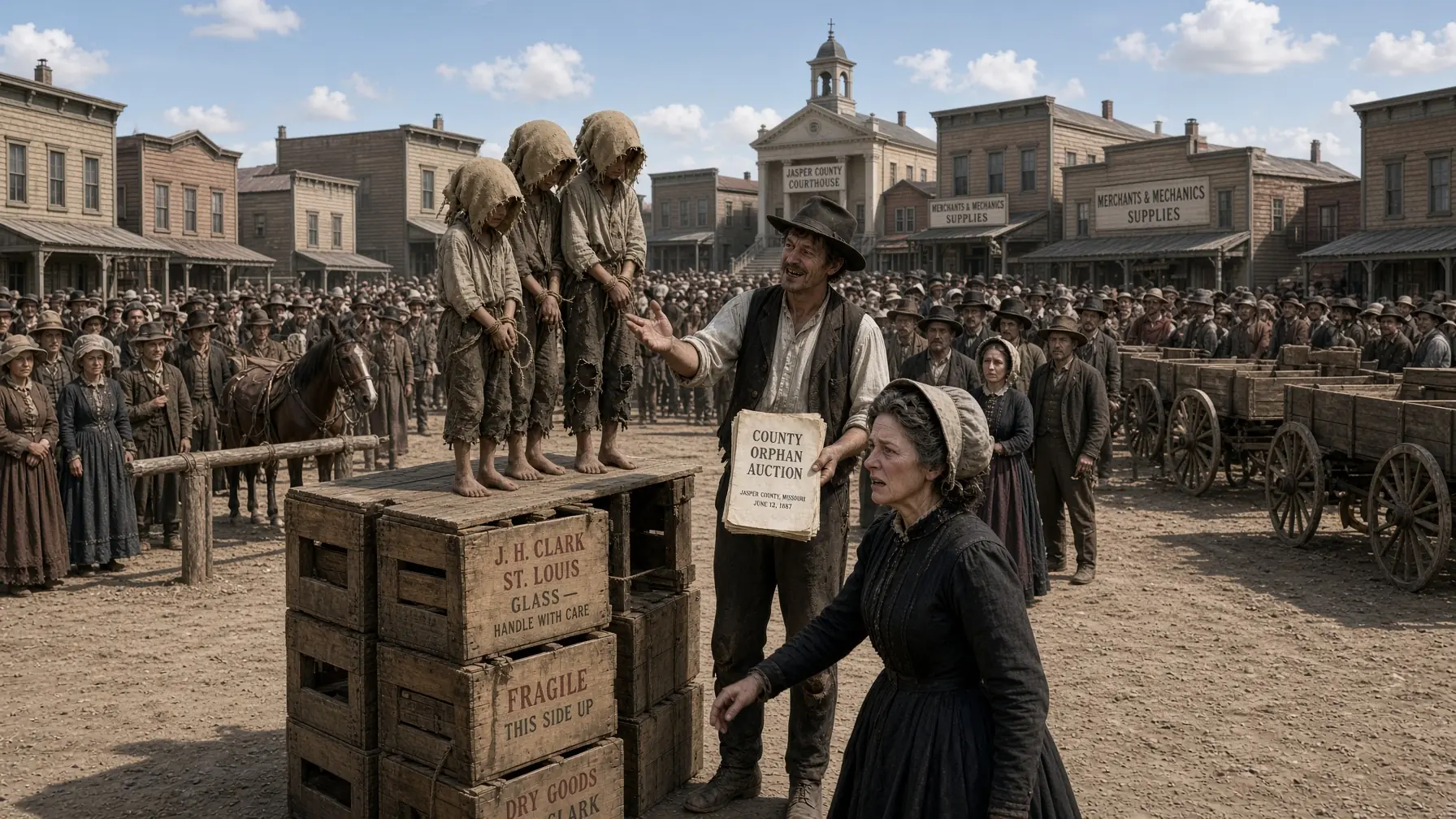
A murmur moved through the crowd gathered in the dusty Missouri town square.
Clara Boon stopped walking.
She had been on her way to the general store with enough money for flour, salt, lamp oil and perhaps a little thread.
Instead, she found three children standing on a makeshift platform beside the courthouse.
Burlap sacks covered their heads.
Rope bound their hands.
The tallest could not have been more than thirteen.
The middle child looked smaller.
The last boy was so slight his bare ankles seemed too thin to carry him.
Beside them stood a man in a stained leather vest.
Mr. Crane.
Clara knew the name only vaguely.
A trader.
A fixer.
A man who seemed to appear whenever desperate people had something they could no longer afford to keep.
“Strong boys,” Crane announced. “No parents coming back for them. No family to claim them. Feed them properly and they'll earn their keep.”
Someone near Clara muttered:
“Children aren't livestock.”
Crane smiled.
“Then take one home.”
Silence.
That was the cruelty of it.
Everyone disapproved.
Nobody stepped forward.
Times had been hard.
A bad drought had left families counting flour by the scoop and meat by the ounce.
Moral outrage cost nothing.
Another mouth did.
Cyrus McKenna, the largest landowner in the county, raised two fingers.
“Two dollars for the tall one.”
“Three,” Crane replied. “As advertised.”
The smallest boy swayed.
The middle child immediately shifted closer, trying to steady him despite the ropes.
“They brothers?” someone called.
Crane shrugged.
“Not by blood.”
“Then separate them.”
Crane’s smile widened.
“Probably wise. Breaks the wildness faster when they haven't got each other.”
Clara’s hands tightened.
Three years earlier, pneumonia had taken her husband Samuel.
Since then, the forty-acre farm north of Hartsville had become a place of echoes.
Samuel’s chair.
Samuel’s tools.
Samuel’s boots she had never moved from beneath the bed.
Three empty bedrooms upstairs that had been built for children who never came.
At fifty-two, Clara had learned to live inside silence so complete that some mornings she spoke aloud simply to prove she still had a voice.
Now she looked at the boys.
The smallest stumbled again.
Something inside her broke.
“I'll take them.”
The square went quiet.
Crane looked toward her.
“All three?”
“All three.”
Martha Phillips, the minister’s wife, grabbed Clara’s sleeve.
“Clara, think.”
“I am.”
“You know nothing about them.”
“They're children.”
“They may be dangerous.”
Clara looked at the three bound figures.
“They look terrified.”
Crane rubbed his chin.
“Eight dollars for the lot.”
Eight dollars.
Nearly everything Clara had brought for winter supplies.
She opened her purse.
Counted the bills.
Crane held out his hand.
Then the smallest child turned his covered head toward her.
“Mrs. Boon.”
Clara froze.
So did Crane.
The square seemed to hold its breath.
“What did you say?” Crane demanded.
The boy spoke again.
“Mrs. Boon.”
Clara stared at the burlap sack.
She had never seen him.
Never spoken to him.
She rarely left her farm except for church and supplies.
Crane seized the boy by the shoulder.
“You know this woman?”
“No, sir.”
“Then how do you know her name?”
The answer came softly.
“I just do.”
Clara stepped onto the platform.
Crane’s fingers tightened on the child.
She pushed the eight dollars into his other hand.
“You have your money.”
He looked at her.
“The transaction isn't—”
“Finished?”
Clara held his gaze.
“Then finish it.”
Money won.
It usually did with Crane.
He pocketed the bills, drew a knife and sliced through the ropes.
Then he yanked the sacks away.
Clara finally saw the boys.
The oldest had dark hair hanging across gray eyes that looked decades older than thirteen.
“This is Ben,” he said.
He indicated the sandy-haired boy beside him.
“Harris. Ten.”
Then the smallest.
“Milo.”
Milo’s hair, once the dirt was ignored, was almost the color of corn silk.
His eyes were an extraordinary pale blue.
He looked straight at Clara.
No fear.
No suspicion.
Trust.
That frightened her more than either would have.
“Hello, Mrs. Boon.”
Clara crouched.
“How did you know my name?”
Milo tilted his head.
As if she had asked why the sky was blue.
“I saw you.”
“Where?”
“In a dream.”
Whispers moved through the crowd.