The first truck came at sunrise, coughing dust up the long gravel road like it owned the place.
Dela Voss stood on the porch of the farmhouse she had inherited only three months earlier, one hand wrapped around a chipped coffee mug, the other pressed against the porch post her grandfather had carved smooth with his own tools.
The late-summer light spread across the Oregon valley, touching the old barn, the vegetable beds, the creek pasture, and the stand of fir trees that marked the back edge of her sixty acres.
It should have been a peaceful morning, the kind her grandfather used to call a good working morning.
Instead, the sound of heavy brakes and grinding gears came rolling toward her like a warning.
The flatbed truck belonged to Blackwood Ridge Vineyards, the expensive winery across the ridge.
Everyone in the valley knew their name now because their bottles were showing up in Portland restaurants, and people with clean hands and polished shoes were suddenly driving out to buy wine where cattle used to graze.
The truck turned into Dela’s yard and stopped near the back lane, loaded high with old oak barrels.
Behind the wheel, the driver gave her a quick nod, then looked away like he had already been told where to dump them.
Dela stepped off the porch and walked toward the truck.
The driver climbed down and pulled on his gloves.
“Morning, Miss Voss. Mr. Albright said the clearing is up by the tree line.”
Dela looked past him at the barrels, hundreds of curved wooden bodies strapped together with rusting hoops.
“They’re just stacking them there, right?” she asked.
The driver shrugged. “Stacking, rolling, unloading. Whatever gets them off the truck.”
That was the first time she felt the deal turn sour in her stomach.
A week earlier, Mr. Calvin Albright, the winery’s operations manager, had come to the farm in a crisp white shirt and polished brown shoes.
He had found Dela behind the barn, kneeling in her grandfather’s overgrown garden, trying to save the roses from blackberry vines.
He had spoken with the smooth patience of a man used to making other people feel practical for agreeing with him.
The winery had a disposal problem, he said.
Their oak barrels were spent after several vintages, useless for wine, expensive to haul away, and inconvenient to store.
Dela had been twenty-five, alone, newly responsible for property taxes, a leaking roof, and a farm people expected her to lose.
Mr. Albright had pointed toward the unused back acreage near the fir trees and called it scrubland.
He offered a small monthly fee to store the barrels there.
“Out of sight, out of mind,” he said with a smile that never warmed his eyes.
Dela, tired of bills and afraid of looking foolish, agreed.
Now the truck bed tilted.
The first barrel broke loose and rolled down hard, thundering against the gravel before bouncing into the clearing.
Then another came after it.
Then another.
Soon the air filled with hollow crashes, dust, sour wine smell, and the groan of old wood striking old wood.
Dela stood frozen as the barrels tumbled into a growing pile on the land her grandfather had kept clean for fifty years.
By noon, there were fifty barrels.
By the end of the week, there were more than eight hundred.
They lay in a chaotic mountain behind the farm, rust-streaked, warped, and stained dark from years of wine.
Some had split staves.
Some leaned open like broken ribs.
Some still smelled sharply of vinegar and old dregs, the odor rising whenever the afternoon heat settled over the clearing.
From a distance, the pile looked less like storage and more like a wound.
The neighbors noticed immediately.
Old Henderson, the cattleman next door, pulled his truck over one afternoon while Dela was mending fence.
He did not get out.
He only leaned his arm through the open window and nodded toward the barrel pile with a grimace.
“That’s a hell of an eyesore, Dela.”
She tightened her grip on the fence staple.
Henderson shook his head.
“You let that winery man sweet-talk you. That pile will bring rats. Fire hazard too, once summer dries it out good.”
Dela wiped sweat from her forehead and tried to answer with pride.
“They’re paying me.”
“Not enough to turn your granddaddy’s place into a dump.”
He drove away before she could say anything else.
The words followed her all evening.
At the feed store, people whispered.
At the post office, they stopped talking when she walked in.
The Voss girl was letting the winery use her land like a junkyard.
The Voss girl must be hard up.
The Voss girl did not have the sense her grandfather had.
Each rumor landed on her confidence like another barrel rolling off the truck.
For a month, Dela avoided the back acreage.
She focused on the garden, patched the barn roof, scraped paint from the porch rail, and repaired the chicken coop.
She told herself the barrels were only temporary income.
She told herself the land up by the fir trees had been unused anyway.
But every morning, when she walked to the pump house, she could see the top of the barrel pile above the brush, dark and crooked against the clean Oregon sky.
One evening, near dusk, she finally walked up the hill.
The sun was lowering behind the ridge, spilling orange and purple across the valley.
Dust clung to the barrels, and the sour smell still rose from them, but beneath it Dela noticed something else.
A deeper scent.
Oak.
Old, dense, weathered oak with something sweet trapped inside it.
She placed her hand on a stave.
The wood was rough under her palm, but solid.
Not rotten.
Not dead.
Just discarded.
And suddenly, she heard her grandfather’s voice.
Ernst Voss had been a quiet man, a cabinetmaker before he became a farmer, and a farmer who never stopped being a cabinetmaker.
His workshop still stood inside the barn, with tools wrapped in oiled cloth, hand planes lined on the shelf, chisels sharpened and waiting, and jars of old screws sorted by size.
When Dela was small, he had taught her that waste was only imagination that had quit too soon.
“This wood has lived a life,” he used to say. “You listen before you cut.”
Dela looked again at the barrels.
The winery saw disposal.
Mr. Albright saw a cheap solution.
The neighbors saw shame.
But Dela saw oak that had been shaped by fire, water, wine, pressure, and time.
The staves were curved, stained, and stubborn, but they had character no lumberyard could sell.
That night, she barely slept.
Before sunrise, she went to the barn and opened her grandfather’s tool chest.
The hinges complained, and the smell of steel, oil, cedar shavings, and old dust rose from inside.
She took out his hand planes, chisels, spoke shaves, draw knives, and clamps.
Then she found his heavy canvas apron hanging on a peg near the workbench.
It still carried the faint smell of tobacco, sawdust, and him.
She put it on.
Her first attempt was a failure.
She dragged one barrel from the pile, knocked off the rusted hoops, and pried loose a stave.
The wood was heavier than she expected, curved harder than she wanted, and dense enough to make her hand plane chatter and jump.
She tried to flatten it into a straight board, forcing the blade across the grain until it tore out ugly chunks.
Within an hour, her palms had blisters.
She tried a saw next.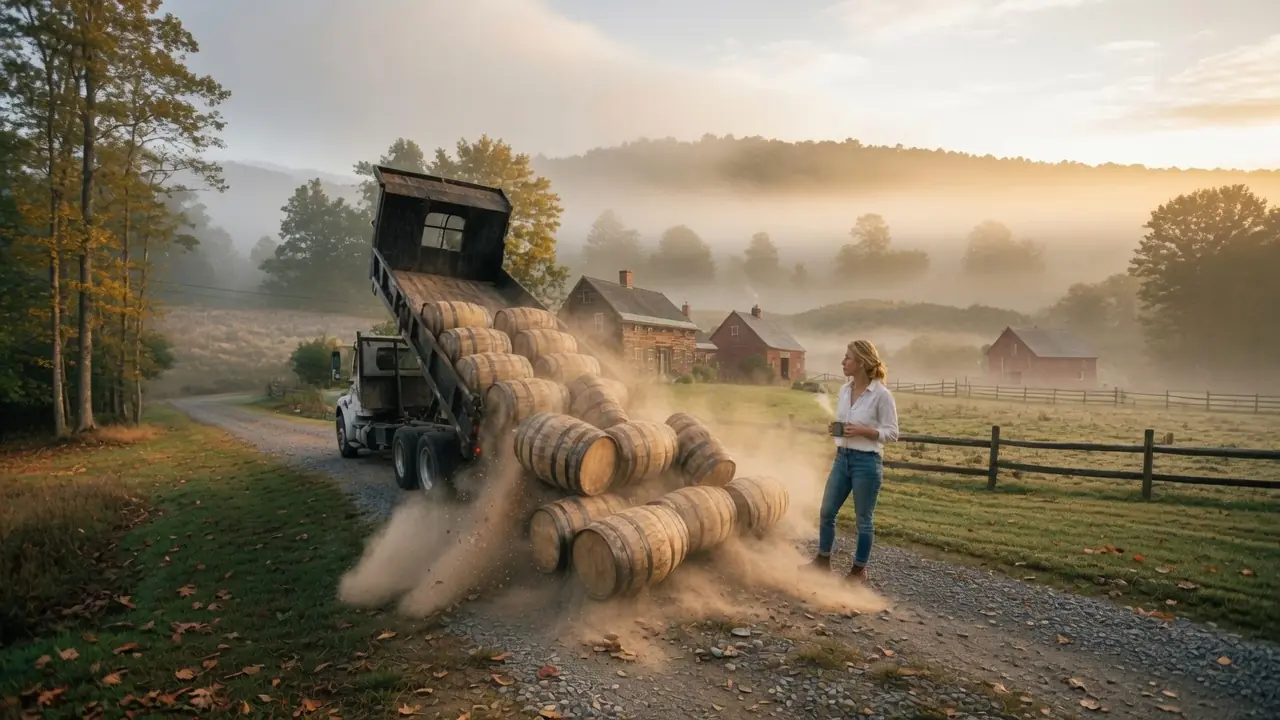
The blade screamed through the wine-soaked oak, binding halfway through the cut.
Purple-black dust floated into the air and stained her sleeves.
She tried to clamp the stave flat.
The wood cracked along a hidden stress line with a sharp sound that made her step back like it had slapped her.
By afternoon, the piece was ruined.
Dela threw the broken stave across the barn.
It struck the wall and fell beside a stack of old feed sacks.
She sat on a hay bale, hands throbbing, throat tight, and felt the neighbors’ whispers become a voice inside her own head.
Maybe Henderson was right.
Maybe she had turned the farm into a dump and was now pretending trash could save her pride.
Then she looked at the broken wood.
Where it had split, the inside glowed with color.
Not surface stain.
Not paint.
A deep burgundy ran through the oak itself, streaked with amber, smoke, plum, and almost black.
Wine had soaked into the wood for years, changing it in a way no factory finish could fake.
The color looked alive.
Dela slid down from the hay bale and picked up the broken pieces.
For the first time, she understood her mistake.
She had tried to force the barrel wood into straight boards because she wanted it to behave like ordinary lumber.
But it was not ordinary lumber.
Its curve was not a flaw.
Its history was not damage.
Its stubbornness was the point.
“You listen before you cut,” she whispered.
After that, the work changed.
Not quickly.
Not easily.
But it changed.
Dela stopped trying to flatten the staves and began designing around their natural curve.
She built a narrow steam box from scrap lumber and an old wallpaper steamer she bought for one dollar at a yard sale.
She learned that the heat would not make the wood obedient, but it would relax enough tension to work without splitting.
She sharpened her grandfather’s blades until the edges flashed like light.
She ruined dozens of pieces.
A chair leg snapped under weight.
A small tabletop warped into a shallow bowl.
A bench joint opened during a rainstorm because she had not allowed enough movement.
Every failure went into the woodstove that heated the barn, and every night she sat watching the flames consume another mistake while sketching the next attempt on brown paper.
The pile behind the farm slowly shrank, but not enough for anyone to notice.
In town, people kept talking.
They said Dela had become strange.
They said she spent all day alone in the barn.
They said the barrel money must have stopped because she had started tearing the pile apart herself.
No one understood that the old barn had become a school, and failure was teaching every lesson.
After two years, Dela knew she had reached the edge of what she could teach herself.
A woman at the hardware store told her about Silas Croft, an old furniture maker who lived in the mountains north of the valley.
People said he was difficult, half hermit and half genius.
He built chairs that looked simple until you sat in them and realized your body had never been properly understood before.
Dela loaded her best failed chair and several staves into her pickup and drove two hours to find him.
Silas Croft came out onto his porch wiping his hands on a rag.
He was thin, bent, and weathered, with eyes sharp enough to cut joinery.
He looked at Dela, then at the wood in her truck, then at the wobbly chair tied in the back.
“I’m trying to work with wine barrel oak,” she said.
“The wood fights me.”
Silas picked up one stave and held it in both hands.
He ran his thumb over the grain, sniffed the dark inner curve, and studied the color without speaking.
Then he looked at the chair.
“You’re treating it like newborn wood,” he said.
“It ain’t. This wood has lived twice. Once as a tree, once as a barrel. Its shape is set.”
Dela swallowed. “So what do I do?”
“You stop telling it what it is. You ask it.”
For two days, he let her stay.
He showed her how to sharpen a plane blade with a microscopic bevel for dense hardwood.
He showed her how to embrace the curve as a chair back, table leg, rocker, or bench support.
He showed her old joinery that needed no nails, only patience, pressure, and understanding.
When she asked about staining the wood, he glared at her like she had insulted his mother.
“Don’t you dare hide that color. Oil only. Let it breathe.”
Dela drove home with her mind burning.
The work became a partnership after that.
She stopped wrestling the wood and began following it.
The staves became graceful chair backs.
The barrel heads became tabletops.
The steel hoops became bands, handles, shelf braces, and accents.
She used oil instead of stain, letting the burgundy and amber glow rise naturally from the oak.
Her first good piece was a bench.
It had a curved back made from matched staves and a seat polished until the grain moved like water under the light.
She placed it on her front porch at sunset and sat there for nearly an hour, staring at the valley.
For the first time since inheriting the farm, she did not feel like she was drowning in someone else’s life.
She felt like she had made something of her own.
Vindication came by accident.
A Portland interior designer named Evelyn Reed took a wrong turn while visiting the valley for a lodge project.
Her expensive car rolled into Dela’s driveway one bright afternoon, and she stepped out to ask for directions.
Then she saw the bench on the porch.
Her question died before she could finish it.
“Where did you get that?” Evelyn asked.
“I made it,” Dela said.
Evelyn walked closer, touching the curved back with reverence.
“The color is extraordinary. What stain is this?”
“It isn’t stain,” Dela said, and for once, confidence steadied her voice.
“It’s wine. The wood came from old barrels.”
Evelyn turned toward the barn.
“Do you have more?”
Dela led her inside.
The barn was no longer only a workshop.
It was a rough gallery of survival.
Chairs leaned against the wall with backs curved like hillside roads.
Small tables glowed with wine-dark grain.
A long coffee table stood near the window, its surface built from joined barrel pieces in shades of plum, honey, smoke, and walnut.
Evelyn moved from piece to piece without speaking for several minutes.
When she finally turned, her face had changed.
“These are not rustic crafts,” she said.
“These are luxury pieces with a story.”
Dela did not know what to say.
Evelyn opened her leather notebook.
“I’m furnishing mountain lodges. I need ten chairs, three dining tables, and five benches. Can you make that?”
Dela’s hands trembled under her apron.
“Yes,” she said, though she was not sure yet how.
The deposit was larger than anything the farm had earned in years.
With it, Dela bought a proper band saw, a drum sander, better clamps, and enough electrical work to make the barn safer.
She hired a young man from town named Peter Lang, who had been laid off from a mill and knew how to work without complaining.
She paid him fairly, taught him carefully, and warned him on the first day that the wood did not forgive arrogance.
He laughed until he ruined his first stave.
By the fifth year, the barrel pile was no longer called an eyesore.
It was inventory.
Dela named the business Voss Barrels, though Evelyn said the name sounded too plain.
Dela kept it anyway because plain names had carried the farm this long.
Designers began calling from Portland, Seattle, San Francisco, and eventually New York.
They wanted dining tables, benches, cabinets, bar fronts, headboards, and chairs with wine-dark backs and steel-hoop accents.
They wanted authenticity, story, reclaimed material, and beauty that could not be manufactured on command.
The business crossed six figures before Dela had time to believe it.
She repaired the farmhouse roof.
She paid the property taxes early.
She restored the barn foundation, bought better equipment, and hired two more apprentices.
She also bought back the lower pasture her grandfather had sold during a hard year and put it under her own name.
The valley began speaking of her differently.
Then Mr. Albright returned.
Five years after the first truck dumped barrels behind her farm, a sensible sedan rolled up the driveway.
Dela was supervising the loading of a finished dining table into a delivery truck when he stepped out.
His shirt was still crisp, but the shine had faded from him.
He looked at the table, at the glowing oak, at the perfect joinery, then past the barn to the remaining barrels stacked neatly under tarps.
“Miss Voss,” he said.
“I heard rumors. I had to see for myself.”
Dela wiped her hands on her apron.
“Good afternoon, Mr. Albright.”
He pointed toward the table.
“Are you making these from our old barrels?”
Dela’s eyes cooled.
“They are not your barrels anymore.”
He lowered his hand.
“No. I suppose they are not.”
Then he looked again at the table and whispered, almost to himself, “We’ve been burning them for years.”
Dela said nothing.
“We had no idea,” he continued.
His voice carried regret now, not arrogance.
“Our marketing department thinks furniture like this could be valuable for the tasting room. Is there any chance we could buy some of the barrels back?”
Dela looked toward the tarped stacks.
Every piece was already planned, promised, or imagined.
“No,” she said quietly.
“This is my inventory.”
Mr. Albright nodded as if he deserved the answer.
“We were fools,” he said.
Dela did not argue.
He offered his hand, not like a manager closing a deal, but like a man admitting he had once mistaken treasure for waste.
Dela shook it.
That was the only apology she needed from him.
Years passed, and the valley changed.
Blackwood Ridge was sold to a corporation.
Henderson retired and sold his ranch.
New houses appeared on hills where cattle once grazed.
But the Voss farm remained, its barn expanded into a world-class workshop where the smell of oil, sawdust, wine-dark oak, and old iron filled the air every morning.
Dela’s furniture became known among collectors, architects, and designers who wanted pieces with memory in them.
She never called herself an artist in interviews.
She called herself a listener.
When apprentices came to her, impatient and eager to force beauty from stubborn wood, she took them to the remaining barrel stacks.
She made them touch the staves before they touched the tools.
She made them close their eyes and feel the curve, the density, the old pressure held in the grain.
“The wood has already lived a life,” she would say.
“You are not here to erase it. You are here to help it speak clearly.”
In her late sixties, Dela still worked every day.
Her hair had turned silver, but her hands remained strong.
Her grandfather’s tool chest sat in the corner of the modern workshop, honored above machines worth thousands.
Inside it rested the old hand plane he had used to teach her.
The handle was worn smooth by his palm, then hers.
Whenever a young apprentice thought new tools made old wisdom unnecessary, Dela placed that plane in their hands.
The barrel pile that had once humiliated her was nearly gone by then.
Not wasted.
Not burned.
Transformed.
It lived in lodges, homes, tasting rooms, galleries, restaurants, and family tables where people ran their fingers over the deep wine-dark grain and asked, “What kind of wood is this?”
And every time, the answer carried a story.
Oak.
Discarded oak.
Oak nobody wanted.
Oak a winery dumped behind a young woman’s farm because they believed she was too desperate to say no and too inexperienced to see value.
Oak the neighbors mocked as junk.
Oak Dela Voss listened to when everyone else only smelled rot and failure.
Oak that built a six-figure business, restored a farm, trained a generation of craftsmen, and proved her grandfather right.
Waste was only imagination that had quit too soon.
Dela stood one evening on the same porch where she had watched the first truck arrive years before.
A finished bench sat beside her, curved and glowing in the sunset.
Behind the barn, only a few barrels remained beneath the fir trees.
The air smelled of grass, cedar, and faintly of wine-soaked oak.
She rested one hand on the bench and smiled.
They had dumped eight hundred barrels behind her farm.
They thought they were giving her trash.
But Dela Voss had harvested eight hundred barrels of time, and from what they threw away, she built a legacy no one could haul off.