Eighty-two-year-old Harold Whitaker arrived at Gate C9 three hours before his flight was supposed to leave. He had always believed in arriving early, not because he loved waiting, but because age had taught him that rushing stole dignity from a man. He wore a beige cardigan over a pressed white shirt, dark trousers, and polished brown shoes that had been resoled twice but still held their shape. In one hand he carried a small leather notebook, and in the other, a black cane his granddaughter had bought for him after he finally admitted his knees were not as proud as his mind.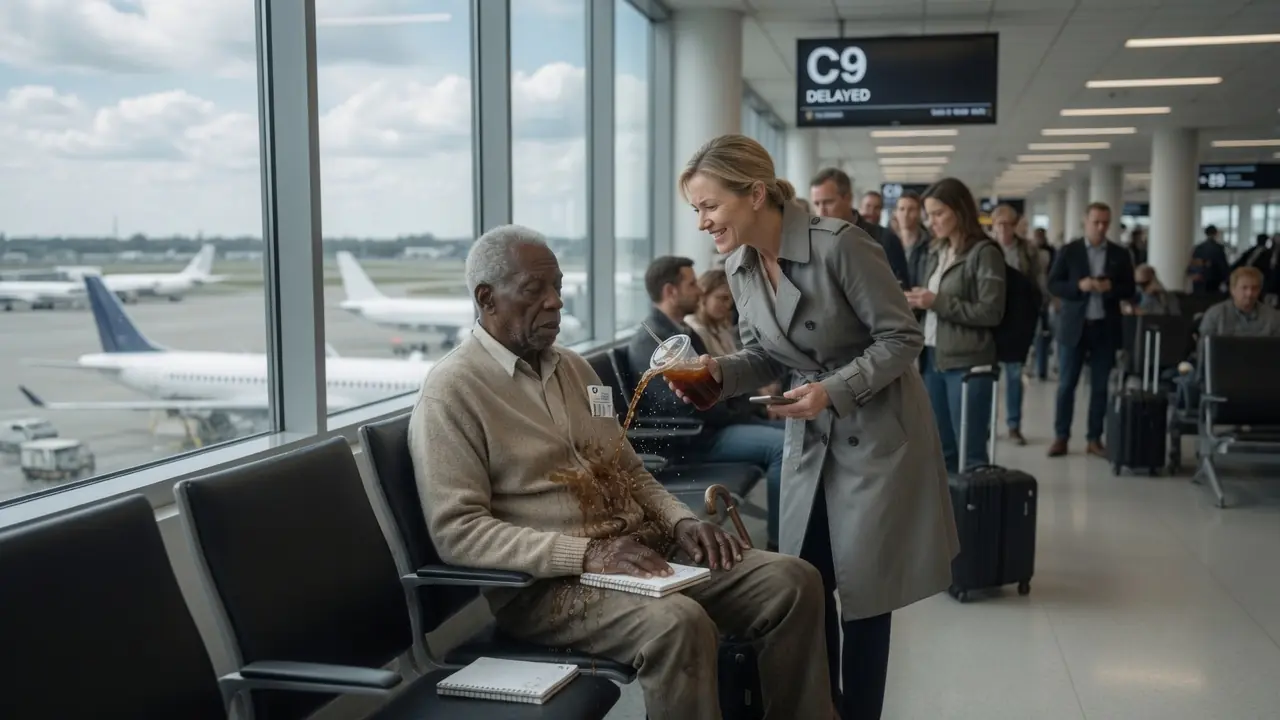
The airport in Charlotte was already crowded that morning. Families sat on suitcases, business travelers paced with phones against their ears, and tired passengers stared at the departure board as if their eyes could force the delayed flights to move. Harold found a seat by the wide windows near Gate C9, where the morning light poured across the floor and planes moved slowly beyond the glass. He placed his cane beside his chair, folded his hands over his notebook, and waited quietly.
His flight to Orlando had been delayed once, then twice. The gate agent announced each update with the tired patience of someone who had already apologized too many times before lunch. Some passengers groaned. Others walked away to find coffee, food, or a different complaint. Harold only nodded, opened his notebook, and wrote the new time beneath the old one.
He was traveling to Orlando to speak at a small charity gathering honoring his late wife, Evelyn. Years earlier, after one miserable trip when Evelyn had watched an elderly woman struggle alone at an airport gate, she had started a foundation that helped older travelers, disabled passengers, and low-income families reach medical appointments and family reunions. After Evelyn died, Harold kept the foundation alive, mostly from behind a desk. This trip would be his first public speech in nearly a year.
In his coat pocket, carefully folded beside his boarding pass, was a short speech written in his own hand. He had rewritten the last line four times. Evelyn always said the best measure of a place was how it treated the person with the least power in the room. Harold had planned to say that softly, then sit down before his voice broke.
At Gate C9, he noticed the people around him the way old men do when they have spent a lifetime learning rooms. A young mother bounced a baby near the windows. A man in a blue suit typed angrily on a laptop. Two teenagers shared a bag of chips and pretended not to be worried about missing a connection. Across from Harold, a blonde woman in a sharp gray trench coat paced near the charging station, talking loudly through wireless earbuds.
Her name, Harold later learned, was Claire Danforth. At that moment, he knew only that she was angry. She spoke as if the airport had personally offended her, snapping at whoever was on the other end of the call. Her iced coffee shook in one hand, the plastic cup cloudy with condensation. Every few steps, she glanced toward Harold’s row as though his quiet presence irritated her more than the delay itself.
Harold tried not to stare. He had met many angry people in eighty-two years. Most of them were not truly angry at the person in front of them. They were angry at time, inconvenience, fear, disappointment, or the collapse of a morning they thought they controlled. Still, he slid his cane slightly closer to his leg so it would not block the aisle.
Another delay announcement came at 10:17. The flight would board in forty minutes, the gate agent said, pending final clearance. A wave of frustration moved through the waiting area. Claire stopped pacing, pulled one earbud out, and stared at the gate desk with open disgust.
“This is unbelievable,” she said loudly. “Some of us have places to be.”
Nobody answered her.
Harold looked down at his notebook again. He drew a small box around the new boarding time. Then he wrote Evelyn’s name at the top of the next page, simply because seeing it steadied him.
That was when Claire’s eyes found him again.
He felt her looking before he lifted his head. She was standing six feet away now, holding her iced coffee, her mouth tight with impatience. The seat beside Harold held only his folded coat and his small notebook case. There were other seats open farther down the gate area, but Claire looked at that one as if it had been stolen from her.
“Are you using all of that?” she asked.
Harold looked at the empty seat. “I can move my coat if you’d like to sit.”
Claire’s eyes dropped to his cane. “And that?”
“My cane?”
“It’s in the way.”
Harold pulled the cane closer. “There you are. No trouble.”
But his calmness seemed to offend her. She looked him over, from the cardigan to the shoes, from his lined face to the boarding pass tucked in his pocket. Her expression shifted into something colder than annoyance. It became contempt.
“You people always act like the whole place has to make room for you,” she muttered.
Harold heard it.
So did the young mother near the window.
Harold did not answer. Silence had carried him through more insults than anger ever could. He moved his coat to his lap and looked back toward the runway, hoping the moment would pass. But Claire was not finished.
She stepped closer.
“You’re taking up too much space,” she said.
Harold turned toward her, surprised by the sharpness in her voice. “Ma’am, I’m only sitting here waiting for my flight.”
The next moment happened so plainly that nobody could mistake it for an accident.
Claire tilted her cup.
Dark iced coffee poured across Harold’s lap, soaking through his beige cardigan, his white shirt, and the folded speech in his coat pocket. Ice cubes bounced off his knees and scattered across the airport floor. The cold hit him so suddenly that he gasped, one hand gripping the armrest while the cup emptied over him. His notebook slid from his lap and landed open on the floor, its pages wet at the edges.
The gate went silent.
Claire lifted the empty plastic cup, sighed dramatically, and looked down at him as if he had inconvenienced her by being soaked.
“He’s taking up too much space,” she said.
For a few seconds, Harold could not move. Coffee dripped from his sleeve onto his shoe. His hands trembled, not from fear, but from the shock of cold liquid and public humiliation. He looked down at the brown stain spreading across the speech he had written for Evelyn, and something in his chest tightened painfully.
The young mother stood first. “Did you just do that on purpose?”
Claire rolled her eyes. “He had his things everywhere.”
“He offered to move them,” the woman said.
A man in the blue suit lowered his laptop screen. “I saw the whole thing.”
Claire turned on him. “Then you saw him blocking seats.”
Harold bent slowly to pick up his notebook, but his wet fingers slipped on the cover. The young mother hurried forward, gathered it gently, and handed it to him. Her face was full of the kind of sympathy that almost made the moment worse, because it reminded Harold that everyone had seen.
“Sir, are you okay?” she asked.
Harold nodded once, though he was not sure he was.
The gate agent, a woman named Denise Carter, came quickly from behind the desk with napkins in both hands. “Sir, I’m so sorry. Please don’t move yet. Let me get someone to help.”
Claire crossed her arms. “Oh, please. It was coffee.”
Denise turned toward her. “Ma’am, stay right there.”
Claire scoffed. “I have a first-class seat. I’m not being detained because he made a mess.”
Harold lifted his head.
Until then, his face had been wounded, tired, and embarrassed. But now something steadier entered his eyes. He reached into his soaked coat pocket and pulled out his boarding pass. The paper was damp, but the printed information was still visible.
“Miss Carter,” he said quietly to the gate agent, “would you please check my passenger record?”
Denise blinked. “Of course, sir.”
Claire laughed under her breath. “What is that supposed to prove?”
Harold held the boarding pass carefully, as if it were not only paper. “That I also have somewhere important to be.”
Denise returned to the gate desk and typed his confirmation code. The people around Gate C9 watched her face change. Her eyebrows rose, then her posture straightened. She looked at the screen, then at Harold, then back at the screen.
“Mr. Whitaker,” she said, her voice suddenly formal, “I didn’t realize.”
Claire looked impatient. “Realize what?”
Denise came around the counter more carefully this time. “Mr. Harold Whitaker is listed as our honored guest passenger today. He is traveling to Orlando for the Whitaker Foundation accessibility dedication.”
Claire’s expression barely changed. “So?”
Denise’s voice tightened. “The foundation that funded the new senior assistance lounge in this terminal. The same lounge opening today.”
The young mother looked at Harold with surprise. The man in the blue suit sat up straighter. A murmur moved through the gate area.
Harold closed his eyes for a brief second. He had not wanted the trip to become about status or recognition. He had not wanted anyone to bow over a foundation, a donation, or a name. He had wanted only to sit by the window, write the last line of his speech, and board quietly.
But dignity sometimes needed witnesses.
Denise looked at Claire. “Ma’am, I need your boarding pass.”
Claire’s mouth tightened. “No.”
“Then airport police will request it.”
The color shifted in Claire’s face. “This is ridiculous. I spilled a drink.”
“You deliberately poured a drink on another passenger,” said the man in the blue suit. “Several of us saw it.”
“And I recorded part of it,” one of the teenagers said, holding up her phone.
Claire spun toward her. “Delete that.”
The teenager did not move. “No.”
Two airport security officers arrived within minutes. They were calm, professional, and careful not to touch anyone unnecessarily. Denise explained what had happened. The witnesses spoke one by one. The young mother described the words Claire had used. The man in the blue suit confirmed that Harold had offered to move his coat. The teenager showed the video.
Claire tried to talk over them at first. Then she tried to soften her voice. Then she tried to say it had been an accident. But the gate had already seen the truth, and the truth had more voices than she did.
Harold sat quietly through it all, wet and cold, his notebook held against his chest.
An airline supervisor named Martin Ellis arrived next. He had been preparing for the small dedication ceremony near the new senior assistance lounge when Denise called him. When he saw Harold’s stained clothes, his expression shifted from professional concern to personal shame.
“Mr. Whitaker,” he said, “I am terribly sorry.”
Harold looked up. “You didn’t pour the coffee.”
“No, sir. But you should not have been left to sit here soaked while we sorted procedures.”
Martin immediately arranged for a clean airline blanket, access to the private family restroom, and a replacement shirt from an airport retail shop. The young mother offered to watch Harold’s notebook while he changed, but he shook his head gently and took it with him. The wet pages had Evelyn’s name on them. He did not want to let them out of his hands.
When Harold returned fifteen minutes later, he wore a simple blue shirt under the airline blanket. His cardigan had been placed in a plastic garment bag. His trousers were still damp at the knees, but he stood straighter now. Claire was still near the gate desk, surrounded by two security officers and Martin Ellis.
Her anger had faded into panic.
“I didn’t know who he was,” she said.
Harold heard it and stopped walking.
The entire gate seemed to hear it too.
He turned toward her slowly. “That is exactly why this matters.”
Claire’s lips parted, but no words came.
Harold stepped closer, leaning lightly on his cane. “You didn’t know my name. You didn’t know why I was traveling. You didn’t know whether I was rich, poor, lonely, sick, important, or forgotten. So you treated me the way you thought an ordinary old man deserved to be treated.”
Claire looked down.
Harold’s voice remained quiet, but every person near Gate C9 listened. “If I had been nobody, would you be sorry?”
She did not answer.
He nodded once, sadly. “There it is.”
Martin Ellis turned to Claire. “Ms. Danforth, based on witness statements and video evidence, you will not be permitted to board this flight today. Your ticket will be reviewed under our passenger conduct policy.”
Claire’s head snapped up. “You can’t do that. I have a conference.”
“You will need to discuss rebooking after airport police complete their report,” Martin said.
“This is insane,” she said. “He’s fine.”
The young mother finally spoke again. “No, he’s dignified. That is not the same thing.”
A few passengers murmured in agreement.
Claire looked around the gate, searching for someone to side with her. No one did. The same room that had watched Harold humiliated now watched her excuses collapse. She clutched her empty cup like it could explain her behavior, but it only made her look smaller.
The officers escorted her away from Gate C9.
No one applauded. Harold was grateful for that. Applause would have turned pain into entertainment, and he had already been made visible enough for one morning. Instead, the gate stayed quiet, respectful, and sober.
Denise approached Harold with his reprinted boarding pass. “Mr. Whitaker, we’ve moved you to seat 2A, and a wheelchair escort is available if you’d like one.”
Harold smiled faintly. “I appreciate the offer, but I can walk.”
“Yes, sir.”
He took the boarding pass and looked at it. The paper was clean this time. Seat 2A. Priority boarding. Assistance note. His name printed clearly at the top: Harold Whitaker.
A name could not protect a person from cruelty. But sometimes it forced cruelty to look at what it had done.
The delay lasted another twenty minutes. During that time, several passengers approached Harold quietly. The young mother introduced herself as Lydia and apologized for not moving faster. The man in the blue suit said his name was Daniel and admitted he had almost stayed silent because he did not want to get involved. The teenager who recorded the video told Harold her grandmother used a cane too, and she hoped someone would stand up for her if needed.
Harold thanked each of them.
He did not give speeches.
He was saving the only speech that mattered for Orlando.
At last, boarding began.
Denise came over the speaker, her voice steadier than before. “We will now begin preboarding for passengers needing additional time or assistance, and for our honored guest today, Mr. Harold Whitaker.”
Harold sighed softly. He would have preferred no announcement, but he understood why Denise made it. Gate C9 needed to hear his name spoken with respect. Not because he was wealthy, not because he had a foundation, but because the room had first heard him reduced to a problem.
He stood, gathered his notebook, and took his cane.
As he walked toward the jet bridge, passengers moved aside without being asked. The young mother smiled at him. Daniel nodded. The teenager raised two fingers in a small wave. Harold paused at the scanner, then turned back to look once more at the waiting area.
“Thank you,” he said.
The words were not loud, but they reached the people who needed them.
On the plane, Harold settled into seat 2A by the window. A flight attendant brought him water and asked if he needed anything else. He said no, then opened his notebook carefully. The lower pages were warped from coffee, and the speech was stained beyond saving in places. Evelyn’s name, however, remained visible at the top.
Harold touched it with one finger.
For a moment, he missed her so deeply that the whole plane seemed to fall away. Evelyn would have been furious at what happened, but not surprised. She had understood people too well to be easily shocked. She would have told him to use the hurt for something good, then she would have pressed his hand until he promised.
So Harold turned to a clean page and began rewriting the speech from memory.
The flight to Orlando was smooth. Outside the window, clouds drifted beneath the wing in soft white layers. Harold wrote slowly, pausing when his hand stiffened. He changed the final line again.
When the plane landed, a representative from the Whitaker Foundation met him at the gate. She gasped when she heard what had happened and insisted on buying him a new jacket before the event. Harold refused the fuss but accepted the jacket because the coffee smell still clung faintly to his clothes.
That afternoon, he stood before a modest crowd at the dedication of a travel assistance center inside Orlando’s airport. The audience included airport employees, volunteers, donors, and families who had used the foundation’s travel grants. A photograph of Evelyn stood on an easel beside the podium, her smile gentle and knowing.
Harold placed his notebook on the podium.
He looked down at the stained pages, then at the clean page he had written on the plane.
“My wife believed airports reveal us,” he began. “Not because travel makes us noble, but because delays, crowds, and inconvenience show what is already inside us.”
The room grew quiet.
“This morning, at Gate C9, a stranger poured coffee over me because she believed I was taking up too much space. She did not know my name. She did not know my destination. She did not know why I was traveling. And because she did not know, she treated me as if I were nothing.”
Several people lowered their eyes.
Harold continued, his voice steady. “But the lesson is not that she should have respected me because I had a foundation, or because someone might call me important. The lesson is that she should have respected me before she knew any of that.”
He looked toward Evelyn’s photograph.
“Every person at a gate is carrying something you cannot see. A diagnosis. A funeral. A reunion. A fear. A memory. A last chance. A first trip. A promise.”
His fingers rested on the notebook.
“My wife taught me that making room for someone is not just about a seat. It is about refusing to decide that another human being is an inconvenience.”
By the time Harold finished, people were wiping their eyes. He did not speak long. He never liked long speeches. But when he reached the final line, the one he had rewritten on the plane, his voice grew stronger.
“A society does not become kinder when it learns who deserves respect,” he said. “It becomes kinder when it stops asking people to prove they deserve it.”
The room stood.
Harold looked at Evelyn’s photograph and smiled through tears.
The video from Gate C9 spread faster than Harold wanted. News outlets called. The airline issued a statement praising staff and witnesses while promising renewed training around passenger dignity and elder care. Claire Danforth’s employer released a careful statement saying they were reviewing the matter internally. Harold declined every interview that asked him to relive the humiliation.
But he agreed to one conversation with a local station because they allowed him to talk about the foundation instead of the woman.
When the reporter asked what he wanted people to remember, Harold did not hesitate.
“Do not wait until someone is important to treat them gently,” he said. “You may be standing beside someone’s father, someone’s grandmother, someone’s last hope, or someone who simply needs a chair.”
Back at Gate C9, Denise Carter printed those words and taped them inside the staff area where only employees could see. A week later, Lydia, the young mother from the airport, sent Harold a letter. She wrote that her son had asked why the lady poured coffee on the old man, and she had told him some people forget that waiting does not make anyone less human.
Daniel, the man in the blue suit, sent a donation to the Whitaker Foundation with a note that said, “For the next person I almost failed to defend.”
Even the teenager who recorded the video wrote an essay for school about courage in public places. She titled it, “When Silence Takes a Side.”
Harold kept all three letters in the drawer beside Evelyn’s old reading glasses.
Months later, he flew again through Charlotte. His connection was at Gate C9. He arrived early, as always, and found a seat by the window. The gate looked ordinary now. Passengers scrolled phones, children leaned against parents, business travelers guarded outlets, and planes moved in bright light beyond the glass.
Denise recognized him from the desk.
She came over with a small smile. “Mr. Whitaker, welcome back.”
Harold smiled. “Good to see you, Miss Carter.”
She glanced at the seat beside him. “Can I get you anything?”
“No, thank you. I have everything I need.”
After she returned to the desk, Harold opened his notebook. On the first page, the coffee stain from that day remained faint but visible. He had thought about replacing the notebook, but decided against it. Some stains were not meant to be hidden. Some became reminders of why the work still mattered.
A few minutes later, an elderly woman with a walker approached the row, looking tired and uncertain. Before she could ask, Harold moved his cane and lifted his coat from the seat beside him.
“Please,” he said gently. “There’s room here.”
The woman smiled with relief and sat down.
Outside, a plane rolled slowly toward the runway. Inside, Gate C9 filled with the ordinary noise of travel. Harold looked at the people around him and thought again of Evelyn’s lesson.
Make room.
Not because someone is important.
Because someone is human.