The Vallejo chapter clubhouse was a fortress, swept for hidden devices every week and guarded by men who trusted almost no one outside their own circle.
It was supposed to be impenetrable.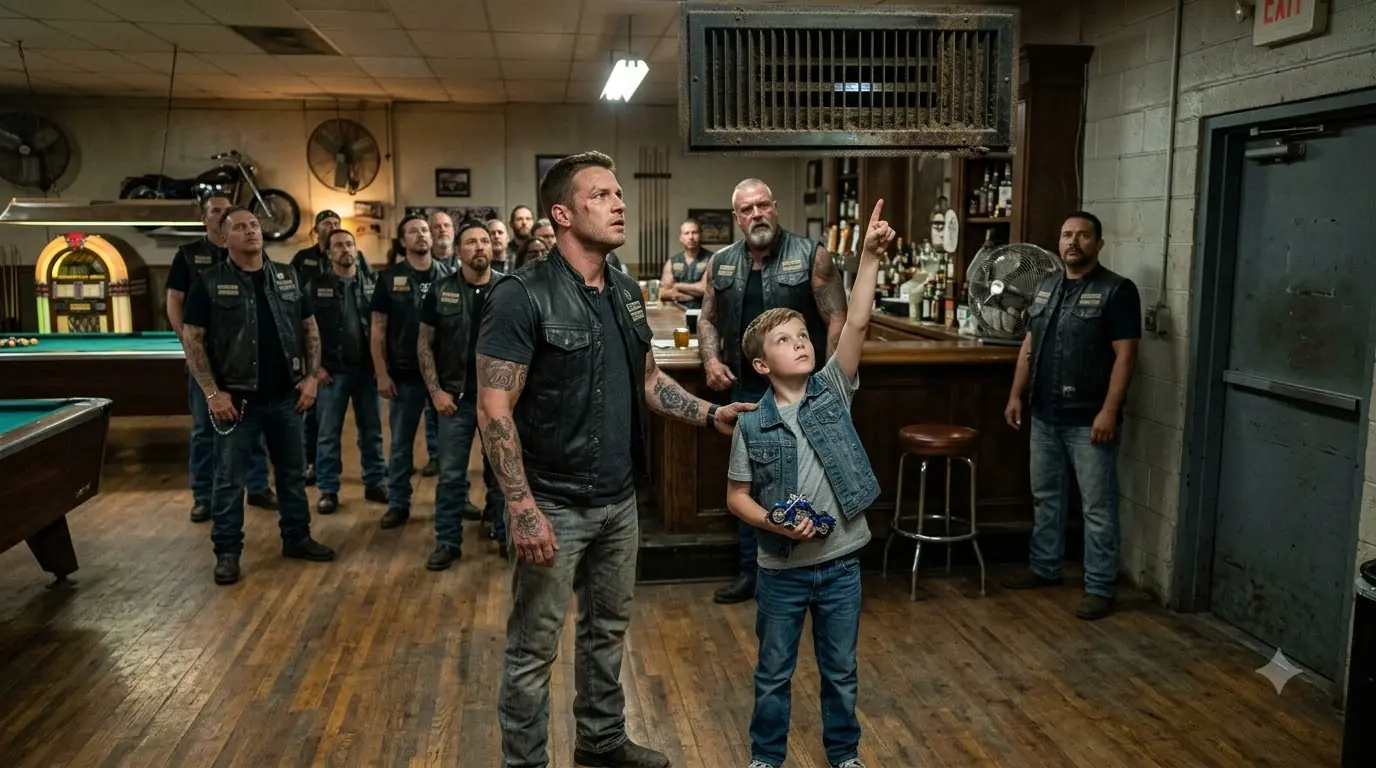
But on a sweltering Sunday afternoon, an innocent nine-year-old boy pointed toward a dusty ventilation grate and asked one simple question that made thirty hardened men go completely silent.
The heat in Vallejo, California, that late-August afternoon was punishing, the kind of dry, heavy warmth that baked the concrete and made the air above the asphalt shimmer.
At the end of a dead-end industrial street off Sonoma Boulevard stood the clubhouse of a notorious outlaw motorcycle club.
To the outside world, it looked like an anonymous cinder-block warehouse surrounded by a tall chain-link fence. The windows had been sealed years earlier, and the only entrance was a heavy steel door covered by multiple security cameras watching the street from different angles.
Inside, however, the atmosphere was completely different.
It was Sunday family day.
The smell of sizzling tri-tip and hickory smoke filled the large main hall, mixing with the stale odors of spilled beer and motor oil. Classic rock poured from an old jukebox. Glasses clinked against the scarred oak bar while massive leather-clad men laughed loudly enough to shake the room.
Wives and girlfriends talked around high-top tables.
Children ran between pool tables.
For a few hours, the intimidating clubhouse almost looked ordinary.
Garrett Sullivan, known inside the chapter as Iron, stood near the open patio doors holding a pair of stainless-steel tongs.
Iron was fifty-six and had been part of the outlaw world for most of his adult life. Three years earlier, he had taken control of the chapter after the previous leadership was removed during a major federal investigation.
He was methodical.
Quiet.
Suspicious of almost everyone.
During his time as president, he had transformed the Vallejo clubhouse into something resembling a bunker.
Standing a few feet away was Brian “Dutch” Miller, one of the chapter’s longtime members.
Dutch was heavily tattooed, with a scar running through his left eyebrow from a fight decades earlier. Usually, he carried himself with the same hard expression as the men surrounding him.
That afternoon, however, there was something softer about him.
His nine-year-old son, Leo, was there.
Leo was a quiet, observant boy wearing a small denim vest his mother had made for him.
He was completely unfazed by the intimidating men surrounding him.
To Leo, they were not frightening outlaws.
They were Uncle Cole.
Uncle Wyatt.
Men who slipped him sodas when his mother was not looking and let him sit on parked motorcycles while telling him not to touch anything important.
Iron glanced toward the corner of the room where several disassembled motorcycle engines rested on workbenches.
“Keep him away from the tools, Dutch.”
Dutch smiled.
“He knocked over a tray of spark plugs last month.”
“He’s curious,” Dutch replied. “Thinks he’s going to build his own bike by the time he’s ten.”
“As long as he cleans up after himself.”
Iron’s expression barely changed.
Even during a barbecue, his eyes continued moving around the room.
Watching doors.
Watching faces.
Watching everything.
The relaxed gathering hid a deeper tension.
The chapter was preparing for an illegal shipment scheduled to move through Northern California within days.
Federal investigators had been watching the club closely for months.
Members had noticed unfamiliar vehicles parked near businesses they frequented. Riders were being stopped more often. Prospects complained about investigators appearing at workplaces and asking questions.
Iron had responded by tightening security.
Personal phones were not allowed inside sensitive meetings.
When members entered the main hall, their devices were stored away from the room.
Every week, the clubhouse was checked for surveillance equipment.
That responsibility belonged to Cole “Ratchet” Hawkins, the chapter’s sergeant-at-arms.
Ratchet was a former military electrician who had spent years working with electrical systems before joining the club full-time.
He treated security like a religion.
Once a week, he moved through the clubhouse with detection equipment, checking walls, light fixtures, furniture, electrical boxes, and anything else he considered suspicious.
His most recent sweep had been three days earlier.
He had declared the room clean.
“Ratchet,” Dutch called across the hall. “We good on ice?”
Ratchet looked up from a conversation near the jukebox.
“Prospect went out ten minutes ago. He’ll be back unless he forgot how to drive.”
Dutch laughed.
Then he glanced down at Leo.
The boy was rolling a small die-cast motorcycle along the edge of the bar, making quiet engine sounds.
Dutch felt a familiar knot of guilt.
He loved the club.
It was his brotherhood.
His entire adult life.
But every time Leo entered the clubhouse, a small voice reminded Dutch that this world could take him away from his son at any moment.
One investigation.
One betrayal.
One terrible decision.
That could be enough.
“Dad.”
Leo tugged on Dutch’s jeans.
“Can I get a soda?”
“Yeah, buddy. Ask Wyatt behind the bar. Just a Sprite.”
Dutch pointed toward him.
“No caffeine. Your mom will blame me when you don’t sleep tonight.”
Leo ran toward the bar.
Iron stepped away from the grill.
He made a small gesture toward Dutch and Ratchet.
The three moved into a corner where their voices could not easily be heard by the families.
“The plan for Tuesday is set,” Iron said quietly.
He kept the discussion broad even inside the clubhouse.
Transportation.
Timing.
Who was responsible for which part.
Where communication would stop.
Nobody outside the room was supposed to know anything.
Ratchet nodded.
“The other side confirmed?”
“Yes.”
Iron’s eyes hardened.
“But federal attention is getting worse. I saw another unfamiliar vehicle near the overpass this morning.”
Dutch frowned.
“You think they know?”
“They know something is happening,” Iron replied. “They don’t know enough.”
He glanced around the windowless room.
“That is why this room stays clean. Nothing gets discussed outside.”
Dutch looked toward the far side of the hall.
“What about the new prospect?”
Iron’s expression tightened.
“He stays away from anything important. He doesn’t know names. He doesn’t know locations. He doesn’t know enough to hurt us.”
The three men fell silent.
Around them, families continued laughing.
Children chased each other between tables.
Music played.
The illusion of safety held.
For the men at the center of the chapter, the clubhouse represented the one place where they believed they were protected from investigators, rivals, and outsiders.
But vulnerability rarely announces itself.
Sometimes it waits quietly above your head until someone finally looks up.
By seven that evening, the worst of the heat had begun to break.
Cooler air drifted inland from the Carquinez Strait.
Family day wound down.
Wives gathered children.
Food containers were packed.
Goodbyes were exchanged.
One by one, people left through the heavy steel door.
Iron remained near the entrance until the last family member was gone.
Then the door closed.
The atmosphere changed almost immediately.
The music was lowered.
The casual laughter disappeared.
Only full members and two prospects remained.
Around thirty men.
Iron moved toward the long oak bar.
“All right, brothers. Grab something and gather around.”
The men shifted toward him.
Some took stools.
Others stood against the wall.
Dutch positioned himself near the center of the room beneath a framed photograph of a deceased member.
Ratchet stood to his left, wiping the bar with a rag in the repetitive way he did whenever he was thinking.
Iron rested both forearms against the wood.
He began discussing Tuesday.
Not family talk now.
Business.
Sensitive business.
Routes.
Vehicles.
People involved.
Money.
Enough information that, if investigators heard it, multiple members could face serious federal charges.
Iron emphasized silence and discipline.
Nobody improvised.
Nobody contacted outsiders.
Nobody discussed the plan once they left the building.
Halfway through the briefing, the steel door at the front rattled.
Every conversation stopped.
Heads turned.
Several men shifted automatically, bodies tensing at the unexpected sound.
Then the inner door opened.
Leo stepped inside.
Dutch exhaled sharply.
“Leo?”
The boy stood in the doorway as though thirty intimidating men staring at him meant nothing.
“I forgot my motorcycle.”
Dutch rubbed his face.
“I thought you left with your mom.”
“She’s waiting in the truck.”
“The blue one?”
Leo nodded.
“All right. Grab it and go. We’re working.”
Low chuckles moved through the room.
The tension eased.
Iron shook his head, almost smiling.
Leo ran toward the jukebox where he had been playing earlier.
Iron turned back toward the group.
“As I was saying...”
Leo got down on his hands and knees.
The small blue motorcycle was not where he had left it.
He checked beneath a chair.
Nothing.
Then under the edge of the bar.
There it was.
Someone had accidentally kicked it beneath the brass foot rail.
Leo climbed onto one of the padded stools to reach farther.
As he leaned over the counter, he tilted his head upward.
His attention left the toy.
High above the bar, directly over the place where Iron stood, was an old ventilation grate.
The building had once been used for industrial purposes decades earlier.
The old vent system had not functioned properly in years.
The grate was rusted.
Dark.
Covered in dust and nicotine stains.
From the floor, nobody paid attention to it.
But Leo was standing higher now.
A neon sign behind the bar cast light across the slats at just the right angle.
Something inside the vent reflected it.
A tiny perfect circle.
Glass.
Leo stared.
It did not flash.
It did not move.
But Leo had grown up around phones, tablets, webcams, and cameras.
He knew what a lens looked like.
More importantly, he noticed something else.
Most of the vent was coated in dirt.
One small section was not.
The dust had been disturbed.
Carefully.
Recently.
Leo climbed down.
His toy motorcycle remained in one hand.
He walked toward Dutch.
“Dad.”
Dutch did not look at him.
Iron was still speaking.
“Not right now, buddy. Go back to your mom.”
Leo tugged harder on his vest.
“Dad.”
Something in the boy’s voice made Dutch finally turn.
“What?”
Leo pointed upward.
“Why is there a camera up there?”
Dutch froze.
The clubhouse did not become silent immediately.
Instead, the ordinary sounds seemed suddenly louder.
The hum of refrigerators.
The faint music from the jukebox.
The low vibration of traffic outside.
Dutch slowly bent closer to his son.
“What did you say?”
Leo pointed again.
“Up there.”
His finger aimed directly toward the ventilation grate above Iron.
“There’s a camera.”
Silence slammed into the room.
Thirty pairs of eyes followed the child’s finger.
Iron stopped speaking.
His jaw tightened.
He did not move for several seconds.
Then his eyes lifted toward the vent.
“Ratchet.”
His voice had changed.
Ratchet looked up.
The color drained from his face.
“No.”
He stepped forward.
“No way.”
His eyes remained locked on the vent.
“I checked this room Thursday. The detector showed nothing.”
Iron turned slowly.
“Ratchet.”
“It was clean,” Ratchet insisted. “Nothing was transmitting.”
Iron spoke again.
“Get a ladder.”
Nobody moved for half a second.
Then one of the prospects rushed toward a utility closet.
Dutch placed both hands on Leo’s shoulders.
He gently moved the boy behind him.
Leo was beginning to understand that his discovery was not a game.
The men who had been laughing moments earlier no longer looked like his uncles at a barbecue.
They looked frightened.
And angry.
The prospect returned with an aluminum ladder.
It was opened beneath the vent.
Ratchet climbed.
His movements were slower than usual.
He aimed a flashlight through the rusted grate.
For several seconds, he said nothing.
Iron watched him.
“So?”
Ratchet’s expression changed.
He reached for a tool.
Carefully, he removed the old grate.
Something black was hidden inside the duct.
A compact surveillance device.
A narrow cable ran from it deeper into the building.
The room collectively seemed to stop breathing.
Ratchet examined it.
His face became even paler.
“It’s wired.”
Iron stared.
“What?”
“It isn’t sending a normal wireless signal.”
Ratchet pointed toward the cable.
“That’s why the detector missed it.”
The implication traveled through the room faster than any explanation.
Their security sweep had been designed mainly to identify certain kinds of wireless transmissions.
This device did not depend on that.
It had been physically connected into the building.
Everything they had just discussed might already have been captured.
Routes.
Names.
Plans.
Money.
Iron slowly looked around the clubhouse.
The camera itself was bad.
The deeper question was worse.
Nobody could simply walk into the building unnoticed and spend hours modifying the interior.
The clubhouse was monitored.
Locked.
Guarded.
Someone would need access.
Time.
Knowledge of the building.
Possibly alarm codes.
The federal investigators might not have broken into the fortress at all.
Someone might have opened the door for them.
“Lock it.”
Iron’s voice was nearly a whisper.
The front door was secured.
“Nobody leaves.”
Dutch looked toward Ratchet.
Ratchet was still standing on the ladder.
Sweat gathered along his forehead.
The entire room had changed.
Brotherhood was disappearing.
Suspicion was replacing it.
Iron ordered the sensitive discussion stopped immediately.
Ratchet disconnected the discovered device from the room.
It no longer mattered.
Whatever had already been captured could not be pulled back.
Dutch bent toward Leo.
“Come here.”
He lifted his son.
Leo’s face pressed against his shoulder.
The boy was frightened now.
“Did I do something bad?”
Dutch’s expression cracked for the first time.
“No.”
His voice softened.
“No, buddy. You did something good.”
He handed Leo to another trusted member.
“Take him to the front room. Stay with him. Don’t let him come back in here.”
The man nodded.
Leo looked over Dutch’s shoulder as he was carried away.
“Dad?”
“I’m right here.”
The door closed behind the child.
Dutch turned back toward the others.
His fists were clenched.
Iron began pacing.
“Think.”
His voice remained low.
“If someone installed that, they needed access.”
Nobody answered.
“They needed time.”
He looked around the room.
“They needed to know where we wouldn’t look.”
Still nothing.
Iron pointed toward the cable disappearing into the wall.
“And they needed someone who understood the building.”
The room became colder.
Only a handful of people knew the full security system.
Dutch turned toward Ratchet.
The former electrician was back on the floor now.
His flashlight remained in his hand.
His face looked different.
Not guilty, necessarily.
Afraid.
Iron stared at him.
“You sweep this room every Thursday.”
Ratchet swallowed.
“Yes.”
“You swept it three days ago.”
“Yes.”
“You told me it was clean.”
“It was clean according to the equipment I used.”
Ratchet raised both hands.
“Listen to me. A wired device like that does not behave like the wireless bugs we usually look for. The detector wouldn’t necessarily identify it.”
Dutch stepped closer.
“But you know systems like this.”
Ratchet looked at him.
“You built half the security infrastructure in this building.”
Murmurs moved through the men.
“You understand the electrical lines,” Dutch continued. “You understand the cameras. You know where everything runs.”
Ratchet shook his head.
“That proves I understand why we missed it. It does not prove I put it there.”
Iron’s expression remained unreadable.
Ratchet looked around at the men forming a loose circle around him.
His voice grew more desperate.
“I’ve been with this chapter fifteen years.”
Nobody replied.
“I’ve been through investigations with you. Raids. Funerals. Court cases. You think I would sell all of you out?”
Iron reached into his pocket.
He placed a heavy ring of keys on the bar.
The metallic impact made several men flinch.
“Last month, you told me the alarm system needed maintenance.”
Ratchet froze.
“You were here alone one night.”
“I was fixing it.”
“You had the codes.”
“Yes, because you gave them to me.”
Iron took another step forward.
“And two years ago, you had your own federal case.”
Ratchet’s face tightened.
“That case was dismissed.”
“That is what we were told.”
“My lawyer challenged the evidence.”
Iron stared at him.
“And you walked away.”
Ratchet’s breathing accelerated.
Dutch watched every reaction.
Ratchet looked suddenly smaller.
Iron’s voice remained quiet.
“What did they offer you?”
Nothing.
Ratchet looked toward the door.
Then toward the ceiling.
Then back at Iron.
“What did they offer you?”
“I didn’t do this.”
“Say it again.”
“I didn’t do this.”
Iron stepped closer.
“Look at me.”
Ratchet did.
For several seconds, neither man spoke.
Then Iron asked a different question.
“How long?”
Ratchet’s eyes moved.
That movement was enough.
Dutch’s stomach dropped.
Iron saw it too.
The silence that followed felt almost unbearable.
Ratchet lowered his hands.
Something inside him seemed to give up.
“You don’t understand.”
Dutch’s expression hardened.
“Then explain.”
Ratchet looked around at the men he had called brothers for fifteen years.
His voice shook.
“They had me.”
Nobody moved.
“They had recordings connected to an old investigation. Enough to bury me.”
Iron’s face did not change.
Ratchet continued.
“They told me I was going away for decades.”
His breathing became ragged.
“I have a daughter.”
Dutch looked at him in disbelief.
Ratchet’s voice rose.
“I have a life outside this room. I wasn’t going to spend the rest of it behind concrete walls.”
Iron whispered, “So you traded us.”
Ratchet’s face twisted.
“I gave them information.”
“How much?”
Ratchet looked away.
“How much?”
“Enough.”
The confession seemed to drain the oxygen from the room.
Men who had trusted Ratchet with their freedom now stared at him as though he were a stranger.
Ratchet began speaking faster.
“You think loyalty would have saved me? You think any of you would have raised my daughter? Paid her bills? Sat with her every week for twenty years?”
Dutch shook his head slowly.
“You let them into this building.”
Ratchet said nothing.
“That camera was yours.”
Another long silence.
Finally, Ratchet answered.
“Yes.”
The word was barely audible.
Iron closed his eyes.
For one moment, the chapter president looked tired instead of angry.
Then something happened outside.
A deep mechanical impact shook the front of the building.
Every man in the room turned.
Another impact followed.
Then amplified commands echoed from outside.
“Federal agents! Stay where you are!”
The room erupted into confusion.
Iron looked toward Ratchet.
Ratchet looked terrified.
The discovery of the camera had apparently triggered an emergency response from the investigators monitoring the clubhouse.
Men shouted over one another.
Some tried to move toward the back.
Others froze.
Dutch immediately thought of Leo.
His son was still inside the building.
“Leo!”
He started toward the front room.
A sudden series of loud distraction devices went off near the entrance.
Bright flashes filled the hall.
The confusion became overwhelming.
Dutch covered his ears and dropped behind the bar.
The heavy steel entrance was forced open.
Federal tactical officers entered quickly, shouting commands for everyone to get down and keep their hands visible.
Several chapter members instinctively moved before thinking better of it.
The response from the agents was immediate.
“Hands where we can see them!”
“Down!”
“Do not move!”
Dutch remained low.
His ears rang.
Smoke hung in the air.
Through the haze, he saw Ratchet move toward the rear of the room.
Iron saw him too.
For one terrible instant, the old bonds of the chapter and the reality of Ratchet’s betrayal collided.
There was a struggle amid the chaos.
Then another deafening sound.
Ratchet collapsed near the wall.
Dutch never clearly saw who caused it.
He only saw Ratchet stop moving.
Whatever anger the club had toward him no longer mattered.
The federal operation had already consumed the room.
Seconds later, officers reached Iron.
He was forced to the floor and restrained.
The chapter president who had spent three years turning the building into a fortress was now face down on the same wooden boards where he had conducted meetings he thought nobody outside would ever hear.
Dutch stayed still.
He raised his empty hands.
“Don’t move!”
“I’m not moving.”
Officers pulled him upright.
His arms were placed behind him.
Cold restraints closed around his wrists.
He looked toward the front hallway.
“My son.”
Nobody responded.
“My son is nine years old. He’s in the front room.”
An officer shouted toward another team.
“There’s a child inside!”
Dutch’s chest tightened.
For several horrifying seconds, he could see nothing.
Then Leo appeared in the hallway with an agent beside him.
The boy was crying.
But he was unharmed.
“Dad!”
Dutch closed his eyes.
Relief and devastation hit him at the same time.
“I’m okay, buddy.”
Leo tried to move toward him.
The agent gently kept the child back.
“Why are they taking you?”
Dutch had no answer.
There were things a father could explain to a nine-year-old.
This was not one of them.
The clubhouse that had seemed untouchable less than an hour earlier was now filled with investigators.
Members were separated.
Evidence was secured.
Rooms were photographed.
Documents were collected.
The secret meeting place had become a crime scene.
Dutch watched as agents moved beneath the old ventilation grate.
Such a small place.
Such a tiny lens.
He thought about how many times they had stood directly beneath it.
Laughing.
Planning.
Trusting their walls.
The fortress had not been defeated by overwhelming force from outside.
It had been compromised from within.
Ratchet had known every procedure.
Every assumption.
Every blind spot.
The system had worked exactly as intended against outsiders.
It had never been designed to defend against someone already trusted enough to maintain it.
As Dutch was led toward the front door, he caught one final glimpse of Iron.
The chapter president looked older than he had that morning.
Not merely arrested.
Defeated.
Years of loyalty, fear, reputation, and criminal activity had collapsed in a single evening.
Outside, the industrial street was filled with official vehicles.
The late-August sky had turned orange over Vallejo.
Neighbors from nearby businesses watched from a distance.
Dutch searched desperately for Leo.
He found him sitting with his mother near the edge of the secured area.
She had returned after learning something was wrong.
Her arms were wrapped tightly around their son.
Leo looked directly at Dutch.
The boy’s expression was confused.
Afraid.
And somehow still innocent.
Dutch realized with painful clarity that Leo had done nothing wrong.
In fact, the child had been the only person in the entire clubhouse who had looked at something everyone else had trained themselves not to see.
A dusty vent.
A tiny reflection.
One detail that did not belong.
Dutch had spent years telling himself that his club life and fatherhood could remain separate.
That he could belong to both worlds.
That Leo could visit the clubhouse, laugh with the men, play with toy motorcycles, and still remain untouched by what happened behind closed doors.
That illusion ended on the pavement outside.
As an officer guided Dutch toward a waiting vehicle, Leo called after him.
“Dad!”
Dutch turned as far as he could.
Leo was crying openly now.
“Was the camera bad?”
Dutch swallowed.
“No, buddy.”
The answer surprised even him.
“The camera wasn’t the bad part.”
Leo did not understand.
Maybe one day he would.
The discovery had not created what happened inside that clubhouse.
It had merely exposed it.
The betrayal already existed.
The investigation already existed.
The crimes already existed.
The men inside had simply believed the walls protected them from consequences.
Dutch looked at his son one final time.
“You did the right thing, Leo.”
The vehicle door closed.
For the first time in years, Dutch had no control over where he was going next.
Behind him, federal investigators continued processing the clubhouse.
The chapter would never recover in the same form.
Members faced serious charges.
The planned shipment was abandoned.
Financial records led investigators toward additional cases.
The surveillance operation became a central part of the prosecution.
Ratchet’s cooperation, hidden for years, was revealed publicly.
For Dutch, none of those details mattered as much as the image that remained in his mind.
Leo standing beneath the old ventilation grate.
One tiny hand pointing upward.
Thirty grown men frozen around him.
A child had noticed what hardened criminals, security equipment, and layers of paranoia had failed to catch.
Not because he was smarter than every adult in the room.
Because he was curious.
Because he looked where no one else bothered to look.
And because he had not yet learned the dangerous adult habit of ignoring something simply because everyone around him assumed it was normal.
Years later, that was the part Dutch remembered most clearly.
Not the raid.
Not the shouting.
Not the betrayal.
The question.
“Dad, why is there a camera up there?”
Eight ordinary words from a nine-year-old boy.
Eight words that broke the illusion of an impenetrable fortress.
Eight words that revealed a secret sitting above their heads.
And eight words that changed the course of every life inside that room.