On a cold October morning in Washington’s Wenatchee Valley, fourteen-year-old Junie Ostrander stood at the top of a muddy slope and watched six bulldozers tear through the trees her grandfather had spent most of his adult life growing.
The machines had arrived shortly after seven.
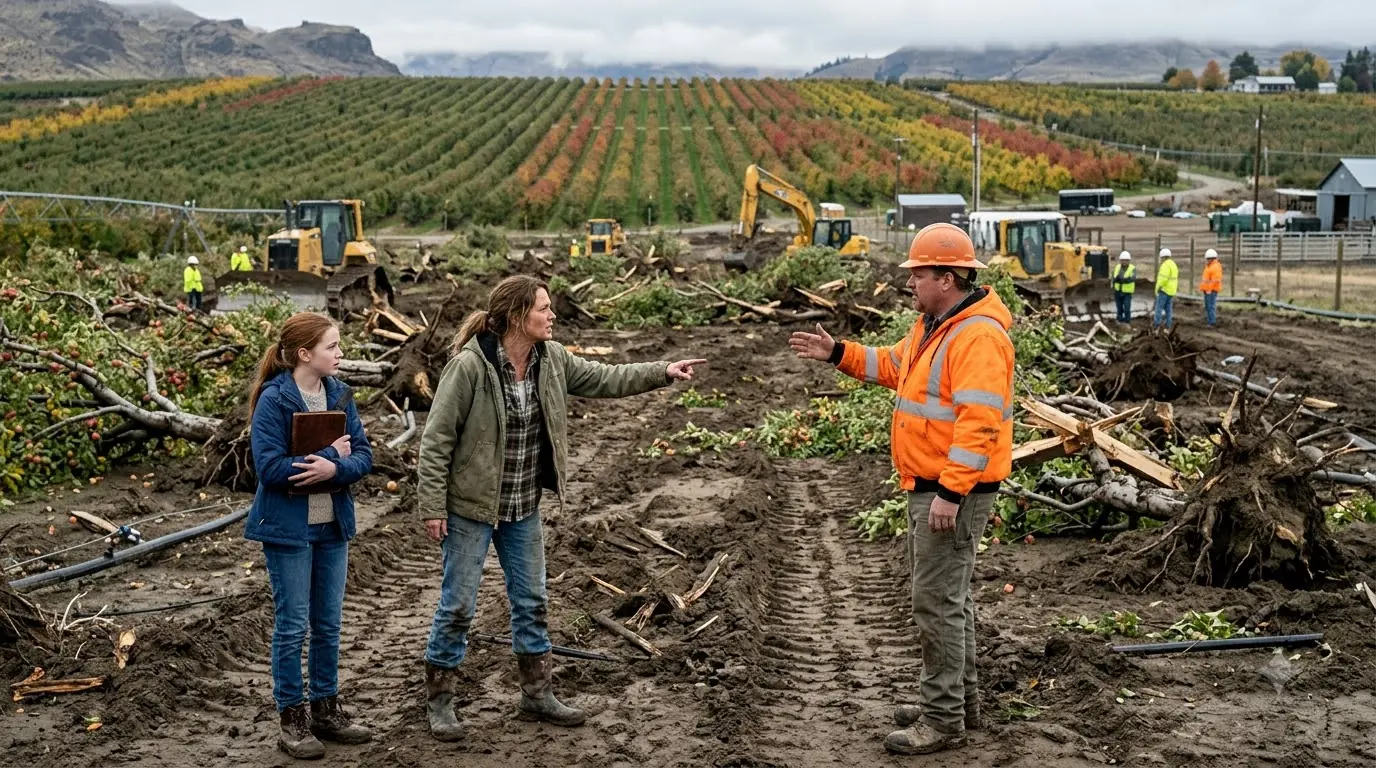
By eight, the eastern fence was gone.
By nine, more than two dozen apple trees lay uprooted in the wet soil, their roots exposed to the gray sky like enormous hands pulled violently from the earth.
By noon, almost an entire two-acre section of the Ostrander farm had been flattened.
Junie did not scream when the first tree fell.
She did not cry either.
At least not immediately.
She simply stood there in an oversized green coat, mud on her boots, long dark hair whipping across her face, and watched a yellow bulldozer push through a row of trees she had known since she was small enough to walk beneath their lowest branches without ducking.
The sound was worse than she expected.
Wood splitting.
Roots tearing.
Branches snapping beneath steel tracks.
Engines growling.
Men shouting over radios.
A tree that had taken thirty years to grow could disappear in less than thirty seconds.
Junie knew that now.
She would never forget it.
The Ostrander orchard sat several miles outside Wenatchee on forty-two acres of sloping ground that had belonged to the family for four generations.
The valley around it was apple country.
Commercial orchards covered hillsides in precise rows.
Packing trucks moved along the highway before sunrise.
Cold-storage buildings sat beside warehouses large enough to hold entire harvests.
During September and October, the air carried the smell of dust, diesel, bruised fruit, damp leaves, and apples.
The Ostrander farm was smaller than many of the modern operations surrounding it.
Marlene Ostrander, Junie’s mother, managed the property with six permanent workers and a rotating group of seasonal pickers.
Their primary varieties were familiar.
Gala.
Fuji.
Honeycrisp.
Granny Smith.
Several rows of Pink Lady apples that Everett Ostrander had added years earlier after insisting the farm needed to stop acting as though consumer preferences would remain unchanged forever.
Most of the orchard looked orderly.
Trellises.
Irrigation lines.
Numbered rows.
Pruned canopies.
Harvest bins.
Everything had a purpose.
Then there was the eastern block.
Two acres.
Old fence.
Uneven rows.
Trees growing at inconsistent distances from one another.
Some leaned.
Some had multiple graft unions.
Others carried small aluminum tags nailed carefully into the trunks.
E-4.
E-11.
E-17.
E-23.
E-31.
The ground beneath them was never as tidy as the commercial orchard.
Everett allowed native grass between some rows.
He irrigated the trees differently.
He pruned them differently.
He kept no commercial harvest crew in that section.
To anyone driving along the neighboring property, the block looked neglected.
To Junie, it was the most important place on the farm.
Her grandfather called it the test orchard.
When Junie was six, she thought that meant the trees were taking tests.
At seven, she asked Everett whether they ever passed.
He laughed so hard he had to sit on an overturned harvest bin.
“Sometimes.”
“What happens if they fail?”
“We learn something.”
“That doesn’t sound like failing.”
Everett looked at her.
“You’re smarter than most growers I know.”
He had been sixty-nine then.
Tall but increasingly stooped, with white hair beneath the same battered canvas cap he wore in nearly every season.
His hands were large.
Knuckles swollen from arthritis.
Fingernails permanently marked by soil.
Everett had spent fifty years around fruit trees and believed almost every human problem could be explained through an orchard metaphor if given enough time.
Junie’s mother found that irritating.
Junie loved it.
She spent hundreds of afternoons following him through the test block.
Everett would stop beneath a tree, examine the underside of a leaf, scrape bark lightly with a pocketknife, measure fruit diameter, and write something in a small brown notebook.
“What are you writing?”
“Things I don't want to forget.”
“What things?”
“Things I won't know matter until later.”
At eight, Junie thought that answer was useless.
At fourteen, she finally understood it.
Everett had been breeding apples for almost forty years.
Not formally at first.
He began as a commercial grower curious about why certain trees performed better than others after difficult springs.
Wenatchee winters could be severe, but Everett worried more about spring.
Warm weather could arrive early.
Buds opened.
Blossoms emerged.
Then a late freeze rolled through the valley overnight and ruined flowers before fruit had a chance to form.
Some trees lost nearly everything.
Others, for reasons Everett became obsessed with understanding, survived better.
He started marking them.
Then collecting scion wood.
Then making controlled crosses.
At first, his wife called it tinkering.
His neighbors called it Everett being Everett.
By the time Junie was born, tinkering had become an actual breeding program.
He wanted several traits in one apple.
Later spring bloom.
Good cold resilience.
Resistance to several common diseases.
Firm fruit that stored well.
Strong flavor.
And enough acidity to interest cider producers as well as fresh-market buyers.
Other growers teased him.
“You're trying to breed a unicorn.”
Everett would answer:
“Then stop bothering me while I’m looking for the horn.”
Junie remembered that.
She remembered dozens of things now that he was gone.
Everett died eight months before the bulldozers arrived.
February.
A stroke.
Fast.
Junie had gone to school that morning.
By lunch, Marlene appeared in the office to take her home.
Everett died before evening.
The farm changed immediately.
Not visibly.
The trees remained.
The irrigation pump still ran.
Workers still arrived.
But every decision suddenly belonged to Marlene.
Payroll.
Fertilizer.
Spray schedules.
Equipment maintenance.
Packing contracts.
Labor housing.
Property taxes.
Crop insurance.
Bank meetings.
The responsibilities Everett had carried so naturally became visible only after he was no longer there to carry them.
Marlene was capable.
Very capable.
She had worked beside her father for almost twenty years.
But commercial orchard management was already enough for one person.
The breeding program was something else entirely.
Everett had not left a formal operating manual.
He had notebooks.
Boxes.
Labels.
Maps.
Photographs.
Thousands of handwritten observations.
Marlene told herself she would organize them after harvest.
Then spring arrived.
Then labor shortages.
Then an irrigation-line failure.
Then a tractor repair.
Then the packing house changed terms.
The test orchard received enough water to stay alive and enough pruning to prevent obvious damage.
Not much else.
Weeds thickened beneath the oldest trees.
A section of fence leaned toward the property line.
To an outsider, it looked forgotten.
That was exactly what Briarcrest Development saw.
The company purchased nearly three hundred acres east of the Ostrander farm in early summer.
The land had once been dry pasture and scrub.
Briarcrest announced plans for a large residential development.
Hundreds of homes.
Walking trails.
A community center.
Parks.
Two entrances.
One of those entrances would connect to the county highway.
The most direct route crossed near the eastern boundary of the Ostrander property.
In August, a man named Roland Petty arrived at the farmhouse with a rolled survey beneath one arm.
Roland was forty-nine, heavyset, sunburned, and looked more comfortable around machinery than people.
He was Briarcrest’s construction foreman.
Marlene met him on the porch.
Junie listened from the kitchen.
“We've got an access easement through the eastern corridor.”
Marlene frowned.
“No, you don't.”
Roland unrolled the survey.
According to the document, an old access easement created decades earlier appeared to extend beyond the fence line into land the Ostranders considered theirs.
Marlene studied it.
“That can't be right.”
“It’s recorded.”
“Recorded where?”
“County.”
“My father would have known.”
Roland shrugged.
“I don't know what your father knew.”
That sentence almost ended the conversation.
Marlene pointed toward the eastern orchard.
“No equipment crosses that line until this is reviewed.”
Roland nodded.
“Fine.”
“I mean it.”
“I understand.”
Marlene called the county.
Then a surveyor.
Then an attorney named Evelyn Hart, who had handled agricultural and property matters in the valley for years.
The old documents were messy.
An easement did exist.
Its precise width and placement were disputed.
The modern fence did not exactly match one historical description.
Evelyn advised everyone to pause construction along that edge until a current survey was completed.
Marlene believed that happened.
It did not.
Briarcrest was behind schedule.
Every week mattered.
Road grading crews were already on site.
Contractors were booked.
Concrete dates had been set.
Someone inside the company decided the access corridor issue was unlikely to become serious.
The work continued.