The sun over Brierwood, Texas, had been hanging in the August sky since morning like a punishment.
By noon the streets had gone almost white beneath the glare, and the hard-packed earth of the town square had split into narrow cracks that curled between wagon tracks. Horses stood beneath shaded awnings with their heads lowered, and merchants kept doors open only because closing them would trap the heat inside. Yet despite the brutal weather, nearly half the town had gathered beneath the courthouse balcony.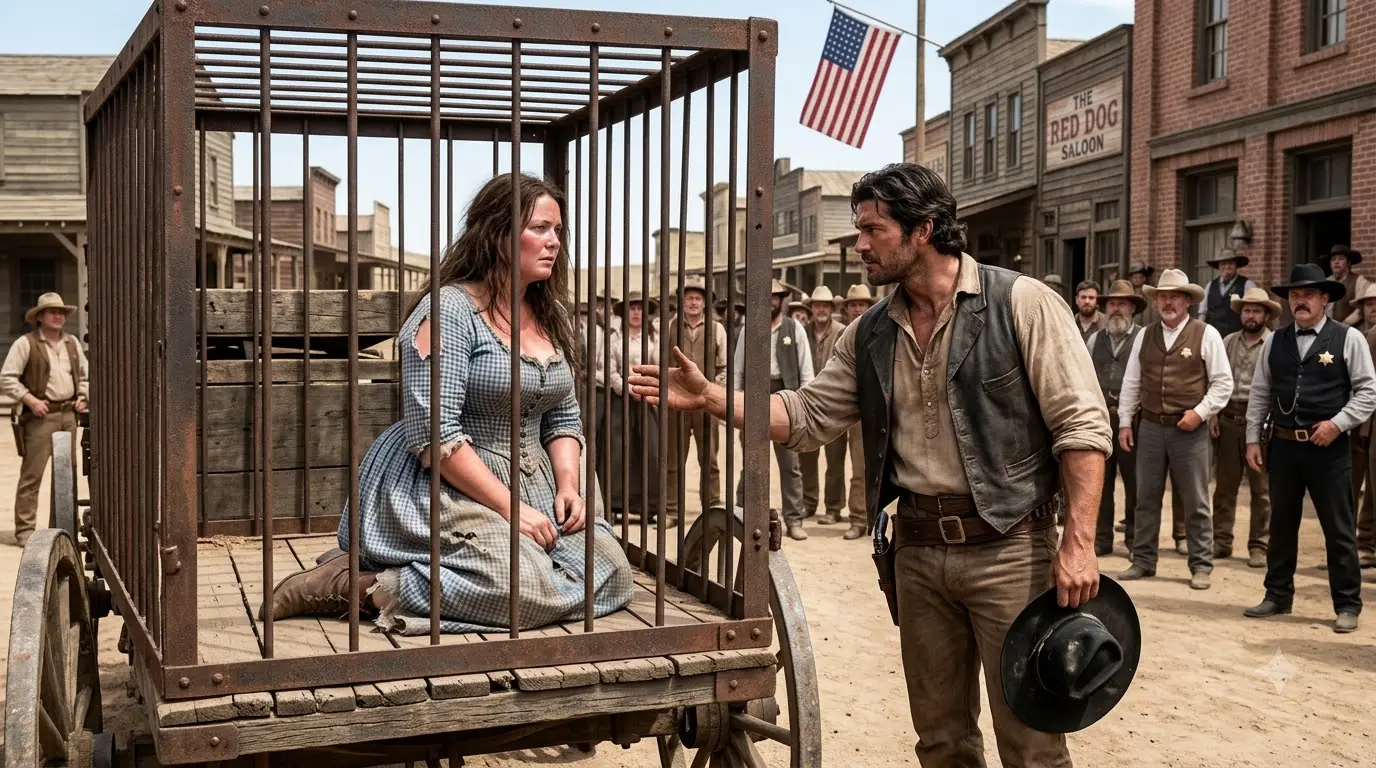
They had come to look at Charlotte Higgins.
A heavy wooden wagon stood in the center of the square. Bolted across its bed was an old iron cage abandoned years earlier by a traveling menagerie, its bars thick enough to hold a bear and rusted orange where rain had eaten the metal. The wagon had once carried exotic animals from one frontier town to another.
Now it carried a woman.
Charlotte sat inside with her back against the bars.
At thirty-six, she was a very large woman, well over three hundred pounds, with a broad frame, powerful arms, and the softness of someone whose body had become a public subject long before she ever learned to defend herself. Her dark hair hung tangled around a tired face, and the blue-and-white gingham dress she wore had been stained by dust, sweat, and weeks of confinement.
She had been inside the cage for twenty-seven days.
Twenty-seven mornings of waking before sunrise because the iron floor became too hot to sit on by midday.
Twenty-seven evenings of listening to drunken men make jokes through the bars.
Twenty-seven nights with no room to stretch her legs properly.
Twenty-seven days of being told that if she confessed to murdering Tobias Higgins and surrendered the farm, all of it could end.
Charlotte had refused every time.
“Look alive, giant!”
A rotten apple struck the cage.
It exploded against one of the bars, splattering brown pulp across Charlotte’s skirt.
Laughter rose.
Ezekiel Cross, the town blacksmith, slapped one enormous hand against his thigh.
“Thought you might be hungry,” he called. “Must cost the county a fortune feeding something your size.”
More laughter.
Charlotte closed her eyes.
She had discovered something during those weeks.
Cruelty was loudest when it believed itself safe.
Alone, few of those men would have dared stand close enough to say half the things they shouted from ten yards away. But behind a crowd, men who had once nodded politely to Charlotte outside the church now competed to see who could make her humiliation worse.
She had known many of them for years.
That hurt more than she expected.
A shadow fell across the cage.
Charlotte opened her eyes.
Mayor Bartholomew Cobb stood outside.
He was fifty-seven, thin except for a round belly straining beneath his vest, with carefully waxed gray whiskers and a silver-tipped walking cane he carried whether or not his legs required it. He had served as mayor for fourteen years and had accumulated land, favors, debts, and enemies with equal enthusiasm.
He tapped the cane against the iron.
“Morning, Mrs. Higgins.”
Charlotte stared.
Cobb smiled.
“You look tired.”
“Then stop visiting.”
A few people laughed nervously.
Cobb’s smile tightened.
“You could be sleeping indoors tonight.”
Charlotte said nothing.
“All you need to do is sign.”
He produced a folded document.
Charlotte recognized the deed immediately.
Her farm.
One hundred and sixty fertile acres west of town.
A narrow creek.
Two hay fields.
The old farmhouse.
The root cellar.
The orchard Tobias had neglected until half the trees died.
The land was the only thing left that legally belonged to her.
Cobb wanted it badly enough to build a cage.
“Sign,” he said. “The county assumes the property. Your husband’s creditors get paid. We transfer you somewhere suitable.”
“An asylum.”
“You would be cared for.”
Charlotte laughed weakly.
“Like this?”
Cobb’s eyes hardened.
“Tobias owed over five hundred dollars.”
“His debt.”
“Your husband’s debt.”
“He’s dead.”
“That does not erase obligation.”
Charlotte looked around the square.
“You never cared about Tobias’s creditors before.”
Cobb stepped closer.
“Careful.”
“You didn’t even know who half of them were until he died.”
“Careful.”
“You want my land.”
Cobb’s jaw moved.
Charlotte continued.
“You always wanted it.”
A silence spread near the cage.
Cobb lowered his voice.
“You are in no position to accuse anybody.”
“I’m in a cage because you accused me without a trial.”
The mayor tapped the cane harder against the bar.
“Tobias was found crushed in your barn.”
“I found him there.”
“The body was destroyed beneath weight.”
“I didn’t kill him.”
“You expect people to believe a man ended up crushed beneath a wagon axle by accident?”
“I don’t care what people believe.”
Cobb leaned close.
“You should.”
Charlotte met his eyes.
For years Tobias had trained her to look away when men became angry.
Cobb expected the same.
She did not give it to him.
“I did not kill my husband.”
The mayor smiled without warmth.
“Then you’ll die in the cage innocent.”
Charlotte swallowed.
Cobb straightened.
“And after that, the county gets your land anyway.”
He turned.
Charlotte’s heart pounded.
That was the first time he had said the truth clearly.
Not confession.
Not justice.
Land.
Cobb walked away.
The crowd slowly returned to its laughter.
Charlotte closed her eyes again.
Five years earlier she would have cried.
Tobias had made crying easy.
He had also made it dangerous.
When she first married him, Tobias Higgins had been handsome enough to make her believe rumors about his temper were exaggerations. He knew how to smile when he needed money, how to become tender after a violent evening, and how to apologize just convincingly enough that hope survived.
Charlotte had loved him.
That admission embarrassed her now.
She had loved the man he pretended to be.
After marriage, he stopped pretending.
The insults came first.
Her weight.
Her clothes.
The way she ate.
How she walked.
How she breathed when climbing stairs.
Then came the gambling.
Then drinking.
Then fists.
Tobias discovered early that the easiest way to control Charlotte was convincing her that no other man would ever want her.
“You’re lucky I took you,” he would say.
Sometimes after hurting her.
Sometimes while eating dinner she had cooked.
Sometimes while lying beside her.
“No one else would want to wake up next to all that.”
Charlotte believed him.
Not completely.
But enough.
That was the real damage.
Tobias did not need her to believe she was worthless every hour of every day.
He only needed her to doubt herself whenever she considered leaving.
Then he died.
Or at least the town believed he did.
Charlotte remembered the morning clearly.
The barn door partly open.
Flies already gathering.
A body in Tobias’s clothing beneath the heavy wagon axle.
The face destroyed beyond recognition.
Cobb arriving before the sheriff had even completed the scene.
Whispers beginning before sunset.
The next day, somebody said Charlotte must have used her size to kill him.
By the end of the week, rumor became fact.
By the second week, Cobb had her in the cage.
Charlotte shifted against the bars.
Pain traveled through her knees.
Then the crowd changed.
Not quieter at first.
Different.
Heads turned toward the east road.
People moved aside.
The heavy rhythm of a large horse’s hooves came down Main Street.
Charlotte opened her eyes.
A black Andalusian entered the square.
The horse was enormous, glossy beneath the sun, carrying a rider almost equally imposing. Tall, broad-shouldered, and sun-darkened from ranch work, the man wore dust-covered brown trousers, worn boots, an open beige work shirt beneath a dark leather vest, and a weathered black hat.
Charlotte knew him.
Everybody did.
Josiah Miller.
Owner of Whispering Pines Ranch.
Three thousand acres of cattle country east of town.
A man rumored to be worth more than the bank.
A man who rarely entered Brierwood unless business required it.
Josiah did not attend dances.
He did not drink in the saloon.
He did not court widows at church picnics.
He kept to himself and paid people fairly.
That alone made him mysterious.
His horse stopped in front of the cage.
No one laughed now.
Josiah looked at Charlotte.
She immediately hated that he had come.
Not him.
His eyes.
Because she imagined what he must see.
Dirty hair.
Stained dress.
Body pressed against iron bars like an animal.
Charlotte lowered her face.
She expected him to look away.
Instead, Josiah dismounted.
His boots hit the dirt.
He walked toward the wagon.
Then removed his hat.
Charlotte slowly lifted her eyes.
Josiah held the hat against his chest.
“Mrs. Higgins.”
His voice was deep.
Calm.
Charlotte did not answer.
Josiah looked at the cage.
Then the crowd.
His expression became colder with every second.
“This is a damn disgrace.”
Nobody laughed.
Mayor Cobb returned quickly.
“Miller.”
Josiah ignored him.
Cobb stepped closer.
“This woman is being legally held pending restitution.”
Josiah finally looked at him.
“She’s sitting in an animal cage.”
“She’s dangerous.”
Josiah turned toward Charlotte again.
She almost laughed at the absurdity.
Dangerous.
Barely enough water.