“Get your dirty hands off our gate, you worthless piece of trash.”
Tom Wilson’s boot struck Michael Brooks’s grocery bag before Michael could reach for it.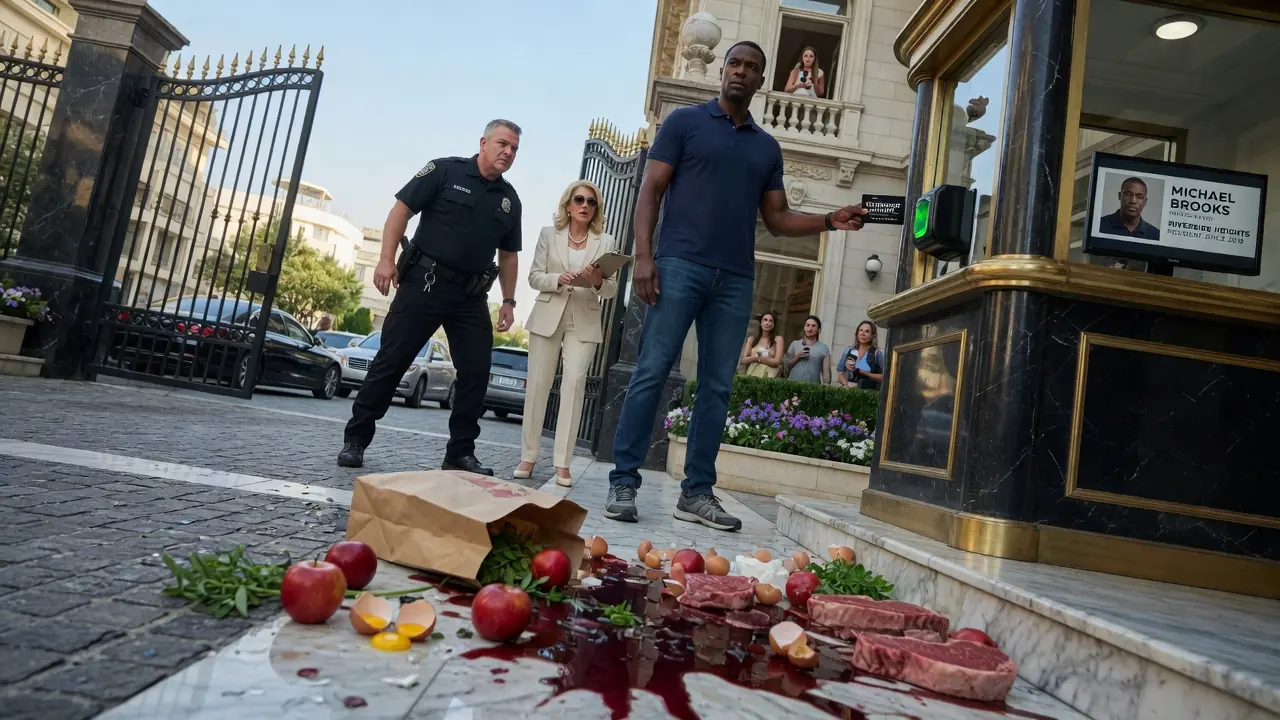
The paper bag split open against the marble steps at the main gate of Riverside Heights, sending organic apples, fresh herbs, a carton of eggs, two ribeye steaks, and a bottle of expensive red wine scattering across the polished stone.
The wine bottle hit the edge of the security booth and shattered, bleeding dark red across the pale marble like an accusation.
A second kick caught Michael just below the knee.
Pain flashed through his leg.
He caught himself against the cold iron bars of the gate before he fell.
Around him, the morning paused.
Joggers slowed.
A silver Mercedes idled near the curb.
A couple walking a white poodle stopped on the sidewalk.
Behind the security booth, the American flag at the entrance snapped sharply in the wind, bright and clean against the blue morning sky.
Michael Brooks breathed once.
Then twice.
He did not raise his voice.
He did not swing back.
He did not give the people watching what they seemed to expect from him.
Tom grabbed the collar of Michael’s navy polo shirt and shoved him chest-first against the iron gate.
“Security to main gate,” Tom barked into his radio. “Removing another vagrant.”
The word hit Michael harder than the kick.
Another.
As if men like him arrived in categories.
As if he had been sorted before he had spoken.
Michael’s cheek pressed against the iron bars. The metal was cold, and beneath the smell of spilled wine and wet groceries, he caught the faint scent of expensive landscaping mulch from the flower beds beyond the gate.
His flower beds, technically.
His landscaping budget.
His gate.
His community.
His home.
“Please,” Michael said quietly. “Just check the resident list.”
Tom laughed close to his ear.
“Boy, you think we’re stupid?”
The word was not shouted.
It did not have to be.
It had weight because everyone there understood exactly what kind of disrespect lived inside it.
Michael turned his head slightly, enough to look at Sandra Lane standing beside the security booth with a clipboard clutched to her chest.
“Sandra,” he said, because her name tag was right there. “Michael Brooks. House 47. Riverside Manor. Please verify it.”
Sandra stared at him as if he had performed a magic trick badly.
She was in her late forties, with perfectly sprayed blonde hair, red lipstick too bright for the morning, and the practiced authority of someone used to ordering landscapers, delivery drivers, cleaners, and contractors through the back entrance.
“Sir,” she said, her voice loud enough for the gathering residents to hear, “service deliveries use the back gate.”
Michael straightened as much as Tom’s grip allowed.
“I live here.”
Sandra’s laugh cut through the morning like breaking glass.
“Sure you do. And I’m the Queen of England.”
A few residents chuckled.
Not loudly.
Not cruelly enough to own it.
Just enough to participate.
Sandra turned toward Tom, rolling her eyes with theatrical exhaustion.
“How many times this month? These people are getting bolder with their scams.”
Tom spat near Michael’s groceries. The saliva landed inches from an apple that had rolled across the marble.
“Third one this month trying the ‘I live here’ con,” he said. “They watch too much TV. Think they can fool us.”
Michael’s hands curled slowly.
Then relaxed.
He had spent too many years training himself not to make anger more visible than facts. Visible anger from a Black man in a wealthy place rarely stayed anger in other people’s minds. It became threat. It became justification. It became a headline that started after the important part of the story.
So Michael stayed still.
At 8:17 a.m., Riverside Heights looked exactly the way it was designed to look.
Perfect.
The private road beyond the gate curved between manicured lawns, stone fountains, imported trees, and houses large enough to have wings instead of rooms. Sprinklers misted over flower beds despite the previous night’s rain. A maintenance cart rolled silently in the distance. The security booth gleamed with tinted glass and brass trim.
Everything about the community whispered wealth.
Exclusivity.
Order.
Belonging, if you had been approved.
Michael Brooks had been approved five years earlier.
More than approved.
He had bought into Riverside Heights so deeply that most of the people now staring at him would not have believed the truth if the iron gate itself announced it.
Which, in a few minutes, it would.
A silver Mercedes slowed beside the scene.
Mrs. Evelyn Henderson lowered her window. She was in her seventies, dripping in morning diamonds, her white tennis visor perfectly positioned over hair that had not moved in a decade. Her earrings caught the sun as she leaned toward Sandra.
“Is everything all right? Should I call the police immediately?”
“Just removing trash, ma’am,” Tom said, one hand resting near his taser. “Nothing for you to worry your pretty head about.”
Michael saw the way Mrs. Henderson looked at him.
Not as a man.
Not as a neighbor.
Not as someone with a name.
As an inconvenience at the gate.
Sandra’s radio crackled.
“Community board meeting in forty-two minutes,” a voice said. “Keep all disruptions to an absolute minimum.”
Sandra pressed the button on her radio.
“Understood. We’re handling it.”
Behind the hedge across from the entrance, a teenager opened an upstairs window.
Emma Martinez, seventeen, lived in House 22 with her parents. Her mother was a cardiologist. Her father owned a chain of dental clinics. Emma had grown up behind gates, but not blind enough to mistake polished surroundings for righteousness.
She saw Tom’s hand on Michael’s collar.
Saw the broken groceries.
Saw the way residents watched without helping.
She pulled out her phone.
“Guys,” she whispered into the camera as she started a live stream, “something absolutely crazy is happening at our gate right now. Security is attacking this man, and nobody is doing anything.”
The viewer count began at 12.
Then 23.
Then 31.
Michael noticed her phone in the window.
He noticed Dr. Amanda Price jogging past in designer athletic wear and platinum jewelry, slowing just enough to witness but not enough to intervene.
He noticed Mr. Richard Kim pulling up in his black BMW, dressed in golf clothes worth more than some people’s rent.
He noticed Carlos Reyes, the head groundskeeper, watching from near the maintenance shed with a rake in his hand and worry on his face.
Michael noticed everything.
That had always been one of his gifts.
Observation before reaction.
Data before decision.
Dignity before damage.
His mother had taught him that long before Wharton did.
Michael Brooks had not been born into the kind of world Riverside Heights was built to protect.
He was born in a two-bedroom apartment in Dayton, Ohio, to a mother who cleaned houses and a father who disappeared before Michael was old enough to remember his voice. His mother, Elaine Brooks, worked in other people’s kitchens, other people’s bedrooms, other people’s bathrooms, polishing homes she would never be invited to sit in.
When Michael was a boy, she sometimes brought him along if the client allowed it.
He remembered sitting on back steps with a library book while his mother cleaned marble floors inside. He remembered seeing chandeliers through windows and learning that beautiful houses could contain ugly manners. He remembered wealthy women calling his mother “sweetheart” in voices that meant servant.
Once, when Michael was eleven, he wandered toward the front gate of an estate where his mother worked. He had been looking at the cars, fascinated by the machines, the shine, the names he had only seen in magazines.
The security guard stopped him.
“Delivery kids use the side path,” the man said.
Michael told him he was waiting for his mother.
The guard looked him up and down.
“Of course you are.”
That tone stayed with Michael longer than the words.
That night, when Elaine found him quiet at dinner, she asked what had happened.
Michael told her.
She did not tell him to ignore it.
She did not tell him life was fair.
She simply set down her fork and said, “Baby, some people build gates because they are afraid the truth will walk in. You make sure you become the kind of man who can open any gate without becoming like the people hiding behind it.”
Michael never forgot that.
He studied until scholarships opened doors.
He worked until investors took his calls.
He failed twice before his first company succeeded.
He built Rivercorp Holdings after selling a logistics software firm for more money than his mother could imagine without sitting down. Then he invested quietly, strategically, almost invisibly. Commercial real estate. Clean transportation. Private infrastructure. Underperforming residential communities with high underlying value.
Riverside Heights had been one of those acquisitions.
Not because he needed the prestige.
He had enough prestige to know how empty it was.
He bought House 47 first because it had a library facing the east gardens and because his mother, before she died, had always loved Georgian brick houses with white columns.
Then Rivercorp Holdings began buying additional properties through separate transactions as families downsized, executives relocated, and investors sold. By 2023, Michael personally controlled forty-seven of the sixty-four homes in the community through his holding company.
Most residents never knew.
They saw Michael occasionally, but not often. He traveled constantly. He kept a small staff. He drove himself half the time. He dressed without announcing his income. He preferred polo shirts, jeans, and old running shoes when he was not in meetings. He shopped at the organic market outside the gate because he liked cooking for himself on quiet mornings.
That was what he had been doing before Tom kicked his groceries across the marble.
He had walked out through the pedestrian gate at sunrise while the biometric system was under scheduled maintenance. His housekeeper was off that week, and Michael wanted to make breakfast for his niece, who was coming over with her two boys. He had bought steaks for dinner, eggs, fresh fruit, and a bottle of wine for his sister, who teased him that successful men always forgot how to host properly.
He returned at 8:13.
The temporary resident database did not load his profile.
Sandra looked at his jeans, his skin, his grocery bag, and his lack of visible deference.
Then she decided.
Everything after that was consequence.
“Please check your resident database again,” Michael said calmly. “Michael Brooks. House 47. Riverside Manor.”
Sandra stabbed at her tablet with exaggerated impatience.
“Let me guess,” she said. “You forgot your access key, right? That’s the classic scam.”
The screen showed no immediate result because the system was still completing the server migration.
Sandra turned the tablet toward the nearby residents like a prosecutor presenting evidence.
“Exactly what I thought.”
Michael’s black key card had slipped from his pocket when Tom shoved him against the gate. It lay face down near his scattered groceries, half hidden beneath a bruised apple. Gold lettering glinted faintly along one edge, but no one bent to examine it.
No one needed evidence after they had found a story they liked.
“Tom,” Sandra said, “escort this gentleman off our property immediately before the other homeowners see this embarrassing mess.”
Tom’s fingers dug into Michael’s arm.
“Come on, boy. Time to go back where you and your kind belong.”
Dr. Amanda Price slowed near the curb, her ponytail swinging, her latest iPhone already in her hand.
Michael looked at her.
“Ma’am,” he said politely, “would you mind recording this interaction? For my legal protection.”
Amanda froze.
Her manicured thumb hovered over the camera app.
For a moment, something human moved across her face. She knew enough to recognize wrong when it stood right in front of her. She knew enough to understand that Michael was calm, that Tom was aggressive, that Sandra had not verified anything properly.
But then Mrs. Henderson looked at her.
Mr. Kim looked at her.
Sandra looked at her.
The weight of belonging pressed down harder than conscience.
Amanda adjusted her earbuds and jogged away.
Tom sneered.
“Smart lady. She knows better than to get involved with troublemakers.”
Michael watched Amanda’s back disappear along the private lane.
He did not hate her.
That would come later, maybe.
In that moment, what he felt was disappointment so old it had almost become boredom.
A black BMW pulled up with aggressive speed.
Mr. Kim stepped out, irritated before he knew the facts.
“What’s causing this delay? I have an important tee time.”
“Some vagrant thinks he lives in Riverside Heights,” Sandra explained. “Claims he owns expensive property here. The audacity is unbelievable.”
Mr. Kim’s mouth tightened with disgust.
“Security breach in broad daylight? This is exactly why we pay premium fees for protection.”
“Sir,” Michael said, turning slightly toward him. “If you could verify my identity through the proper channels—”
“I don’t waste time talking to obvious trespassers,” Mr. Kim cut in, flicking one hand as if brushing away dust. “Handle this quickly and quietly. Property values don’t maintain themselves with this kind of publicity.”
The irony was so complete that Michael almost smiled.
Emma’s live stream had reached 267 viewers.
Then 400.
Then 612.
Comments started flying across her screen.
Why is nobody helping him?
This is insane.
He’s literally asking them to check the list.
That guard just kicked him.
Record everything.
Emma whispered, “I’m recording. I’m recording all of it.”
At 8:24, Patricia Stone arrived.
The HOA president stepped out of a pearl-white Range Rover wearing a cream suit, oversized sunglasses, and a string of pearls that looked heavy enough to be inherited. Patricia was the kind of woman who treated rules like scripture when they benefited her and like suggestions when they did not.
She had been HOA president for six years, mostly because no one else had the stamina to fight her.
“What is happening?” she demanded.
Sandra rushed to her side.
“Patricia, we have a trespasser claiming to be a resident. He refuses to leave.”
Michael looked directly at Patricia.
“My name is Michael Brooks. I live at 47 Riverside Manor. The database is not loading because of last night’s scheduled maintenance. Please contact property management or check the master ownership file.”
Patricia removed her sunglasses slowly.
She looked at him the way someone might look at mud on a white rug.
“Your home?” she repeated.
“Yes.”
“How dare you make such an outrageous claim?” she said, voice rising for the audience now. “This exclusive community represents generations of hard work, legitimate achievement, and careful stewardship.”
Several residents nodded.
A few murmured agreement.
Michael thought of his mother’s hands, cracked from cleaning chemicals. He thought of working two campus jobs at Wharton while classmates discussed ski trips. He thought of the first investor who told him his idea was brilliant but asked if there was someone else on the team who could “present it better.”
Generations of hard work.
Yes.
He knew something about that.
Patricia turned to Frank Thompson, the senior security supervisor, who had just arrived from the secondary gate. Frank was in his late fifties, with gray hair, a military posture, and eyes that took in details faster than his staff did.
“Frank,” Patricia said, “remove this individual from our property immediately. Use whatever physical force you deem necessary.”
Frank hesitated.
That hesitation saved him later.
His twenty-seven years of military service had taught him to recognize when a situation did not fit the pattern people were trying to force onto it. Michael’s clothes were casual, yes. His groceries were scattered. His face was pressed with humiliation. But his eyes were not panicked. His speech was precise. His posture, even under pressure, carried too much discipline to dismiss.
Something felt wrong.
“Sir,” Frank said carefully, “I’m going to have to ask you to leave peacefully right now. If you don’t comply, we’ll be forced to use physical restraint.”
Michael looked around the complete circle of hostile faces.
Expensive watches.
Designer athletic wear.
Luxury cars.
Perfect lawns.
Perfect teeth.
Perfect indifference.
Everything he had spent three decades earning the right to enter, now closing around him because the people inside could not imagine ownership in his face.
“I am not leaving my own home,” he said.
Tom grabbed Michael’s left arm again.
Rita Martinez, another security guard, took his right arm, though her grip was less certain. Frank’s jaw tightened, but he did not stop them.
“Time to go, boy,” Tom growled. “Should have left quietly.”
Michael looked down.
The black key card lay near his foot.
Face down.
Half hidden beneath an apple.
For the first time that morning, he felt the anger rise high enough to want expression. Not shouting. Not violence. Something cleaner. Something undeniable.
His mother had always said truth did not need to rush.
It only needed the right moment to stand up.
Michael bent slowly.
Tom jerked his arm.
“Don’t reach for anything.”
Michael paused and looked at him.
“It is my key card.”
Tom laughed, but the sound was less confident now.
Michael picked up the card with deliberate calm.
The hostile crowd watched intently, expecting perhaps some cheap plastic visitor pass, some fake credential, some final desperate trick.
Michael turned it over.
Bold gold lettering gleamed in the morning sunlight.
Riverside Heights Property Owner
Michael A. Brooks
Master Access
Unlimited Privileges
The silence arrived all at once.
It fell across the gate, the residents, the marble steps, the broken wine, and the spilled groceries like a sheet dropped over furniture in an abandoned house.
Patricia squinted hard.
“That’s impossible,” she said.
Michael brushed a smear of apple juice from the edge of the card.
“Those cards don’t exist,” Sandra whispered.
“They do for primary stakeholders and founding investors,” Michael said.
He walked toward the biometric scanner.
Frank stepped forward automatically.
“Sir, please step away from the security panel until we verify—”
Michael placed his thumb on the scanner.
Beep.
A crisp mechanical voice filled the morning air.
“Welcome home, Mr. Brooks. Biometric identification confirmed. Property owner access granted.”
The massive ornate iron gates began to swing open.
Slowly.
Smoothly.
With mechanical obedience.
Beep.
“Good morning, Michael. Current weather is seventy-two degrees with clear skies. No scheduled maintenance activities today.”
Patricia’s face drained of color.
“No,” she whispered. “No, that cannot be possible.”
The main security monitor flickered on inside the booth, displaying Michael’s professional photograph alongside his official profile.
Brooks, Michael A.
Primary Property Owner
47 Riverside Manor
Resident Since 2019
Master Access Authorized
Sandra’s tablet chimed loudly.
Then again.
Then several times in quick succession.
She looked down, and horror spread across her face as the resident database updated in real time.
Michael Brooks.
Homeowner since 2019.
Current property value: $3.2 million.
HOA fees: current.
Board voting power: restricted file.
Special access authorization: active.
Tom’s grip loosened on Michael’s arm as if the card had burned him.
Rita stepped backward.
Frank removed his security cap slowly and ran one hand over his gray hair.
Mrs. Henderson sat frozen in her Mercedes.
Mr. Kim stood beside his BMW with his mouth slightly open, his expensive golf clubs forgotten.
Dr. Amanda Price had stopped jogging down the lane. She now held her phone with both hands, filming what she had refused to film before.
Emma’s live stream exploded.
The viewer count jumped past 1,800.
Then 2,600.
Then 3,000.
Comments flooded too fast to read.
He actually lives there.
No way.
They assaulted a homeowner.
That gate just welcomed him.
This is going viral.
Michael slipped the black key card back into his pocket.
Then he turned to Tom.
“You did not know,” he said quietly. “Because you did not bother to ask.”
Tom swallowed hard.
“Mr. Brooks, I—”
Michael raised one hand.
Do not.
The word was not spoken, but everyone understood it.
Frank stepped forward, voice low.
“Mr. Brooks, there has been a serious misunderstanding. I sincerely apologize for any—”
Michael stopped him too.
“We will discuss this after I attend to something important.”
He looked down at the spilled groceries.
The broken wine.
The ruined steaks.
The eggs smashed against the marble.
Then he looked back at the residents.
Everyone suddenly seemed smaller.
Not physically.
Morally.
“Everyone directly involved in this incident,” Michael said, “will meet me at my home office in exactly one hour. That includes security personnel, the HOA president, the treasurer, the gate attendant, property management, and legal counsel.”
Patricia found her voice.
“Mr. Brooks, surely we can handle this matter privately.”
Michael looked at Emma’s window, then at Amanda’s phone, then at the security cameras mounted on the gate.
“That opportunity passed when you made it public.”
The police sirens that Mrs. Henderson had requested grew louder in the distance.
Michael turned toward the open gate.
“One hour,” he repeated. “House 47. The Georgian house with the circular marble driveway.”
Then he walked through his own gate.
No one stopped him.
Behind him, fifteen people stood in the kind of silence that follows a catastrophe no one can blame on weather.
Carlos, the groundskeeper, watched from the maintenance shed.
He had known something was wrong.
He had known it from the first minute.
But he had stayed silent because twenty years of working around wealthy people had taught him the cost of speaking out of place.
Now he watched Michael Brooks walk up the lane toward Riverside Manor, and shame settled over him more heavily than any workday exhaustion ever had.
The police arrived three minutes later.
Too late to protect Michael.
Just in time to document the truth.
At 9:30 a.m., seven people sat around the marble conference table in Michael Brooks’s second-floor home office.
The room itself made several of them visibly uncomfortable.
Not because it was ostentatious.
Because it was undeniable.
Floor-to-ceiling windows overlooked the private gardens of Riverside Manor. Hand-carved mahogany shelves displayed leadership awards, framed photographs with Fortune 500 executives, an honorary doctorate, and certificates from Wharton Business School. On one wall hung a black-and-white photograph of Michael’s mother, Elaine, standing outside her first apartment in Dayton, holding a young Michael’s hand.
It was the only photograph in the room larger than the awards.
Patricia Stone sat nearest the door, fingers locked around her Hermes handbag.
Sandra Lane stared at her trembling hands.
Tom Wilson sat red-faced and silent.
Rita Martinez kept her eyes lowered.
Frank Thompson sat upright, but his shoulders had lost their military certainty.
Robert Hayes, the HOA’s legal counsel, had arrived with a yellow legal pad and the expression of a man already estimating liability.
Lisa Kim, the property management director, looked through contract documents with visible panic.
Michael entered last.
He had showered and changed into a tailored charcoal suit. Not because he needed the armor, but because he wanted the room to understand that the man they had shoved against the gate and the man who controlled their contracts were the same person.
He opened his laptop.
The wall monitor came to life.
“Let’s review what happened this morning,” Michael began.
No one spoke.
“Ms. Lane,” he said, turning to Sandra, “you assumed I was a delivery person based solely on my physical appearance and casual clothing, correct?”
Sandra’s voice cracked.
“I… yes, but the database—”
“The database was temporarily incomplete due to scheduled maintenance. You received notice of that maintenance last night at 10:14 p.m., correct?”
Sandra looked down.
“I didn’t read it.”
“Correct,” Michael said.
He clicked once.
An email appeared on the monitor.
Scheduled Maintenance Notification
Resident Database Migration
Temporary Data Gaps Possible
Manual Verification Required
Michael let the words sit there.
“Mr. Wilson,” he continued, turning to Tom, “you physically assaulted me, destroyed my personal property, and used racially charged language in front of witnesses. Correct?”
Tom’s mouth opened and closed.
“I was following procedure.”
Michael’s tone stayed calm.
“Your procedure includes kicking grocery bags, striking residents, pressing their faces against gates, and calling Black men boy?”
Tom went pale.
Robert Hayes closed his eyes briefly.
Frank looked at the table.
Michael clicked again.
Security protocol appeared on the screen.
“Section 7B of your service contract requires resident verification within ninety seconds of initial contact before denial of access. Mr. Thompson, was that protocol followed?”
Frank’s answer came quietly.
“No, sir.”
“Section 9C prohibits physical contact unless there is an immediate threat. Was I a threat?”
Frank looked at Michael.
“No, sir.”
“Section 11A requires de-escalation language before force. Did any officer use de-escalation language?”
“No, sir.”
Michael turned toward Patricia.
“Ms. Stone, as HOA president, you ordered security to use whatever physical force they deemed necessary against a legitimate homeowner who had repeatedly requested verification. Correct?”
Patricia’s face tightened.
“I believed you were a trespasser.”
“You believed what was convenient.”
She flinched.
Michael clicked again.
The monitor changed to a spreadsheet.
Riverside Heights Ownership Analysis
Rivercorp Holdings
Property Control Summary
Patricia leaned forward.
Then froze.
Michael spoke evenly.
“I personally own forty-seven of the sixty-four properties in Riverside Heights through Rivercorp Holdings. That represents 73.4% of total property value within this community.”
Sandra made a small sound.
Mr. Kim, who had been invited but did not attend after claiming illness, had sent legal counsel instead. Robert Hayes wrote faster.
Michael continued.
“Annual property taxes paid through my holdings: $847,000. Annual HOA fees paid: $127,000. Total community property value represented: approximately $127 million.”
Patricia’s lips parted.
“That is impossible.”
“It is public record,” Michael said. “You failed to notice because Rivercorp Holdings purchased through separate legal entities, all properly disclosed to county offices.”
He clicked again.
“Your current security contract is worth $480,000 annually. My properties fund approximately 73% of it through assessment fees.”
Tom looked up sharply.
Michael met his gaze.
“Yes, Mr. Wilson. My money has been paying your salary while you stood at my gate deciding I did not belong.”
Tom looked down.
Michael clicked again.
The screen filled with incident reports.
“Over the last twelve months, there have been eleven complaints involving residents, guests, contractors, or invited workers of color being delayed, questioned aggressively, searched without cause, denied access, or verbally mistreated at Riverside Heights.”
The room tightened.
“Zero resulted in meaningful disciplinary action.”
Lisa Kim whispered, “Those were reviewed internally.”
Michael looked at her.
“By the same people being complained about.”
She had no answer.
“Here is what happened this morning,” Michael said. “You did not encounter a security threat. You encountered a man whose appearance did not match your assumptions about ownership. You turned bias into procedure, procedure into force, force into public humiliation, and humiliation into evidence.”
Robert Hayes cleared his throat.
“Mr. Brooks, we acknowledge serious concerns. I believe everyone here is committed to resolving this in a way that avoids unnecessary escalation.”
Michael’s expression did not change.
“Unnecessary for whom?”
The lawyer stopped writing.
Michael clicked again.
Legal exposure appeared on the screen.
Fair Housing Act.
State civil rights statutes.
Assault and battery.
Negligent supervision.
Contract breach.
Intentional infliction of emotional distress.
Public reputational damage.
Potential federal investigation.
Michael let the room read it.
Then he said, “I have the footage from the gate cameras. I have Dr. Price’s recording. I have Emma Martinez’s live stream, currently viewed more than four million times. I have police reports. I have timestamps. I have witness statements. And I have a gate system that audibly confirmed my identity after your staff assaulted me.”
Patricia whispered, “This will destroy the community.”
“No,” Michael said. “What happened this morning revealed the community.”
The silence after that was complete.
Then Frank spoke.
His voice was rough.
“Mr. Brooks, what do you want?”
Michael looked at him for a long moment.
It was the first useful question anyone had asked all morning.
“I want what should have existed before I ever arrived at the gate,” Michael said. “A system where dignity is not dependent on perceived wealth.”
He clicked again.
A reform plan appeared on the screen.
“First. Tom Wilson is terminated for cause immediately, with all evidence preserved for possible criminal review.”
Tom stood halfway.
“You can’t just—”
“I can,” Michael said. “And I am.”
Tom looked toward Frank, then Patricia, then Robert Hayes.
No one helped him.
The loneliness of consequence entered his face slowly.
Michael continued.
“Second. Rita Martinez receives a thirty-day unpaid suspension and mandatory retraining. Her future employment depends on full cooperation.”
Rita nodded quickly, tears in her eyes.
“Third. Frank Thompson remains as senior supervisor only if he completes retraining, issues a written apology, and implements new verification protocols personally.”
Frank nodded once.
“Yes, sir.”
“Fourth. Sandra Lane is removed from gate authority pending training and review. Whether she remains employed will depend on performance and formal apology.”
Sandra covered her mouth.
“Fifth. Patricia Stone resigns as HOA president effective immediately.”
Patricia looked up.
“Excuse me?”
Michael’s voice stayed quiet.
“You authorized force against a homeowner while invoking the values of an exclusive community. You cannot lead reform in a system your judgment endangered.”
Patricia looked to Robert Hayes.
He looked at the table.
Michael continued.
“Sixth. Riverside Heights will create a permanent independent oversight committee with voting authority over security policy, complaint resolution, vendor access, and resident verification standards. That committee will include residents of color, service employees, and outside civil rights counsel.”
Lisa Kim wrote frantically.
“Seventh. A $500,000 community accountability fund will be established for training, independent audits, technology upgrades, and legal support for victims of discrimination connected to Riverside Heights.”
Sandra whispered, “Five hundred thousand?”
“I will contribute $200,000 personally,” Michael said. “The remainder will come from HOA reserves and special assessments.”
Patricia looked horrified.
“The homeowners will never approve that.”
Michael turned toward her.
“I am 73.4% of the homeowners.”
No one spoke after that.
“Eighth. Every employee, contractor, and board member connected to Riverside Heights will complete mandatory bias training within thirty days. No exceptions. Attendance recorded. Refusal means termination or removal.”
“Ninth. Resident verification technology will be upgraded within seventy-two hours. Facial records, guest access logs, maintenance alerts, and backup protocols will prevent data gaps from becoming excuses.”
“Tenth. All discrimination complaints from the last five years will be reviewed by an external auditing firm. Findings will be shared with residents.”
Michael closed the laptop.
“You have forty-eight hours to begin implementation. If you refuse or delay, I terminate the security and property management contracts, file federal civil rights claims, pursue assault charges, and provide every document to national media.”
Robert Hayes leaned forward.
“Mr. Brooks, may we discuss the possibility of settlement?”
Michael looked at him.
“This is the settlement.”
The room went still again.
After a moment, Frank stood.
He removed his badge and placed it on the table.
Everyone looked at him.
“Mr. Thompson?” Patricia said, alarmed.
Frank looked at Michael.
“I failed you this morning,” he said. “I saw something wrong and hesitated because the wrong voices had authority. I don’t deserve to keep command just because I was less cruel than Tom.”
Michael studied him.
Frank continued, “I will complete whatever training you require. I will write the apology. I will rebuild the department if you allow it. But if you decide I should resign, I will accept that.”
For the first time that morning, Michael’s expression softened slightly.
“Accountability begins with truth,” he said. “Sit down, Mr. Thompson. You have work to do.”
Frank sat.
Tom stared at him with open disbelief, as if honesty itself were betrayal.
Michael stood, signaling the meeting’s end.
“One more thing,” he said.
Everyone froze.
“This reform is not being done to protect property values. It is being done because what happened was wrong. If anyone here participates only because they fear lawsuits, they will fail. Fear produces temporary compliance. Conviction produces change.”
He looked around the table.
“You have forty-eight hours.”
The emergency HOA meeting began that evening at 7:00 p.m. sharp.
The Riverside Heights clubhouse, usually a place for wine tastings, charity luncheons, and arguments about landscaping aesthetics, was packed wall to wall. Every leather chair was filled. Residents who had ignored community politics for years now sat rigid with concern.
Some worried about legal exposure.
Some worried about property values.
Some worried about being identified in Emma’s video.
A smaller number, though Michael noticed them carefully, looked ashamed.
Patricia Stone stepped to the podium, but she no longer looked like a woman in command. Her cream suit was immaculate. Her pearls were perfect. But her face had the stunned pallor of someone who had learned too late that authority borrowed from prejudice collapses quickly under truth.
“The board has voted unanimously,” she said, voice trembling slightly, “to implement immediate policy reforms following today’s unacceptable incident at the main gate.”
A murmur moved through the room.
Dr. James Washington, the only other Black homeowner in the community, sat in the second row beside his wife, Denise. He had lived in Riverside Heights for three years and had been stopped at the gate six times.
Once in his own car.
Twice while walking.
Three times while bringing guests.
He had complained twice and been told security was only being cautious.
Now he sat very still, hands folded, expression unreadable.
Michael sat near the back.
He had no need to stand at the front.
Power did not always require the podium.
Frank Thompson spoke next, his voice steady but somber.
“Effective immediately, Tom Wilson has been terminated for cause. Rita Martinez has been suspended pending retraining and review. All security staff will complete forty hours of mandatory bias recognition, de-escalation, and resident verification training within two weeks.”
A resident raised his hand.
“Isn’t this excessive? One mistake shouldn’t ruin a man’s career.”
Dr. Washington stood.
The room quieted.
“One mistake?” he said. “I was stopped by that same guard last month while walking my own dog. He asked which house I worked at.”
The room shifted uncomfortably.
Denise Washington stood beside him.
“When our nephew visited, security searched his trunk. He is nineteen. He had a suitcase and a birthday cake. Your staff treated him like a suspect because he came in an older Honda.”
No one replied.
Then Maria Santos, a Latina civil rights attorney who lived at House 31, stood.
“My mother was delayed at the back entrance for twenty-seven minutes when she came to my daughter’s piano recital,” she said. “She was told guests like her needed extra verification.”
Mrs. Henderson looked down at her lap.
Another resident stood.
Then another.
Stories began surfacing like objects rising from deep water.
A Black delivery driver made to wait in the rain.
A Filipino nurse questioned while visiting an elderly resident.
A Latino contractor accused of stealing tools from his own truck.
A biracial teenager asked which family he worked for while walking to a friend’s house.
Each story carried a pattern.
Not accidents.
Not misunderstandings.
A culture.
By the end of the meeting, no one was speaking about one mistake anymore.
Patricia Stone resigned publicly before the meeting closed.
Dr. James Washington was nominated as interim HOA president.
Maria Santos agreed to chair the oversight committee.
Frank Thompson apologized directly to Michael, then to the room.
“I spent my career looking for threats outside the perimeter,” he said. “Today proved that bias inside the perimeter is a threat too. I failed to recognize that. I will not fail that way again.”
Emma Martinez stood near the back, still holding her phone, but not streaming now.
She looked at Michael across the room.
When the meeting ended, she approached him nervously.
“Mr. Brooks?”
Michael turned.
She swallowed.
“I’m sorry I filmed you without asking. I just… I thought if I didn’t record, they’d pretend it didn’t happen.”
Michael looked at her young face.
She was afraid he would be angry.
Instead, he said, “You did the right thing.”
Her eyes widened.
“I did?”
“You documented truth when adults were trying to bury it.”
She looked down.
“My mom says I shouldn’t have posted it.”
“What do you think?”
Emma hesitated.
“I think if I hadn’t, everyone would be calling it a misunderstanding.”
Michael nodded.
“Then remember that. But also remember this: filming injustice is not the same as stopping it. Next time, if you are safe enough, use your voice too.”
Emma nodded slowly.
“I will.”
Across the room, Carlos Reyes stood near the exit, cap in his hands.
Michael saw him and walked over.
Carlos lowered his eyes.
“Mr. Brooks,” he said quietly, “I should have spoken.”
Michael did not answer immediately.
Carlos continued, “I saw it was wrong. I knew it was wrong. But I have worked here twenty years. Men like me learn to stay quiet if we want to keep jobs.”
Michael understood that more deeply than Carlos knew.
“My mother cleaned houses behind gates like this,” Michael said. “She stayed quiet often because my dinner depended on it.”
Carlos looked up.
Michael continued, “Silence has reasons. But so does courage. Next time, choose courage sooner.”
Carlos nodded, eyes wet.
“I will.”
The next forty-eight hours transformed Riverside Heights faster than any landscaping project ever had.
The Resident First verification system launched with new tablets, updated resident photos, backup access files, and mandatory manual confirmation protocols during any technology interruption.
Every security guard was retrained.
Every complaint from the past five years was reopened.
Anonymous reporting went live and received eight submissions in the first day.
A message went to all residents:
No person entering Riverside Heights will be judged by appearance, accent, clothing, vehicle, occupation, race, or perceived status. Every individual will be treated with dignity while identity is verified according to written protocol.
Some residents called it embarrassing.
Some called it necessary.
Some called it overcorrection.
Michael called it overdue.
The media came, of course.
At first, the headlines were brutal.
Black Homeowner Assaulted At Luxury Community Gate.
Elite HOA Faces Civil Rights Scrutiny After Viral Video.
Security Guard Fired After Mistaking Majority Property Owner For Trespasser.
But over the next weeks, the story changed.
Not because Michael hired a public relations firm to bury it.
Because he refused to let the narrative stop at humiliation.
He gave one interview.
Only one.
He sat across from a local journalist named Dana Willis, whose first question was simple.
“What did you feel when they called you a trespasser at your own gate?”
Michael looked down at his hands.
He could still feel the iron bars.
The kick to his knee.
The wine breaking on marble.
He could still hear Tom’s voice.
Boy.
He looked back up.
“I felt what many people feel when they are misjudged,” he said. “I felt angry. I felt humiliated. But mostly, I felt tired. Tired because the facts were simple and the assumptions were louder.”
Dana waited.
Michael continued.
“I could have destroyed people legally. I had grounds. I still do. But I am more interested in destroying the system that made them feel safe treating a stranger that way.”
The clip spread widely.
Lead with data. Respond with dignity.
People began using the phrase before Michael realized he had said it.
Riverside Heights changed.
Not perfectly.
Not instantly in every heart.
But structurally, which mattered.
Dr. Washington became HOA president and refused to run meetings like a gentleman’s club with bylaws. Maria Santos pushed through policy reviews that made several residents uncomfortable. Frank Thompson turned security training into a model program and began speaking openly about what he had failed to do.
Sandra Lane attended cultural competency courses at the community college. Her first apology to Michael sounded stiff and terrified. Her second, weeks later, sounded human.
“I thought I was protecting the community,” she told him one morning at the gate. “But I was protecting a picture in my head of who belonged here.”
Michael nodded.
“That is a hard thing to admit.”
“Yes,” she said. “It is.”
Rita Martinez returned after suspension and retraining. She approached Michael personally, hands shaking.
“I grabbed your arm,” she said. “I knew Tom was going too far, but I followed because he was senior. That was cowardice.”
Michael looked at her.
“What will you do differently now?”
“I will refuse unlawful force. Even if it costs me.”
“Then prove it.”
She did.
Three months later, when a contractor was aggressively questioned by a resident who insisted he “looked suspicious,” Rita intervened, verified the contractor properly, and filed a complaint against the resident for harassment.
That mattered more to Michael than her apology.
Tom Wilson did not change.
At least not publicly.
He threatened lawsuits, gave one angry interview claiming he had been “sacrificed to politics,” and insisted he had only done what security guards were hired to do. The interview did not help him. The video of him kicking Michael’s groceries played beneath his words.
Eventually, he disappeared from the conversation.
Some people do not become better when exposed.
They only become unemployed.
Six months after the incident, Michael walked through the main gate wearing jeans, an old gray sweatshirt, and running shoes.
No one stopped him incorrectly.
Sandra smiled from the booth.
“Good morning, Mr. Brooks.”
“Good morning, Sandra.”
The gate opened.
As he walked in, Carlos passed in a maintenance cart and lifted one hand.
“Morning, Mr. Brooks.”
“Morning, Carlos.”
On the community lawn, children played near the expanded garden plots. Michael saw Dr. Washington’s grandchildren running with Mrs. Henderson’s great-granddaughter. He saw a new family touring House 18 with a real estate agent. The father was Black, the mother was Korean, and their little boy pressed his face excitedly against the window of the empty house.
Michael paused.
Years earlier, as a child, he had stood outside gates wondering what kind of people were allowed through.
Now he watched a child look at Riverside Heights with wonder instead of fear.
That did not erase what had happened.
It did not undo the iron bars against his cheek or the wine bleeding across the marble.
But it meant something had moved.
That afternoon, Michael sat in his home office and removed the black key card from his desk drawer.
For a while, he had kept it in his pocket every day, not because he needed access, but because he needed the reminder. Then, slowly, carrying it began to feel like carrying the gate with him.
So he had it framed.
Not as a trophy.
As evidence.
Beneath it, he placed a small brass plaque.
Dignity should not require proof of ownership.
His sister, Naomi, saw it when she visited with her sons.
She stood before the frame for a long time.
“Mom would have said something about this,” she said.
Michael smiled faintly.
“She would have said I spent too much money on the frame.”
Naomi laughed, then wiped her eyes.
“She would have been proud.”
Michael looked at the key card.
Then at the photograph of Elaine Brooks on the opposite wall.
“She taught me how to stand still long enough for truth to arrive.”
Naomi slipped her arm through his.
“No. She taught you how to open gates without becoming the gatekeeper.”
That stayed with him.
A year later, Michael was invited to speak at Harvard Business School.
The auditorium was full of students, executives, professors, and community leaders who had studied the Riverside Heights case as an example of crisis leadership. Some expected him to speak about asset leverage, contract authority, legal exposure, and reputational control.
He did speak about those things.
But not first.
First, he told them about his mother.
He told them about a boy sitting on back steps while his mother cleaned houses she could never enter as a guest. He told them about learning early that systems were built by people, and therefore could be changed by people. He told them about gates, assumptions, and the danger of confusing wealth with worth.
Then he said, “Power is not proven by making people afraid of you. Power is proven by making it harder for people to be harmed after you leave the room.”
The auditorium was silent.
Michael continued.
“What happened to me at Riverside Heights was humiliating. But humiliation is not rare. What was rare was that I had enough money, documentation, and legal leverage to force people to respond. Most people who face that kind of treatment do not own forty-seven houses. They do not have attorneys waiting. They do not have a key card that makes the gate apologize.”
A few people shifted in their seats.
Good.
He wanted them uncomfortable.
“So the lesson is not that people should become rich enough to be treated with dignity. The lesson is that dignity must become policy before power is required to demand it.”
The applause lasted a long time.
But the message that mattered most came later.
That night, his phone buzzed with a text from Carlos.
Saw your speech online. Made me cry with pride. Thank you for showing us change can happen without losing our souls.
Michael sat alone in his hotel room, reading the message twice.
Then a third time.
Of all the awards, interviews, legal victories, policy reforms, and public recognition that followed Riverside Heights, that message meant the most.
Because Carlos had been silent at the gate.
And now he was speaking.
That was change.
Not perfect.
But real.
Back at Riverside Heights, life continued.
The lawns stayed green.
The fountains still ran.
Residents still argued over paint colors, parking rules, landscaping budgets, and whether the holiday party music was too loud.
But beneath the ordinary complaints, something fundamental had shifted.
People at the gate were verified, not judged.
Guests were addressed with respect.
Contractors used the proper entrance without being treated as threats.
Security officers documented every interaction.
Residents who once looked away now looked twice.
Emma Martinez started a student organization focused on bystander intervention and digital accountability. Dr. Amanda Price volunteered to lead the first session, standing before teenagers and admitting she had failed to help when it mattered.
“I had a phone in my hand,” Amanda said. “I had social status. I had safety. And I still chose silence because I did not want to be uncomfortable. That is how injustice survives in polite places.”
Emma filmed that too.
But this time, Amanda had asked her to.
Mrs. Henderson invited Michael to tea once.
He almost declined.
Then curiosity won.
She served Earl Grey in china cups and apologized so awkwardly that Michael nearly felt sorry for her.
“I thought I understood the world,” she said.
Michael looked around her perfect sitting room.
“No,” he said gently. “You understood your world.”
She absorbed that.
Then she nodded.
It was not friendship.
Not exactly.
But it was a beginning.
Riverside Heights eventually became a case study in community reform. Real estate associations asked for the Brooks Protocol. Property managers copied the verification systems. Security firms added bias accountability clauses to contracts because clients began demanding them.
Michael never pretended the community became perfect.
Perfection was usually branding.
Progress was harder and more useful.
Two years after the incident, the main gate was renovated.
Not extravagantly.
Thoughtfully.
The old iron bars remained because history did not need to be erased to be corrected. But beside the security booth, the oversight committee installed a simple stone marker.
It read:
Every person who arrives here will be treated with dignity.
Verification is a process.
Respect is a requirement.
At the dedication, Michael stood near the back.
Dr. Washington spoke.
Maria Santos spoke.
Frank Thompson spoke briefly, his voice thick with emotion.
Then Carlos surprised everyone by stepping forward.
He held his cap in both hands.
“I worked here twenty years,” he said. “I saw things. I stayed quiet too many times. That day at the gate, I told myself I was protecting my job. But a job that asks you to swallow your conscience is already taking more than wages give back.”
The crowd went still.
Carlos looked at Michael.
“Mr. Brooks told me silence has reasons, but so does courage. I wrote that down. I keep it in my truck.”
Michael lowered his eyes.
Carlos continued.
“I cannot change what I did not say that morning. But I can say this now. You belonged here before the gate said your name. You belonged because you are a human being. We all should have known that.”
For a moment, no one clapped.
The silence was not empty.
It was reverent.
Then the applause came slowly, then fully.
Michael did not cry.
But he came close.
After the ceremony, he walked alone to the gate.
The morning looked different from that first morning. Softer. Less sharp. The marble steps had been replaced after the wine stains proved impossible to fully remove. The new stone was clean, pale, and smooth.
Michael looked down at the place where his groceries had scattered.
He remembered the steaks.
The apples.
The broken wine.
Tom’s boot.
Sandra’s laugh.
Patricia’s outrage.
The grip on his arms.
The cold iron against his cheek.
Then he remembered the gate opening.
Welcome home, Mr. Brooks.
At the time, those words had felt like vindication.
Now they felt incomplete.
Because home should not be the place where a machine recognizes you before people do.
Michael slipped his hand into his pocket and touched the black key card.
He no longer carried it every day.
Only on certain days.
Days when memory needed to be held carefully.
A young security guard stepped out of the booth.
“Good morning, Mr. Brooks.”
Michael turned.
The guard was new, maybe twenty-three, with nervous eyes and posture too straight from fresh training.
“Good morning,” Michael said.
The guard glanced at the marker, then back at him.
“I’ve heard about what happened.”
Michael nodded.
“Most people have.”
“I just wanted to say… I’m sorry, sir. I know I wasn’t here, but still.”
Michael studied him.
“What did they teach you in training?”
The young guard swallowed.
“To verify before assuming. To speak with respect. To call for a supervisor before escalation. To document everything. To remember every person is someone’s family.”
Michael nodded slowly.
“Good.”
The guard hesitated.
“And Mr. Thompson says if we forget any of that, we should imagine explaining our actions to the person’s mother.”
Michael smiled.
Frank had added that part.
“Then you were trained well.”
The guard stood a little taller.
Michael walked through the gate.
This time, it opened quietly.
No announcement.
No spectacle.
No crowd.
Just a man entering his community on a clear morning, carrying nothing but a folded newspaper and the weight of a memory that no longer owned him.
Some stories end with revenge.
This one did not.
Michael could have destroyed Riverside Heights.
He could have filed every lawsuit, ruined reputations, bankrupted the HOA, and watched the same people who humiliated him suffer beneath the machinery of consequence.
Part of him had wanted to.
For one brief moment, standing in his office with their faces pale around his table, he had felt the old, hot temptation of making pain symmetrical.
But his mother had raised him better than symmetry.
She had raised him for legacy.
So Michael did not choose revenge.
He chose reform.
He chose data.
He chose policy.
He chose accountability that outlasted apology.
He chose to make sure the next person who arrived at that gate in work boots, scrubs, delivery clothes, a hoodie, old jeans, or skin that made someone suspicious would not have to produce millions of dollars in ownership to be treated like a human being.
That was the real victory.
Not the key card.
Not the gate opening.
Not Patricia losing power or Tom losing his job.
The victory was a system changed because one man refused to let humiliation become silence.
Years later, when Michael spoke to young leaders, they always wanted to know how he stayed so calm.
He always told them the truth.
“I was not calm,” he said. “I was disciplined.”
Then he would explain the difference.
Calm meant the fire was gone.
Discipline meant the fire was held.
That morning at Riverside Heights, Michael had been furious. He had been embarrassed. He had been hurt in ways that no gate system could repair. But he had also known that the most powerful response was not always the loudest one.
Sometimes power was picking up the key card slowly.
Sometimes power was letting the machine say what people refused to believe.
Sometimes power was inviting your accusers into your office and showing them, line by line, that their prejudice had a cost.
And sometimes power was not using all the power you had, because what you wanted was not destruction.
It was change.
The black key card remained framed in Michael’s office.
Visitors often noticed it.
Some asked about it.
Some recognized it from the story.
Whenever they did, Michael would glance at the plaque beneath it.
Dignity should not require proof of ownership.
Then he would look out the window toward the community his mother never lived to see.
The lawns.
The houses.
The gate.
The people slowly learning how to become better than the world that shaped them.
And he would remember Elaine Brooks’s words.
Some people build gates because they are afraid the truth will walk in.
Michael had walked in.
And once the truth entered Riverside Heights, no one could close the gate fast enough to keep it out again.