For two straight weeks, Staff Sergeant Olivia Harper failed every combat test placed before her. She missed targets that inexperienced soldiers struck easily, fumbled reloads she should have performed without looking, and froze whenever a flashbang shattered the desert silence. The instructors saw a soldier whose abilities had collapsed, while her classmates saw an embarrassment threatening the reputation of their elite training class. Nobody understood that Olivia was not struggling to become dangerous—she was struggling to keep something dangerous contained.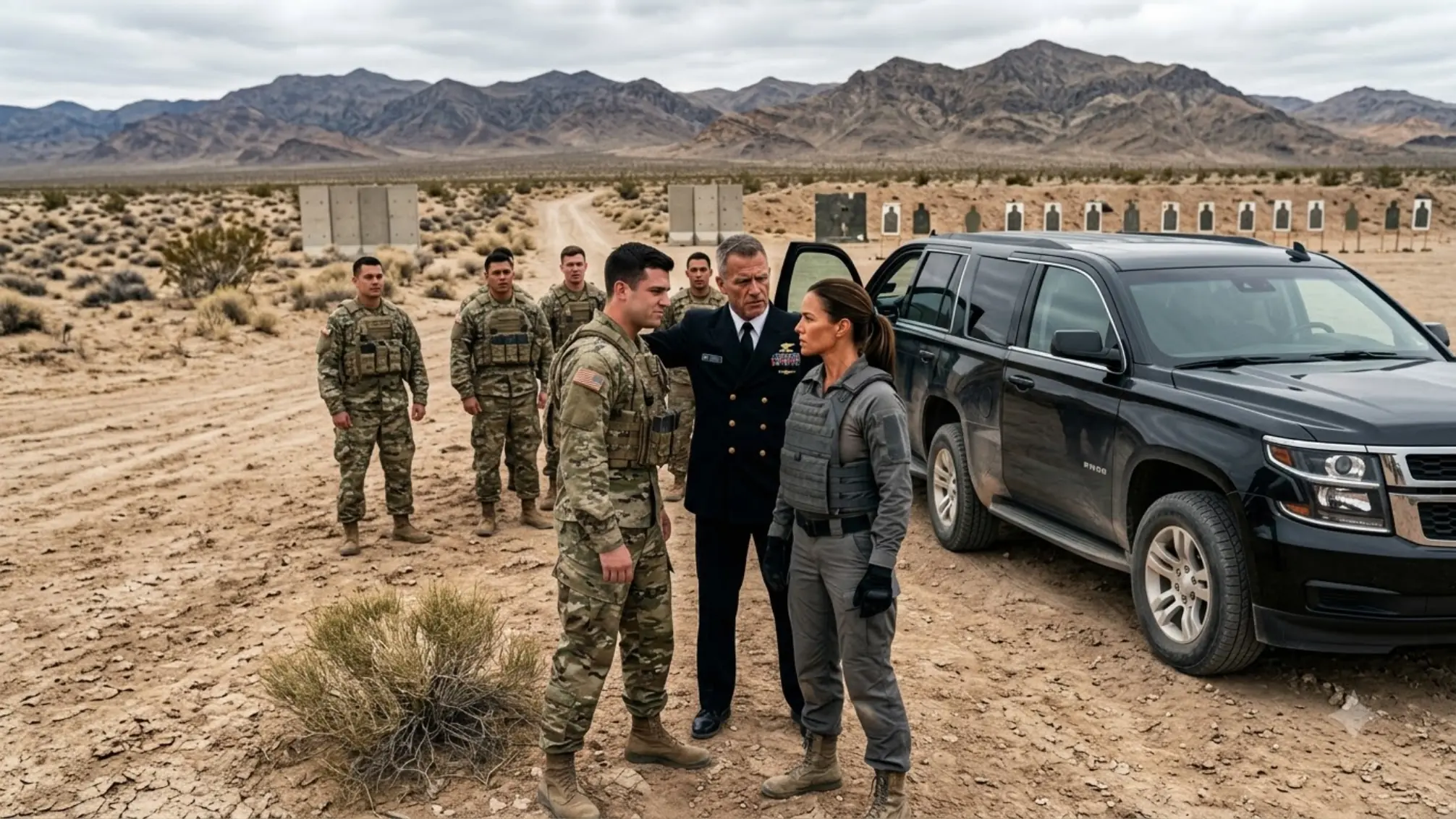
Olivia arrived at the advanced combat training facility in Nevada on a gray military transport van. At thirty-five, she possessed an athletic build, intense dark-brown eyes, and the quiet physical control of someone who never wasted movement. Her long dark hair remained secured in a regulation tactical ponytail, and the slight hitch in her left step appeared only when she descended from the vehicle. She reported to the administrative desk, accepted a room key, and received the same warning given to every new arrival: previous accomplishments meant nothing there.
Inside the barracks, Olivia chose a bunk in the far corner. The wall protected her back, the entrance remained clearly visible, and the nearby window offered a secondary exit if the main doorway became unusable. Those choices happened without conscious thought. They belonged to an older life her body remembered even when her mind tried to bury it.
During dinner, Lieutenant Grant Mercer sat with three soldiers who had already decided they belonged at the top of the class. Grant was handsome, muscular, and polished, with the easy arrogance of a man who had never faced an opponent capable of exposing his limitations. Beside him sat Peter Dawson, Luis Torres, and Claire Miller, each eager to reinforce whatever judgment Grant announced. When Olivia passed their table, Grant remarked that some soldiers arrived through ability while others arrived because someone felt sorry for them.
The group laughed quietly.
Olivia did not turn.
She carried her tray to the window, sat facing the room, and ate with measured efficiency. Her gaze moved across entrances, reflections, and blind corners so naturally that most people never noticed. Master Chief Daniel Brooks noticed.
Brooks had spent twenty-six years training soldiers and sailors for operations where a single mistake could kill an entire team. He recognized fear, dishonesty, arrogance, and genuine incompetence within minutes. Olivia did not resemble any of those things. Her silence appeared deliberate, and the careful way she occupied space suggested experience far beyond what her incomplete personnel file revealed.
The first rifle qualification began beneath a brutal desert sun. Targets stood at varying distances across the shimmering range, and the exercise required controlled shooting followed by rapid magazine changes. Olivia’s first round struck far outside the center. Her second missed completely.
During the reload, her hands seemed to forget what they had done thousands of times. She angled the fresh magazine incorrectly, lost several seconds, and resumed firing only after the rest of the line had already engaged its final targets. When the scores appeared, Olivia sat near the bottom.
Grant walked past her target and laughed.
“Someone’s qualification records must have been exaggerated.”
Peter asked whether basic training scores expired after enough years. Torres suggested she might have worked in a kitchen rather than a combat unit. Miller simply smiled and said the dangerous part was that Olivia apparently believed she belonged among them.
Olivia cleared her weapon and walked away.
Later, before dawn, Brooks found her alone on the same range. No instructors watched, no scores were recorded, and nobody stood nearby to judge her. Olivia performed magazine changes with impossible smoothness, cleared simulated malfunctions without lowering her weapon, and transitioned between targets faster than Brooks could follow.
The difference disturbed him.
She was not incapable.
She was divided.
The next evaluation took place inside a mock urban compound built from shipping containers and reinforced plywood. The narrow rooms simulated apartments, offices, and hostile safe houses where threats could appear from any angle. Olivia stacked outside the first doorway, rifle raised, breathing controlled. When the instructor signaled her forward, she hesitated.
It lasted less than two seconds.
That was enough.
A mechanical target appeared behind a cardboard hostage, and the system registered a civilian casualty before Olivia fired. Red lights flashed above the door. The instructor reset the room and warned her that hesitation killed people.
On the second attempt, she entered too quickly and allowed her muzzle to drift across a teammate. Another failure sounded. By the third room, simulated gunfire echoed through the structure, and something behind Olivia’s eyes changed.
For one brief moment, she was no longer in Nevada.
She saw a dark corridor inside a building that officially had never existed. Dust filled the air, emergency lights flickered, and somebody behind her screamed a name she had spent years trying not to remember. The training rifle became heavier in her hands as the distant memory pulled her away from the present.
“Harper!”
The instructor’s voice returned her to the course.
She completed the exercise, but her score guaranteed another failure.
Grant waited near the staging area with his arms crossed. He said watching her move through the building had been physically painful. Torres claimed she would get an entire squad killed, while Miller suggested a safer career in accounting.
Peter called her a tourist.
The nickname spread through the class before sunset.
Whenever Olivia entered the dining facility, someone asked whether she needed directions. When she crossed the equipment yard, trainees joked that the gift shop was in another building. The insults remained carefully phrased, never quite severe enough for formal discipline but always loud enough for her to hear.
Olivia ignored every one.
Yet Brooks noticed the tension in her jaw and the deliberate looseness of her hands. She was controlling more than anger. She was resisting an instinct that wanted to answer the humiliation in a language those soldiers would understand immediately.
The obstacle course revealed the first visible crack.
Olivia cleared the wall, crossed the rope bridge, moved beneath wire, and entered the tire run with a competitive time. She looked fast, efficient, and physically stronger than her earlier performances suggested. Then the flashbang simulator detonated.
The sound tore through the training ground.
Olivia stopped completely.
Her eyes remained open, but they no longer saw the obstacle course. Her breath shortened, shoulders tightened, and one hand drifted toward an injury beneath her vest as though checking for blood that was not there. Fifteen seconds passed before an instructor reached her voice through the memory.
She finished the course far behind the others.
That night, the mocking changed.
Grant no longer called her merely slow. He called her broken. Miller said combat trauma could make someone unreliable forever, while Torres argued that keeping Olivia in the program endangered everyone forced to train beside her.
Peter nodded as though they were discussing equipment rather than a human being.
Olivia lay on her bunk facing the wall. Her eyes remained closed, but her hands tightened beneath the blanket. She remembered an explosion inside a building overseas, a collapsing staircase, and the faces of teammates she had carried through smoke.
She also remembered the order given afterward.
Containment protocols had been placed deep inside her conditioning. Years of classified operations had trained her to suppress certain tactical responses unless she received a specific authorization command. The system protected civilians, teammates, and Olivia herself from instincts developed in places where hesitation meant death.
After her final mission and the injury to her leg, the authorization was withdrawn.
Without the trigger phrase, she could still function as an ordinary soldier. She could aim, run, and follow commands, but every movement requiring the full Shadowblade response remained trapped behind a mental barrier she could not cross voluntarily. During high-pressure drills, her body reached for operational conditioning and encountered a locked door.
The result looked like incompetence.
The second week introduced team-based exercises. Olivia was assigned to Grant’s squad with Peter, Torres, and Miller. Grant greeted the decision by announcing that his team had been issued dead weight.
Their first mission required clearing several connected buildings, rescuing role-playing civilians, and reaching an extraction zone within thirty minutes. Grant positioned Olivia in the rear, claiming he wanted reliable soldiers near the danger. She followed his orders even when they contradicted sound tactics.
Peter entered the first room alone and received a simulated fatal hit.
He blamed Olivia immediately.
In the second building, Grant rushed a hallway without checking an elevated angle. Olivia saw the hidden threat but hesitated before issuing the warning, unable to access the decisive command response that once came naturally. Torres and Miller were marked as casualties moments later.
The instructors ended the evaluation early.
Grant removed his helmet and demanded to know why anyone continued pretending Olivia could recover. She had failed shooting, movement, judgment, and stress response. In his opinion, the only responsible decision was removal.
The instructors privately agreed.
Brooks objected that Olivia’s habits revealed advanced experience, but performance records carried more weight than intuition. Administrative staff prepared her dismissal paperwork with a recommendation for medical discharge. Olivia received notice that Friday’s comprehensive evaluation would be her final opportunity.
Everyone understood it was ceremonial.
She would fail.
Then she would disappear.
On Thursday afternoon, a black government SUV entered the facility without warning. Conversations stopped across the training yard as the vehicle parked beside the administrative building. Two men stepped out, but attention immediately settled on the taller figure.
Commander Ryan Ellis carried the authority of someone who never needed to announce it. He was forty-eight, broad-shouldered, and weathered by decades in military environments that produced few public records. His uniform displayed only essential decorations, and his eyes examined the facility as though identifying threats before acknowledging people.
He walked directly toward Brooks.
“I understand Staff Sergeant Harper is assigned here.”
Brooks confirmed it.
Ellis asked to observe her final evaluation.
“Sir, the dismissal decision is practically complete,” Brooks explained. “Her scores have been consistently unacceptable.”
Ellis glanced across the yard.
Olivia stood beside a weapons rack, perfectly motionless.
“What if she isn’t failing?” he asked.
Brooks frowned. “I’ve watched every evaluation.”
“You watched what happens without authorization.”
The master chief studied him. “What authorization?”
Ellis’s expression revealed nothing.
“Give her one final run.”
Across the yard, Grant noticed Olivia’s reaction. For the first time since her arrival, she looked genuinely unsettled. She knew Ellis, and whatever history connected them carried enough weight to fracture her carefully controlled expression.
Grant stepped in front of her and reached toward the rifle hanging across her chest.
“You heard the board,” he said. “You’re finished.”
Olivia caught his wrist before his hand touched the weapon.
The movement was so fast that Grant froze.
“Grab my rifle,” she said quietly, “and you’ll lose that hand.”
For a moment, the entire range went silent.
Grant pulled free and stepped closer. “You freeze in doorways. You’d get all of us killed.”
Olivia met his eyes. “Then stay out of my doorway.”
Ellis approached before Grant could answer.
He looked at Olivia but offered no greeting. She stood straighter, as though the sight of him had awakened a part of her posture the others had never seen.
“Tomorrow,” he said. “One final course.”
Olivia’s voice lowered. “Under whose authority?”
“Mine.”
“Do you still have it?”
Ellis held her gaze.
“Yes.”
Friday’s evaluation began beneath punishing heat. The scenario involved multiple buildings, armed role players, civilian hostages, and a strict thirty-minute limit. Grant’s squad entered first while Ellis watched from inside the perimeter.
Olivia returned to the same hesitant pattern.
She slowed at the initial doorway, allowing Peter to enter before the team was ready. A target eliminated him immediately. Torres shouted that she was destroying their final score.
Inside the second building, Olivia checked angles that appeared irrelevant and paused at corners others considered safe. Grant ordered her to stop wasting time. Miller demanded that she move like she wanted to pass.
To the instructors, everything looked familiar.
To Ellis, it looked precise.
Olivia’s attention followed hidden routes and secondary threats placed beyond the obvious training design. She tracked reflections, structural weaknesses, and escape paths no conventional trainee had been taught to prioritize. Her hesitation occurred whenever deeper operational instincts reached the containment barrier.
The ability remained intact.
Only permission was missing.
Grant entered the second corridor and signaled Olivia toward a doorway. She approached, then froze as simulated gunfire erupted from inside. The instructor reached for his clipboard, preparing to mark another failure.
Ellis stepped forward.
His voice cut through the range.
“Harper—Shadowblade, execute.”
The transformation happened before anyone understood the words.
Olivia’s posture shifted.
The uncertainty disappeared from her eyes, replaced by ruthless focus. Her rifle rose as she moved past Grant, acquiring the first target before it fully appeared. Two controlled shots struck center mass.
She continued without slowing.
At the next corner, Olivia transferred the rifle to her opposite shoulder and used the narrow angle without exposing her body. She cleared the room, identified a hidden shooter through a reflection, and neutralized the threat before the mechanical target completed its movement.
Torres stopped running.
“What the hell?”
Olivia was already through the next doorway.
She moved like the building’s architect had given her every secret. Reloads occurred without breaking stride. Every corner was cleared at exactly the correct height, and every transition placed her rifle where the next threat would appear before it emerged.
Grant tried issuing orders.
Nobody followed him.
His squad followed Olivia because survival instinct recognized command before pride could object. She repositioned Torres, directed Miller toward the hostage route, and used Peter’s simulated casualty marker as cover while breaching the final structure.
The course had been designed for thirty minutes.
Olivia reached the hostage room in fewer than ten.
Inside, three threats surrounded two civilians. Most teams paused to calculate angles. Olivia entered immediately, firing two controlled pairs, shifting her body between the final shooter and the nearest hostage, then disarming the role player before his weapon reached position.
The success alarm sounded.
Silence followed.
Olivia secured her rifle and returned to an ordinary stance as though nothing remarkable had happened. Grant pulled off his helmet, staring at her with fear replacing arrogance.
“How did you do that?”
Olivia looked at him calmly.
“Do what?”
The instructors reviewed the time repeatedly.
She had broken the course record by more than six minutes.
Inside the debriefing room, Brooks demanded an explanation. Ellis revealed that Olivia had served inside a classified special-operations program known informally as Shadowblade. Small teams entered denied areas, extracted high-value targets, and completed missions absent from public records.
Olivia had been among the program’s finest operators.
Three years of field service.
No failed missions.
No abandoned teammates.
No friendly casualties under her command.
The containment conditioning prevented her from accessing the complete response without a recognized authorization phrase. After the injury, military officials transferred her into conventional training to determine whether she could still function. They misread containment as decline.
“Was she pretending?” Brooks asked.
“No,” Olivia answered. “I was restrained.”
The discharge paperwork vanished that afternoon.
A new assignment appeared in its place: Advanced Tactical Instructor, Special Operations Training Command. The role recognized that Olivia’s greatest value no longer required returning to the missions that had nearly destroyed her.
Grant and his friends became quiet.
Peter attempted an apology outside the dining facility. He explained that they had not known what she could do. Olivia told him most people were never supposed to know.
“Why didn’t you show us earlier?”
“Because nobody authorized it.”
Torres and Miller stopped using the word tourist. Instead, they watched Olivia during training and attempted to understand the techniques they had once mistaken for hesitation. Neither approached her casually again.
Grant struggled most.
His identity depended on being the most capable leader in every room. Olivia had allowed him to mock her for two weeks, then surpassed everything he could do the moment one commander unlocked her real training.
She never humiliated him publicly.
That made the lesson worse.
On graduation day, Olivia stood among the class in an ordinary uniform. Nothing about her appearance revealed the speed, precision, or violence hidden behind her calm expression. She accepted her orders and prepared to leave for the instructor assignment.
Ellis arrived only long enough to say goodbye.
“You could return to operations,” he told her.
“I know.”
“Do you want to?”
Olivia looked toward the trainees preparing for another course.
“No.”
Ellis nodded. “Good.”
He understood that dangerous people were often treated as though their only value lay in how effectively they could continue exposing themselves to danger. Olivia had already given enough years to missions nobody would acknowledge.
Now she would teach others how to survive.
The course record remained posted long after her class departed. New trainees saw Olivia Harper’s name at the top and asked instructors how one soldier completed the hostage scenario so quickly.
The instructors never discussed Shadowblade.
They offered only one explanation.
“Never mistake silence for weakness.”
Grant remembered that lesson better than anyone. He had looked at Olivia’s failed scores, quiet manner, and momentary freezing and decided she was worthless. He judged her without knowing what battles remained trapped behind her eyes.
The woman he ordered off the range had never lacked courage or ability.
She had simply been waiting for permission.
When Commander Ellis finally spoke the authorization, the soldier they called broken disappeared. In her place stood Shadowblade—the operator who completed in ten minutes what the rest of them could not survive in thirty.