Clare Bennett stopped beneath the oldest apple tree on the farm and looked up.
Something red was hanging from a branch that almost everyone in town had told her to cut down.
The tree did not look rescued.
Its trunk was split deeply through the center. Moss covered most of the northern side. One major limb had died years earlier and another leaned so low that Clare had finally built a wooden support beneath it to keep the weight from tearing it away completely.
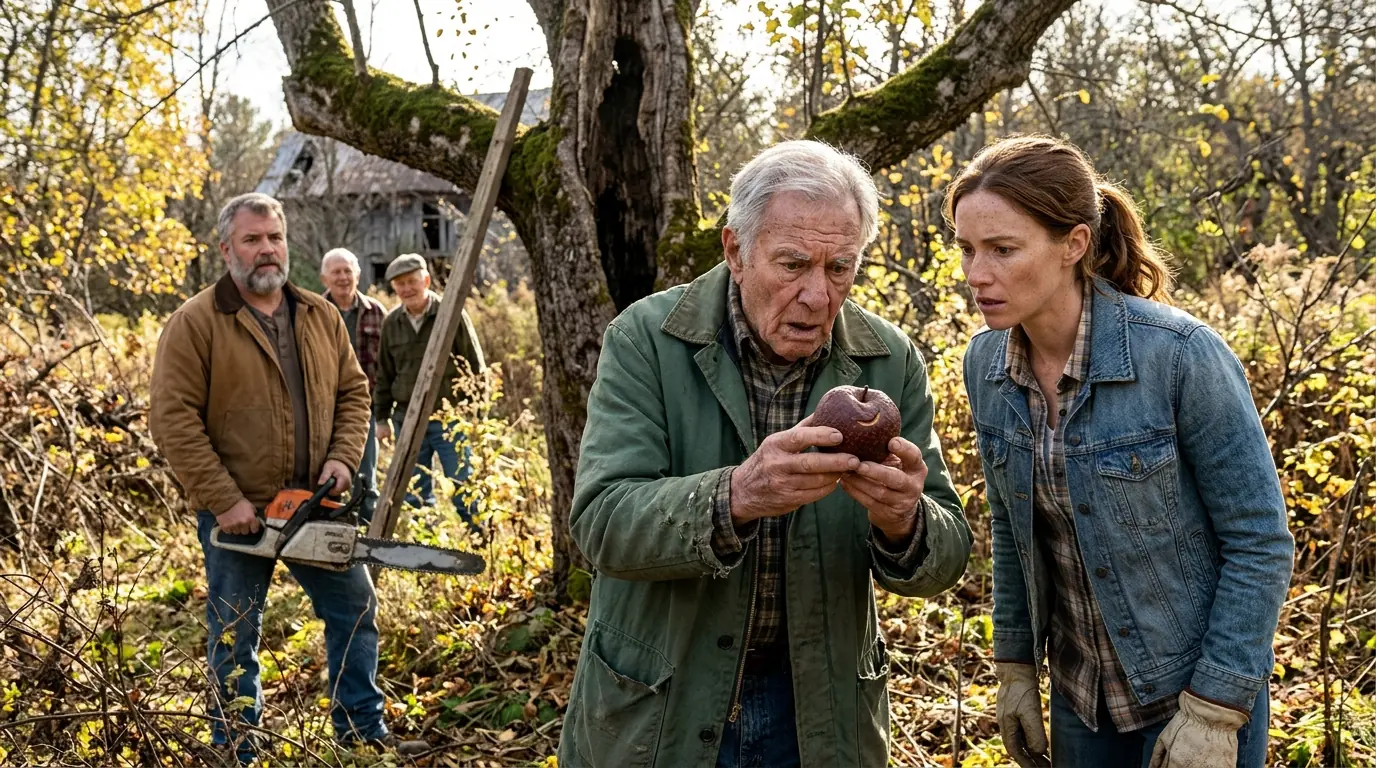
From twenty yards away, the tree still looked like firewood.
Yet between a handful of tired leaves hung one apple.
Clare reached up and twisted it carefully from the branch.
The skin was rough.
One side was darker than the other.
A scar curved beneath the stem.
Nothing about it looked like fruit selected for a supermarket display.
But that was not why the three men standing behind Clare had gone quiet.
A year earlier, two of those men had told her the tree was finished.
They had said the same thing about the farm.
Seventy neglected acres stretched behind a rusted gate at the edge of town. The farmhouse had been empty for years. Part of the barn roof had collapsed. Blackberry vines buried fence lines, and young maples and black locusts had grown through fields that no longer looked like fields at all.
When Clare first bought the place, nearly everybody gave her some version of the same advice.
Clear it.
Cut it.
Burn what remained.
Start over.
For a while, even Clare wondered if they were right.
Then she found the rows.
And after that, nothing about the farm looked the same again.
The first morning Clare owned the farm, she could not find the kitchen key. She stood on the porch with four nearly identical keys hanging from a ring, testing each one against a lock swollen by weather. A bee worked the heads of goldenrod near the steps. Somewhere inside, an unseen floorboard shifted with a noise like somebody clearing a throat. By the time the door yielded, the small victory had cost her twenty minutes and all her confidence about how the rest of the day would go.
She had made a list the night before. The roof leak came first. Then the porch step, the broken kitchen window latch, the well pump, the wiring, and the barn door that hung by a single hinge. It was a sensible list for a property she intended to inhabit, not necessarily to farm. She had left her job in town only partway behind, arranging to keep enough paid work to cover groceries and utilities while she learned whether the land could support anything more ambitious than an enormous vegetable garden. The purchase had consumed much of what she had saved. She could manage necessities or a long string of expensive surprises, but not both.