His name was Robert Keane, Bobby to those who knew him best.
On that quiet Tuesday morning, he was not looking for attention. He was not there to make a scene, flash medals, or brag about battles long past.
All he wanted was to withdraw a few hundred dollars from an old account he had not touched in years, the same account he had used decades ago to deposit hazard pay from deployments the government still would not fully acknowledge.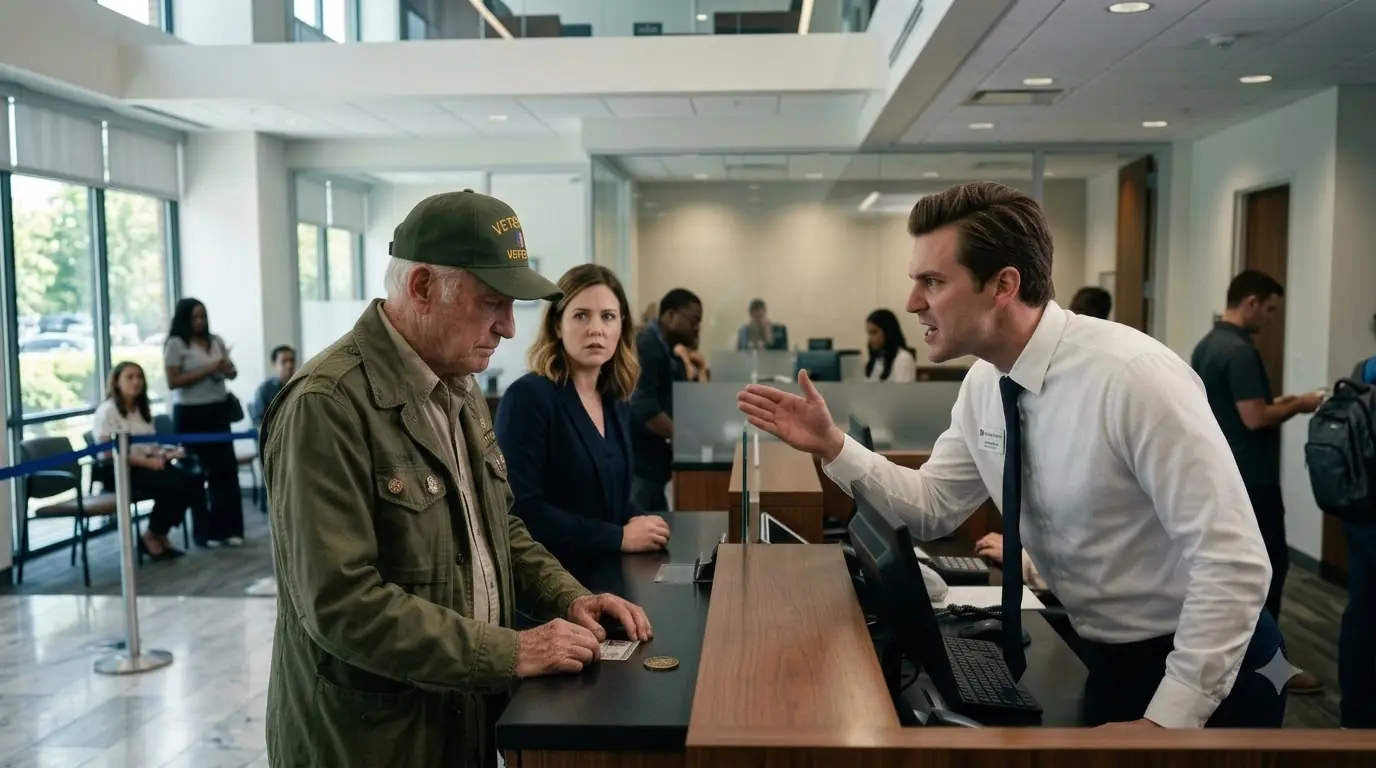
He stepped through the front doors of Summit Ridge National Bank like anyone else would, steady, calm, hat in hand.
That hat, a black cap stitched with gold thread reading “Korea/Vietnam Veteran,” had been brushed clean before he left home.
His shirt was pressed, though the cuffs were fraying, and in his coat pocket were a folded VA card, two tattered discharge papers, and a brass challenge coin worn smooth around the edges. He stood in line patiently and quietly, the way men from his era often did, as if waiting your turn was still sacred.
But the moment he reached the counter, everything shifted. The teller, maybe in her mid-twenties, blinked at the name on the account and raised an eyebrow, clearly uncertain.
Bobby offered his ID with a slight tremor in his hands, not from fear or weakness, but from the lingering damage of time and a few too many cold nights in places with no names. “I’m just trying to withdraw some funds,” he said politely. “This account is under Robert Keane. It’s been a while.”
The teller gave a tight smile and typed, then paused. Something on the screen did not match what she expected, so she called over her manager. His name was Kaden, with a slick haircut, a tie that was too short, and the kind of smirk that did not need words to insult you. He stepped up, looked at Bobby’s documents, then at Bobby himself, and let out a chuckle that was not friendly.
The teller laughed nervously. Bobby said nothing. He simply reached into his coat and placed something on the counter with slow, careful fingers.
It was a brass challenge coin engraved with a Thunderbird and seven stars, something no civilian would recognize, but something any real soldier would stop breathing over. Kaden did not even look at it.
“Cute trinket,” he muttered. “Anybody can buy those online these days.”
He turned to security and motioned toward the door. “I think we’ve got another wannabe vet trying to game the system. Escort him out, please.”
The guard hesitated for just a second, but it was enough for Bobby to hear every word and for the rest of the bank to take notice. A few customers chuckled behind their phones. One or two pretended not to hear.
Bobby did not argue. He did not demand anything. He simply picked up the coin, slid it gently back into his coat pocket, nodded once, and walked slowly to a bench by the window. There he sat upright, hands folded, eyes fixed on nothing in particular.
The laughter quieted, and a strange silence settled over the bank lobby. It was not guilt, not yet, but something colder: discomfort, as if deep down, people were no longer so sure of themselves.
One person, however, had not laughed. Her name was Maya Rodriguez, an early-thirties former Air Force logistics specialist who now worked in defense contracting. She had seen a coin like that once, when a retired JSOC colonel had come to brief her team, and she remembered the way every officer in the room had stood when he placed it on the table.
She walked up to the counter, locked eyes with the manager, and said, “You just made a mistake.”
Kaden blinked. “Excuse me?”
Maya pointed at the bench. “That man isn’t a fake. That coin alone carries more weight than every paycheck in this building.”
Kaden snorted. “If he’s so important, why isn’t someone here with him?”
Maya did not reply. She simply stepped outside and made a call.
But someone else had already noticed. In the back office, an older employee, one of those quiet lifers with no title but all the knowledge, had overheard the name Robert Keane. He paused, then walked slowly to the corner of the room where a brass plaque hung on the wall.
It had been there since the bank opened, dedicated to Summit Ridge Command Base and to those who had built it. Among the engraved names was one that had not faded: R. J. Keane, the man who had overseen the original military infrastructure before the land was converted to civilian use. It was the same man now being accused of faking a service record in the very bank that existed because of his command.
The employee did not speak. He picked up the phone, dialed a number that only a handful of people knew by heart, and said just six words.
“It’s Bishop Coin. Summit Ridge. He’s here.”
Then he hung up.
By the window, Bobby sat still as stone. He did not pull out his phone. He did not make a fuss. He simply watched the wind tug at the flag across the street and waited.
He was not waiting for justice or praise. He waited because that was what men like him had always done. They waited until they were needed. They waited even when no one believed them, and they waited while the world laughed.
What no one in that bank knew, not the manager, not the teller, not even Maya, was that within thirty minutes, the laughter would turn to silence. Down the road, a furious general had already slammed his phone onto a desk, put on his dress uniform, and started toward the bank to make sure the man everyone had dismissed, the man they had called a fake, would never be overlooked again.
The next twenty minutes inside Summit Ridge National Bank passed like molasses, slow, thick, and uncomfortable, especially for those who had been laughing moments earlier. The teller who had snickered now kept her head low, pretending to type, while Kaden paced behind the counter and threw the occasional glance at the front doors. He was clearly agitated, though he did not yet know why.
Bobby Keane had not moved. He sat exactly where he had been told to sit, as if this were just another waiting room in another government building, another day in a long life of lines and cold stairs. His hands rested on his cane, his shoulders straight despite the age he did not talk about. The challenge coin remained tucked away, its presence as invisible to these people as his service.
But the silence around him was different now. It was no longer the silence of dismissal. It was the silence of doubt.
Maya Rodriguez watched him from across the lobby, arms crossed tightly and lips pressed together in frustration. She had already made her call to a retired command contact at Fort Brixton, who needed to hear only “Bishop Coin” and “Robert Keane” before his tone changed completely.
“You say he’s there now?” the voice had asked. “Don’t let him leave.”
Maya did not know what would happen next, but her instincts told her something was already in motion. She was right.
Two blocks away, a black SUV cut across traffic, its lights flashing once to signal authority without invitation. Inside sat Major General Everett Kane, decorated, feared, and famously precise. He was currently the head of regional operations for four military districts and one of only five men alive authorized to carry bishop-level active reconnaissance clearance.
When he received the call and heard the name Robert Keane, he stopped in the middle of a briefing, rose from his chair, and said only four words to his aide.
“Suit up. We’re leaving.”
Keane was not just a name in a file to Kane. He was the reason Kane wore stars on his shoulders, a living ghost, a man thought long out of circulation, the kind of figure whispered about in strategic meetings and legacy briefings. Kane had trained under doctrine Keane had helped write.
The fact that Keane had been publicly insulted out of uniform in a building sitting on land he had once commanded ignited something the general rarely allowed to show: fury.
Meanwhile, back at the bank, Bobby adjusted the sleeve of his coat. The quiet buzz of fluorescent lights overhead filled the air, but no one was speaking. A customer near the coffee station awkwardly left without making his deposit.
A security guard stood near the exit, shifting nervously and casting sideways glances at the old man. Bobby had not made a single threat, raised his voice once, or even looked angry, but he still seemed to radiate the kind of presence that unsettled people who were used to authority.
Kaden tried to brush off the discomfort. “He’s still here,” he muttered, peeking over the teller line. “Seriously?”
He turned to one of the newer employees and snorted. “He’s probably hoping someone posts about it so he can get a pity donation online. Veterans pull that stuff all the time.”
Maya’s jaw clenched, and the young woman at the teller window lowered her gaze. Even she knew this had gone too far.
Kaden leaned back against the counter as though he were proud of himself. “I should have called the cops. It’s only a matter of time before he causes a scene.”
But just as the words left his mouth, the bank’s glass doors swung open hard, the kind of opening no one ignored. It was not a gust of wind or an ordinary customer. It was a command.
A chill seemed to slice through the room. Real military boots struck the tile with precision, not rushed or hesitant, but deliberate.
Major General Everett Kane entered in full dress uniform, every ribbon gleaming, every line of fabric pressed razor sharp. His presence filled the entire lobby before he even spoke. Behind him, an aide followed with a briefcase in one hand, solemn and silent.
No one moved. The noise died instantly. Telephones were hung up, coffee was abandoned mid-pour, and Kaden, still leaning against the counter, looked up and froze. His smirk collapsed into silence.
Kane did not acknowledge anyone at first. His eyes locked directly on the bench by the window where Bobby Keane still sat.
Then, in front of the entire bank, the general snapped to attention and saluted.
The crack of palm against temple rang louder than any apology ever could. Bobby looked up, confused for only a moment, before slowly rising and returning the salute with the dignity of someone who had not been saluted in years, but had never once forgotten how.
Then Kane turned and scanned the room like a blade. When he spoke, his voice was low but sharp enough to cut glass.
“Who here called Colonel Robert Keane a fraud?”
No one answered, at least not at first. Kane stepped forward.
“Colonel Keane,” he said again, emphasizing the rank with chilling clarity, “was instrumental in establishing joint-force reconnaissance protocols still used in three nations. His record spans two wars, six theaters, and fourteen unacknowledged operations. You questioned his identity?”
Every eye turned toward Kaden. The manager looked as though he might be sick.
“I didn’t know,” he stammered. “His papers were old, and—”
“Of course they’re old,” Kane snapped. “Because he earned his age. He fought for this country while your biggest challenge was learning how to schedule social media posts.”
The silence in the room shifted again, from awkwardness to shame.
Kane’s aide stepped forward and opened the briefcase. Inside was a thick folder marked CLASSIFIED, a commemorative coin set into velvet, and a printed scan of the plaque on the bank wall with Robert Keane’s name engraved in bold.
Kane placed the folder on the counter. “This bank exists because of his strategic design. That account you flagged as suspicious helped fund the original supply lines you now profit from.”
He turned back to Bobby, his voice softer now. “Sir, I’m sorry. I didn’t know you were in town sooner.”
Bobby gave a tired nod. “Didn’t come to be found. Just needed enough to help my grandson with school.”
Kane nodded slowly. “Then let’s make that happen.”
Together, they stepped toward the counter as Kaden backed away, hands raised in silence. The laughter was gone, and the lesson was only beginning.
The silence inside Summit Ridge National Bank was no longer awkward. It was reverent. Every person in that room had just witnessed something shift, as if the ground itself remembered the weight it once held.
General Everett Kane stood beside Colonel Robert Keane at the counter, not barking orders or calling for punishment, but simply standing as though nothing else in the world mattered until this man received what he had come for.
Bobby withdrew the funds quietly and without ceremony to help his grandson pay for college, something he had not even mentioned until the general asked. He did not want attention. He never had. All he wanted was to keep his word to those he had fought for and to those he had come home to.
The teller’s hands shook as she printed the receipt and whispered an apology that Bobby did not acknowledge. It was not out of spite. He simply did not need it. He took the slip, folded it once, and tucked it into his pocket like it was just another task completed.
As he turned to leave, General Kane stopped him with a hand on his shoulder. “Colonel, you’ve got five minutes,” he said.
Bobby raised an eyebrow. “For what?”
Kane nodded toward the room. “For the honor you never asked for.”
Then, without a single word of command, every military veteran in the room, from a young reservist by the ATM to an old Navy corpsman filling out a deposit slip, stood tall and saluted. Even civilians rose from their seats.
They did not stand because they were told to. Something in the room told them that this was how you honored a man like that.
Bobby froze for a second, not in pride, but in disbelief. Then he slowly returned the salute with quiet precision.
Kane reached into his coat pocket and handed Bobby a small velvet box. “We’ve been holding this for years,” he said. “Thought you might want to have it now.”
Inside was a medal, clean and polished, engraved only with a name and three words: SERVICE BEYOND RECORD.
Bobby stared at it for a long time. There were no tears and no speech, only a slow nod, as though he had finally closed a door no one else had known was still open.
Then he looked at Kane and said softly, “I didn’t come here to be remembered. I came to keep a promise.”
Kane nodded. “And in doing so, you reminded us all what service really means.”
Bobby walked out into the sunlight. No cameras followed him, and no headlines came, but the people inside stood a little straighter and spoke a little softer.
Later that week, a new line was added to the plaque by the bank’s front entrance. Beneath the original dedication, a second inscription appeared:
Robert J. Keane
Colonel, United States Army
Honor in Silence
It did not mention the incident. It did not mention the general. But everyone who worked there knew, because some truths do not need to be shouted to change everything.
From then on, every customer who walked through those doors saw the name of the man they had almost laughed out of the building.