“That rusted heap is as useless as you are, old man,” Brent Holloway said, pointing at the faded red tractor beside the grain bins.
Amos Reed stood quietly beside his 1956 Massey Ferguson, one weathered hand resting on its cracked steering wheel. The seat was torn, the paint had faded to the color of dried blood, and old oil stains darkened the engine housing. Behind Brent, two young farmhands laughed while a new green combine gleamed beneath the afternoon sun.
“Big words from a man hiding behind newer paint,” Amos replied.
Brent struck the damaged seat with his palm. “That antique couldn’t survive one real harvest.”
Amos gently patted the tractor’s hood. “She still does the work I ask.”
Brent leaned closer, smiling cruelly. “When she dies in the mud, don’t expect us to pull you out.”
Amos met his eyes. “When your shiny machines drown, you’ll beg this old girl to save your harvest.”
The men laughed again.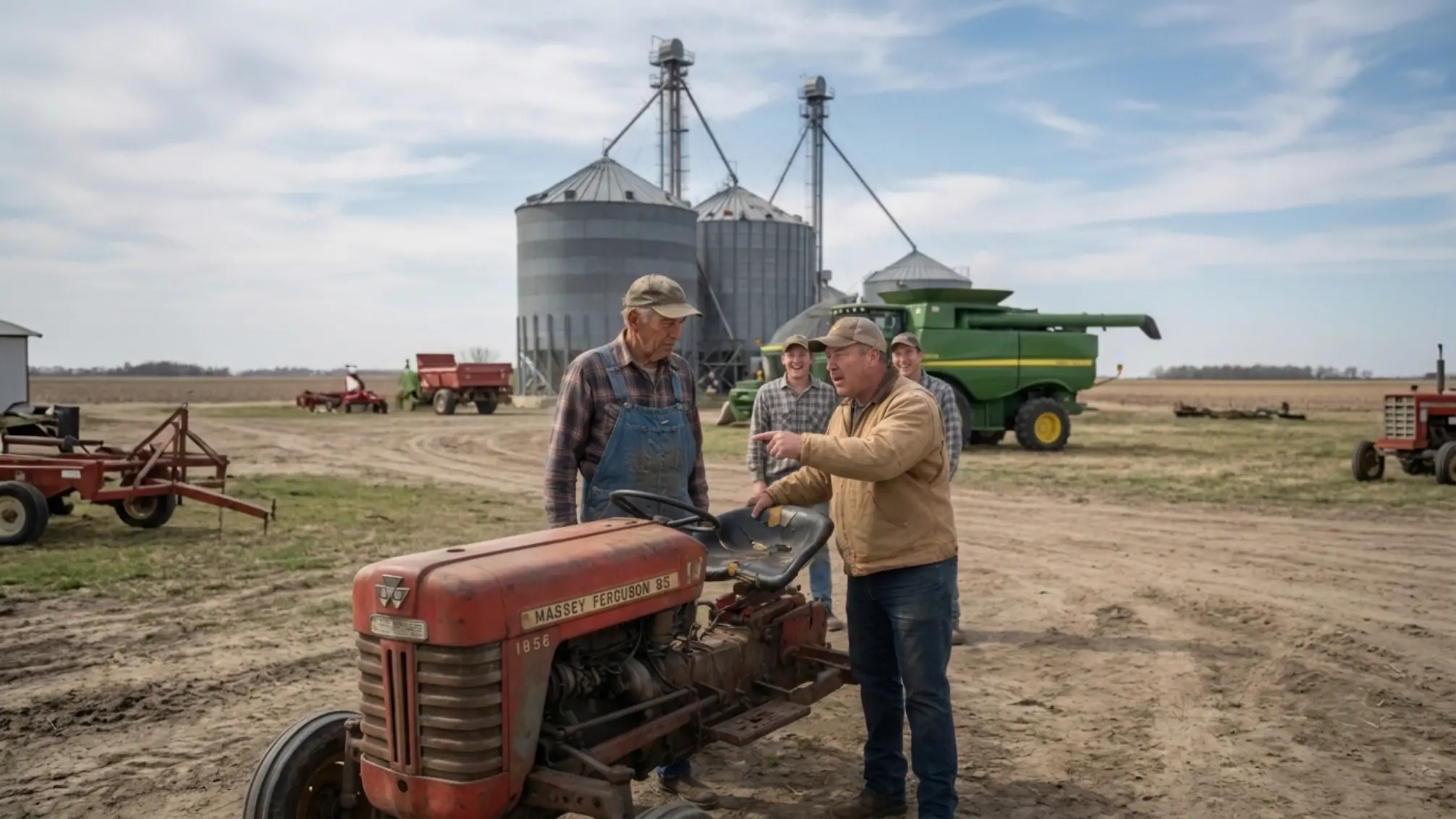
Amos did not.
He climbed onto the Massey Ferguson, turned the worn key, and listened as the old diesel engine coughed twice before settling into its familiar uneven rhythm. A thin cloud of smoke rose from the exhaust, and the tractor rolled away from the grain yard at a speed that gave Brent plenty of time to keep laughing.
The Reed farm covered four hundred eighty acres outside Mason Creek, Iowa. Amos’s grandfather had bought the first eighty acres during the final years of the Great Depression, clearing the fields with horses and a borrowed plow. Amos’s father expanded the farm after the war, adding corn, soybeans, and a small cattle operation.
The Massey Ferguson arrived in 1956.
Amos was eight years old when his father drove it down the county road for the first time. The red paint shone beneath the sun, and the engine sounded more powerful than anything the Reed family had ever owned. To a child who had spent his earliest years watching horses drag equipment through wet ground, the tractor looked like the future.
Amos learned to drive it before his feet comfortably reached the pedals.
He hauled hay, pulled wagons, cultivated corn, cleared snow, and carried feed to cattle during winters when the roads disappeared beneath ice. The tractor helped build fences, pull fallen trees, and rescue newer machines that became trapped in soft fields.
It never performed any task beautifully.
It simply completed them.
Amos inherited the farm at thirty-two after his father suffered a stroke. For the next three decades, he slowly modernized the operation. He purchased larger tractors, upgraded the planter, and eventually bought a used combine equipped with more technology than his father could have imagined.
Yet he never sold the Massey Ferguson.
His wife, Ruth, called the tractor “Maggie” because Amos spoke about it as though it were a stubborn older woman who refused to retire. Whenever Amos complained that the engine was difficult to start, Ruth would tell him Maggie had earned the right to be temperamental.
Ruth died seven years before Brent mocked the tractor in the grain yard.
After her death, Amos reduced the cattle herd and rented part of his land to neighboring farmers. His son lived in Des Moines and worked as an accountant, while his daughter taught school in Minnesota. Neither wanted to take over the farm.
Amos understood.
He never tried to force the land onto children who had built lives elsewhere. Yet he continued farming the remaining acres because mornings felt emptier when there was no work waiting outside.
The Massey Ferguson became part of his routine.
Every winter, Amos drained the fluids, inspected the fuel lines, adjusted the valves, and replaced anything showing dangerous wear. He kept spare belts, filters, hoses, bearings, and gaskets organized inside wooden boxes in the workshop.
Most of the tractor was original.
What was not original had been repaired by Amos himself.
Brent Holloway’s farm bordered the Reed property to the east. At forty-eight, Brent was ambitious, successful, and determined to ensure everyone knew both facts. He had inherited six hundred acres, rented another nine hundred, and purchased machinery large enough to appear impressive even when parked.
His newest tractor contained climate control, satellite guidance, automated steering, and electronic systems capable of recording every movement across the field. His combine cost more than Amos’s entire farm had been worth when Amos inherited it.
Brent treated old machinery as evidence of poor judgment.
“A machine that old costs more in lost time than it saves in money,” he often said at the co-op. “Sentiment has no place in serious farming.”
Amos never argued.
He had noticed that Brent confused purchasing power with knowledge. Brent understood financing, acreage expansion, and market timing. He did not always understand the ground beneath his tires.
The autumn began perfectly.
The corn matured evenly, the weather stayed dry, and grain moisture dropped faster than expected. Farmers across Mason Creek prepared for an efficient harvest.
Brent planned to finish his largest fields before anyone else in the county. He hired two temporary workers, leased another grain cart, and arranged trucks to carry corn directly to the elevator.
Amos moved more slowly.
His combine was twenty years old, but it ran well. He harvested eighty acres during the first week and stored the grain inside two smaller bins near the barn. Each evening, he checked weather forecasts and walked the lower fields near Willow Creek.
The creek had barely moved all summer.
However, the soil beneath the grass felt strangely cool.
Amos noticed dark clouds gathering far to the west on a Thursday afternoon. The local forecast predicted scattered showers, perhaps half an inch of rain. Brent continued harvesting without concern.
Amos stopped.
He parked the combine, moved wagons onto higher ground, cleaned the drainage channel beside the southern field, and filled the Massey Ferguson’s fuel tank.
Brent saw him working near the ditch.
“You afraid of a little rain?” he called from the cab of his new tractor.
“I’m afraid of water that has nowhere to go.”
“The forecast says showers.”
“The sky didn’t read it.”
Brent laughed through the open window. “At your speed, winter will arrive before you finish.”
Amos continued clearing branches from the drainage channel.
Rain began shortly after midnight.
At first, it fell gently against the farmhouse roof. Amos woke, listened for several minutes, and returned to sleep.
At two in the morning, thunder shook the windows.
The rain became a continuous roar.
By dawn, more than four inches had fallen. Willow Creek had risen over its banks and spread across the lowest pastures. Water filled roadside ditches and crossed the gravel lane leading toward Brent’s eastern fields.
The storm did not move away.
It remained over Mason Creek for nearly two days.
Seven inches became ten.
The flat fields could no longer absorb the water. Corn rows disappeared beneath wide brown pools, and recently harvested ground became deep mud. Several county roads closed after culverts washed out.
Amos stood beneath the barn roof and watched water move across the southern field.
Half his corn remained unharvested.
Brent had more than six hundred acres still standing.
The weather cleared on Sunday morning, leaving a bright blue sky above a landscape transformed into shallow lakes. Farmers drove along the roads examining damage and calculating how long the fields might require to dry.
More rain was forecast within six days.
That prediction changed everything.
If farmers waited for the ground to dry naturally, the next storm could flatten the corn, encourage mold, and destroy grain quality. If they entered too early, heavy machinery would sink.
Brent chose to enter.
His four-wheel-drive tractor pulled a large grain cart into the western field shortly before noon. The upper soil appeared firm, but beneath the surface lay several inches of saturated clay.
The tractor traveled nearly two hundred yards before the rear tires began cutting deep tracks.
Brent continued.
The machine sank to its axles.
His second tractor entered from another direction carrying heavy chains. It reached the first machine, attached the tow line, and immediately began sinking as well.
By evening, two tractors and a grain cart stood trapped in the field.
The young farmhands who had laughed at Amos now worked knee-deep in mud, shoveling around tires taller than they were. Each attempt to escape made the holes deeper.
Brent called a recovery company.
The operator studied photographs and refused to send a heavy tow vehicle until the field strengthened. Bringing another large machine onto the ground could create a third problem without solving the first two.
Meanwhile, Brent’s combine remained parked beside the road.
It was too heavy to risk.
Amos watched from his property.
He did not celebrate.
A trapped tractor was not merely an embarrassment. It represented hundreds of thousands of dollars, a delayed harvest, and the possibility that an entire season’s income might rot in the field.
He started Maggie.
The old Massey Ferguson weighed a fraction of Brent’s machines. Amos had fitted it with narrower tires designed to cut through loose upper soil until reaching firmer ground beneath. The tractor carried no electronic sensors, computer controls, or wiring vulnerable to water.
Amos attached a small empty wagon and drove toward his northern field.
The first hundred yards were slow.
Mud pushed around the tires, but the tractor did not sink. Its light body allowed it to cross the raised ridge Amos’s father had created decades earlier when drainage channels were dug by hand.
Amos followed that ridge to the corn.
His combine could not enter, but a small two-row harvesting attachment stored behind the workshop could. Amos had not used it in twenty years. It was slow, narrow, and painfully inefficient compared with modern equipment.
It was also light.
He spent the afternoon greasing bearings, replacing a belt, and attaching the harvester to Maggie. By sunrise the following morning, Amos entered the field.
He harvested two rows at a time.
The machine moved slowly enough that a person could nearly walk beside it. Corn dropped into the small wagon, which Amos filled only halfway to reduce weight. He then followed the raised ground back to the yard, unloaded, and returned.
Neighbors stopped along the road.
Some smiled at the sight of the ancient tractor and tiny harvester working in a field modern machinery could not enter. Others quickly understood what Amos was accomplishing.
He was not harvesting efficiently.
He was harvesting.
By noon, he had saved several acres.
Brent arrived in a muddy pickup.
“You’re going to finish six weeks from now using that toy,” he said.
Amos shut down the engine. “Corn saved slowly is still saved.”
“My combine could clear this field in an afternoon.”
“Your combine is sitting beside the road.”
Brent looked toward his flooded acres. “I need those tractors out.”
“I know.”
“You said that thing could save the harvest.”
“I said you would beg her to.”
Brent’s jaw tightened. “Are you enjoying this?”
“No.”
“Sounds like you are.”
Amos climbed down. “You insulted me. You insulted my tractor. That matters less than the corn dying behind you.”
Brent looked away.
“What do you need?” Amos asked.
The question surprised him.
“My machines recovered,” Brent said. “Then some way to move grain without sinking everything else.”
Amos studied the field. “The big tractors stay where they are until the ground dries.”
“I can’t leave them there.”
“You can, or you can bury them deeper.”
“And the harvest?”
“We use light machines.”
“I don’t own light machines.”
“You sold them.”
Years earlier, Brent had traded several small tractors for larger equipment. He had believed efficiency meant replacing many modest machines with a few powerful ones.
Now every machine he owned was too heavy.
Amos walked around the stuck tractors. He tested the soil with a steel rod, followed the field’s elevation, and located an old drainage ridge nearly hidden beneath the corn.
“Your grandfather built this?” he asked.
Brent nodded. “Before the land was leveled.”
“It still rises eight inches.”
“That won’t carry a combine.”
“No. It might carry Maggie.”
Brent stared at the old tractor near the road.
“What exactly are you planning?”
“A cable, a ground anchor, and patience.”
Amos returned with a mechanical winch that had once been used for pulling logs. He mounted it to the Massey Ferguson’s rear frame and drove along the firmest ridge until he came within eighty yards of the first trapped tractor.
He refused to approach closer.
Instead, he secured Maggie behind a high section of ground, drove steel anchors into the soil, and extended the cable toward the trapped machine. The first pull accomplished almost nothing.
Amos ordered the farmhands to dig mud from around the buried tires and place boards beneath them. Then he tightened the cable again while Brent gently powered the trapped tractor.
The massive machine moved three inches.
They reset the system.
Another six inches.
The work continued through the afternoon. Every short movement required digging, boards, cable adjustments, and careful use of power. Maggie did not pull the modern tractor by strength alone. The winch multiplied force while the anchors transferred pressure into the ground.
Shortly before sunset, the trapped tractor reached firmer soil.
The young farmhands stopped laughing.
The second machine required another day.
Once both tractors were secure, Brent asked what came next.
Amos pointed toward the line of standing corn. “We find every small tractor still running in this county.”
Brent stared at him. “There can’t be many.”
“There were plenty before people started calling them useless.”
Amos made telephone calls.
A retired farmer owned a 1962 Ford tractor stored inside a shed. Another family still used a small International for mowing. Calvin Pierce had an old Allis-Chalmers that started only when pushed downhill, but it ran once the engine warmed.
By Wednesday morning, six small tractors stood in Brent’s yard.
None looked impressive.
Their combined value was less than one wheel on Brent’s newest machine.
Amos organized the work.
The modern combine remained on the firm headland, where it harvested only sections accessible from the road. Small tractors pulled light wagons along raised ridges and carried limited loads back to the trucks.
In areas where the combine could not enter, Amos used his narrow harvester. Other farmers brought similar attachments stored in barns and equipment sheds.
The operation was slow, dirty, and exhausting.
It also worked.
Brent spent twelve hours driving an old Ford tractor whose seat springs pushed painfully through the vinyl. It had no climate control, no automatic steering, and no enclosed cab.
By evening, his clothing was covered with mud and corn dust.
“How did people farm like this?” one young worker complained.
Amos looked at him. “They finished tired.”
The approaching storm strengthened as it crossed Nebraska.
Weather reports now predicted another four inches of rain, possibly more. Mason Creek had three days before it arrived.
Farmers began joining the effort.
Some came because Brent had helped them during earlier harvests. Others came because they realized their fields could be next. They brought small wagons, chains, portable augers, and forgotten machinery no dealership would have accepted as a trade-in.
The Reed farmyard became a repair station.
Amos adjusted carburetors, replaced belts, cleaned fuel systems, and repaired damaged electrical connections. Maggie carried tools, pulled wagons, powered an auger, and dragged equipment through mud that stopped heavier tractors.
She never moved quickly.
She never stopped.
On the second night, one of the young farmhands approached Amos while he was refueling.
“I was laughing the other day,” the young man said.
“I remember.”
“I didn’t know that tractor could do all this.”
“Neither did the tractor.”
The young man frowned.
Amos tightened the fuel cap. “A machine only knows the job in front of it.”
By Thursday afternoon, most of Brent’s highest-value corn had been harvested. Several low acres remained unreachable, but hundreds of acres were safe inside bins and trucks.
The final field lay beyond a broad section of standing water.
Brent wanted to abandon it.
“Too dangerous,” he said. “We got more than I expected.”
Amos studied the old farm map hanging inside Brent’s office. The field once contained a raised livestock lane running from the barn to a distant pasture. Years of cultivation had flattened it, but the compacted base might remain beneath the surface.
He drove Maggie toward the water.
Brent blocked him. “You’ve done enough.”
“Probably.”
“Then stop.”
Amos looked toward the flooded field. “Your father ever use that livestock lane?”
“Before I was born.”
“It ran straight through there.”
“That was sixty years ago.”
“So is this tractor.”
Amos entered the water.
It reached the front axle in the deepest section. Mud dragged against the wheels, and the engine labored as the tractor searched for traction.
For one frightening moment, Maggie stopped.
Brent shouted from the bank. “Back out!”
Amos lowered the throttle, waited for the tires to settle, and shifted into a lower gear. The engine strained.
The tractor moved forward.
Beneath the water, the old compacted lane still existed.
Amos marked it with tall stakes. The small tractors followed one at a time, carrying empty wagons into the field and returning with partial loads.
They worked through the night beneath portable lights.
At three in the morning, Maggie’s engine suddenly stopped.
Everyone froze.
Brent walked toward Amos through ankle-deep mud. “Is she finished?”
Amos climbed down, opened the engine cover, and inspected the fuel line. Water and debris had clogged the sediment bowl.
He removed it, cleaned the glass, replaced the seal, and bled air from the line.
The engine restarted.
“She still does the work I ask,” Amos said quietly.
By sunrise, the final wagon crossed the flooded lane.
The first drops of the next storm began falling while the grain was being unloaded.
Within hours, heavy rain covered the field again.
Had the corn remained there, much of it would have been lost.
The county newspaper published a photograph of the rescue operation. At the center stood Amos beside the faded Massey Ferguson, while modern machinery waited uselessly on firmer ground.
The headline read:
1956 TRACTOR LEADS FLOODED HARVEST RESCUE
Amos disliked the word “leads.”
He said the neighbors had saved the harvest, not one tractor.
Brent disagreed.
At the annual farm association dinner that winter, he stood before more than one hundred farmers and told the story himself. The two young workers sat near the back, no longer laughing.
“I called Amos Reed useless,” Brent said. “Then I said the same thing about his tractor.”
The room became quiet.
“I believed newer meant stronger, and larger meant safer. When the fields flooded, everything I trusted was too heavy to move. Amos came with a machine I mocked, recovered my tractors, organized the harvest, and saved more corn than I could have saved alone.”
He looked toward Amos.
“I was wrong.”
Amos nodded once.
After the dinner, Brent handed him a small box.
Inside was a new metal plate engraved with the tractor’s name and year:
MAGGIE — 1956
SHE STILL DOES THE WORK I ASK
Amos attached it beside the steering column.
The following spring, Brent purchased two older small tractors at auction. He restored them instead of replacing them and stored them beside his modern machines.
When someone asked why a successful farmer needed obsolete equipment, Brent gave a simple answer.
“Because the ground doesn’t care what something costs.”
Maggie continued working.
Amos used her for mowing, hauling firewood, moving wagons, and clearing snow. Her paint remained faded, and he never repaired the torn seat completely because Ruth had once sewn part of it with thick black thread.
Years later, Amos’s granddaughter came to the farm during harvest. She climbed onto the old tractor and examined the engraved plate.
“Does she really do everything you ask?” the girl said.
“No.”
“What won’t she do?”
“Anything fast.”
She laughed. “Then why keep her?”
Amos looked across the fields, remembering the flooded harvest, the buried machines, and the long line of forgotten tractors returning to work.
“Because useful and impressive aren’t the same thing,” he said.
The 1956 Massey Ferguson never became the strongest tractor in Mason Creek.
It never became the fastest, most valuable, or most comfortable.
But when the harvest fields flooded and the expensive machines sank beneath their own weight, the old tractor remained light enough to move, simple enough to repair, and stubborn enough to keep working.
The men who had laughed at her finally understood what Amos had known all along.
Old did not mean finished.
Rust did not mean worthless.
And a machine that still did the work asked of it had earned more respect than any amount of new paint could buy.