By the third week of October, pickup trucks began lining Route 58 before sunlight touched the Blue Ridge ridgeline. Nobody had received an invitation, and no advertisement had appeared in the newspaper or feed store. Yet word had traveled across Grayson County that something valuable was growing on Emmett Callaway’s forty acres. People who had ignored the property for years now slowed beside his fence, hoping to understand why buyers from three states were arriving with contracts and checkbooks.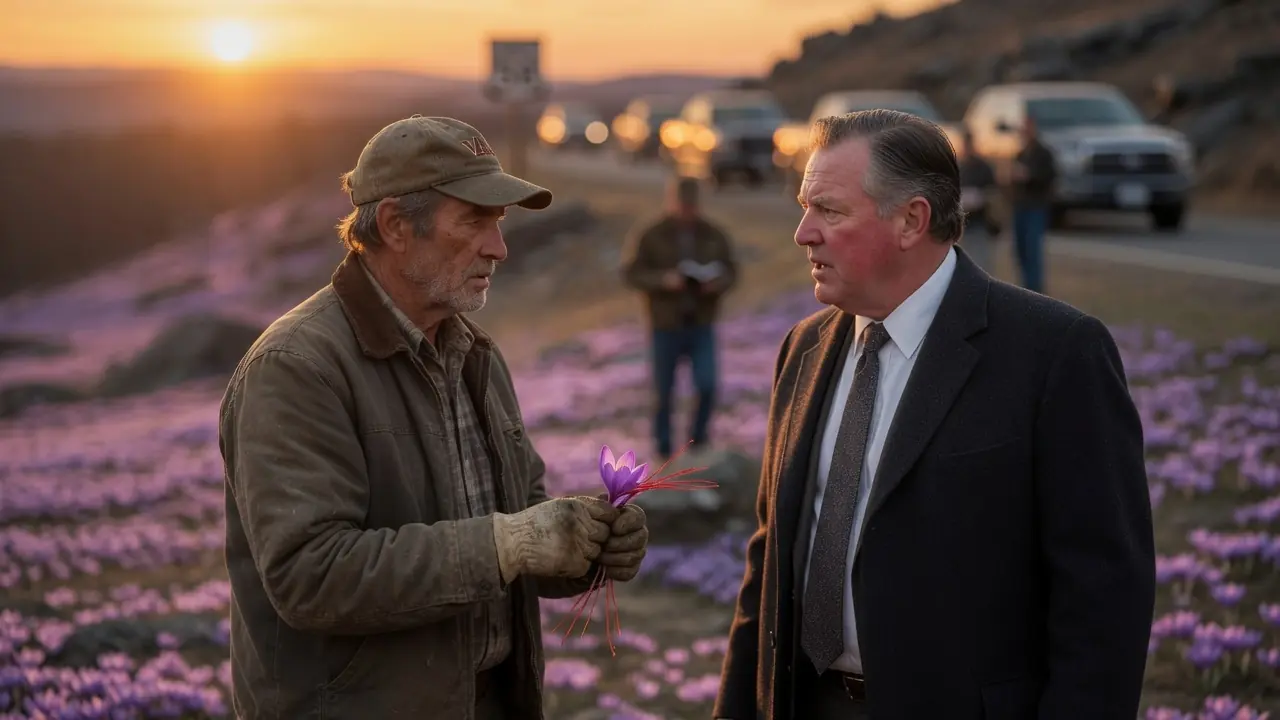
A soil consultant had driven two hours from Blacksburg to walk the upper slope. A representative from a specialty food company in Charlotte visited three times after Emmett rejected his first two offers. Restaurant owners from Asheville called before breakfast, while spice dealers from New York sent emails asking for samples. Even people who had never planted anything more demanding than a backyard tomato were asking questions at the Independence hardware store.
The greatest curiosity came from Wade Drummond.
Wade owned four hundred acres across Meadow Creek and had not spoken to Emmett properly in six years. He had examined the Callaway property before Emmett purchased it, walked the fields once, and declared the land unworthy of serious investment. Now he appeared almost every morning beside the boundary fence, leaning against the posts and squinting across the purple hillside.
Emmett never waved him closer.
He continued working before dawn as though the watching trucks, whispered rumors, and growing line of visitors did not exist. At fifty-nine, he had spent most of his life making careful decisions that other people understood only after the results became impossible to ignore. Silence was not a strategy he had learned for this harvest. It was simply the way he had always worked.
Two years earlier, the forty acres had looked entirely different.
The previous owner had grazed cattle on the same ground for three decades without rotating the pasture or protecting the exposed soil. Heavy hooves had compressed the low fields until rainwater remained near the surface rather than sinking into the ground. The upper slopes held only a shallow layer of topsoil mixed with rock, and erosion had carved narrow paths along the steepest sections. Most local farmers saw damage too expensive to correct.
Wade Drummond had seen it as proof.
“Nothing profitable grows in ground like that,” he told anyone considering the property.
Emmett heard the remark before buying the farm. He did not argue because Wade’s assessment was accurate for the crops Wade understood. Corn would struggle on the upper slopes, commercial hay would produce poorly, and large machinery could not move efficiently across several rocky sections. The land was not suitable for ordinary farming.
That did not mean it was useless.
Emmett had spent twenty years working as a soil technician for the Virginia Cooperative Extension. He had studied compacted fields, nutrient imbalances, poor drainage, erosion, damaged root systems, and the consequences of treating soil like an empty material rather than a living environment. A knee injury eventually forced him away from constant field travel, but it did not remove what he had learned. When he examined the abandoned farm, he saw problems that could be corrected and one unusual advantage nobody else valued.
The rocky upper slopes drained exceptionally well.
Water moved downward quickly without collecting around plant roots. The southern exposure captured enough autumn sunlight, while the mountain nights remained cool. Meadow Creek provided reliable water for the lower fields, and wild ramps growing near the tree line proved that the land still supported delicate seasonal plants. Emmett did not see a failed cattle farm.
He saw the beginning of a specialty crop operation.
He purchased the property for one hundred eighty thousand dollars using savings, a small pension, and nearly every ounce of confidence he possessed. His daughter Clara believed the decision was reckless but knew better than to describe it that way. At thirty-two, she lived in Roanoke and worked as a laboratory manager. She had inherited her father’s patience but not his willingness to explain nothing.
“What exactly are you buying?” she asked when they first walked the property.
“Forty acres.”
“I can see that.”
“Then we agree.”
“Dad, there is more rock than grass up there.”
“Rock is not always the enemy.”
Clara watched him push a soil probe into the lower field and examine the compacted clay. “You have a plan.”
“I have questions.”
“That means you already have half a plan.”
Emmett smiled but offered nothing more.
During the first year, he planted no commercial crop. This decision convinced most neighbors that the purchase had been a mistake. They expected him to sow corn, establish hay, or graze livestock because land was supposed to produce income quickly. Instead, Emmett spent money improving ground that generated nothing.
He ran a subsoiler eighteen inches deep across the compacted lower sections to break the hardpan. He spread truckloads of wood chips along the eroded upper slopes and drilled crimson clover, winter rye, and tillage radish into the open fields. The radish roots pushed through compressed layers, while the clover fixed nitrogen and the rye protected exposed soil from winter rain. Emmett treated the first year not as a lost season but as construction.
People laughed at the feed cooperative.
“He is spending money on dirt,” one farmer said.
Wade answered loudly enough for others to hear. “A man who pays too much for bad land usually spends more trying to prove he was right.”
Emmett stood two aisles away selecting mineral amendments. He heard every word and continued reading the labels. Experience had taught him that defending an unfinished idea only invited people to judge it before the evidence existed. He purchased sulfur, calcium, and small amounts of boron, then drove home without speaking to Wade.
He tested the soil four times through four different laboratories.
The results agreed on the major problems. Organic matter was low, the mineral balance was poor, and biological activity had been reduced by years of neglect. Emmett applied finished windrow compost that smelled like wet forest soil, then measured changes through every season. He did not guess.
Healthy soil was not simply dirt with fertilizer added.
It was a living system in which fungi, bacteria, insects, worms, minerals, moisture, and roots worked together. Mycorrhizal fungi connected plant roots through underground networks and improved access to water and nutrients. Bacteria converted organic material into forms plants could use. Worms created channels, moved nutrients, and allowed air deeper into the profile.
Emmett rebuilt those relationships slowly.
By the following spring, earthworms appeared in places where he had found none the year before. The cover-crop roots reached several inches deeper, and rain soaked into the lower field instead of forming shallow pools. An Extension agent named Dr. Melissa Grant visited twice in one month and cut narrow soil profiles across the property. The root development surprised her.
“You changed this faster than I expected,” she said.
“I did not change it.”
She looked toward him.
“I gave the soil what it needed to change itself.”
Melissa smiled. “That sounds like something you used to tell farmers when you worked for us.”
“They rarely listened.”
“Now you are the farmer.”
“That explains why I listen.”
The mysterious boxes arrived near the end of the second August.
A refrigerated delivery truck stopped beside Emmett’s barn and unloaded temperature-controlled packages from a specialty grower in Pennsylvania. The cartons were small, sealed, and marked only with planting and storage instructions. Wade happened to drive past while Emmett moved them inside.
By supper, half the county knew.
Clara arrived from Roanoke that Friday and found her father kneeling across the upper slope with a planting tool. He was setting small papery corms into the carefully prepared ground, measuring depth and spacing with more attention than many farmers gave expensive seed. She joined him despite his refusal to explain.
They worked until dusk.
At the farmhouse, Clara placed two plates of food on the table and sat across from him. “Dad, what are we growing?”
Emmett looked over his glasses. “Something that needs good soil to do what it is supposed to do.”
“That describes every plant.”
“Then it is an accurate answer.”
“You do realize I am your daughter.”
“I remember the hospital.”
“Why the secrecy?”
Emmett folded his hands around his coffee cup. “Because the market is small, the crop is unusual, and curiosity becomes imitation faster than knowledge becomes competence.”
Clara studied him. “You think someone will copy you before understanding the work.”
“I think people copy harvests, not preparation.”
That was all he said.
By the end of the week, the boxes were empty and the corms disappeared beneath the rocky soil. The hillside showed no sign that anything extraordinary had been planted. Wade drove past repeatedly, while farmers asked questions at the grocery store and county office. Emmett answered none of them.
Wade became increasingly irritated.
He was not a cruel man, but he believed successful farming followed rules he already understood. He measured land through acreage, machinery size, and commodity yield. His four hundred acres produced corn, hay, and enough revenue to support newer equipment, larger loans, and the public confidence that came from operating one of the county’s most visible farms.
Emmett’s silence felt like a challenge.
When the Extension visits became common knowledge, Wade called a county commissioner and asked whether the Callaway farm held the correct permits. Everything was in order. He asked the feed-store manager whether Emmett had purchased unusual chemicals. The manager said Emmett bought only soil amendments and ordinary supplies.
Wade’s wife, Helen, noticed the obsession.
“You said the land was worthless,” she reminded him one evening.
“It is.”
“Then why do you drive past it every day?”
“I use Route 58.”
“You drove five miles out of your way yesterday.”
Wade did not answer.
During the final week of September, the hillside changed overnight.
Purple flowers opened by the thousands across the upper slope. They were small and delicate, spreading between stones in vivid rows that seemed almost impossible against the pale autumn grass. The flowers covered the land Wade had called useless and transformed it into something no one in Grayson County had ever seen at that scale.
Trucks slowed immediately.
Clara arrived before sunset and stopped beside the gate. She had seen photographs during her father’s research but was unprepared for the sight of the entire slope blooming beneath the mountains. Tears filled her eyes before she reached Emmett.
“You planted saffron.”
He stood with both hands inside his jacket pockets. “I did.”
“You could have told me.”
“You would have told no one.”
“Exactly.”
“You would have worried.”
“I worried anyway.”
Emmett looked across the flowers. “Then I saved you from worrying about the correct thing.”
Inside each bloom were three crimson stigmas. When harvested and dried correctly, those thin threads became saffron, one of the most valuable spices in the world by weight. High-quality American-grown saffron with documented origin could sell for thousands of dollars per pound in specialty markets.
But value did not make the crop easy.
The harvest window lasted only about ten days, and every flower needed to be picked by hand before heat and sunlight reduced its quality. Each bloom produced only three usable threads. Tens of thousands of flowers were required to create a single pound of dried saffron.
Emmett woke at four each morning.
Clara brought two friends from Roanoke, and Melissa Grant volunteered during the first weekend. They moved across the rows wearing headlamps and carrying shallow baskets. The work required speed without carelessness because crushing the flowers could damage the valuable stigmas inside.
By sunrise, their fingers were cold and stained yellow with pollen.
They carried each basket to the barn, separated the crimson threads by hand, and placed them into controlled drying trays. Emmett recorded harvest time, field section, moisture level, drying duration, and final weight. He had spent two years creating the soil and refused to lose quality through careless processing.
The first buyer arrived on the third morning.
His name was Owen Price, and he represented a specialty food company in Charlotte. He had learned about the field through a restaurant owner who saw photographs online. Owen inspected the dried saffron, smelled it, rubbed one thread between his fingers, and offered Emmett a price nearly twice what he expected from the first wholesale inquiry.
Emmett refused.
Owen believed he had misunderstood. “I am offering a premium.”
“The harvest is not finished.”
“I can purchase everything available now.”
“No.”
“You may not receive another offer at this level.”
“Then I will learn something.”
Owen returned two days later with a better figure.
Emmett refused again.
By then, an Asheville restaurant group had called, a New York importer requested laboratory samples, and several chefs wanted direct contracts. Emmett did not reject the offers because he wanted a dramatic bidding war. He rejected them because he refused to sell before knowing his final volume and quality.
The field continued attracting visitors.
Pickup trucks lined the highway before dawn, and people stood beside the fence watching Clara and Emmett harvest. Several offered to help without understanding how delicate the work was. Others asked whether Emmett would sell corms immediately.
Wade appeared every morning.
On the sixth day, he finally crossed the boundary fence.
Emmett stood near the barn sealing a small container when Wade approached. The older farmer glanced at the label, then toward the purple hillside.
“You wasted two years and your savings planting flowers on land every real farmer knew was worthless.”
Emmett continued writing the harvest date.
Wade pointed toward the crimson threads. “What did you plant, and why are buyers lining the road?”
“You already know what it is.”
“Saffron.”
“Yes.”
Wade stared at the container. “You think this is farming?”
Emmett looked at him. “The plants grew from soil, and we harvested them. That usually qualifies.”
“You cannot run forty acres by hand.”
“I did not plant all forty.”
“How many acres?”
“Enough for this year.”
Wade lowered his voice. “How much is it worth?”
“Ask me after harvest.”
“You always have to make everything mysterious.”
“No. I simply do not owe every unfinished number to the county.”
Wade watched Owen Price’s vehicle approaching the lane. “You think this hillside will earn more than four hundred acres?”
Emmett sealed the container. “I think you measured the land before understanding it.”
The words landed harder than an insult because Emmett spoke without anger.
Wade looked toward the flowers and then back at the farmer he had mocked for two years. He wanted to argue that saffron was fragile, risky, dependent on specialty buyers, and impossible to expand quickly. Every criticism would have been partly true.
None changed what was growing before him.
On the final harvest morning, Emmett sat on his pickup’s tailgate as sunlight touched the ridge. Eleven pounds of dried saffron rested inside sealed, labeled containers arranged in insulated storage boxes. The final laboratory tests confirmed high quality, strong aroma, excellent color, and low moisture.
At domestic specialty prices, the harvest was worth more than the original purchase price of the farm.
The number did not feel real to Clara.
She sat beside her father and looked repeatedly from the containers to the purple field. “You knew this could happen.”
“I knew it was possible.”
“That is not the same thing.”
“No.”
“You risked almost everything on possibility.”
Emmett shook his head. “I risked part of my savings after twenty years of soil work, two years of market research, four laboratory reports, and a purchase contract for planting material.”
Clara smiled. “You make courage sound boring.”
“Good courage usually is.”
Emmett did not sell everything to one buyer.
He divided the harvest among a Charlotte specialty company, the Asheville restaurant group, two regional chefs, and a smaller direct-sale program under the Callaway Ridge name. Keeping multiple buyers reduced dependency and allowed him to learn which market valued quality rather than merely scarcity. He kept enough saffron for laboratory samples, future promotion, and local sales.
The money paid the remaining farm debt.
It also funded a proper processing room, improved irrigation, and a second soil-restoration area that would not be planted for two more years. Emmett refused to rush expansion simply because the first harvest succeeded. He believed the quickest way to ruin a specialty crop was to mistake demand for permission to ignore preparation.
Wade said nothing publicly for several weeks.
Then one cold November afternoon, his truck appeared in Emmett’s driveway. He stepped onto the porch carrying no paperwork, no questions from other farmers, and none of the confidence he displayed at the cooperative. Emmett opened the door but did not invite him inside immediately.
“Do you have a few minutes?” Wade asked.
“That depends.”
“I came to listen.”
Emmett stepped aside.
They sat on the porch for more than an hour while Meadow Creek moved below the bare trees. Wade asked about soil structure, drainage, corm costs, planting density, labor, disease pressure, processing, and buyers. Emmett answered every serious question.
“You could have embarrassed me at the fence,” Wade said eventually.
“I was busy.”
“I told everyone the land could not grow anything profitable.”
“You were correct about corn and hay.”
“That is generous.”
“It is accurate.”
Wade looked toward the upper slope. “I judged the land by what I already knew how to grow.”
“Yes.”
“You saw what fit the land instead of forcing the land to fit you.”
Emmett nodded.
The admission seemed to relieve something inside Wade. “Would saffron work on my south ridge?”
“I do not know.”
“You have seen it.”
“I have not tested it.”
Wade laughed quietly. “Of course.”
Emmett offered to help him take soil samples, but he warned that copying the crop without rebuilding the ground would likely fail. Wade accepted the warning. For the first time in years, he listened without trying to prove he already understood the answer.
The county commissioner later asked to feature Callaway Ridge in an agricultural development report. Emmett agreed only if the report emphasized soil restoration, market research, labor demands, and risk rather than presenting saffron as an easy miracle crop. He did not want desperate farmers believing purple flowers could rescue neglected land without years of preparation.
Clara began traveling from Roanoke every weekend.
By spring, she had reduced her laboratory hours and started developing quality-control procedures for the farm. She studied packaging, traceability, and direct sales while Emmett prepared another hillside through cover crops and compost. Neither expected the operation to become large quickly.
That was the point.
The next autumn brought another bloom.
The harvest was smaller because Emmett divided several corm beds for future planting. Yet quality remained high, buyers returned, and local chefs began featuring Callaway Ridge saffron in seasonal dishes. The farm became known not because it produced the cheapest spice, but because every container could be traced to a specific field and harvest morning.
Pickup trucks still slowed along Route 58.
Some visitors came to purchase small jars. Others wanted to see the purple flowers and ask whether they could grow saffron themselves. Emmett answered honest questions but refused to encourage anyone seeking quick money.
One young farmer asked him for the secret.
Emmett pointed toward a field covered only in winter rye.
“That is the secret.”
The visitor looked confused. “There is nothing valuable growing there.”
“Not yet.”
A year earlier, the town had lined the road desperate to know what Emmett planted. By then, many understood that the crop itself had never been the full answer. The true work had happened during the seasons when the land appeared empty.
Emmett restored soil before asking it to produce.
He studied markets before trusting them.
He chose a crop suited to the ground rather than one suited to local expectations.
Wade Drummond eventually converted six acres of his south ridge into a soil-restoration trial. He did not plant saffron immediately, and whenever someone asked what he intended to grow, he gave an answer Emmett recognized.
“Something the land is ready for.”
The first time Emmett heard it, he smiled but said nothing.
By the fifth harvest, Callaway Ridge employed eight seasonal workers and supplied restaurants across four states. Clara returned to Grayson County permanently and built a small laboratory beside the barn. The original forty acres remained modest compared with Wade’s operation, but the income from the specialty crop supported the farm without massive equipment loans or endless expansion.
Emmett still woke before sunrise.
He carried coffee in one hand and a soil probe in the other, walking the fields before the road filled with visitors. He checked moisture, soil structure, plant health, and the conditions beneath the surface that nobody passing in a pickup could see.
The land had never been worthless.
It had been misunderstood.
Most people saw rocky slopes, depleted clay, and decades of neglect, then calculated failure according to familiar crops. Emmett saw drainage, climate, biology, chemistry, and hidden capacity. He did not plant a miracle.
He created the conditions in which an unusual crop could succeed.
When the purple flowers finally opened, the entire county wanted to know what he had planted.
Emmett’s answer was larger than saffron.
He had planted patience before the first corm entered the ground.
He had planted knowledge while others planted doubt.
And by harvest, the land returned both in a form valuable enough to make everyone who dismissed it stand along the fence and finally look again.