The locked door handle moved once.
Marcus Reed heard the latch hold from inside the living room and stopped several feet behind the large front window. Karen Whitmore’s hand came away from the knob, not in embarrassment but in irritation, as though the lock were an inconvenience someone else had carelessly left in her path.
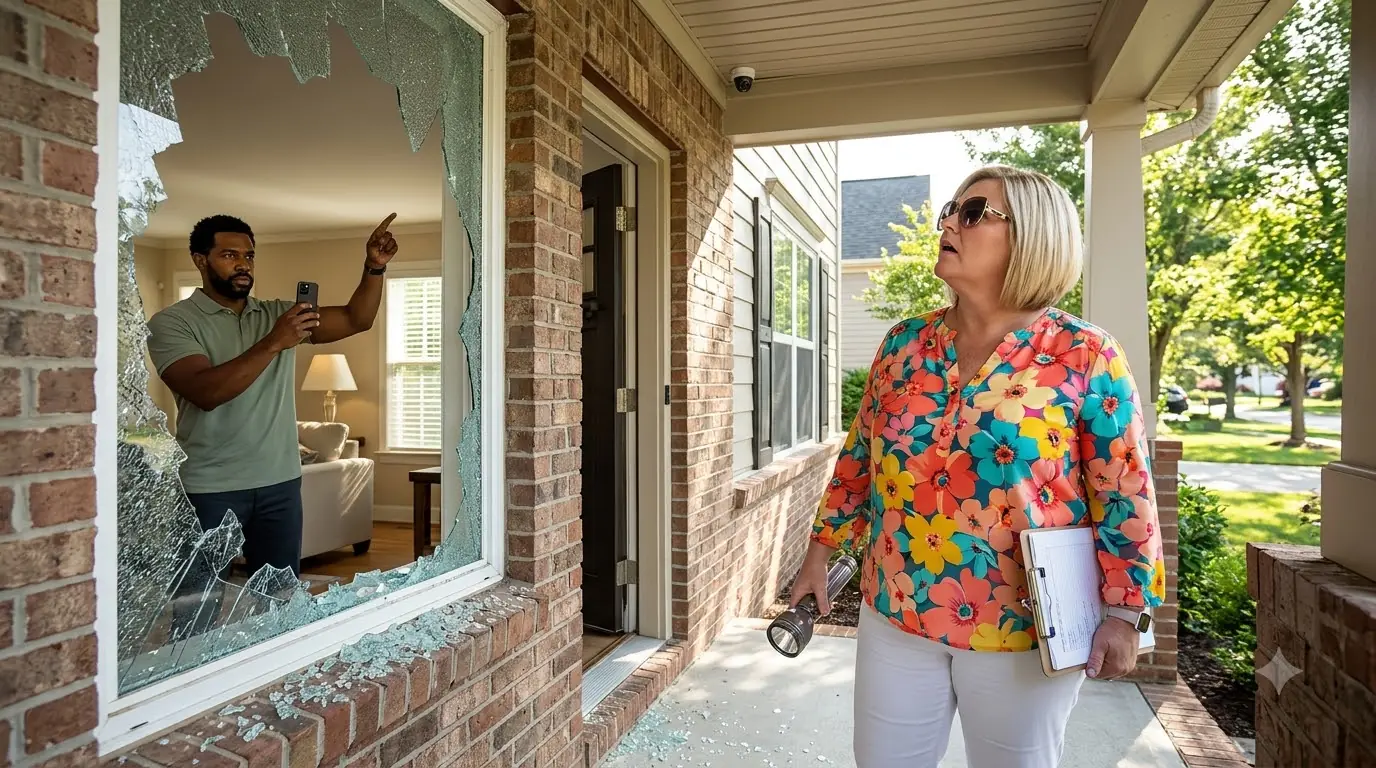
Then she turned toward the glass.
A heavy metal flashlight hung from her right hand.
Until that moment, Marcus had been more irritated than concerned. The afternoon had begun quietly, one of those rare stretches of weekend time that felt almost suspicious in a neighborhood where somebody always seemed to be mowing, drilling, blowing leaves, or discovering a new reason to send an email with the word compliance in the subject line.
He had finished a few things around the house, put away a tool bag from the garage, and changed out of a dusty shirt into a sage green polo and charcoal trousers. Sunlight came through the living-room window in a broad warm stripe, touching the floor near the sofa and catching on the edge of a framed photograph he had been meaning to straighten for three days.
There was nothing unusual about the room.
That mattered because Karen Whitmore had a way of making ordinary things sound like evidence.
A chair stood a little farther from the wall than Marcus preferred. A stack of unopened mail waited on a side table. One sneaker had been kicked near the staircase that morning and forgotten. The house held the ordinary evidence of a person living in it rather than preparing it for inspection.
At forty-three, Marcus valued that distinction more than most people understood.
He had worked enough, moved enough, paid enough, and dealt with enough other people’s expectations to appreciate the simple freedom of deciding what happened inside his own front door. He was tall and broad-shouldered, with short curls and a neatly trimmed beard, and he carried himself with the practiced calm of a man who had learned years ago that anger is easiest to lose control of when another person wants you to display it.
Karen wanted that from him often.
She was forty-nine, white, stocky, square-faced, with a short auburn bob and green eyes that seemed to sharpen whenever she thought a rule had become personal. Today she wore a coral blazer over a white blouse, beige trousers, and brown loafers. A clipboard was tucked under her left arm.
The flashlight rested beside her thigh.
Marcus noticed it because the day was bright.
The porch was brightly lit.
No bulb had burned out. No corner was dark. She was not looking beneath a step or checking a meter box. She had brought the flashlight for some other reason, and he did not yet know what that reason was.
He remained inside.
There was a practical reason for that too.
The large front window gave him visibility without surrendering space. He could see Karen clearly. She could see him. If she had something legitimate to say, there was no obstacle to saying it. Marcus had no intention of opening the door simply because she had arrived assuming he would.
That assumption had been the entire problem between them for months.
Karen’s attention moved past him into the living room before she spoke. The furniture. The wall. The staircase. The interior doorway beyond. Her eyes moved as if she were already conducting a task Marcus had agreed to.