The laughter started before Virgil Moss had even lowered his hand.
It was a hot Saturday morning at the Harper County Farm Machinery Auction, and nearly two hundred farmers, mechanics, collectors, and dealers had crowded into the gravel lot behind an old metal equipment shed. Rows of tractors stretched beneath the bright sky, some polished for collectors and others dragged from barns where they had sat untouched for decades. At the far end of the yard, rusting crookedly on a flatbed trailer, sat the machine nobody wanted.
It was an old Chamberlain 9G.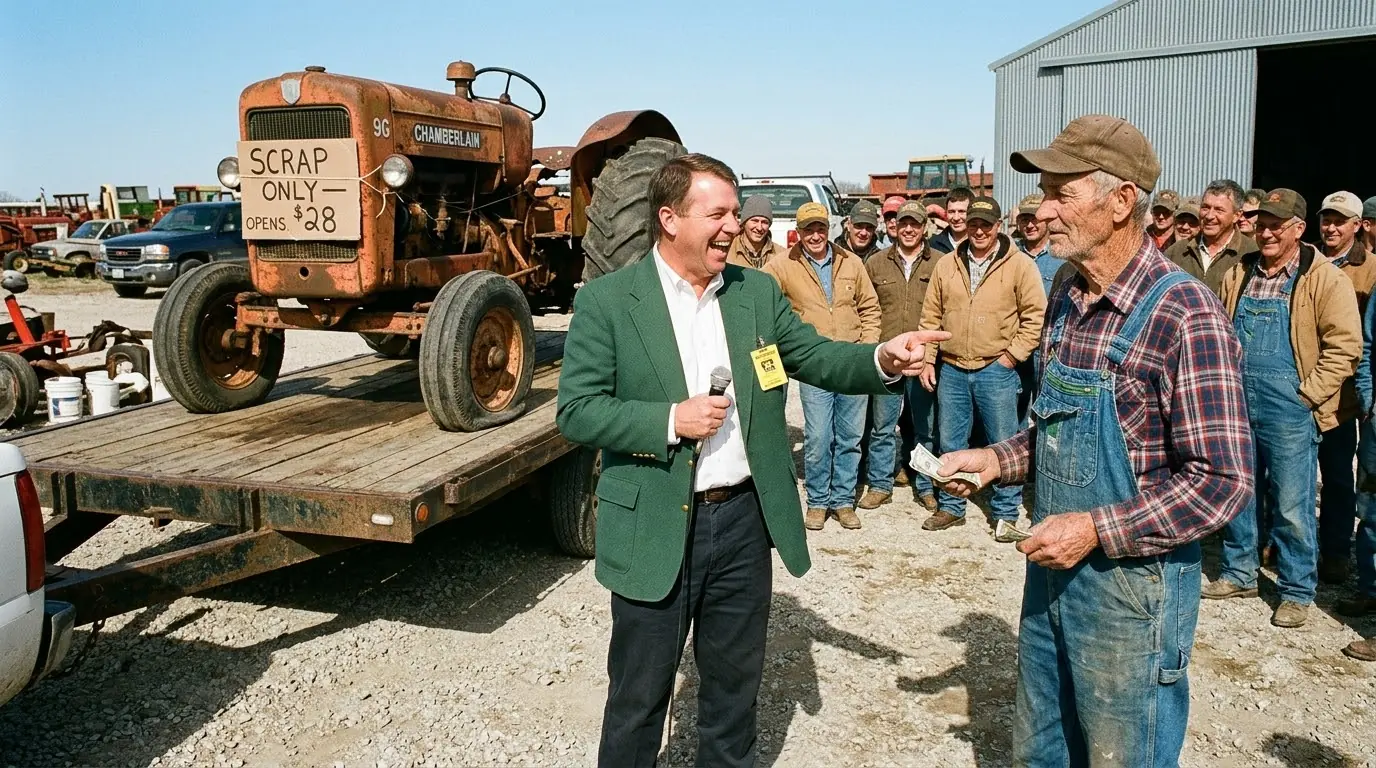
The faded orange paint had turned almost brown in places. Rust covered the hood, one headlight hung at an angle, the seat was cracked, and weeds were still tangled around the rear axle from wherever it had been abandoned. Someone from the auction crew had tied a piece of cardboard to the grille with wire.
SCRAP ONLY — $28 OPENS.
Auctioneer Stephen Cole climbed onto the trailer with a microphone in one hand.
Stephen loved moments like this. He was fifty-one, loud, theatrical, and experienced enough to know that an auction crowd needed entertainment between serious purchases. If a machine was worthless, Stephen turned it into a joke before sending it away.
He slapped the tractor hood.
“Gentlemen, I’m not even going to insult you by calling this agricultural equipment.”
The crowd laughed.
Stephen smiled.
“This Chamberlain 9G is scrap. We’re opening at twenty-eight dollars for parts value only. Anybody want twenty-eight dollars’ worth of Australian rust?”
More laughter.
Nobody raised a hand.
Stephen waited.
“Come on. Twenty-eight dollars. You could make a mailbox out of the hood.”
A hand rose near the back.
The crowd turned.
Virgil Moss stood beside his twenty-one-year-old grandson Jake.
At seventy-three, Virgil was lean, weathered, and permanently bent slightly forward from decades spent working around engines and fields. His gray hair was hidden beneath an old canvas cap, and he wore faded blue overalls over a plaid shirt washed so many times that nobody could identify its original color. His expression did not change as the entire auction yard looked at him.
Stephen stared.
“Virgil?”
Virgil nodded.
“Twenty-eight.”
Stephen laughed into the microphone.
“Well, gentlemen, apparently we found our optimist.”
Several farmers clapped.
Virgil ignored them.
“Anybody give me thirty?”
Silence.
“Twenty-nine?”
Nothing.
Stephen raised his gavel.
“Sold for twenty-eight dollars to Virgil Moss, the bravest man in the county.”
The gavel struck.
The crowd laughed again.
Jake covered his face with one hand.
“Grandpa.”
Virgil started walking toward the trailer.
Jake hurried after him.
“You actually bought it.”
“Yes.”
“You told me you were only looking.”
“I looked.”
“And then you spent twenty-eight dollars.”
Virgil glanced at him.
“That’s generally how buying works.”
Jake laughed despite himself.
Nearby, Carl Briggs approached.
Carl owned one of the largest farms in the county and had repaired machinery nearly as long as Virgil had, although Carl preferred newer equipment and considered anything older than twenty years a burden. He stopped beside the Chamberlain and looked at Virgil as though examining a man who had lost his judgment.
“Virgil, that thing hasn’t run in thirty years.”
“Closer to twenty-two.”
Carl laughed.
“How in God’s name would you know that?”
Virgil placed one hand on the tractor hood.
“Fuel system.”
“What about it?”
“Carbon pattern.”
Carl stared at him.
“You’re dating a dead tractor by soot?”
“Not dead.”
Carl pointed toward the rust.
“You’re looking at it.”
Virgil shook his head.
“Surface rust isn’t a diagnosis.”
“What is it?”
“A color.”
Several men nearby laughed, assuming Virgil had made a joke.
He had not.
Two days earlier, Virgil had arrived at the auction preview before most buyers.
He had walked past three restored John Deeres, an almost-new combine, several balers, and a row of diesel tractors that would eventually sell for thousands of dollars. Then he saw the Chamberlain.
Almost everyone else walked around it.
Virgil walked toward it.
He had first worked on diesel engines at eleven years old, standing beside his father on an apple crate because he was too short to see over the workbench. By fifteen, he could diagnose common fuel problems by sound. By thirty, neighboring farmers were bringing tractors to the Moss farm because Virgil was usually cheaper than a dealership and, more importantly, rarely replaced anything that could still be repaired.
He crouched beside the Chamberlain for forty minutes.
He checked the block for obvious cracks.
None.
He examined the fuel line.
Dirty, but complete.
Injector assembly.
Carbon buildup.
Expected.
Oil.
Old.
No obvious water contamination.
Then Virgil put a bar against the engine and carefully turned it.
The engine moved.
Slowly.
But freely.
He stood.
Jake, who had been filming random equipment on his new handheld video camera, asked what he had found.
“Engine turns.”
“So?”
Virgil wiped his hands.
“Seized engines don’t.”
Jake looked at the rust.
“It still looks dead.”
Virgil shook his head.
“You kids trust appearances too much.”
Jake was twenty-one, not twelve, but knew arguing with his grandfather about age was useless.
“How much would you pay?”
Virgil looked at the tractor.
“Twenty-eight.”
Jake laughed.
“What if they want fifty?”
“Then someone else can have it.”
“Why exactly twenty-eight?”
“That’s what scrap man offered the estate.”
“How do you know?”
“Tag.”
Jake looked.
A small auction note listed SCRAP ESTIMATE $28.
Virgil smiled.
“If everybody thinks it’s scrap, I’ll pay scrap.”
Saturday proved him right.
After the auction, Virgil handed Stephen twenty-eight dollars in folded bills.
Stephen counted them dramatically.
“One, five, ten…”
Virgil watched.
“Need help?”
Stephen laughed.
“You understand there are no refunds.”
“Wouldn’t ask.”
“If that tractor falls apart on your trailer, that’s your problem.”
“Everything becomes your problem after you buy it.”
Carl stood nearby smiling.
“Virgil, I’ll give you thirty right now.”
“For what?”
“The entertainment.”
Virgil pocketed the receipt.
“No.”
“Thirty-five.”
“No.”
Carl raised his hands.
“You already made seven dollars.”
Virgil climbed onto the trailer.
“I didn’t buy it to sell.”
“What are you going to do?”
“Run it.”
That produced the loudest laughter of the day.
Jake filmed everything.
That evening, mostly as a joke, he edited the footage into a short video and uploaded it online.
He titled it:
GRANDPA PAID $28 FOR A TRACTOR EVERYONE CALLED DEAD.
Jake expected family members and perhaps several dozen local people to watch it.
By Sunday morning it had been viewed nearly four hundred thousand times.
Jake believed the counter was broken.
By Monday afternoon, it had crossed two million.
People were fascinated by the old farmer standing among laughing auction buyers while insisting that the engine was not dead. Comments arrived from farmers in Australia, mechanics in Canada, collectors in England, and teenagers who had never seen a tractor older than themselves.
Most repeated one line.
Surface rust isn’t a diagnosis. It’s a color.
Virgil knew none of this.
He did not own a computer.
Jake found him Monday morning beneath the machine shed, already removing the Chamberlain’s injector assembly.
“Grandpa.”
Virgil kept working.
“You’re famous.”
“No.”
“Four million people watched the auction video.”
Virgil stopped.
“Four million people have nothing better to do?”
Jake laughed.
“They want to know if it runs.”
“So do I.”
Virgil returned to the injector.
“What are you doing?”
“Cleaning it.”
“Can I film?”
Virgil shrugged.
“Don’t get in the way.”
The restoration began without ceremony.
No professional shop.
No expensive diagnostic computer.
No complete restoration manual.
Virgil placed the tractor beneath the shed, arranged his basic tools along a wooden bench, and began working through the machine one system at a time.
He never attempted to start it immediately.
Jake asked why.
Virgil looked at him as though the question itself might damage the engine.
“You wake up after twenty-two years, you want somebody making you sprint?”
Jake lowered the camera.
“So what comes first?”
“See what works.”
Virgil removed the injectors.
Carbon had built around the tips.
He cleaned them carefully.
Then he drained the fuel system.
The diesel that emerged smelled terrible and looked closer to varnish than fuel.
Jake filmed Virgil holding the jar toward the light.
“That’s bad, right?”
“That’s old.”
“Difference?”
“Bad means broken.”
Virgil placed the jar aside.
“Old means old.”
He flushed the tank.
Replaced cracked fuel line sections.
Cleaned the filter housing.
Inspected the pump.
The Chamberlain 9G had been built during an era when equipment designers expected farmers to repair machinery in the field. Its diesel engine relied on mechanical systems that could be disassembled, cleaned, measured, and rebuilt without electronic control units or specialized software. To Virgil, that simplicity was not primitive.
It was honest.
“You can see what’s wrong,” he told Jake.
Day four, the injectors were finished.
Day seven, Virgil replaced degraded sleeve seals.
Day eleven, the fuel system was clean.
Jake continued filming.
Online, the videos became increasingly popular.
People argued over whether the tractor would run.
Some mechanics insisted the engine would have lost compression after sitting so long.
Others believed the fuel pump would fail.
Several people offered Jake money for the tractor before Virgil ever attempted to start it.
Jake rejected all offers without asking.
He already knew the answer.
On day twelve, a woman called.
“My name is Diane Fuller.”
Jake recognized it.
Diane was a vintage machinery appraiser whose name appeared regularly in collector magazines.
“I saw your grandfather’s tractor.”
Jake laughed.
“So did four million other people.”
“I’m not calling because of the video.”
“Why are you calling?”
“Because he said twenty-two years.”
Jake frowned.
“What?”
“The tractor. He said it hadn’t run for closer to twenty-two years, not thirty.”
“Yeah.”
“How did he know?”
“Carbon pattern.”
There was silence.
Then Diane said, “Any man who claims he can estimate storage time from injector carbon either knows exactly what he’s looking at or is completely insane.”