Captain Elena Vance entered the packed Virginia federal courtroom with steel around her wrists and a silence so heavy that even the reporters stopped whispering. Every polished shoe, every camera, every grieving relative seemed turned toward her as though the verdict had already been decided, and across the aisle sat the man who had made that possible. General Arthur Vance wore four stars, forty-one years of reputation, and the smallest trace of satisfaction on his face. He was also Elena’s father.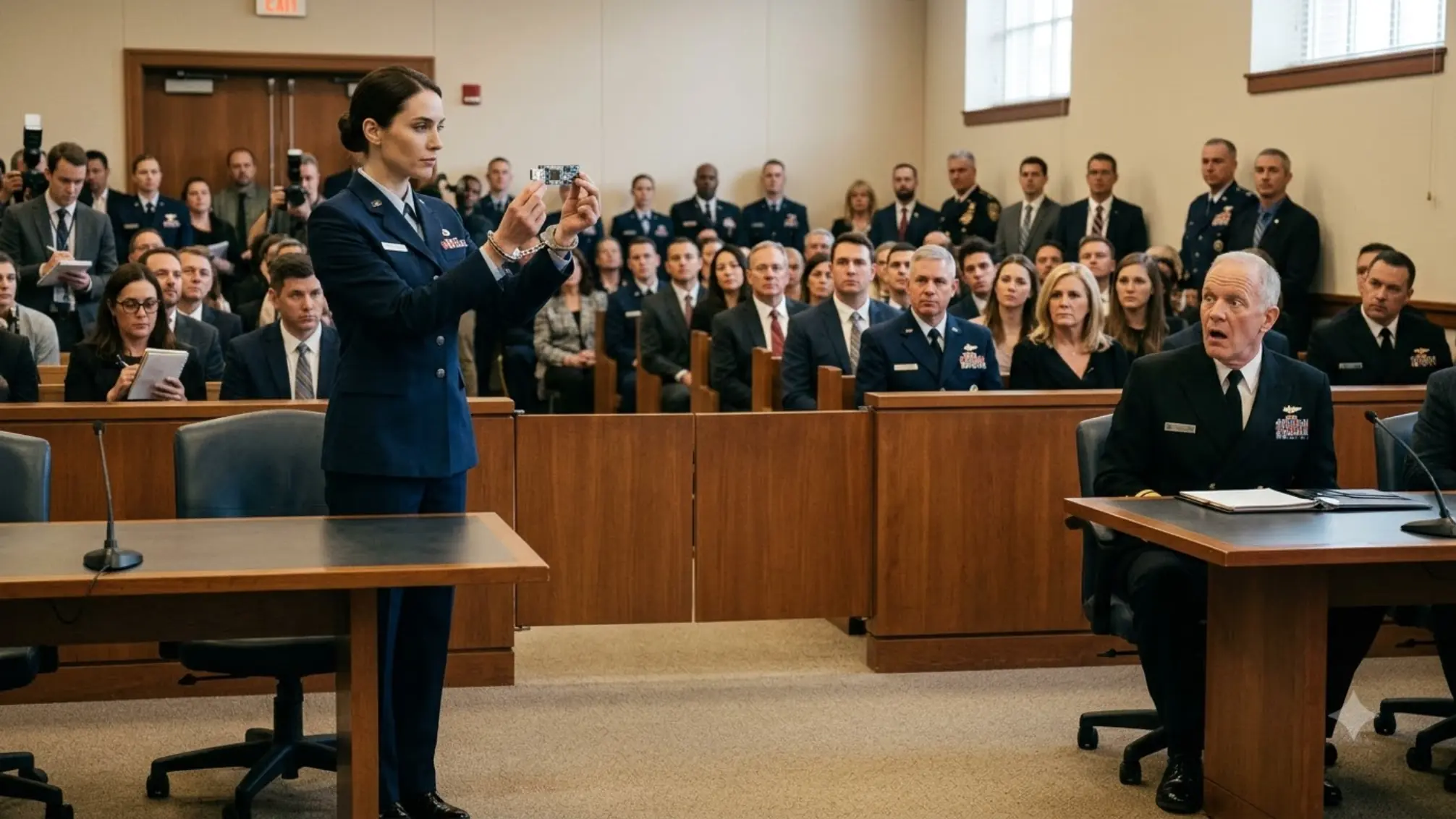
Three men had died at Checkpoint Echo. Their families had been told Elena abandoned them during the attack, shut down communications, and fled toward an extraction zone while Miller, Hayes, and Jenkins remained behind. The official drone footage seemed to prove it: Elena’s heat signature moved away from the compound, disappeared behind the western ridge, and twenty minutes later the position was lost. What the video did not show were the forty-five seconds somebody had removed.
Judge Marcus Harrison looked down from the bench. “Captain Vance, how do you plead?”
Her court-appointed attorney, Daniel Reynolds, leaned close enough that his voice barely reached her. “The government is offering life with review after thirty years. Take it before they withdraw it.”
Elena kept her eyes on Arthur.
“Not guilty.”
The courtroom erupted.
A woman in the front row cried out that her husband had trusted Elena. Another man shouted that his son had died because of her. The judge hammered his gavel until the room settled again, while Elena remained completely still beneath the weight of every accusation.
Arthur never looked concerned.
That frightened her more than anger would have.
The prosecution called him first.
General Arthur Vance walked to the witness stand with the effortless command of someone who had spent decades entering rooms where everyone else straightened automatically. His silver hair was perfect, his dark formal uniform immaculate, and every ribbon seemed carefully positioned to remind the jury panel that the man speaking had spent most of his adult life being believed.
Colonel Nathaniel Price approached him.
“General, what happened at Checkpoint Echo?”
Arthur lowered his eyes with practiced grief.
“Leadership failed.”
Elena watched his face.
He continued.
“Captain Vance was ordered to maintain the position until reinforcement arrived. Instead, she left the defensive perimeter and moved toward an extraction point without authorization. The soldiers under her command were overwhelmed shortly afterward.”
Daniel shifted beside Elena.
The words were devastating because Arthur delivered them without hatred. He sounded disappointed rather than vindictive, like a senior officer reluctantly condemning someone whose failure had personally wounded him.
Price activated the courtroom monitor.
The drone footage began.
Elena saw Checkpoint Echo from above.
Miller near the communications shelter.
Hayes at the eastern barrier.
Jenkins running across the yard.
Then Elena herself.
The recording distorted.
Forty-five seconds disappeared.
When the image returned, Elena’s heat signature was already moving west.
Price paused the footage.
“General, did Captain Vance have authorization to leave?”
“No.”
“Did she request extraction?”
“No.”
“Did you speak directly to her that day?”
Arthur did not hesitate.
“No.”
Elena’s entire body went cold.
Of every lie he had told, that was the one she needed.
Daniel leaned toward her. “What?”
Elena barely moved her lips.
“He just buried himself.”
Arthur finished his testimony with the same composed expression he had worn when Elena entered the courtroom. Price returned to his table, confident enough to place one hand casually against the chair. The judge looked toward Daniel.
“Cross-examination?”
Daniel stood.
He glanced once at Elena.
She whispered, “Ask about communications suspension.”
Daniel approached the witness stand.
“General Vance, was there any regional communications restriction issued before the attack?”
“No.”
“Any frequency jamming?”
“Not to my knowledge.”
“Any classified directive involving Checkpoint Echo that afternoon?”
Price rose immediately.
“Objection. Classified operational matters without foundation.”
“Sustained,” Harrison said.
Daniel stepped backward.
Elena watched Arthur.
He had expected that objection.
Of course he had.
The entire case had been built around classification. The truth lived behind doors Elena was legally forbidden to open, and Arthur understood her training well enough to know that she would rather destroy herself than expose protected operations casually.
He had made loyalty into a weapon.
Daniel returned to the table.
“We have nothing.”
Elena looked toward her father.
“We have his voice.”
Daniel frowned.
“What voice?”
Elena said nothing.
Not yet.
The prosecution called additional witnesses throughout the morning. An intelligence analyst confirmed that Elena’s primary communications terminal stopped transmitting before the attack. A drone technician testified that the footage had been collected automatically and stored in the regional system.
Daniel asked whether the recording contained any unexplained gap.
The technician hesitated.
“There is data corruption.”
“How much?”
“Approximately forty-five seconds.”
The courtroom became quieter.
Price immediately redirected.
“Is data loss unusual in operational environments?”
“No.”
“So the gap itself proves nothing.”
“That is correct.”
Arthur looked toward Elena.
For the first time, she saw him touch the front of his jacket with two fingers.
The old signal.
When Elena was a child, he used it during official dinners and public ceremonies.
Stand straight.
Stay quiet.
Do not embarrass me.
Elena stared back.
Not this time.
During the lunch recess, Daniel followed her into a secure consultation room.
“What are you hiding?”
Elena sat with her wrists still secured.
“Something Miller gave me.”
Daniel’s face tightened.
“What?”
“A drive.”
His chair scraped backward.
“You have evidence?”
“I have what he recorded.”
“Where?”
Elena looked toward the guards outside the glass.
Daniel’s eyes widened.
“You brought it into court?”
“Yes.”
“Are you insane?”
“Possibly.”
“Why didn’t you give it to me?”
“Because I didn’t know who was compromised.”
Daniel stared at her.
“You thought I might be?”
“I thought everybody might be.”
His anger faded.
That answer made sense.
“How did you keep it through detention?”
“Boot lining.”
“Do they know?”
“No.”
“What’s on it?”
Elena exhaled slowly.
“I haven’t seen everything.”
Daniel looked horrified.
“You’re risking your life over evidence you haven’t fully reviewed?”
“Miller died protecting it.”
“That doesn’t answer me.”
“It’s enough.”
Daniel stood and paced.
“If this contains classified information, introducing it improperly could create another charge.”
“I know.”
“If it contains operational secrets unrelated to the case, the judge could seal everything before the jury sees it.”
“I know.”
“And if Arthur already knows it exists—”
“He doesn’t.”
Daniel stopped.
“How can you be certain?”
Elena looked at him.
“Because he smiled when he lied.”
The afternoon session began with Sarah Miller, widow of Staff Sergeant Evan Miller.
She walked to the witness stand holding the folded flag she had carried every day since the funeral.
Elena could barely look at her.
Sarah testified about her husband’s final call three days before the attack. He had told her Elena was the best officer he had ever served under. He had trusted her completely.
Price used that trust against Elena.
“Mrs. Miller, did your husband ever suggest he planned to abandon Checkpoint Echo?”
“No.”
“Did he suggest he feared Captain Vance?”
“No.”
“And how did you feel when you learned she had left?”
Sarah’s eyes filled.
“I thought she killed him.”
The sentence struck Elena harder than everything Arthur had said.
Then Daniel stood.
“Mrs. Miller, did your husband ever discuss unusual activity near the checkpoint?”
Price objected.
The judge allowed limited questioning.
Sarah wiped her eyes.
“He said trucks were moving at night.”
Arthur’s face changed slightly.
Daniel noticed.
“What trucks?”
“He didn’t know.”
“Did he photograph them?”
Sarah looked confused.
“He said Jenkins had gotten pictures of something they weren’t supposed to see.”
Price stood.
“Objection. Hearsay.”
“Sustained.”
Daniel looked toward Elena.
There it was.
A door.
Small.
But open.
Sarah stepped down.
As she passed Elena, she did not look at her.
Elena understood.
The next witness was the regional communications officer.
His name was Major Franklin Tate.
He testified that no authorized jamming occurred near Checkpoint Echo.
Daniel asked whether unauthorized jamming was technically possible.
“Yes.”
“Could central command initiate it?”
Tate hesitated.
“Yes.”
“Would records exist?”
“They should.”
“Do they?”
Another hesitation.
“I was told the archive was damaged during a cyber incident.”
Daniel returned to the defense table.
Elena leaned toward him.
“Now.”
He looked at her.
“Are you sure?”
“No.”
“That’s not comforting.”
“Do it anyway.”
Daniel stood.
“Your Honor, defense requests permission to introduce newly discovered physical evidence.”
The courtroom changed instantly.
Price rose.
“What evidence?”
Judge Harrison looked irritated.
“Major Reynolds, approach.”
Daniel walked to the bench.
Elena remained seated.
Arthur watched him.
For the first time, his face no longer looked completely relaxed.
Daniel spoke quietly with the judge.
Price joined them.
Then Harrison looked toward Elena.
“Captain Vance, do you personally possess this evidence?”
“Yes, Your Honor.”
“Where?”
Elena looked directly at Arthur.
“In my right boot.”
A murmur moved through the gallery.
The judge ordered an officer to retrieve it.
Elena shook her head.
“With respect, Your Honor, I want my attorney to remove it.”
Price laughed.
“This is absurd.”
Elena looked toward the bench.
“The evidence may have been the target of prior destruction attempts.”
That killed the laughter.
Harrison stared at her.
Then nodded.
Daniel knelt beside her chair.
Elena lifted her foot slightly.
He carefully pulled back the hidden interior seam inside the boot.
A tiny black USB drive slid into his palm.
Arthur stopped breathing.
Elena saw it.
So did Daniel.
The general’s eyes were fixed on the drive.
Elena lifted her cuffed hands.
Daniel placed the USB between her fingers.
She raised it.
Arthur’s face drained.
Elena spoke.
“General Vance.”
The judge immediately snapped, “Captain, address the court.”
But Elena did not look away.
Arthur’s composure was cracking.
Elena’s voice remained low.
“You testified you never spoke to me that day.”
Arthur stared.
“Yes.”
“Good.”
She raised the drive slightly higher.
“Say it one more time.”
Price shot to his feet.
“Objection!”
Harrison struck the gavel.
“Captain Vance!”
Arthur’s voice came before anyone could stop him.
“Where did you get that?”
Silence.
Complete.
The courtroom froze.
Elena held his gaze.
“From the forty-five seconds you forgot to erase.”
Arthur realized the mistake immediately.
He had recognized evidence he supposedly knew nothing about.
Price sat down slowly.
Daniel looked toward the judge.
“Your Honor, we request immediate preservation and forensic examination.”
Harrison stared at Arthur.
Then at the drive.
“Granted.”
Arthur stood.
“This material may contain information subject to the highest classification restrictions.”
Daniel turned sharply.
“How would you know what it contains?”
Arthur stopped.
Second mistake.
The judge noticed.
“General Vance, sit down.”
Arthur obeyed.
For the first time in Elena’s entire life, her father looked small.
The court recessed under emergency seal while cleared forensic personnel examined the drive. Every copy was hashed, logged, and duplicated under chain-of-custody procedures. The courtroom remained locked down while reporters were temporarily prohibited from transmitting details.
Nearly three hours passed.
Then Judge Harrison returned.
His expression had changed.
So had Price’s.
The prosecutor looked physically ill.
Harrison spoke slowly.
“Portions of the drive contain material relevant to the charges against Captain Vance.”
Arthur closed his eyes.
The court authorized limited playback.
The first file was audio.
Static filled the speakers.
Then Elena’s voice.
“My people are still here.”
Arthur’s recorded voice answered.
“You are ordered to leave the position immediately.”
The courtroom went dead silent.
Elena heard the memory before she heard the recording.
“The directive is final.”
“They will die.”
A pause.
Then Arthur’s voice:
“Some losses are operationally necessary.”
Sarah Miller gasped.
David Hayes Sr. stood before a court officer forced him back into his seat.
Arthur stared at the floor.
The audio continued.
Elena refusing extraction.
Another voice ordering the communications network cut.
Then rotor noise.
The missing helicopter.
The forty-five seconds.
The second file showed helmet-camera footage from Miller.
Three trucks moved through a corridor beyond Checkpoint Echo.
Crates were unloaded.
Jenkins whispered something behind the camera.
“Those markings are ours.”
Miller zoomed in.
American inventory numbers.
Weapons transferred through an operation never disclosed in the official mission summary.
The third file was worse.
A recorded conversation between Arthur and another senior official.
“They photographed the convoy.”
“What about Vance?”
“She’ll obey.”
“And if she doesn’t?”
Arthur’s answer:
“She always has.”
Elena closed her eyes.
That sentence hurt more than every charge.
Her father had not simply used authority against her.
He had used what he believed he knew about her character.
He knew she would protect classified operations.
He knew she would follow procedure.
He knew she would remain silent rather than expose sensitive information publicly.
He had built the trap around her integrity.
Price stood.
His voice shook.
“Your Honor, the prosecution requests an immediate recess and independent review of all charges.”
Daniel looked at Elena.
She barely breathed.
Judge Harrison did something nobody expected.
He ordered Elena’s restraints removed.
The marshal approached.
Metal opened around her wrists.
The cuffs came away.
For the first time in weeks, Elena rubbed the marks beneath them.
Arthur watched.
Harrison turned toward him.
“General Vance, you are not to leave this building.”
Arthur looked up.
“Your Honor—”
“That was not a request.”
Two federal officers moved toward him.
The gallery exploded again.
This time nobody shouted at Elena.
Sarah Miller stood in the front row staring at her.
Their eyes finally met.
Elena looked away first.
She could face her father.
She was not yet ready to face the widow.
The criminal case against Elena collapsed within forty-eight hours.
All charges connected to abandonment and dereliction were dismissed.
The destruction-of-classified-material allegation disappeared when forensic investigators proved Elena’s equipment had been seized and altered after extraction.
Then the investigation expanded.
The hidden weapons-transfer program had operated for nearly three years through layers of classified authorities, shell contractors, and falsified mission descriptions. Not everyone involved understood the full purpose, but enough senior officials had manipulated records to create a disaster once soldiers at Checkpoint Echo accidentally documented the wrong convoy.
Arthur had authorized the removal of Elena.
He had also approved communications interference.
Investigators could not prove he ordered the attack itself.
They did prove he knew the threat was coming and allowed the position to remain exposed because moving the soldiers would risk revealing the covert corridor.
Miller, Hayes, and Jenkins became more than names attached to a failed outpost.
Their final hours became evidence.
Months later, Arthur Vance stood in a different courtroom.
No stars.
No polished command posture.
No gallery full of admirers.
Elena attended only one day.
He looked at her when he entered.
She felt nothing at first.
Then grief.
Not for the general.
For the father she had spent forty years believing existed beneath him.
During a recess, Arthur asked to speak with her.
Elena almost refused.
Then she entered the secure interview room.
He sat on the opposite side of the table.
“You destroyed everything.”
Elena looked at him.
“No.”
Arthur’s jaw tightened.
“You exposed operations you never fully understood.”
“Three men died.”
“War kills people.”
“Lies killed them.”
He leaned forward.
“You think truth is clean?”
“No.”
Her answer stopped him.
Elena continued.
“I think truth is usually expensive.”
Arthur stared.
“But somebody still has to pay for it.”
He looked older.
“You were always too sentimental.”
Elena almost smiled.
“You were counting on me being obedient.”
Silence.
“That was your mistake.”
Arthur looked down.
Elena stood.
As she reached the door, his voice stopped her.
“Did you ever consider destroying the drive?”
She looked back.
“Yes.”
His eyes widened.
“Why didn’t you?”
Elena thought of Miller.
Hayes.
Jenkins.
Sarah holding the folded flag.
“Because it wasn’t mine to erase.”
She left.
One year later, Checkpoint Echo received a new memorial.
No grand speeches about glory.
No attempt to turn three dead men into symbols useful to people who never knew them.
The monument carried only their names and a line chosen by the families:
THEY HELD THEIR GROUND WHILE OTHERS HID THE TRUTH.
Sarah Miller stood beside Elena during the dedication.
For a long time, neither woman spoke.
Then Sarah said, “I hated you.”
“I know.”
“I said things in court.”
“You had every reason.”
“No.”
Sarah looked toward her.
“I had a reason. That’s different.”
Elena swallowed.
Sarah held out the folded flag.
For a moment Elena thought she wanted her to take it.
Instead Sarah opened the folds slightly and removed a small photograph.
Miller stood beside Elena at Checkpoint Echo, both of them covered in dust and smiling like exhausted siblings.
“He kept this in his locker.”
Elena’s eyes filled.
Sarah handed it to her.
“He believed you.”
Elena looked down.
That was enough to break her.
For the first time since the attack, she cried without hiding it.
Years later, people would remember the courtroom footage.
The handcuffs.
The general’s face.
The USB raised between Elena’s fingers.
Those images became the public version of the story because public stories prefer simple reversals.
Powerful man lies.
Accused woman reveals evidence.
Truth wins.
Elena knew better.
Truth had arrived too late for three men.
It had not restored Sarah’s husband.
It had not given Hayes’s father another phone call.
It had not returned Jenkins to his children.
And it had not given Elena her father back.
But truth had done something smaller and more permanent.
It had corrected the record.
It had taken the word coward away from Elena’s name.
It had taken failure away from Miller, Hayes, and Jenkins.
And it had forced powerful people to understand that classification could protect national security, but it could never be allowed to become a grave where accountability was buried.
Elena kept the original USB after the courts finally released it years later.
Not inside a display case.
Not framed.
Not shown to visitors.
She placed it inside a small wooden box beside Miller’s photograph.
Occasionally someone asked why she kept such an ordinary object.
Elena always gave the same answer.
“Because sometimes the smallest thing in the room is carrying the heaviest truth.”
And whenever she remembered Arthur’s face the moment he saw that black drive between her fingers, Elena remembered something else too.
For decades, her father had taught her that power meant making everyone else stay silent.
The courtroom taught her the opposite.
Real power was surviving long enough to speak when silence finally stopped protecting the truth.