By the third morning without water, the cattle stopped waiting by the trough. They stood in the shade instead, too tired to hope.
Cora Danver stood at the edge of her dry irrigation ditch, watching dust lift off the cracked earth where a stream used to run.
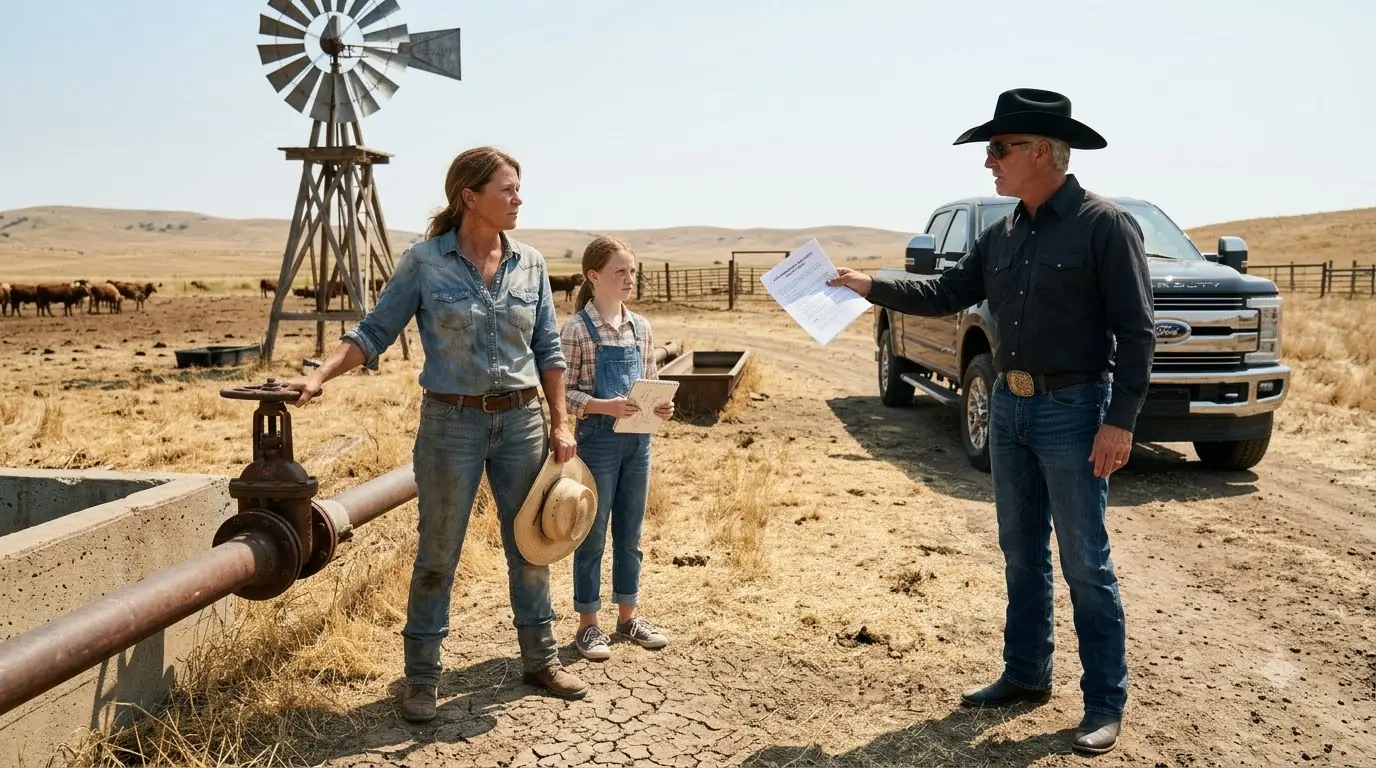
The man who controlled that stream had made himself very clear the day before: sell the ranch or watch it die of thirst.
He believed she had no other option. He believed the land would break her before her spirit did.
But 300 yards from where Cora stood, her 12-year-old daughter, Ren, was crouched in the weeds behind the old windmill, staring at a single patch of grass that had no business being green.
The valley hadn’t seen real rain in 14 months. Cracks ran through the pastures like old scars, and the creek that once fed half the county had shrunk to a memory of stones.
Cora Danver had inherited Danver’s Hollow from her father, who inherited it from his. Four generations of cattle and hay, and stubbornness, pressed into 200 acres at the base of Red Tale Ridge.
She was 44 years old, sunburned at the collar, and she had exactly one thing left that mattered more to her than pride: keeping this land in her family’s hands until Ren was old enough to decide whether she wanted it, too.
The water that fed Danver’s Hollow ran through a shared channel from Blackwood Ranch, the sprawling operation next door owned by Holt Garrison, a man whose grandfather had once been friends with Cora’s grandfather, back when handshake agreements meant something.
Holt had inherited more than land. He’d inherited leverage.
The old water-sharing agreement between the two properties had never been reduced to a modern legal document. Just decades of goodwill and a rusted iron valve at the property line.
That valve was closed on a Tuesday.
Cora noticed it the way farmers notice everything, not with panic, but with a slow, sinking recognition. The irrigation line that fed her lower pasture ran dry mid-morning.
She walked the ditch on foot, boots crunching over baked mud, until she reached the valve and found it wrenched shut, padlocked, a strip of yellow tape wrapped around the handle like a warning label.
Holt arrived 20 minutes later in a truck that cost more than her tractor, dust rolling behind him like a small storm of his own making.
“Drought’s hard on everybody,” he said, leaning against his door instead of getting out. “County’s asking ranchers to conserve. I’ve got obligations of my own now. You’ve got obligations to me, too.”
“Fifty years of them,” Cora said.
“Handshake deals don’t hold up in a drought.”
“Paper does.”
He let that sit a moment, watching her.
“I’ll give you a fair number for the Hollow. More than fair, considering the state of things. You could walk away with something instead of losing it to the bank in a year.”
She didn’t answer. She didn’t need to.
He already knew what her silence meant, and it visibly irritated him: the fact that a woman with cracked soil and a dying herd would rather struggle than sell to him.
“You’ll come around,” he said, and drove off before she could tell him otherwise.
That night, Cora sat on the porch steps and watched her cattle mill restlessly near the empty trough.
Twenty-six head, down from 40 the year before.
She had already sold off what she could bear to lose. There wasn’t much room left to lose more.
Inside the house, Ren sat at the kitchen table with a notebook, the kind she’d carried everywhere since she was nine. Pages filled with sketches of beetles, notes on which plants wilted first in the heat, little arrows connecting one observation to another.
She didn’t fully understand what her mother was facing. But she understood dry. She understood watching something you loved get smaller every day.
What followed wasn’t a single crisis. It was a hundred small ones stacked one on top of another until they became the shape of an entire life.
Cora began hauling water in a rented tank trailer from the county co-op, 40 minutes round trip twice a day, siphoning fuel money from an account that had little left to give.
She rationed what she hauled between the cattle and the vegetable rows her mother had planted decades earlier. Rose Cora couldn’t bring herself to let die, even as she watched them wilt.
Anyway, she sold her father’s old truck, the one with the good transmission, to a buyer three counties over and used the money to keep the bank from calling the loan due early.
Word moved through the valley the way it always does.
Some neighbors offered quiet help, a loaned water tank, an unspoken understanding at the feed store.
Others kept their distance, unwilling to cross a man as influential as Holt Garrison, who had spent years cultivating friendships with half the officials at the county water authority, and had a way of remembering who helped his enemies.
A rancher two properties over stopped returning Cora’s calls entirely after Holt mentioned in passing that he was reconsidering a grazing lease the man depended on.
Holt’s offers kept coming, each one lower than the last. Each one delivered with the same patient, unbothered tone of a man who believed time was entirely on his side.
“$80,000,” he said the second time, standing at her fence line instead of driving up to the house. “That drops next month.”
“You’re negotiating against a drought you caused,” Cora said.
“I’m negotiating with reality,” he said. “Reality doesn’t care whose fault it is.”
She went to bed most nights doing math in her head that never balanced.
She woke most mornings before the sun, walking the fence lines out of habit more than hope, checking on animals that had less water in them than she wanted to admit.