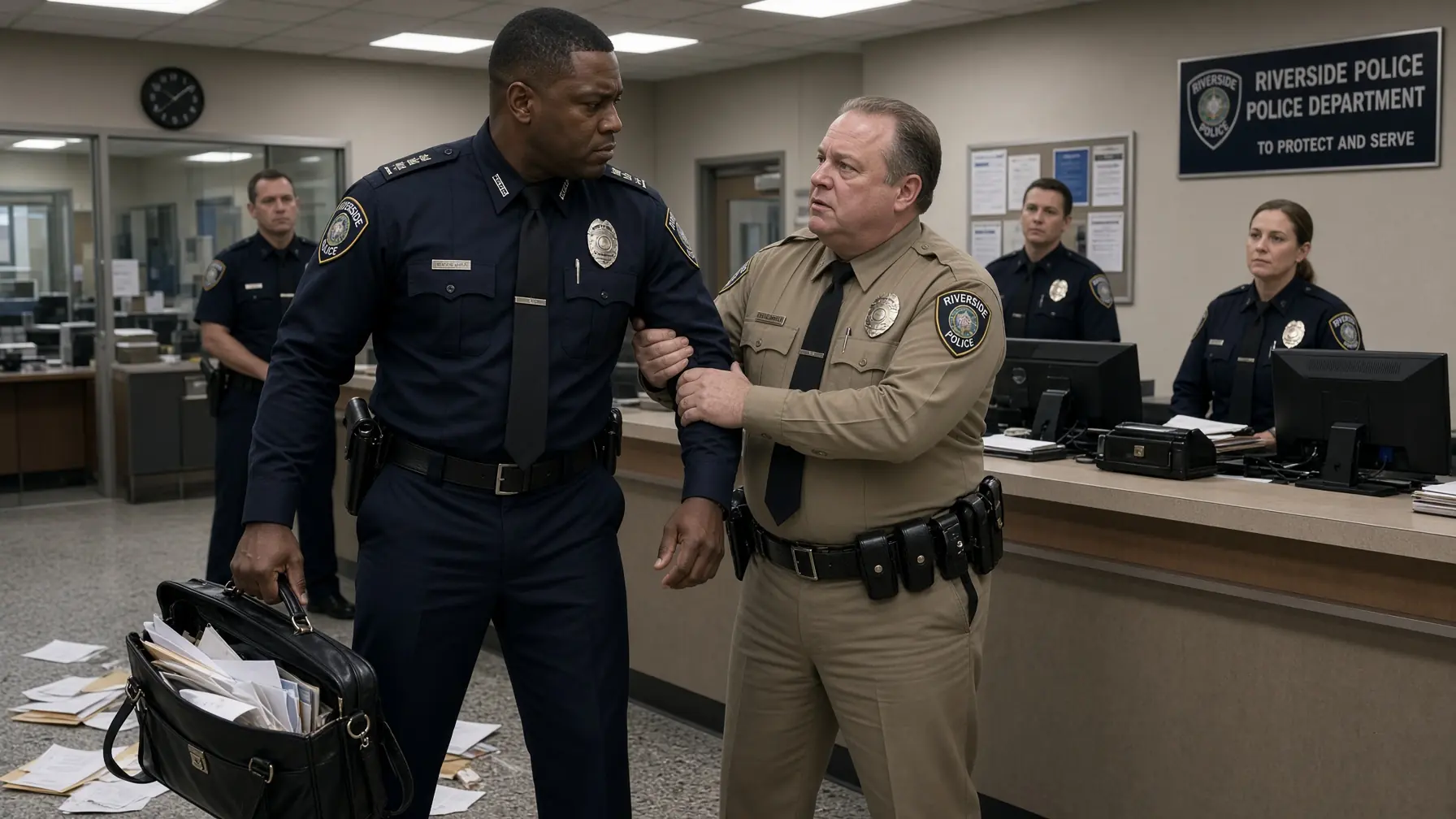
The handcuffs closed before anyone asked his name. His briefcase struck the floor, scattering papers beneath the officers’ shoes, and Sergeant Garrett Caldwell pressed his face harder against the counter. For eight minutes, the man in the command uniform remained still while Riverside Police Department showed him what happened to someone it had decided not to believe. Then the radio behind the desk crackled, and the first words out of it changed the meaning of everything they had just done.
“Keep your hands where I can see them.”
Marcus Reed looked down at the polished counter.
One of his hands lay flat against it. The other was being pulled behind his back.
He could have pointed out the contradiction. Instead, he turned his head just enough to keep his cheek from pressing against the sharp edge.
“I’m not resisting.”
“Then stop making this difficult.”
The second cuff closed.
Its metal edge caught his skin before settling around his wrist. Caldwell pulled upward, bringing Marcus’s shoulders back and forcing his chest closer to the desk.
Behind them, a leather briefcase landed with a heavy crack.
The latch sprang open.
Papers slid across the lobby floor, some stopping beneath the chairs along the wall, others spreading around the sergeant’s black shoes. Marcus saw the corner of an appointment document turn upward before another officer stepped across it.
No one bent down.
The digital clock behind the desk read 8:50.
Marcus had entered Riverside Police Department barely two minutes earlier.
He had come through the public entrance carrying the briefcase in his left hand. His uniform was pressed, his black shoes polished, and the gold command badge on his chest caught the overhead light as he approached the counter.
There had been no raised voice, no sudden movement.
A woman sat beneath the bulletin board with a folded envelope in her lap. An officer behind the counter typed at a computer. Somewhere deeper inside the building, someone laughed.
Marcus had noticed those details because he had arrived intending to notice things.
He wanted to see how the station received an unfamiliar person before anybody announced who that person was. He wanted to hear the tone used at the front desk, see whether questions were answered, and discover whether people waiting for help appeared comfortable enough to ask for it.
He had expected ten quiet minutes.
Instead, Caldwell stepped into his path.
“Where do you think you’re going?”
“To the desk.”
“For what?”
“I need to speak with someone about—”
“Identification.”
Marcus began turning the briefcase slightly, intending to set it down before reaching for the credential case inside his jacket.
Caldwell caught his arm.
“Don’t reach.”
Marcus stopped immediately.
“All right.”
“Put it down.”
He lowered the briefcase.
“Slowly.”
Marcus moved more slowly.
Then Caldwell pulled him sideways toward the counter.
“What are you doing?”
“Securing you.”
“For what reason?”
“You can explain your little performance after we find out what you’re carrying.”
The edge of the desk struck Marcus’s cheek.
For an instant, the room blurred.
He tasted the faint metallic bitterness of a place inside his mouth where his teeth had caught flesh. He steadied himself against the counter, and Caldwell interpreted the movement as something else.
“Hands back.”
Marcus let the briefcase go.
That was how the papers came to be on the floor.
Now the sergeant leaned close enough for Marcus to smell coffee on his breath.
“You thought you could walk in here pretending to be important?”
Marcus did not answer.
“You picked the wrong station.”
Across the desk, the typing stopped.
The officer at the computer looked up, glanced at the cuffs, then returned to the screen.
That small movement stayed with Marcus.
It meant the officer had seen enough to know something was happening. It also meant he had decided that whatever was happening did not require him to act.
Marcus lowered his eyes to the counter.
A pen lay beside a public complaint form. A notice instructed visitors to have identification ready. Another described the department’s commitment to respectful service.
He read the words without moving his head.
Caldwell followed his gaze.
“Not much to say now?”