Nobody in Caldwell Flats talked about Garrett Masterson the way they talked about other men.
They did not say he was mean exactly. They did not call him cruel. What they said in low voices over fence posts and dry goods counters was that something had gone quiet in him a long time ago.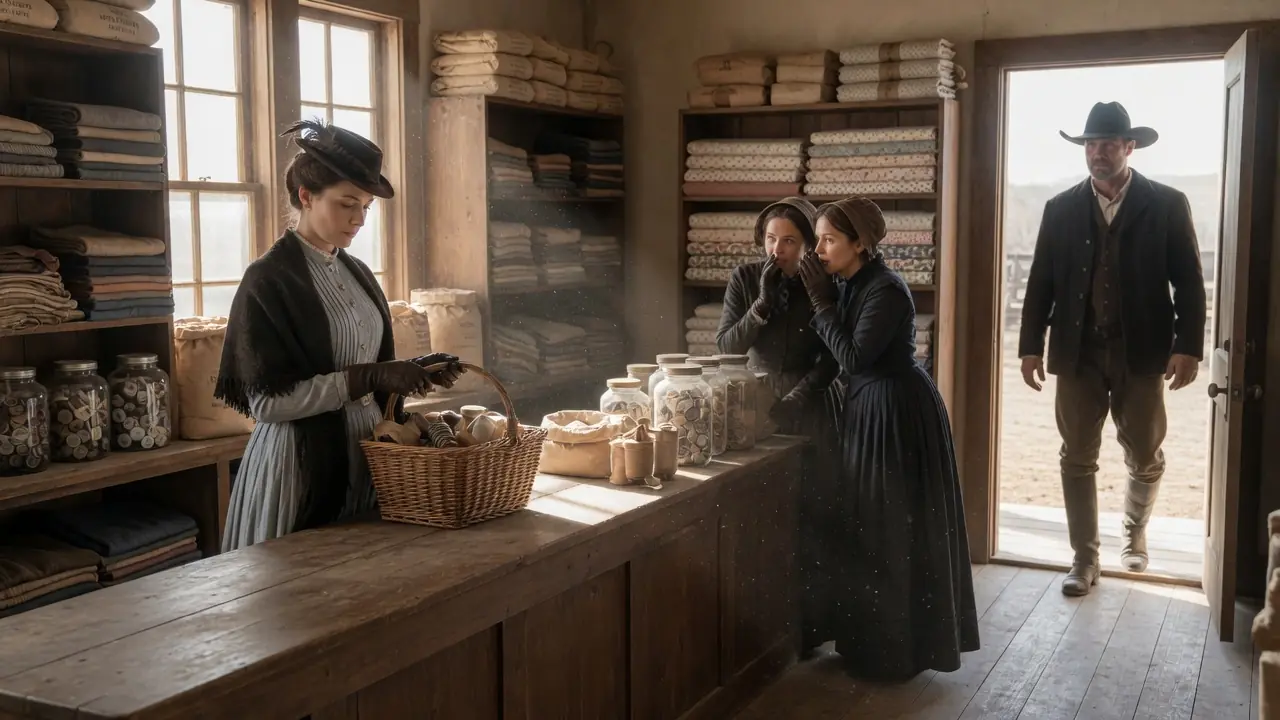
And that quiet, they agreed, was more unsettling than any amount of noise.
He owned the largest cattle operation within forty miles. He paid fair wages and kept his word on a deal. But he ate alone, rode alone, and had not once in seven years been seen sitting inside the Caldwell church on a Sunday morning.
That, more than anything, was what the town held against him.
So when the letter arrived at the post office, a letter addressed to Garrett Masterson from a woman named Eliza Callaway of Harlan County, Kentucky, the postmaster read the return address twice before tucking it into the box.
And when a second letter arrived three weeks later, then a third, the whispers started before Garrett had even opened the first one.
Eliza had not written those letters lightly.
She had sat at her aunt’s narrow kitchen table for two evenings before she wrote the first word, the pen in her hand and the blank page in front of her feeling like the edge of something she could not come back from.
She was twenty-four years old. She had seventeen dollars to her name, a small trunk of belongings, and a situation at home that had quietly become impossible.
Her aunt’s husband had made that clear enough, not with words, but with the way a room changed when he entered it and the way Eliza had started sleeping with a chair wedged under her bedroom door.
She had found Garrett Masterson’s name through a land registry notice reprinted in a regional paper.
A rancher seeking a capable woman of good character for the purpose of marriage and household management.
The wording was blunt, almost cold, but Eliza had read it four times and decided that blunt and cold were not the worst things a man could be.
She wrote honestly.
She did not pretend to be something she wasn’t. She told him she was not delicate, that she could cook and manage accounts and was not frightened of hard work. She told him she came from modest means.
And in the third letter, after he had written back twice in that same clipped, careful handwriting, she told him the plain truth.
She needed to leave where she was, and she believed, if he was willing, they could build something decent together.
His final letter back was four sentences long.
Come on the fifteenth.
I’ll meet the stage.
We can speak plainly when you arrive.
Bring only what you need.
She brought everything she owned, which was not much.
The stage rolled into Caldwell Flats on a Thursday afternoon with the kind of dust cloud that made people step out onto their porches just to watch.
Eliza pressed her face close to the small window and saw the town for the first time. One main street, a row of timber-front buildings, a water trough, and two dogs sleeping in the shade of a hitching post.
And then she saw him.
He was standing apart from the small crowd that had gathered, the way a man stands when he is used to being watched and has long since stopped caring about it.
Tall, with a dark hat pulled low and his arms loose at his sides. He was not scowling, and he was not smiling either. He was simply watching the stage come in with the same expression a man uses when he is waiting on a weather report.
Eliza straightened her collar, picked up her traveling bag, and stepped down into the afternoon heat.
He walked toward her without being waved over.
That was the first thing she noticed. He did not wait to be invited.
He covered the distance between them in a few unhurried strides and stopped two feet away, close enough to speak quietly.
“Miss Callaway,” he said.
“Mr. Masterson,” she replied.
Then he picked up her trunk without asking and carried it toward a wagon at the edge of the street.
She followed him.
Behind her, she could already hear the murmuring begin.
They rode out to the ranch mostly in silence. Garrett kept his eyes on the road. Eliza kept hers on the land, the flat sprawl of it, the pale grass bending in the afternoon wind, and the distant line of hills sitting low against the sky.
It was nothing like Kentucky.
It felt enormous in a way that was almost frightening and almost freeing at the same time.
“The house is plain,” he said after a long while.
“That’s fine,” she said.
Another silence.
Then he said, “I want to be straightforward with you before we go any further with this arrangement.”
“I’d prefer that,” she said.
He glanced at her sideways, just briefly, as if the answer had surprised him slightly.
“There are people in town who won’t receive this well. A man in my position taking a mail-order bride, they’ll have opinions.”
“People generally do,” Eliza said.
Something shifted in his jaw.
Not quite a smile.
Not quite not one either.
“You’re not what I expected,” he said.
“What did you expect?”
He thought about that for a moment, genuinely.
“Someone more nervous,” he finally said.
Eliza looked out at the wide, flat land again.
“Oh, I’m nervous,” she said quietly. “I’m just not going to show you that on the first day.”
This time he did almost smile.
It lasted about half a second before his face settled back into its usual stillness. But she caught it.
And for reasons she could not entirely explain, it steadied something inside her that had been unsteady for a very long time.
The house was plain, as he had warned, but it was solid and clean and larger than she had expected. There was a covered porch that looked west toward the hills. In the late afternoon light, the whole front of it glowed a deep amber that made Eliza stop on the steps and simply look for a moment.
Garrett had already carried her trunk inside.
He came back to the door and found her standing there, and he did not rush her or ask what she was doing.
He just waited.
“It’s a good porch,” she said.
“I’ve always thought so,” he said.
She went inside.
Over the following three days, they moved around each other carefully, the way two people do when they are both too honest to pretend comfort they do not yet feel, and too respectful to manufacture friction they do not actually have.
He showed her the house, the kitchen stores, and the ranch ledgers. She asked clear questions and remembered the answers.
He noticed that.
On the fourth morning, over coffee, he told her they should ride into town to speak to the preacher. If she was still willing, they could marry by the end of the week.
Eliza wrapped both hands around her cup.
“Are you still willing?” she asked.
“I asked first,” he said.
“Yes,” she said. “I’m still willing.”
He nodded once, the way a man nods when something has been decided and he intends to honor it.
“End of week, then.”
But what neither of them knew, what they could not have known sitting quietly at that kitchen table with the morning light coming through the window, was that the town of Caldwell Flats had already made up its mind about the two of them.
And it had decided against them before they had even had the chance to begin.
The preacher’s name was Hollis Dunbar, and he was a man who believed, above most things, that a community’s opinion was as close to God’s will as anything written in scripture.
He received Garrett and Eliza on a Friday morning in the small front room of the church, with his hands folded on his desk and an expression that sat somewhere between concern and disapproval.
He offered them each a seat. He did not offer coffee.
“I’ve heard about your arrangement,” he said, looking mostly at Eliza.
“Then you know why we’re here,” Garrett said.
Dunbar shifted his gaze.
“A marriage is not something to be entered into as a matter of convenience, Mr. Masterson. The church takes it seriously.”
“We’re not asking for your opinion on it,” Garrett said.
Not rudely.
Just plainly, the way he said most things.
“We’re asking for a date.”
A silence followed that had weight to it.
Eliza kept her hands folded in her lap and her eyes steady. She had dealt with men like Dunbar before, men who dressed their personal objections in the language of principle.
She had learned that the worst thing you could do was let them see you flinch.
“Two weeks,” Dunbar finally said. “I’ll need two weeks. There are notices to be posted. Formalities.”
Garrett looked at him for a long moment.
“One week,” he said. “Post whatever you need to post.”
They left without shaking his hand.
The talk in town moved fast after that.
By Saturday, it had reached the feed store, the seamstress, and both of Caldwell Flats’ two saloons. By Sunday, it had settled into the spaces between church pews like smoke that would not clear.
The women spoke of it in careful, charitable tones that said everything they did not say out loud.
The men were less careful.
Eliza heard it for the first time on Monday morning, when she came into Harding’s Dry Goods for flour and thread.
The two women at the counter did not see her come in. They were deep enough in their conversation that the bell above the door did not register.
“No one even knows where she came from. A letter, of all things.”
“Well, what does that say about him? That’s what I want to know.”
“Seven years and not a single woman in this town good enough. And now he sends off for one like she’s a piece of ordered furniture.”
Eliza set her basket on the counter with a quiet, deliberate sound.
Both women turned. The color rising in their faces told her they knew she had heard.
She looked at them both for a moment, not with anger, not with hurt, but with the kind of steady composure that is somehow more unsettling than either.
“Good morning,” she said.
Neither of them quite managed a natural response.
She bought her flour and thread, thanked Mr. Harding, and walked back out into the morning sun.
She made it half a block before she stopped, stood very still for a moment with her basket in both hands, and let out a slow breath.
She was not going to cry in the middle of the street in Caldwell Flats.
She had decided that before she had even arrived.
But she allowed herself, in that one quiet moment, to feel how alone she was.
Garrett found out about the incident at the dry goods store the same afternoon from one of his ranch hands, who had been in the hardware store next door and heard the whole thing through the wall.
He did not say anything when he was told.
He finished what he was doing, checking the tension on a fence line at the east pasture, and then he rode into town.
He walked into Harding’s, stood at the counter, and looked at the two women who were still there browsing fabric bolts as though the morning had been perfectly ordinary.
He did not raise his voice.
He never raised his voice.
“I’d like you both to understand something,” he said. “Miss Callaway came to this town because I asked her to. Whatever you think of me, she doesn’t deserve to carry it. If you have something to say about my affairs, say it to me.”
One of the women opened her mouth.
He held up a hand, not threateningly, just with the quiet authority of a man who was finished speaking and knew it.
He left.
The town talked about that too, of course, but it talked about it differently.
That evening, Eliza was on the porch when she heard his horse come in.
She had been sitting there for an hour, watching the light leave the hills, turning a small thought over and over in her mind that she had not yet decided what to do with.
She heard him unsaddle and stable the horse. She heard his boots on the steps. He came and stood at the porch rail and looked out at the same hills she had been watching.
For a while, neither of them said anything.
“You didn’t have to do that,” she said finally.
“I know,” he said.
“It’ll make them talk more.”
“They were going to talk regardless.”
He was quiet for a moment.
“I don’t particularly care what they say about me. I never have. But I care what they say about you. That’s different.”
Eliza looked at him.
In the fading light, his face was hard to read, but his voice had been plain.
He meant it.
“Why?” she asked, not challenging him, genuinely asking.
He turned to look at her then, and for a moment he seemed to weigh something privately, the way a man does when the honest answer costs him something.
“Because you came here in good faith,” he said. “And I intend to honor that.”
It was not a declaration. It was not poetry.
But something in the simplicity of it reached her more than either of those things would have.
She turned back to the hills so he would not see what crossed her face.
“Thank you, Garrett,” she said quietly.
He nodded once.
Then he went inside and left her to the evening.
Three days before the wedding, something happened that neither of them had anticipated.
A man rode into Caldwell Flats from the direction of the eastern counties, well-dressed, composed, with the kind of easy confidence that comes from never having been told no about anything important.
His name was Douglas Fenn.
He took a room at the boarding house, ate supper at the hotel dining room, and then the next morning he walked into Garrett’s ranch and asked to speak with Eliza Callaway.
Garrett was the one who answered the door.
He looked at the man for a long moment.
“She’s not available,” he said.
“With respect,” Fenn said, “I’d prefer to hear that from her.”
A silence followed that had an edge to it.
“Wait here,” Garrett said.
Eliza came to the door and saw Douglas Fenn, and felt something drop in her stomach.
She had known him in Harlan County. He was her aunt’s husband’s younger brother, part of the same household she had fled, connected to the same reasons she had left.
He had never been unkind to her directly, but he represented everything she had traveled eight hundred miles to put behind her.
“Eliza,” he said, with a smile that did not quite reach his eyes. “Your aunt is worried. We’ve come to bring you home.”
“I don’t have a home there,” she said.
“You have family there.”
“That’s not the same thing.”
Fenn glanced past her at Garrett, who was standing a few feet behind her, saying nothing, watching everything.
“Surely you don’t intend to go through with this. You don’t know this man.”
“I know enough,” Eliza said.
“Your aunt would like to speak with you personally. I have a letter.”
“You can keep the letter,” she said.
And then she did something that surprised even herself.
She stepped back, closer to Garrett.
Not dramatically. Not as a performance.
Simply because it was where she wanted to stand.
Garrett said nothing.
But he did not move away.
Fenn looked between them both.
And something in his composed expression flickered, just briefly, before he recovered it.
He nodded slowly.
“I see,” he said. “I’ll tell your aunt you’re well.”
“Please do,” Eliza said.
He left.
The door closed.
The room was very quiet.
Eliza stood with her back to Garrett for a moment, her eyes forward, her hands still at her sides. She was steadier than she felt.
“Old trouble?” Garrett asked quietly behind her.
“Old life,” she said. “It’s handled.”
He did not push further.
But when she finally turned around, he was looking at her with something in his expression she had not seen there before. Something that was not quite concern and not quite admiration, but lived somewhere between the two.
“Three more days,” he said.
“Three more days,” she agreed.
But neither of them moved for a moment.
And in that stillness, something shifted between them.
Quietly, without announcement.
The way important things often do.
The morning before the wedding, Eliza woke before dawn and could not go back to sleep.
She lay in the plain bedroom of Garrett Masterson’s ranch house, stared at the ceiling, and asked herself honestly what she was feeling.
Not fear.
She had expected fear, and it had not come.
What she felt instead was something more complicated.
A tenderness she had not planned for toward a man she was still learning in a town that had already decided it did not want her.
She thought about the way he had spoken at the dry goods store, the way he had stood at the porch rail in the evening light, the way he had looked at her when Fenn left.
She thought, this could be real.
And then, almost immediately, what if he doesn’t feel it the same way?
That was the question she carried with her into the morning.
That was the thing she could not yet answer.
And it was still unanswered when, just after breakfast, one of Garrett’s ranch hands came riding in fast from the east road with news that made Garrett’s face go very still in a way Eliza had not yet seen.
Someone had cut the fence line on the south pasture overnight.
Thirty head of cattle were gone, and the tracks led directly toward town.
The south pasture fence had been cut clean. Not broken. Not weathered through.
Cut.
With intention, and in the dark, by someone who knew exactly where to walk and when.
Garrett stood at the gap in the wire for a long time without speaking. Two of his ranch hands stood behind him, waiting.
The morning was still cool, the dew not yet off the grass, and the tracks in the soft earth were clear enough to follow.
He followed them.
They led east, as reported. Then they curved, deliberately and almost carefully, toward the edge of the Dunbar property line.
Not onto it.
Just close enough to suggest something without proving it.
Garrett crouched beside the last clear print and stayed there for a moment, thinking.
Then he stood up, told his men to start rounding up what cattle they could find in the neighboring draws, and rode back to the ranch alone.
Eliza saw his face when he came in and knew before he spoke that something had changed in the situation.
Not worsened, exactly.
Complicated.
She poured him coffee without being asked, set it on the table, and sat down across from him.
She did not ask what happened.
She waited.
He told her plainly. The fence. The cattle. The tracks that curved conveniently toward Dunbar land.
“Someone wants it to look like Dunbar,” she said.
“Or Dunbar wants it to look like someone wants it to look like Dunbar,” he said.
She thought about that.
“Either way, the timing isn’t accidental.”
“No,” he said. “It isn’t.”
The wedding was tomorrow morning.
She watched him turn the coffee cup slowly in his hands and recognized what was happening behind his eyes.
The old instinct of a man who had survived seven years alone by solving his own problems quietly, pulling back into himself, handling things the way he always handled them.
Without asking for help.
Without letting anyone close enough to be affected by the fallout.
“Garrett,” she said.
He looked up.
“Don’t pull away from me right now,” she said, quietly and directly. “Whatever this is, don’t handle it alone and leave me standing at the edge of it. If we’re doing this tomorrow, we’re doing all of it together.”
Something crossed his face that she could not entirely name.
It was not resistance. It was closer to the expression of a man who had been offered something he wanted, but had spent so long not expecting it that the receiving of it caught him off guard.
“I’m not used to that,” he said honestly.
“I know,” she said. “Start getting used to it.”
By midday, the story had reached town before Garrett did.
It had been shaped along the way, the way stories are, smoothed in some places and sharpened in others, until by the time it reached the saloon and the feed store, it had become something close to an accusation.
Masterson’s cattle missing the day before his wedding.
Tracks near Dunbar land.
Some people said Dunbar had finally had enough of Garrett’s cold manner and decided to send a message. Some people said Garrett had staged the whole thing for reasons no one could quite articulate, but everyone seemed willing to believe.
And a smaller number, quieter and meaner, said the woman had something to do with it.
That she had brought trouble with her from wherever she came from. That Caldwell Flats had been perfectly functional before she stepped off that stage.
Garrett heard that last version in the hardware store from a man who did not know he was standing close enough to be heard.
He turned around slowly.
The man, a rancher named Cobble, broad and red-faced and suddenly aware he had made an error, took a step back.
“Say that again,” Garrett said.
Very quietly.
Cobble did not say it again.
“Miss Callaway,” Garrett said in the same quiet voice to the room at large, “came to this town with more integrity than most of the people in it. I’ll hear her name spoken with respect, or I’ll hear it spoken nowhere near me. That goes for every man in here.”
The hardware store was very silent.
He bought what he came for and left.
What he did not know was that Eliza had come into town behind him.
She had not followed him. She had come on her own, for her own reasons, with her own intention.
She had thought about what he had said on the porch, about what she had felt that morning lying awake, about Douglas Fenn and the old life, and about everything she had ridden eight hundred miles to leave behind.
And she had decided she was not going to let this town, or this moment, or her own uncertainty take something from her that she had not even fully allowed herself to want yet.
She went to see Preacher Dunbar and found him in the church arranging hymnals with the deliberate care of a man avoiding his own thoughts.
She walked in, sat down in the front pew, and waited until he acknowledged her.
“Miss Callaway,” he said with the same careful expression he had worn at their first meeting.
“I want to talk to you plainly,” she said.
He sat down across the aisle from her slowly, as though sitting might commit him to something.
“I know what this town thinks of this arrangement,” she said. “I know what they think of me. I know some of it comes through you.”
She paused.
“I’m not here to argue with you about any of that.”
He said nothing.
“I’m here to tell you that tomorrow morning I am marrying Garrett Masterson. And I’m asking you, not as a matter of approval, because I don’t need your approval, but as a matter of decency, to perform the ceremony with the same respect you’d give any two people standing in front of you.”
Dunbar looked at her for a long moment.
His expression shifted slowly, almost reluctantly, the way a man’s face shifts when he has been confronted with a version of something he has been deliberately not looking at.
“You love him,” he said.
It came out sounding almost surprised.
Eliza held the preacher’s gaze.
“I’m getting there,” she said honestly. “And he deserves the chance. So do I.”
A long silence followed.
“Tomorrow morning,” Dunbar said finally. “Eight o’clock.”
She stood up.
“Thank you.”
She walked back out into the sunlight and stood on the church steps for a moment, her heart beating harder than she wanted to admit.
Then she walked back to where she had tied her horse and rode toward the ranch.
And somewhere on that road, with the wide land around her and the afternoon sky overhead, she realized that the nervousness she had been carrying since Kentucky had changed into something else entirely.
Not certainty.
Not yet.
But something adjacent to it.
Something that felt, for the first time in a long time, like the beginning of solid ground.
Garrett found her on the porch that evening.
He had recovered fourteen of the thirty cattle. He had spoken to the sheriff, who had promised to look into the fence line and seemed, for once, genuinely willing to do so. He had handled what could be handled and left the rest for the morning.
He came up the porch steps and found Eliza sitting with her feet tucked under her and a cup of tea going cold in her hand, watching the hills the way she always watched them, with a kind of quiet attention, as if she was listening for something.
He sat down in the other chair, the one he had started thinking of without meaning to as hers.
“I went to see Dunbar today,” she said.
He looked at her.
“I asked him to perform the ceremony with respect,” she said. “He agreed.”
Garrett was quiet for a moment.
“You didn’t have to do that.”
“I know,” she said, and she almost smiled. “I wanted to.”
He looked at her for a long time in the evening light.
This woman who had written him three honest letters, stepped off a stage into a strange town, and stood her ground against everything that had been thrown at her without once asking him to fight her battles or apologizing for the trouble her presence had caused.
“Eliza,” he said.
She turned to look at him.
“I want you to know something before tomorrow,” he said. “This started as an arrangement. That was honest, and I won’t pretend otherwise.”
He paused.
“But it isn’t only that anymore. Not for me.”
The evening was very still around them.
“It isn’t only that for me either,” she said quietly.
He reached over and took her hand, carefully, like it was something worth being careful with.
She turned her palm up and let him, and they sat like that as the last of the light left the hills and the first stars appeared over Caldwell Flats.
They were married the next morning at eight o’clock.
Preacher Dunbar performed the ceremony with quiet dignity, his voice steady, his manner composed. A small number of townspeople attended, fewer than a proper wedding deserved, but more than either of them had expected.
When Dunbar said the words and Garrett slid the plain silver band onto Eliza’s finger, she looked up at him and found him already looking at her with an expression she had not seen on his face before.
Open.
Unguarded.
Certain in a way that his face rarely allowed itself to be.
She held onto that.
The town did not change overnight.
Small places rarely do.
There were still cool nods on the street, still conversations that stopped when Eliza walked into a room. There were still people who would never entirely forgive Garrett Masterson for being the kind of man who did not explain himself, and never entirely accept Eliza for arriving the way she had.
But there were other things too.
Mrs. Harding brought a jar of preserved peaches to the ranch two weeks after the wedding and left them on the porch without a note.
One of the women from the dry goods store crossed the street one morning and apologized to Eliza briefly and quietly, then walked away before Eliza could fully respond.
The sheriff found evidence that the fence line had been cut by a drifter passing through, a man with no connection to Dunbar or anyone else, and the accusation dissolved the way unfounded things eventually do.
And Garrett, slowly, without announcement, began to change in ways that only Eliza could see.
He started leaving the ranch for Sunday morning church, not every week, but some weeks. He started taking his coffee on the porch instead of inside alone. He started laughing, not often, not loudly, but genuinely, at the things she said that were worth laughing at.
She started to feel the solid ground under her feet.
Two years after Eliza Callaway stepped off that stage into the dust of Caldwell Flats, she sat on the porch of the ranch house in the late afternoon and watched Garrett come in from the south pasture.
The same pasture where the fence had been cut once, in what already felt like a different life.
He unsaddled his horse, turned it out, and walked across the yard toward her. He took off his hat when he reached the steps. His eyes went to her first, the way they always did now, and then to the small bundle she was holding carefully in both arms.
He sat down beside her.
The baby was asleep, eight days old, with Eliza’s coloring and what appeared so far to be Garrett’s disposition.
Quiet.
Watchful.
Seemingly content to take the measure of the world before deciding what to do about it.
Garrett looked at the two of them for a long moment.
Then he put his arm around Eliza’s shoulders, and she leaned into him.
The three of them sat together as the sun went down over the hills of Caldwell Flats.
The town had not given them this.
They had built it themselves, out of three honest letters, a plain silver band, and the decision made over and over again, in small ways and large ones, to choose each other anyway.
That, in the end, was the whole of it.
And it was enough.