The first farmer tapped Emily Carter’s white plastic bucket with the toe of his boot.
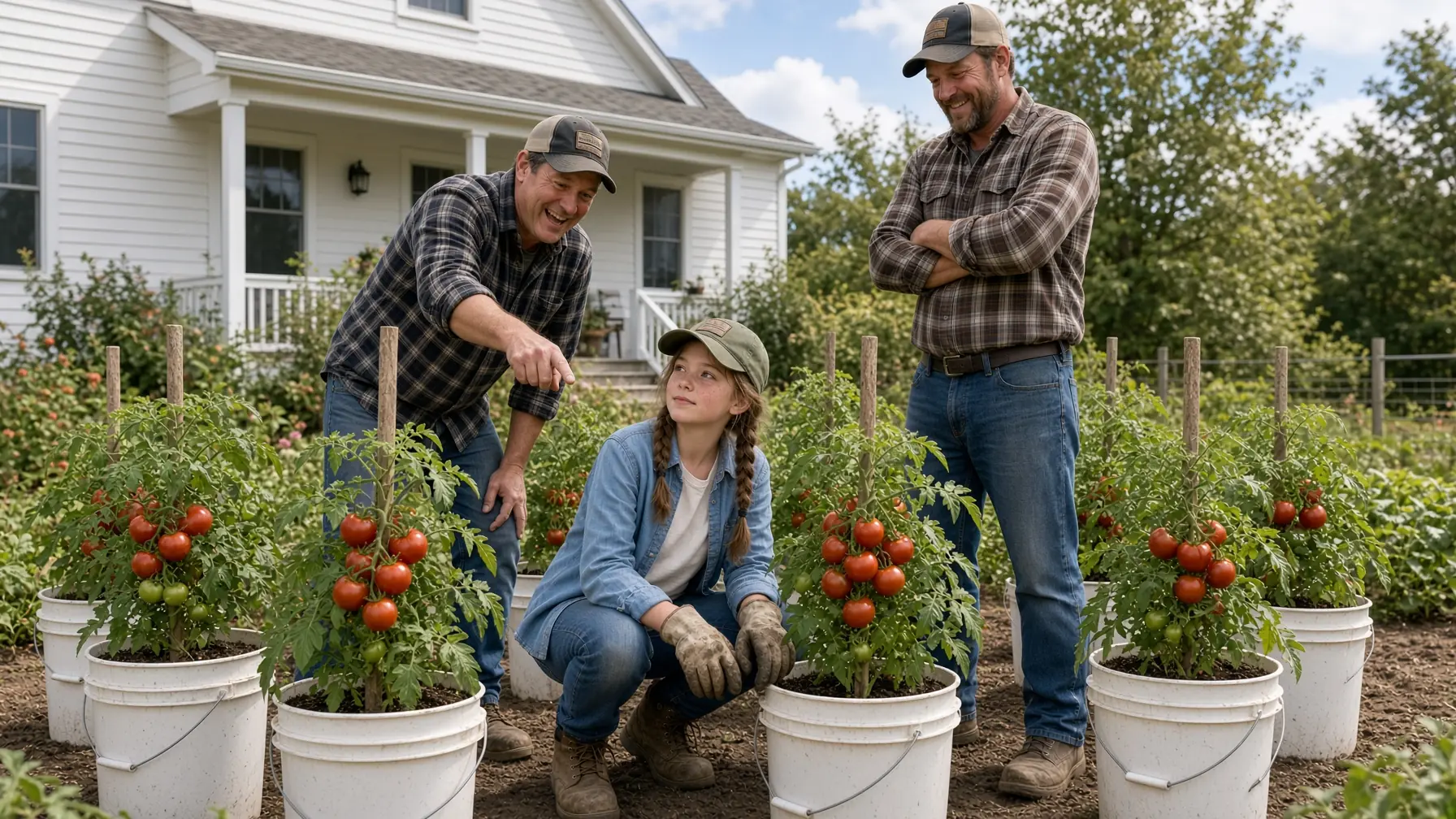
Hollow plastic answered with a dull knock.
He laughed.
“You spent all summer growing tomatoes in a bucket?”
Emily remained crouched beside the plant.
She was ten years old, small for her age, with freckles across her nose and two long brown braids tucked beneath a green baseball cap.
Her gardening gloves were too large.
The fingers folded awkwardly whenever she tried to pick anything delicate.
But she liked them because they had belonged to her mother before the palms wore thin.
Beside her stood six large white food-grade buckets, each one filled almost to the rim with dark potting soil.
From every bucket rose a healthy tomato plant supported by a wooden stake.
Clusters of ripe red fruit hung between the leaves.
Some were almost as large as baseballs.
The second farmer shook his head.
“Cute.”
Then he looked toward Emily’s father, Daniel Carter, who stood several yards away beside the farmhouse.
“But that’s not farming, kid.”
Emily looked up.
Said nothing.
She reached into the foliage.
Twisted one red tomato free.
Then another.
Placed both carefully into a small wicker basket.
The men chuckled again.
The first farmer was Roy Jenkins.
Forty-six.
Third-generation corn and soybean grower.
Good farmer.
Loud opinion.
The second was Glenn Parker, who leased eighty acres across the county road and had spent most of the summer joking about “Emily’s bucket empire.”
Neither man was cruel by nature.
But both had the bad habit of treating anything unfamiliar as ridiculous until somebody older than them explained it.
Roy folded his arms.
“You know, when I was your age, we grew food in the ground.”
Emily wiped one tomato leaf from her sleeve.
“I know.”
Glenn smiled.
“Then why all the buckets?”
Emily looked toward her father.
Daniel said nothing.
This was hers.
She had made him promise.
Roy nudged the bucket again.
“What are you going to do, sell six tomatoes and retire?”
A few neighbors laughed.
Not meanly.
Still, Emily heard it.
She had heard versions of the same joke for three months.
Plastic buckets.
Tiny farm girl.
Pointless experiment.
Tomatoes already grew perfectly well in gardens.
Why complicate something simple?
Emily stood.
Her boots sank slightly into the dry summer grass.
“I wasn’t growing just tomatoes.”
Roy’s smile widened.
“What else could be in there?”
Emily looked down at the bucket.
Then at him.
“Help me tip it over.”
Four months earlier, the Carter farm had nearly run out of water.
Not completely.
That would have been dramatic.
Reality was slower.
Worse in some ways.
The farm sat on fourteen acres outside a small town in eastern Washington.
Too small for commodity farming.
Too large to call a garden.
Daniel Carter grew vegetables for a farmers market, supplied two local restaurants, and raised enough laying hens to make mornings permanently noisy.
It was a modern small farm.
Drip irrigation.
Plastic mulch.
A compact tractor.
Solar panels on the equipment shed.
Weather sensors connected to Daniel’s phone.
But technology did not create rain.
By late May, their well level had dropped.
The county restricted irrigation hours.
Daniel stopped planting one field entirely.
He reduced the sweet corn.
Moved lettuce production beneath shade cloth.
And spent several evenings at the kitchen table with bills spread around his coffee cup.
Emily noticed.
Adults often believed children missed those things.
They did not.
Children simply lacked the vocabulary adults used to hide fear.
One night Emily came downstairs for water and found her father staring at a seed invoice.
“You’re doing the face.”
Daniel looked up.
“What face?”
“The money face.”
“I don't have a money face.”
“You do.”
“What does it look like?”
Emily narrowed her eyes dramatically and pressed her lips together.
Daniel laughed despite himself.
“That’s rude.”
“Are we losing the farm?”
The laugh disappeared.
“No.”
Emily waited.
Her father sighed.
“No, Em. We’re not losing the farm.”
“But?”
“But this year might be tight.”
“How tight?”
Daniel thought.
“Less ice cream.”