Emma Carter reached the gate with four minutes left before boarding closed. She was still wearing the soft-gray scrubs she had put on before dawn, her hospital badge remained clipped near her waist, and her honey-blonde hair had been twisted into a loose bun hours earlier when she still believed she would have time to go home before the flight. She had spent most of the morning assisting with an emergency surgery involving a construction worker who arrived at the hospital with massive internal bleeding. By the time another surgeon finally told her the patient was stable, Emma had grabbed her already-packed bag, driven straight to the airport, and boarded without changing clothes.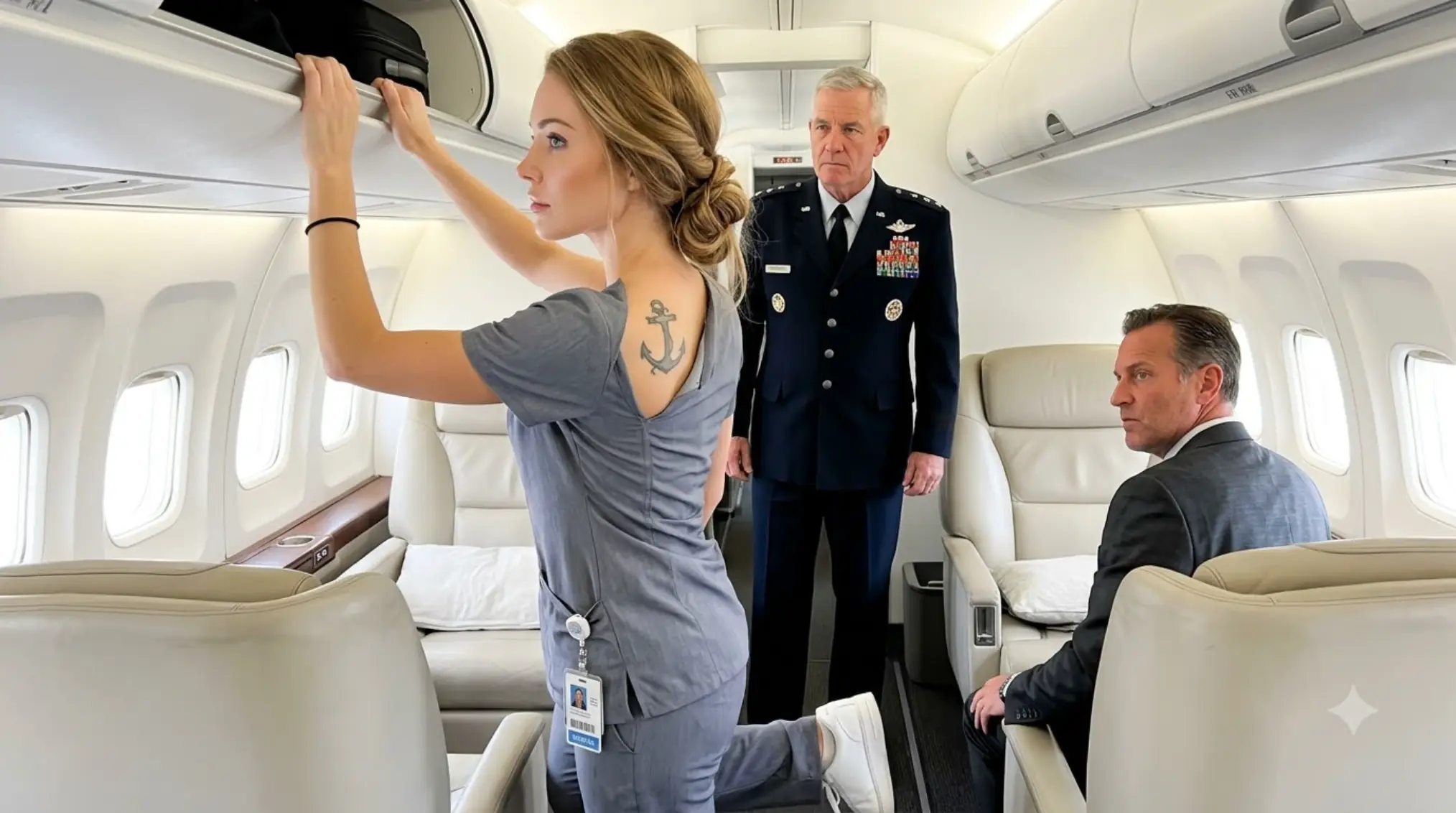
Seat 2A waited beside the window in first class. Emma placed her bag under the seat, lowered herself into the wide leather chair, and closed her luminous blue eyes for what she hoped would be a few uninterrupted minutes. She was thirty-one, strikingly beautiful even while exhausted, with delicate features, fair skin, and the sort of composed expression that made strangers assume life had always been gentle with her. Nothing could have been further from the truth.
Across the aisle sat Richard Voss and his wife, Diana. Richard was fifty-five, impeccably groomed, dressed in a charcoal suit that looked more expensive than Emma’s monthly rent, with a silver watch shining beneath his cuff and the confident posture of a man who expected rooms to arrange themselves around him. Diana wore an elegant cream jacket, designer shoes, and an expression of permanent amusement at whatever her husband decided was beneath them. They noticed Emma before she even finished fastening her seat belt.
Richard leaned toward Diana and whispered something. Diana looked at Emma’s scrubs, covered her mouth, and laughed. A businessman seated behind them glanced over with a small smile, while another passenger lowered her eyes toward her phone as though pretending not to notice could absolve her from participating. Emma heard everything but continued looking through the window at workers moving baggage carts across the morning runway.
Richard apparently interpreted silence as permission. “Excuse me, sweetheart,” he said loudly enough for several rows to hear. Emma slowly turned her head. Richard smiled. “I’m just curious how a hospital nurse ends up in first class.”
Emma looked at him for a moment. “By purchasing a first-class ticket.” Her voice was calm, almost gentle. Diana laughed again, this time louder. Richard leaned back as though Emma had entertained him.
“I suppose airlines are generous with upgrades these days,” he said. “Standards certainly aren't what they used to be.” Emma turned toward the window again. She had learned years earlier that some people did not ask questions because they wanted answers. They asked because they wanted witnesses.
Richard continued. “Don't misunderstand me. I respect hardworking people.” Diana nodded approvingly. “But there used to be certain spaces where people understood presentation mattered.” Emma closed her eyes and breathed slowly, not because Richard frightened her, but because exhaustion made patience more expensive than usual.
A flight attendant named Patrick approached from the galley. He had heard enough to understand exactly what was happening, but he also recognized Richard Voss from business magazines and frequent-flyer records. Patrick hesitated. That hesitation lasted only seconds, but Emma noticed it.
Richard lifted his champagne glass. “No problem here. We’re just discussing how fascinating modern air travel has become.” Patrick looked toward Emma. She gave him a slight nod indicating she wanted nothing. He returned to the galley, relieved to postpone a confrontation he clearly did not want.
Emma reached above her head to adjust her bag in the overhead compartment. Her scrub top shifted upward and sideways as she stretched, exposing several inches of skin high across her right shoulder blade. There, visible for only a moment, was a faded black tattoo: a small anchor enclosed by geometric lines, with the Roman numerals XX beneath it. Emma lowered her arm and the fabric covered the symbol again.
Three rows behind her, James Harker placed his glass of water onto the tray table. He was sixty, silver-haired, broad-shouldered, and wore a dark civilian jacket over a plain shirt. Nothing about him suggested wealth or celebrity. Yet something about the way he suddenly stopped moving caused the passenger beside him to glance over.
James had seen that symbol before. Not on someone’s skin, but inside a restricted after-action file he had reviewed eight months earlier while serving as a senior director for a classified federal response program. The file contained thirteen photographs. Eleven people were dead. Two had survived.
One survivor was a man named Daniel Reyes. The other was a woman whose identity had been removed from most copies of the record. Her operational designation had been Echo Phantom, and according to the sealed report, she had completed twenty-seven missions before disappearing from government service entirely. James had read the account of her final operation more times than he wanted to admit.
He remembered the tattoo description from page nine. Anchor. Twenty. Right shoulder blade. He remembered the note explaining that only members who completed the program’s twentieth high-risk deployment were permitted to carry it.
James stood. Richard was still talking. “Honestly, if I walked into one of my boardrooms dressed like that, security would probably redirect me downstairs.” Diana laughed. Emma remained seated.
James stopped beside row two. “I think you've made your point.” Richard looked up at him. “Excuse me?” James did not look angry. That made him more intimidating.
“I said you've made your point.” Richard studied James’s clothes, searching for an obvious reason to take him seriously and apparently finding none. “And who exactly are you?” James reached into his jacket and took out his phone.
“Someone who can make one call and have this aircraft returned to the gate before it leaves.” The laughter disappeared. Patrick stepped halfway out of the galley. Richard’s smile weakened.
“You’re threatening to delay an entire aircraft because of a conversation?” Richard asked. James looked at Emma, then back at him. “No. I’m giving you an opportunity to correct your behavior before somebody with less patience decides the conversation has become harassment.”
Richard’s jaw tightened. “I haven't harassed anyone.” Emma finally turned from the window. Her blue eyes rested on him. “You questioned why I belonged here, insulted how I was dressed, and suggested I needed to be moved because my job didn't match your idea of first class.”
Richard opened his mouth. Emma continued. “You’re welcome to call it whatever makes you comfortable.” James almost smiled. Richard did not.
Diana touched her husband’s sleeve. “Richard, forget it.” He looked around the cabin and realized almost everyone was watching now. The audience he had wanted had turned against him.
He cleared his throat. “Fine. I apologize.” James remained still. Richard frowned. “What?”
James said nothing. Richard understood anyway.
He turned fully toward Emma. “I apologize to you.” Emma held his gaze. “Thank you.”
Diana murmured an apology too. Emma nodded once and turned toward the window. She could have ended everything there.
Then James quietly said, “Echo Phantom.”
Emma froze.
Not visibly enough for Richard or Diana to understand what happened, but James saw it. The tiny change behind her eyes. The almost imperceptible tightening of her fingers against her knee.
She looked at him. “You have the wrong person.” James glanced toward the black bracelet around her wrist. Eleven small steel beads had been threaded along its cord. His expression softened.
“No,” he said quietly. “I don't.”
Emma’s exhaustion vanished. “Who are you?” James lowered his voice further. “Someone who read the final report.”
For the first time since boarding, Emma looked genuinely unsettled. “That report isn't available to civilians.” James gave a faint smile. “Correct.”
He returned to his seat before Richard could ask questions. Emma stared ahead for several seconds, then slowly looked out the window. Eight months of carefully constructed anonymity had cracked because she had reached for an overhead compartment.
The plane departed. During the climb, Richard said nothing. Diana kept her headphones on. Patrick treated Emma with a noticeably different level of attention, although he clearly had no idea why James had approached her.
Twenty minutes after the seat-belt sign disappeared, James returned. Seat 2B beside Emma was empty. He gestured toward it.
“May I?” Emma studied him. “You already know enough about me to understand asking after sitting down would be easier.” James smiled. “Fair point.”
She nodded. James sat. For several minutes neither spoke.
Finally Emma asked, “How much did you read?” James answered honestly. “Everything I was authorized to read.” Her expression hardened. “That's not what I asked.”
“All twenty-seven deployments. The final extraction. The casualties. Your medical evacuation.” James paused. “The eleven.”
Emma’s fingers moved unconsciously over the steel beads around her wrist. One for every teammate who had not come home. James watched but did not comment.
“You weren't supposed to know my civilian identity,” she said. “I didn't.” James nodded toward her shoulder. “Until ten minutes ago.”
Emma looked frustrated with herself. “I should have covered it.” James shook his head. “You shouldn't have to organize your entire life around preventing strangers from recognizing something you've earned.”
“It’s not about earning it.” Emma’s voice became colder. “It’s about keeping old doors closed.” James accepted the correction.
The flight attendant brought coffee. Emma asked for water instead. James declined anything.
“You’re a trauma nurse now,” James said. Emma stared at him. “Is there something wrong with that?”
“No.” James looked toward her hospital badge. “I think it makes more sense than most things I've read about you.”
Emma’s expression softened slightly. “Why?” James considered his answer.
“Because your file repeatedly described you moving toward injured people when everyone else was moving away.” Emma looked down. “That's one interpretation.”
“What’s yours?” “I knew what to do.”
James nodded. “Maybe that's enough.”
They sat quietly before Emma asked what James had been doing with the report. His answer changed the conversation. He had been appointed to an internal review examining whether the final mission had been properly authorized.
Emma’s blue eyes sharpened. “You're investigating the people who sent us?” “Reviewing the decision structure.” “That's a cleaner phrase.”
James accepted the criticism. “Yes.”
Emma turned fully toward him. “Did they know what we were walking into?” James did not answer immediately. That told her enough.
“How much?” she asked. “Emma—” “How much did they know?”
James exhaled slowly. “Intelligence estimated a sixty-percent probability of successful full-team extraction.” Her jaw tightened. “Meaning forty percent chance somebody wasn't coming home.”
“Yes.”
“All of us knew there was risk.” “I know.”
“No.” Emma shook her head. “You know because you read paper after the fact. We knew because we were standing there.”
James said nothing.
Emma continued. “The report says mission completed, doesn't it?” “Yes.” “Objective recovered?” “Yes.”
“Then eleven dead people became acceptable arithmetic because the objective survived.” James looked at her. “I don't think they became acceptable.”
“The system does.”
That sentence remained between them.
James reached into his jacket. He removed a small photograph, worn around the edges. Thirteen people stood together beneath a harsh desert sky.
Emma immediately recognized it.
Her breath changed.
“Where did you get that?”
“From the archive attached to the review.” James placed it on the tray table. “I started carrying it because I realized I was reading decisions as numbers.”
Emma stared at the photograph. Herself at twenty-nine. Danny Reyes beside her. Eleven others surrounding them.
Alive.
Laughing.
Unaware.
Her thumb touched one corner.
James said quietly, “I wanted to remember every number had a face.”
Emma looked away toward the clouds.
The silence lasted almost five minutes.
Then she said, “Danny is why I’m flying.”
James knew the name.
“Daniel Reyes.”
“He was admitted three days ago.” Emma folded the photograph carefully. “Complications from an old injury.”
“Does he know you're coming?”
“No.”
James almost smiled. “Why not?”
“Because he'd tell me not to.”
“And you’d come anyway.”
“Yes.”
“That sounds consistent with the file.”
Emma gave him a tired look. “Stop reading my personality from government paperwork.”
“Fair.”
For the first time that morning, she smiled.
Only briefly.
James noticed.
The conversation shifted.
Emma told him what happened after leaving classified work. She had spent several months unable to decide what ordinary life was supposed to mean. Grocery stores overwhelmed her more than dangerous environments ever had.
She slept badly. Crowds bothered her. Silence bothered her more.
Then she volunteered at a hospital during a regional emergency. A surgeon noticed how calm she remained around critical patients and suggested nursing school. Emma initially laughed.
“What did you say?” James asked.
“I told him I'd spent enough time around people bleeding.”
“And?”
Emma looked through the window.
“Turns out that meant I knew how badly I wanted them to stop.”
She went back to school.
Training turned into work.
Work became routine.
Routine became something resembling a life.
Her colleagues knew almost nothing about her past. To them she was simply Emma, the nurse who took difficult shifts, never panicked during trauma calls, and somehow always knew when a frightened patient needed someone beside them even after the medical emergency had passed.
James understood why now.
“You couldn't save the eleven,” he said. Emma's face became still. “Don't.”
“I’m sorry.”
“No.” She shook her head. “People say things like that because they want the grief to become a lesson.”
James listened.
“It wasn't a lesson. They died.” Emma touched the beads. “Some things don't become meaningful because you survive them.”
James nodded slowly.
“You're right.”
That answer surprised her.
Most people tried to improve grief.
James did not.
He let it remain ugly.
Emma appreciated that more than she expected.
A few rows away, Richard Voss had spent much of the flight pretending to work. In reality, he had watched Emma and James repeatedly. He understood only enough to realize the woman he had insulted possessed a history far beyond her hospital badge.
Finally Richard closed his laptop and approached.
Emma looked up.
James stayed seated.
Richard stopped beside them. “I don't want to interrupt.”
“You already are,” Emma said.
Richard accepted it.
“I wanted to apologize again.”
She studied him.
“This time without an audience?”
He looked embarrassed.
“Yes.”
Emma waited.
Richard lowered his voice. “I was rude. Worse than rude. I saw your clothes and made assumptions.”
“Yes.”
Difficult silence.
“My company employs thousands of people,” he said. “I talk constantly about judging performance, not background.” He laughed bitterly at himself. “Apparently I’m better at giving speeches than following them.”
Emma's expression softened slightly.
Richard continued. “You didn't deserve what I said.”
“No.”
He nodded. “I’m sorry.”
Emma looked at him for several seconds.
Then she said, “Accepted.”
Relief appeared on his face.
Before leaving, Richard glanced at James. “Whatever she did before becoming a nurse, I suppose I don't need to know.”
James answered, “Correct.”
Richard nodded quickly and returned to his seat.
Emma almost laughed.
“Enjoying yourself?” she asked.
“Immensely.”
“You're terrible.”
“I've been called worse.”
The aircraft began descending toward Washington shortly afterward.
James returned the photograph to Emma instead of placing it back in his pocket.
She tried handing it back.
“Keep it.”
“It belongs in the archive.”
“There are copies.”
Emma looked at the thirteen faces again.
“Why?”
James’s answer came simply.
“Because it belongs more with you than with me.”
She folded it carefully and slipped it into her bag.
Before returning to his seat, James handed her a cream envelope.
“What’s this?”
“Something I was supposed to discuss at a meeting today.”
Emma frowned.
“It concerns formal recognition of the eleven names.”
She immediately became guarded.
“No speeches.”
“I didn't say speeches.”
“No staged ceremony where people who never knew them congratulate themselves for remembering.”
James almost smiled.
“You've thought about this.”
“For eight months.”
He nodded.
“The proposal is simple. Their names become part of the permanent official record instead of remaining buried under classification.”
Emma looked at the envelope.
“That matters.”
“I thought you might think so.”
She did not open it.
Not yet.
The plane landed at 11:38.
Richard remained seated until Emma passed him. Diana quietly wished her a good day. Emma nodded.
James stood near the aircraft door.
“Bethesda?”
“Yes.”
“I can arrange a car.”
Emma gave him a look.
“I know how taxis work.”
“Of course.”
He smiled.
Then his expression became serious.
“Emma.”
She stopped.
“For what it's worth, nobody in that cabin needed to know your history before treating you with basic respect.”
Emma studied him.
That sentence mattered.
“Exactly.”
James nodded.
“Good luck with Danny.”
Emma left the plane.
She reached the hospital just after noon.
Still wearing scrubs.
Still exhausted.
Still carrying an envelope she had not opened.
Room 414 stood at the end of a quiet corridor.
Emma stopped outside.
For the first time all day, she became nervous.
Not before surgery.
Not while Richard mocked her.
Not when James recognized the tattoo.
Here.
She knocked.
“Come in.”
Emma opened the door.
Daniel Reyes sat upright in bed with one arm supported by a brace. He was thinner than she remembered.
His eyes widened.
Then moved immediately toward her wrist.
Eleven beads.
Emma looked toward his.
Eleven beads.
For several seconds neither spoke.
Then Danny smiled.
“I wondered how long you'd take.”
Emma walked inside.
“You look terrible.”
“You always were sentimental.”
She dropped her bag onto the chair.
Danny looked at the scrubs.
“You came from work?”
“Yes.”
“Straight here?”
“Mostly.”
“What does mostly mean?”
Emma sat.
“It means some idiot in first class decided nurses don't belong there.”
Danny stared.
Then started laughing.
Emma frowned.
“What?”
“You?”
“Yes.”
“He picked you?”
“Apparently.”
Danny laughed harder until his injured side hurt.
“Stop.”
“I’m trying.”
“This isn't funny.”
“It’s extremely funny.”
Emma finally smiled.
Danny wiped his eyes.
“What happened?”
Emma thought about Richard.
James.
The tattoo.
The photograph.
The envelope.
“Long story.”
“We've got time.”
That stopped her.
Time.
For years, time had felt like something stolen.
Eleven people did not get more of it.
Emma and Danny did.
She reached into her bag.
Placed the old photograph between them.
Danny’s expression changed.
“Where did you get this?”
“Someone remembered us.”
Danny touched the photograph.
Emma placed the unopened envelope beside it.
“And apparently they're finally going to remember everyone else too.”
Danny stared at her.
“You believe that?”
Emma looked at the eleven faces.
“Yes.”
Then she corrected herself.
“I believe we're going to make sure they do.”
Danny nodded.
That was better.
They spent four hours talking.
Not about operations.
Not about classifications.
Not even about Richard Voss.
They talked about bad hospital food.
Danny’s failed attempt at growing tomatoes.
Emma’s inability to sleep past seven.
A dog Danny wanted to adopt.
Ordinary things.
The things eleven people no longer had.
When Emma finally left, evening light filled the corridor.
Her phone buzzed.
A message from James.
Meeting completed. The review moved forward. All eleven names included.
Emma stared at the screen.
Then typed:
Good. Keep them there.
She put the phone away.
For years, Emma had believed surviving meant carrying the past quietly enough that nobody else had to feel its weight.
That morning taught her something different.
Silence could protect.
But silence could also erase.
The tattoo on her shoulder had never been intended for strangers.
The eleven beads on her wrist were not decoration.
And the nurse sitting in first class had never needed anyone to know what she had once survived before believing she belonged there.
Richard Voss had seen gray scrubs and assumed he understood the woman wearing them.
James Harker saw one inch of faded black ink and understood how little anyone in that cabin actually knew.
But Emma understood something both men had initially missed.
The most important thing about her was not the hidden past.
Not the tattoo.
Not the sealed files.
Not even the twenty-seven missions buried beneath another life.
It was what she had chosen afterward.
She had survived a world built around taking lives and returned to one built around saving them.
Every morning she tied back her blonde hair.
Put on gray scrubs.
Walked into another hospital room.
And tried again.
That was the identity Emma Carter wanted remembered.