The auctioneer had been trying to move the old truck for 40 minutes. He'd started the bidding at $800, dropped it to five, then stood there in the June heat with his clipboard pressed against his chest, watching the line of farmers and county workers shuffle past it like it wasn't worth slowing down for.
It wasn't hard to understand why.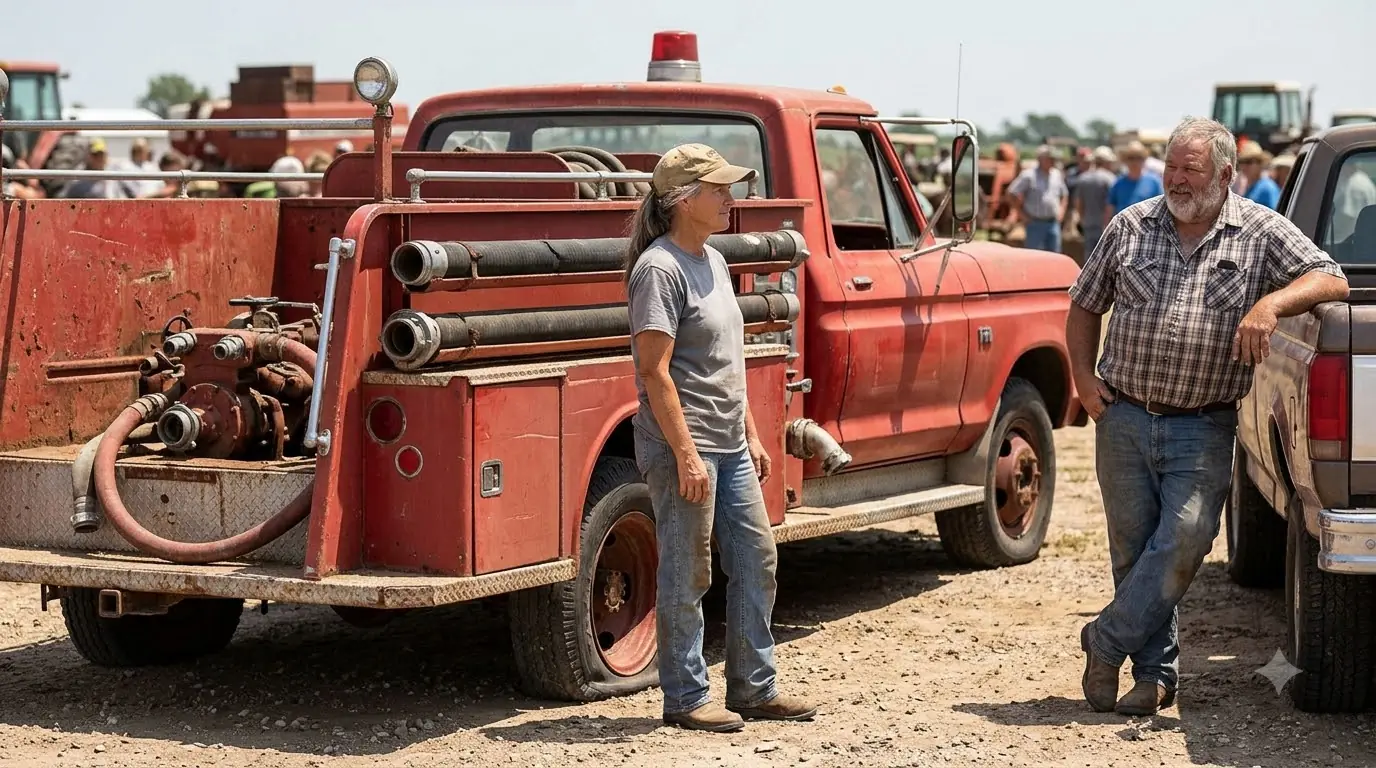
The truck sat off to the left of the main lot, away from the working equipment, parked between a stripped brush hog and a pile of culvert pipe. It was a 1974 rural fire truck built for a county department that had since moved on to newer units.
The red paint had faded to something closer to rust. Both rear tires were flat enough that the whole frame listed slightly to one side. The hose reels mounted along the body were cracked from years of sitting in open air, and the hoses themselves were brittle, the couplings green with corrosion. Someone had duct-taped a rag around one of the discharge valves. Nobody had bothered to remove it.
Dale Mercer, the county road supervisor running the auction, walked past it again and shook his head.
"Tank's probably rusted through," he said to nobody in particular. "Pump's seized. You'd spend more fixing it than it'd ever be worth."
A couple of the younger farmers standing nearby agreed. One of them said it couldn't put out a campfire. The other one laughed.
The truck just sat there.
Then Ruth Keller raised her hand.
She was standing near the back of the small crowd, wearing a faded canvas work shirt and a hat she'd owned for the better part of a decade. She was 57 years old and had been running wheat ground north of Pratt for nearly 30 of those years, first alongside her husband and then alone after he passed, with help from her nephew, Cole.
She wasn't a woman who made gestures. She raised her hand the same way she did everything, quietly, with purpose, like she'd already decided.
"200," she said.
Dale Mercer looked at her for a moment. Then he looked at the truck. Then he looked back at her.
"Sold."
He didn't bother asking for another bid.
The laughter came from somewhere off to the right. A couple of the men near the front shook their heads.
Harold Briggs, who farmed a section and a half just east of Ruth's property, leaned against his pickup and grinned.
"Ruth Keller," Harold said, loud enough for the people nearby to hear, "buying herself a fire truck."
Ruth didn't respond. She was already walking toward the auctioneer's table to sign the paperwork.
Cole Keller found out about it when Ruth called him from the county road. He drove out to the auction lot and stood in front of the old truck for a moment without saying anything.
He walked around the back of it, looked at the flat tires, and pushed on the running board with his boot. The metal made a sound that wasn't encouraging.
He was 26, lean and sun-darkened, wearing the same dirt on his jeans he'd been wearing since morning. He'd come out from Colorado three years earlier to help his aunt after her husband's stroke, and he'd never quite left.
He was a good farmer. He worked hard, and he didn't complain.
But right now, he was looking at this truck like a man trying to find something polite to say.
"What do you need with this?" he asked.
Ruth was checking the tow hitch fitting.
"Hook it up," she said.
"It's not— I mean, the tires alone."
"I know about the tires."
She stood there for another second, then he hooked it up.
On the way back to the farm, they passed Harold Briggs' property. Harold was out by his fence line, and he spotted the old red truck rolling behind Ruth's pickup, listing on its flat rears, the cracked hose reels catching the afternoon sun.
Harold raised his coffee thermos like a toast.
They pulled the truck around behind Ruth's machine shed, out of the way of the main yard.
Ruth walked the whole length of it twice before she opened anything.
The water tank was steel, older design, held maybe 750 gallons when full. She knocked on the side panel with her knuckle, a low, hollow sound. She did it again in three other spots.
She nodded once, like she'd confirmed something.
She pulled the pump access panel and shone a flashlight inside.
The pump housing had rust along the seams, but the casing itself looked intact. The intake valve handle was stiff, and when Cole tried to turn it, it didn't move.
"Seized," he said. "Probably. Could be scale buildup. Could be the seat swelled shut."
Ruth ran her finger along the inside edge of the pump housing.
"Gasket's cracked. She's been pulling air."
"You think you can fix it?"
Ruth didn't answer that directly. She was already looking at the suction line, tracing it with one hand from the pump head down to where it connected to the intake screen at the bottom of the tank.
The line was stiff, the rubber hard from years of heat and cold. She bent it gently.
It cracked faintly at the curve.
She stood up, put both hands on the side of the truck, and looked it over one more time.
Cole finally asked the question that had been sitting in his mouth since the auction lot.
"Why did you buy it?"
Ruth pulled a small notebook from her back pocket. She'd already been writing in it, lists of parts, measurements, notes on what she'd seen inside the pump housing.
"I'm not buying a fire truck," she said. "I'm buying a pump and a tank."
Cole waited for more.
There wasn't more.
Frank Willis came by the following week. He was the volunteer fire chief for their district, a big, steady man in his late 50s who'd been doing the job for 20 years, and still drove his personal truck to calls because the department only had two vehicles, and one of them was almost always already out.
He'd heard about Ruth's purchase through the usual channels, which in Pratt County meant Harold Briggs had mentioned it at the co-op.
Frank walked around the truck with his thumbs hooked in his belt loops.
He looked at the pump housing, the hose reels, the discharge outlets. He wasn't dismissive. He was just honest.
"I know that truck," he said. "We ran it for about six years before the county replaced it. Pump was getting unreliable even back then. Pressure dropped during extended operations. We had a field call where she lost prime, and we were standing there with a dead line."
"I can't count on something like this for official response."
"I know," Ruth said.
Frank looked at her.
"Then what are you planning to do with it? Keep it here?"
Frank waited.
"We're a long way from the station," Ruth said. "Fire starts in the north field during harvest. You're looking at what? Twelve minutes minimum before a truck gets to me. Could be longer if you've got another call."
Frank didn't deny it.
"I just want something that can move water while I'm waiting," Ruth said. "That's all."
Frank looked at the truck again.