The first thing Emily Carter heard was laughter.
It came across the fence in sharp little bursts, carried by the north wind over a field so blackened by frost that it resembled the aftermath of a grass fire. Nearly nineteen acres of radish leaves lay collapsed against the hard Kansas soil. Their stems had softened overnight and then stiffened again in the morning cold, leaving row after row of ruined-looking plants beneath a sky as pale and merciless as tin. The laughter came from three men beside two pickup trucks, and Emily knew the loudest voice without looking up.
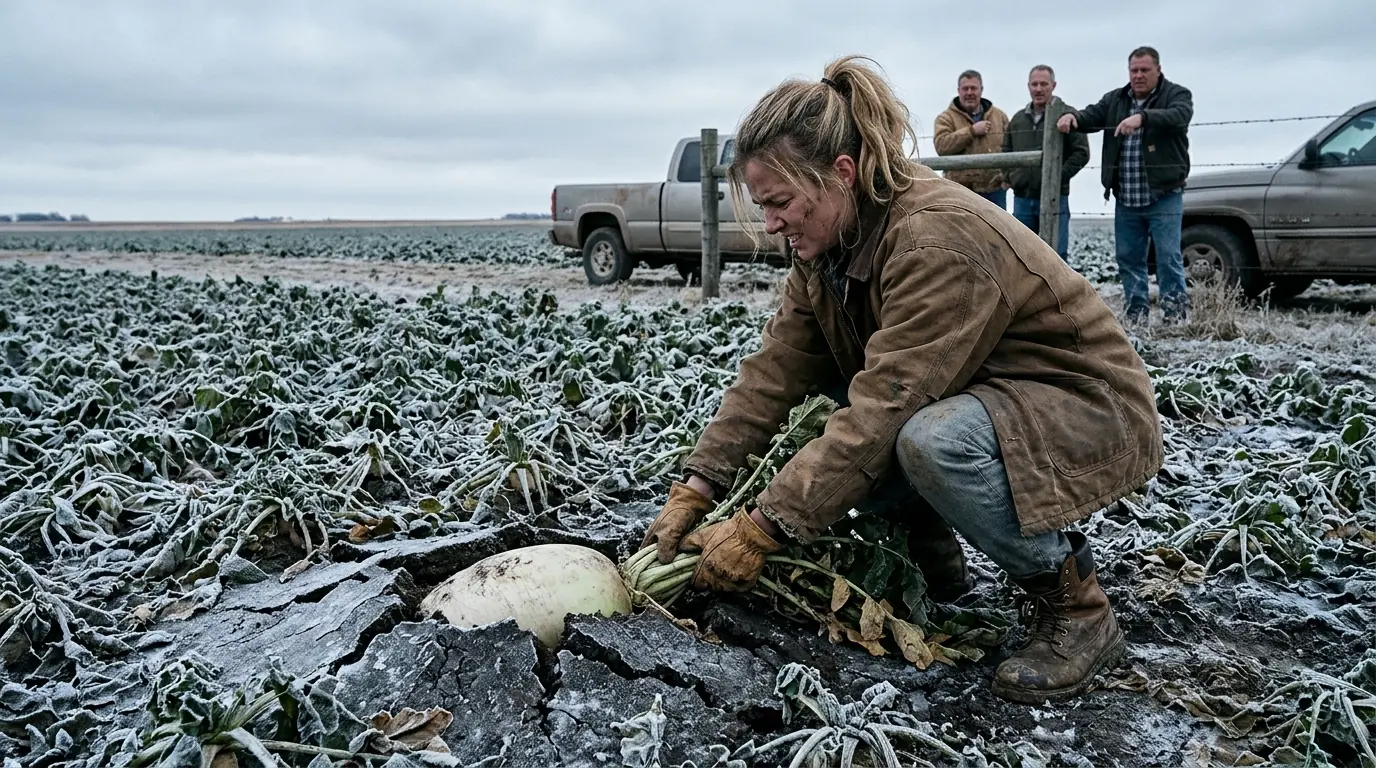
Ray Harlan had driven past her property every morning for the past six weeks. Sometimes he slowed. Sometimes he stopped at the fence and counted the days until the bank, the weather, or plain foolishness finished what he considered her father's unfinished business. Today he stepped out in an expensive work jacket over a clean plaid shirt, planted one boot on a dead leaf, and ground it into the dirt as though crushing something that had insulted him personally.
“Nineteen acres of dead weeds,” he called. “You've finally ruined this farm.”
His companions laughed harder. One raised both hands and mimed a woman trying to pull a stubborn plant. The other bent his knees and jerked backward theatrically, nearly falling against a truck door. Both were old enough to have children Emily's age. They knew her father had died in March. They knew she was wearing his brown canvas coat because the cuffs had been patched by her mother's hands. And they knew that if the land failed this season, there might not be another.
Emily tightened her leather gloves around the base of a thick stem. The leaves hung limp from it, dark and brittle around the edges. Beneath the cracked surface, just a sliver of pale root curved upward where the frost had heaved the earth. It was less than the width of two fingers. She had walked this row before dawn, stopping at a dozen plants, and she had not yet allowed herself to believe what the ground seemed to be telling her.
The first pull did nothing. Her boots slid a fraction in the crusted mud, and the stem held so firmly that she felt the strain in her shoulders rather than in the plant. Ray made a pleased sound, as if the field had supplied a final punch line.
Emily adjusted her grip. She set one boot beside the stem and the other behind her, keeping her weight low so that if the top snapped she would not go backward. She pulled a second time, harder. A thin crack appeared in the soil a few inches from her gloves. It ran sideways, hesitated, and widened in a shallow arc.
The men's laughter thinned. Emily felt the change without looking at them. Something under the dead leaves resisted not like the narrow radishes she knew from grocery-store bunches, but like a buried stone being lifted from one side. She leaned back once more, and the pale curve rose barely an inch. Soil shifted around several neighboring plants, as if the movement belonged to more than one root.
“Then why is the ground moving?” she asked.