In the summer of 1972, Greta Pfeifenberger stood in the doorway of a failing Michigan co-op with a burlap sack of tartary buckwheat seed at her feet and $217 in cash on the counter. The men around her did not see a plan, a study, or the beginning of a twelve-year experiment. They saw a tired farm wife buying what they believed was nothing more than a weed. And because her husband Harlan was sick upstairs at home, unable to defend the farm himself, they laughed with the easy confidence of men who thought the world already agreed with them.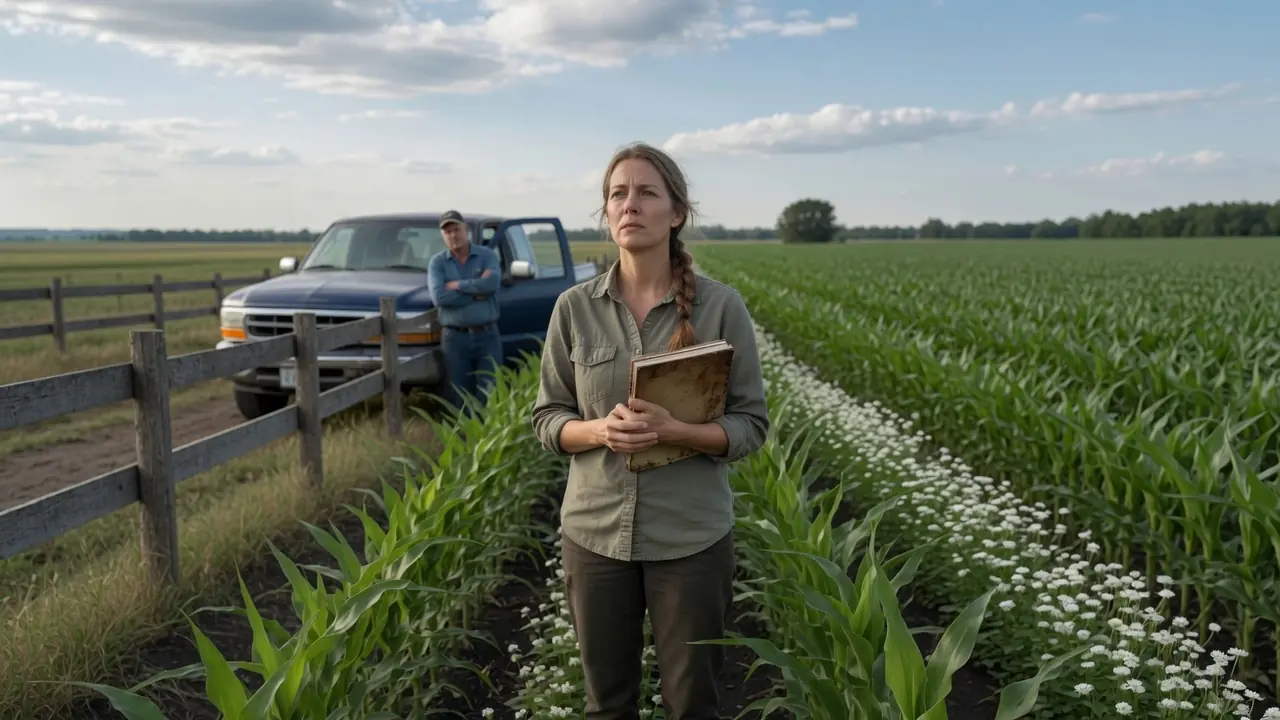
Greta did not answer their laughter. She only folded the receipt, tied the mouth of the sack tighter, and dragged it toward the door with both hands. Outside, the afternoon sun struck the dust rising from the parking lot, and she paused beside her pickup, breathing through the weight of what she had just done. Forty-seven pounds of seed did not look like much in the bed of a truck. But to Greta, it felt like a promise too heavy for any man in that room to understand.
Back home in Mecosta County, her cornfield waited behind the farmhouse, forty-seven acres that had once been Harlan’s pride. For years, he had walked those rows with an instinct Greta had admired but never fully claimed for herself. Now Harlan lay upstairs, thin and exhausted, his illness turning every day into a careful routine of medicine, silence, and pain. The farm had not asked whether Greta was ready to lead it. It had simply become hers.
At the kitchen table that night, Greta opened the last letter from Dr. Ulrich Stecker, the retired German soil scientist who had written to her for more than a decade. His handwriting was shaky, but his instructions were clear. Plant the tartary buckwheat between the corn rows, seven inches from each side, and do not listen when neighbors call it madness. Test the soil every spring and fall, he had written, because the numbers will speak when people refuse to.
Greta traced the line with her finger. The numbers will speak. She had spent years learning that soil was not dead dirt waiting to be forced into production, but a living system filled with roots, fungi, minerals, moisture, and quiet exchanges too small for the eye to see. Buckwheat, Dr. Stecker believed, could help unlock the phosphorus already trapped in the ground. It would not steal from the corn. It would teach the soil how to feed it.
The next week, Greta took apart Harlan’s old Massey Ferguson planter in the machine shed. It had been built to plant corn, not two crops side by side, but Greta had learned from years of farm accounts that problems often became smaller when broken into parts. She salvaged canisters from an old seed drill, mounted them behind the corn hoppers, and calibrated the feed rate with gears from a broken hay rake. By the time she finished, the machine looked ugly, uneven, and homemade. But when she tested it in the yard, buckwheat seed fell exactly where Dr. Stecker had told her it should.
Dietrich Pfeifenberger, Harlan’s older brother, watched from across the fence as Greta planted. His own land beside hers was clean, straight, and managed with expensive equipment bought on credit. He finished his fields in less than two days, while Greta took four long days crawling over her forty-seven acres. Each time she stopped to check seed depth, she could feel Dietrich’s eyes on her. By the second evening, she no longer looked toward his house.
By mid-June, the field began to change. The corn rose in straight green rows, but between the stalks a soft haze spread over the soil. By July, that haze had become a low, living carpet of white blossoms. Bees moved through the field like a humming cloud, and the dark soil beneath the buckwheat stayed cool even under the summer sun. To Greta, the field looked alive in a way it never had before.
To everyone else, it looked ruined.
At Stanwood Hardware, the men gathered around the coffee urn and repeated Wendell Tibbetts’s verdict as if it were a law of nature. Wendell was the grain buyer at the Big Rapids Co-op, and because he ran the scale, men treated his opinions like weather reports. He said the buckwheat would go to seed before the corn tasseled. He said it would steal nitrogen, choke the crop, and leave Greta with a mess by harvest.
“Poor Harlan,” one farmer said, shaking his head.
“Poor farm,” another replied.
At the Morley fire hall pie social, the women spoke more softly, but their pity cut deeper. Verlena Stebbins stood by the dessert table, arranging paper plates while pretending not to gossip. She told two other farm wives that Greta’s field looked more like a meadow than a cornfield. Then she lowered her voice and said people ought to pray for Greta and Harlan both.
Greta heard about it by Sunday.
She did not cry until night.
That evening, she carried a bowl of soup upstairs to Harlan and found him awake, staring toward the window where the last sunlight lay across the curtains. His hands had grown thin, but when she sat beside him, his fingers moved slightly toward hers. She told him the corn was up. She told him the buckwheat had bloomed.
“They’re laughing,” she said quietly.
Harlan’s eyes shifted toward her. For a moment, the illness loosened its grip, and the old steadiness returned to his face. He could not say much anymore, but he squeezed her hand once. Greta lowered her head over their joined fingers. That one small pressure was enough to send her back to the field the next morning.
Late in July, Dietrich finally drove his pickup to the fence line. Greta was kneeling between the rows with a trowel in one hand and her notebook open beside her. She was checking the base of the corn stalks, noting color, moisture, and the first thin threads of white fungal growth clinging to the roots. Dietrich did not get out of the truck. He leaned out the window and looked over the flowering field with disgust.
“Greta, what is this?” he called. “People are talking.”
She stood slowly and wiped dirt from her hands. “The corn looks fine.”
“It looks fine now,” he said. “Wait until harvest.”
Greta picked up her notebook. “The soil is cooler under the cover. The corn is holding moisture.”
Dietrich laughed once, sharp and humorless. “This isn’t farming. This is gardening. You’re out here playing some kind of Steiner witch while Harlan fades away upstairs.”
The words struck harder than she expected. Greta looked across the fence at the man who shared her husband’s blood and wondered how concern could sound so much like contempt. She wanted to defend herself, to explain phosphorus, fungi, and the hidden life of soil. But Dietrich’s face was already closed.
So she only said, “The corn looks fine.”
Dietrich shook his head. “You’re embarrassing his name.”
After he drove away, Greta stood among the white blossoms until the dust settled. She pressed her notebook to her chest and listened to the bees. For the first time since buying the seed, anger rose through her grief and steadied her spine. If the whole county wanted to laugh from the road, then let them. She would listen from inside the field.
Harvest came with cold mornings and hard work. Greta brought in 138 bushels per acre, only slightly below the county average and better than Harlan had managed the previous year with full fertilizer. Wendell Tibbetts weighed the grain and grunted that she had gotten lucky with the rain. Dietrich called it a fluke. Nobody credited the buckwheat.
Greta did not argue.
She was waiting for the soil test.
When the letter from the Michigan State University Extension Lab arrived, she carried it unopened to the kitchen table. Her hands shook as she unfolded the paper and scanned the columns. Phosphorus, Bray One test: fifteen parts per million. Two points higher than spring.
It was small enough for others to dismiss.
To Greta, it was the first reply.
She wrote the number in her logbook with the date, the quadrant notes, the rainfall total, and the yield. Then she sat back and closed her eyes. The field had spoken softly, but it had spoken. The argument had begun.
The second year, the laughter changed into waiting. Farmers wanted to see the collapse they had predicted, because a single decent yield had not been enough to shake what they believed. Greta planted again with the same ugly modified planter, the same slow passes, the same quiet care. In July, the white blossoms returned beneath the corn, and trucks slowed again along the road.
Then the drought came.
The rain stopped in late July, and the heat settled over central Michigan like a lid. Conventional fields turned gray and hard between the rows. Corn leaves curled inward under the sun, and men stood at field edges talking about moisture loss and bad luck. Dietrich’s corn began to burn at the tips.
Greta’s field held.
The buckwheat covered the ground like a living blanket, keeping the soil shaded and damp. Her corn leaves stayed open. The stalks remained green. Neighbors began slowing their trucks not to laugh, but to stare.
At the church potluck, Verlena Stebbins admitted it was odd. She said Dietrich’s corn looked thirsty while Greta’s looked as if it had been rained on every night. She did not say Greta might have been right. Not yet. But confusion had entered the conversation, and confusion was the first crack in certainty.
That fall, Greta’s field yielded 136 bushels per acre while the county average dropped far below that. Still, people found reasons. Lower ground, better timing, luck, seed choice, anything but the white flowering cover they had mocked. Greta wrote the yield in her logbook and waited for the soil report. Phosphorus had climbed again.
Nineteen parts per million.
The years became a rhythm. Spring samples, planting, bloom, root checks, harvest, fall samples, numbers. Greta learned to live inside repetition. She learned that proof did not arrive as thunder. It arrived as a column of numbers moving slowly upward while everyone else looked away.
By the third planting, Dietrich confronted her again, this time in the machine shed. He had learned from the bank that she had not taken out a fertilizer loan in three years. To him, that was not intelligence or thrift. It was neglect.
“You’re mining the soil,” he said, standing in the doorway like a judge. “You’re taking out fertility and putting nothing back.”
Greta held a cleaned gear in one hand and looked at him calmly. “The phosphorus levels are rising.”
Dietrich stared at her. “What?”
“They were thirteen parts per million when I began. They are twenty-seven now.”
“That’s impossible,” he said. “You can’t make phosphorus.”
“I’m not making it,” Greta replied. “I’m unlocking it.”
The sentence hung between them like a language from another country. Dietrich’s face twisted with frustration, because he wanted tons, invoices, and clean rows, not invisible fungi and locked minerals. He turned away without saying goodbye. After that, he did not step onto her property for nearly a decade.
Greta kept working.
Harlan stayed alive through seasons that seemed to wear away everything but his eyes. In the evenings, Greta sat beside his bed and read from her logbooks. Rainfall totals. Planting dates. Earthworm counts. Phosphorus readings. Sometimes, when she reached the newest number, Harlan’s eyes cleared and he nodded faintly, as if some part of the farmer in him still understood.
By 1978, the soil no longer looked the same. Greta could feel it beneath her boots. What had once been pale and compact now crumbled in her hands, darker each year, richer each year. Earthworms appeared in numbers she had never seen before. When she pulled back the buckwheat at midsummer and dug gently between corn and cover crop, she found fine white threads weaving through the roots like a hidden net.
Mycorrhizae.
Dr. Stecker had told her they were the miners of the soil, trading nutrients for sugars, connecting plant to plant in a living underground bargain. Greta held a small root mat in her palm and felt sudden awe. The county had mocked a weed. Beneath their laughter, a whole unseen world had been building the farm back together.
The fertilizer prices rose. Equipment grew larger. Chemicals became stronger. Farmers borrowed more money to keep producing the same acres in the same way. Greta’s inputs remained almost embarrassingly simple: seed, labor, observation, and patience. Her yields did not merely survive. They began to beat the county average.
But still, the county shrugged.
“That’s just what Greta does,” people said.
They had stopped laughing because laughter no longer felt safe, but they had not truly understood. Her field had become an oddity, something accepted without explanation. Greta knew that was not enough. The numbers in her logbook were proof, but only to someone willing to read them.
In 1983, the soil test came back so high she thought the lab had made an error. Phosphorus: 78.8 parts per million. She read the number again, then sat very still at the kitchen table. The field had increased its available phosphorus sixfold without commercial phosphate fertilizer.
Dr. Stecker had died four years earlier. Greta had no one to send the number to. The man who had taught her to trust the soil would never see the final answer.
She carried the report upstairs to Harlan.
His breathing was shallow that evening, but his eyes opened when she touched his arm. She read the number aloud. For a long moment, nothing happened. Then Harlan’s hand moved over the blanket, searching for hers.
Greta placed her fingers in his palm.
He squeezed once.
That winter, Greta wrote to Michigan State University. She did not write dramatically. She introduced herself, described the interplanting system, included a photocopy of twelve years of data, and asked a simple question: Is this unusual? Then she mailed the letter and returned to her chores.
At first, nothing happened.
Her letter sat on a desk in East Lansing, passed from one person to another as if it were just another odd inquiry from a rural citizen. Then Dr. Laveonia Spring Hartwell, a soil scientist from the Kellogg Biological Station, saw the chart. She read the phosphorus numbers twice. Then she read them a third time.
A sixfold increase without phosphate fertilizer should not have been possible under ordinary assumptions. Either the data was wrong, the testing flawed, or the woman in Mecosta County had stumbled into something extraordinary. Dr. Spring Hartwell called Greta and asked careful, skeptical questions. Greta answered each one with the plain precision of a person who had done the same work for twelve years.
Finally, the scientist said, “Mrs. Pfeifenberger, your data suggests you are creating available phosphorus out of thin air.”
Greta looked through the kitchen window toward the winter field. “I didn’t create it,” she said. “It was already there. I just asked the soil to release it.”
There was silence on the line.
Then Dr. Spring Hartwell asked if she could visit in August.
The summer of 1984 arrived hot, bright, and heavy with bees. Greta’s corn stood tall, deep green, and straight, while the buckwheat bloomed beneath it in white waves. The field looked beautiful enough to stop even the men who had once mocked it. But on the morning Dr. Spring Hartwell arrived, Greta was not thinking about beauty. She was thinking about proof.
The scientist came in a dusty university car with sample bags, probes, maps, and a skepticism she tried politely to hide. Greta met her at the gate and did not offer speeches. She simply pointed toward the field and said, “The logbooks are on the porch. You may start wherever you like.”
For two hours, Dr. Spring Hartwell worked through the rows. She laid out grids, took soil cores, labeled samples, measured cover, checked root structures, and compared Greta’s field against a conventional field across the road. Greta watched from the porch with folded hands. She had waited twelve years for someone else to ask the soil the same question.
When the scientist finished sampling, she sat on the porch and opened Greta’s logbooks.
The afternoon passed quietly. Pages turned. Bees hummed in the field. Greta rocked slowly in her chair and watched Dr. Spring Hartwell’s expression change from professional doubt to concentration, then from concentration to something like astonishment.
The logbooks held everything. Rainfall totals, soil temperatures, planting dates, root notes, earthworm counts, mycorrhizal observations, yields, phosphorus readings, organic matter changes, and margin notes written in Greta’s careful hand. It was not a diary. It was a long-term ecological study created at a kitchen table by a woman no one had thought to respect.
Dr. Spring Hartwell finally looked up.
“Mrs. Pfeifenberger,” she said softly, “do you have any idea what you’ve done here?”
Greta looked out at the tall green corn and the white flowers moving gently beneath it. “I listened,” she said. “That’s all.”
Two months later, the official report came.
It was dry, academic, and filled with charts, but it landed in Mecosta County like a thunderclap. Michigan State University confirmed that Greta’s soil had far higher available phosphorus than nearby conventional ground. It confirmed better organic matter, better water infiltration, stronger biological activity, and a yield that shocked every man who had once predicted failure.
Greta’s forty-seven acres had produced 187 bushels per acre with no commercial fertilizer.
The county average was far lower.
The same men who once laughed over coffee now read the report in silence.
Wendell Tibbetts read it at the co-op counter. Dietrich read it at his kitchen table, his own clean fields visible through the window. Verlena Stebbins read it twice and folded it carefully, as if the paper itself had accused her. The words were no longer gossip. They were printed numbers.
The climax came a week later when Dr. Spring Hartwell returned to Greta’s farm with extension officers, farmers, and local reporters. Trucks lined the road outside the cornfield. Men who had mocked the white blooms now stood shoulder to shoulder at the fence, staring into the field as if it had become a courtroom.
Greta stood beside the gate in her work boots, holding the MSU report in one hand and her oldest logbook in the other. Wendell Tibbetts came forward slowly, his cap twisted between his fingers. He looked older than he had in 1972. Less certain.
“I called it a weed patch,” Wendell said, barely loud enough for the front row to hear. “Told every farmer who would listen that you were ruining the field.”
Greta did not rescue him from the silence.
He swallowed. “I was wrong.”
She looked past him, over the field where bees moved through the buckwheat and the corn stood green and high. “I remember the co-op, Wendell.”
His face reddened. He nodded once because there was nothing else to say.
Dietrich stood farther back, unable to meet her eyes. At last, he stepped forward. “Greta,” he said, voice rough, “what I said about you and Harlan was ignorant. I thought I was defending my brother’s name, but I was only defending my pride.”
Greta turned to him.
For years, she had imagined this moment. She had imagined anger, victory, perhaps even relief. But standing there with the report in her hand, she felt only the weight of how long a wound could last.
“Harlan believed in this farm,” she said. “You should have believed he knew the woman he left it to.”
Dietrich lowered his head.
Dr. Spring Hartwell addressed the gathered farmers next, explaining the data in clean, careful language. She spoke of phosphorus cycling, microbial activity, mycorrhizal networks, living cover, and water retention. Some men listened with open curiosity. Others listened as if every sentence dismantled something inside them.
But Greta barely heard the speech.
She was watching the field.
The corn had been her witness when no person would stand with her. The soil had kept answering, season after season, while the county laughed, doubted, pitied, and dismissed her. Now the field stood tall in front of them all, beautiful and undeniable. It had not shouted. It had simply grown.
That evening, after everyone left, Greta carried the report upstairs to Harlan. He was weaker now, but still alive. She sat beside his bed and read the important lines slowly, pausing whenever her voice threatened to break. When she finished, she placed the report on the blanket between them.
“They know now,” she whispered.
Harlan’s eyes filled with tears. His hand moved toward hers, and this time the squeeze was so faint she almost missed it. But she felt it. She bowed her head and let herself cry.
Harlan passed away that winter in his sleep. Greta buried him beside his parents and returned to the farm not as the sick farmer’s wife, not as the woman who planted weeds, but as the person who had carried the land through its hardest years. The title did not matter to her. The work did.
In the years that followed, farmers came to ask questions. They approached her at the co-op, at the post office, and sometimes at the edge of her field, embarrassed but curious. What kind of buckwheat? How far from the corn row? When did she plant? How often did she test? Greta answered each question plainly, without triumph.
She never said, “I told you so.”
She did not need to.
The field said it every July.
Years later, when people called Greta Pfeifenberger a pioneer, she accepted the word politely but never seemed comfortable with it. She preferred to say she had remembered something older than modern farming had forgotten. Soil was not a machine, and fertility was not only something poured from a bag. It was a community of living relationships, and like any community, it answered care with strength.
At a public ceremony in Lansing, Greta was asked to make a statement. She unfolded a small card and read in a clear, steady voice.
“The soil is not a resource to be consumed. It is a community to be cultivated. My work was not an invention, but a remembrance of that simple truth.”
Then she folded the card, accepted the certificate, and went home.
Because the cornfield still needed walking.