Marie Fontenot was twenty-three years old when she inherited fifty acres of land nobody wanted anymore. The farmhouse leaned under a rusted tin roof, the pasture grass had gone yellow, and the old pond behind the barn looked more like a cracked bowl than a place that had ever held water. Her father had spent his last years fighting that land, planting soybeans, corn, and winter greens that either drowned, burned, or came up too thin to pay the seed bill. By the time he died, most folks in St. Martin Parish had already decided the Fontenot farm was finished.
The first person to tell Marie to sell was Curtis Landry, the neighbor whose family farm bordered hers on the west side. Curtis was sixty-two, broad-shouldered, gray-haired, and proud of speaking in a way that made advice sound like an insult. He had known Marie since she was small enough to sit on her father’s tractor fender, but that did not make him gentle with her. On the morning after the funeral, he leaned against the fence and told her, “Your daddy fought this place until it buried him, girl. Don’t let it bury you too.”
Marie stood in the yard wearing her father’s old work shirt, the sleeves rolled twice because they were too long. Her eyes were swollen from crying, but her chin stayed lifted as she stared at the broken fields behind Curtis. “It didn’t bury him,” she said quietly. “He loved this place.” Curtis looked toward the cracked pond and shook his head with a sad little smile. “Love won’t pay taxes, Marie. Neither will dry mud.”
For two weeks, everyone seemed to have an opinion about what she should do with the farm. Her aunt said to sell before the bank came knocking, her cousin said developers might pay good money for the road frontage, and a feed-store clerk told her she was too young to be tied to dead land. Marie listened, nodded, and went home every evening with dirt on her boots and anger tightening in her chest. She did not know everything, but she knew the farm was not dead just because men with paid-off trucks said so.
The idea came to her from one of her father’s notebooks, found in a kitchen drawer beneath old tractor receipts. He had written about the pond years earlier, noting how it stayed low in summer but held water after heavy rain longer than any ditch on the property. He had underlined one sentence twice: Poor row crop soil, maybe better for crawfish rotation if water control can be fixed. Marie sat at the table with that notebook open, one hand over her mouth, feeling as if her father had reached across death and placed a plan in her lap.
She spent nights studying crawfish farming on her phone until her eyes burned. She learned about flooding fields, rice stubble, drainage, burrows, stocking rates, oxygen levels, and how crawfish could turn wet, troublesome ground into profit when handled carefully. The more she read, the more the farm began to look different in her mind. What everyone called weakness might have been the only strength the land had left.
Curtis Landry showed up just as she began tipping the first crate into the shallow water. He came with two other older farmers, both wearing faded caps and the kind of smiles men wear when they expect a good story to tell later. Marie knelt in the mud, her red hair falling loose from its tie, her hands wet as crawfish spilled from the crate and flicked into the pond. Curtis laughed so loudly that birds lifted from the fence line.
“Why are you dumping crawfish into dead mud, girl?” Curtis called. Marie set the empty crate beside her and wiped her wrist across her cheek, leaving a streak of wet soil there. “Because dead land still feeds people who know how to listen,” she said. The two farmers behind Curtis chuckled, but Curtis’s smile tightened because she had answered sharper than he expected.
He stepped closer to the pond bank, boots sinking slightly into the damp edge. “Your father failed here, and you’ll fail twice as fast.” Marie rose from the mud slowly, her hands still wet, her eyes locked on his face. “Don’t use my father’s name to bless your ignorance,” she said, and the laughter behind him died. Curtis stared at her, surprised by the strength in her voice.
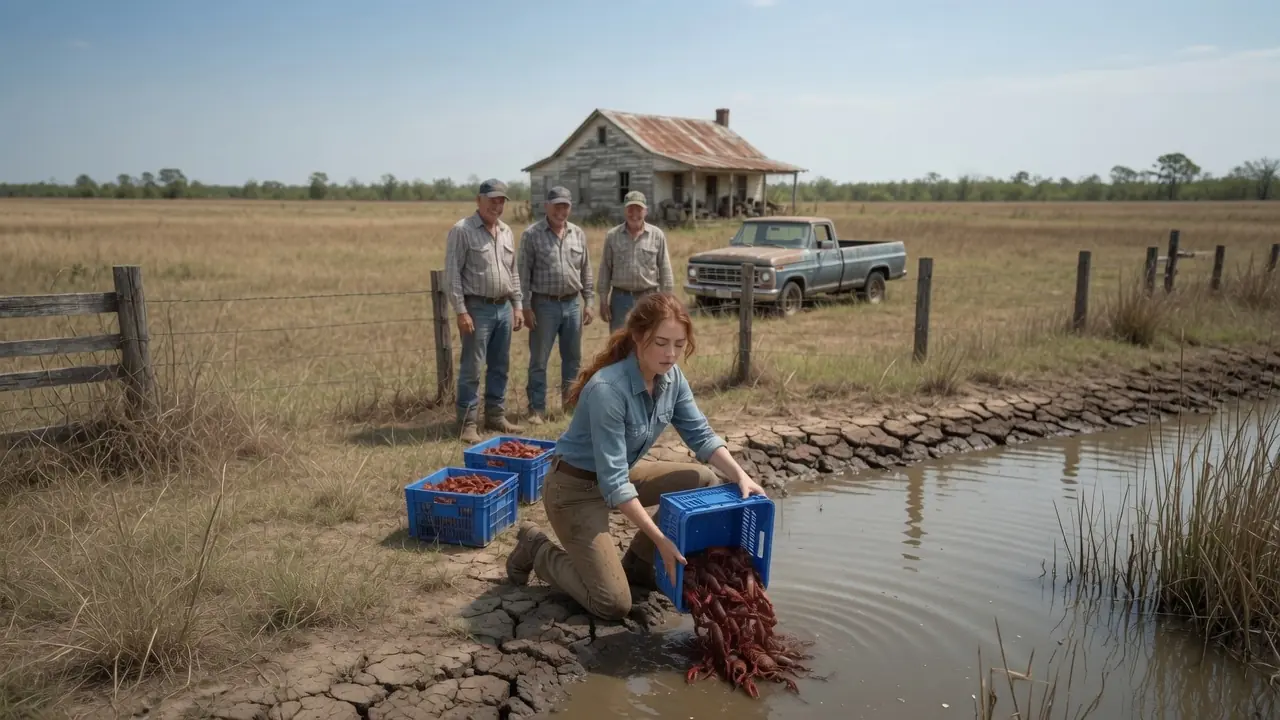
His pride recovered quickly. “Sell the farm before this pond buries your future,” he said, pointing toward the water like he was pointing at a grave. Marie picked up another crate, arms shaking from the weight, but she did not look away. “Come harvest season, Curtis, you’ll be asking me how to save yours.” He laughed again then, but it was too loud, and Marie could hear the discomfort beneath it.
The first month nearly broke her. The pump clogged twice, one pipe split, and a heat wave dropped the water level so fast she had to borrow a neighbor’s tanker truck at a price that made her hands tremble when she signed the receipt. At night, she lay awake listening to frogs, insects, and the low hum of the pump, wondering if everyone was right. Each morning, she walked the pond bank anyway, checking water, mud, traps, and tiny signs of life with a notebook in one hand.
People kept laughing, but now they did it from farther away. Trucks slowed on the road when she carried sacks of feed or repaired the levee with a shovel. Men at the feed store stopped talking when she walked in, then started again as soon as she left. Marie heard enough to know they called her “Crawfish Queen” behind her back, not as praise, but as proof that grief had made her foolish.
Curtis visited often, always pretending he happened to be nearby. He stood at the fence with coffee in one hand and criticism ready in his mouth. “Water’s too shallow,” he said one morning. Another day, he nodded toward her traps and said, “You’ll spend more on bait than you’ll ever pull out of that hole.” Marie answered less and less, saving her strength for the work.
By late fall, the pond no longer looked dead. Water covered the cracked bottom, grass grew at the edges, and crawfish burrows appeared like small chimneys along the damp banks. Marie moved through the place with more confidence, her boots leaving deep prints in the softened soil. She still worried every day, but worry no longer controlled her hands. The farm had begun speaking back.
Winter brought rain, and with it came a different kind of danger. The pond rose too fast one night, water licking at the emergency spillway while thunder shook the old windows of the farmhouse. Marie ran outside in a rain jacket, flashlight between her teeth, and spent two hours clearing debris from the drain while water rushed around her calves. When she came back inside soaked and shaking, she sat on the kitchen floor and laughed until she cried because the pond everyone called dead now had too much life in it.
Curtis saw the rising water the next morning and shook his head from the fence. “You’re lucky it didn’t wash out,” he said. Marie was too exhausted to pretend patience. She turned with a shovel in her hand and said, “Funny how you call it luck after calling it failure for six months.” Curtis looked away toward his own fields, where the soil lay tired and pale under winter rain. For the first time, he did not answer.
Spring came slowly, softening the fields with green. Marie set traps before sunrise, her breath visible in the cool air, her hands moving carefully through the practiced routine she had built from trial, error, and stubbornness. The first traps came up light, and her heart sank. Then she pulled the seventh trap from the water and froze.
It was heavy.
The mesh bulged with crawfish, red and dark and snapping, their shells shining in the morning light. Marie stood knee-deep at the pond edge, one hand gripping the rope, her mouth open as if she had forgotten how to breathe. Then she laughed, a broken, relieved sound that startled a heron from the bank. She emptied the trap into a blue crate and listened to the living weight of it hit plastic.
By noon, she had filled five crates. By evening, she had filled twelve. Her arms ached, her back burned, and her knees were streaked with mud, but she worked until the sun dropped low and the pond turned silver. When she finally looked toward the fence, Curtis was standing there silently.
He did not smile this time. His cap was low over his eyes, and both hands rested on the top rail as he stared at the crates lined beside the water. Marie carried the last crate up the bank and set it down with a heavy thud. “Come to laugh?” she asked, breathing hard. Curtis swallowed, his eyes fixed on the crawfish. “No,” he said quietly. “I came to see if it was true.”
The first buyer arrived two days later. Then came another. A small seafood market in Lafayette offered her a steady weekly pickup if she could keep the quality high. A restaurant owner tasted the first batch and called her that same night, asking how much she could deliver before Easter weekend.
Marie cried in the pantry after that call, one hand pressed over her mouth so no one outside could hear. The farm had not made her rich overnight, but it had done something almost as powerful. It had answered. After years of being called worthless, the land had finally produced something people wanted.
Word spread quickly through the parish. The same men who had laughed at the dry pond began driving by slowly, pretending to check fences or road conditions. Some asked casual questions at the feed store about water control and stocking rates. Others stopped speaking when Marie entered because they did not want to admit they were discussing her success. Curtis stopped coming to the fence for nearly two weeks.
When he finally appeared, Marie was sorting crawfish beside the pond. His shoulders looked lower than before, and his face carried a tightness she had never seen in him. He watched her work for a minute, then removed his cap. “Marie,” he said, and the sound of her name without mockery made her hands pause.
She looked up. “What do you want, Curtis?” He glanced toward the old farmhouse, then toward the water. “I want to apologize.” Marie stared at him, mud on her sleeves, crawfish snapping in the crate between them. The wind moved softly through the dry grass, and for once, Curtis Landry seemed unsure of where to put his eyes.
“I talked ugly to you,” he said. “Worse than ugly.” Marie kept her face still, but her fingers tightened around the rim of the crate. “You used my father to do it.” Curtis nodded slowly. “I did. And I was wrong.”
She stood then, wiping her hands on a towel tucked into her belt. “Wrong about what?” Curtis looked uncomfortable, but Marie did not help him. She had carried his words through every hard morning, every broken pipe, every night she wondered if failure would prove him right. If he wanted forgiveness, he would not get it in easy pieces.
Curtis took a breath. “I was wrong that the land was dead. I was wrong that you were too young to know what you were doing.” He looked down at the mud, then back at her. “And I was wrong to laugh because I was scared you might prove something I didn’t want to admit.” Marie’s anger shifted slightly, not gone, but listening.
“What didn’t you want to admit?” she asked. Curtis’s jaw worked. “That maybe the old way isn’t saving us anymore.” He gestured toward his own farm beyond the fence, where fields that once made him proud had been losing money for years. “I kept planting the same crops because my daddy did, and his daddy did. Watching you try something new made me feel old, so I treated you like a fool.”
Marie looked at him for a long time. His apology did not erase what he had done, but it sounded real in a way his advice never had. She picked up the crate and set it with the others. “You made me feel small on land that was already hard enough to stand on,” she said. Curtis lowered his eyes. “I know.”
That should have been the end of it, but Curtis surprised her. “I need help,” he said. Marie turned back toward him slowly. He swallowed hard, pride visibly fighting him. “My back field floods every spring and burns every summer. I think it might work for crawfish, but I don’t know how to start.”
Marie almost laughed, not because it was funny, but because the sentence sounded exactly like the future she had promised him months earlier. Come harvest season, Curtis, you’ll be asking me how to save yours. She looked toward his farm, then at the man who had mocked her at the pond bank. “You want me to teach you?” she asked.
Curtis nodded. “If you’ll have the patience.” Marie folded her arms, studying him. “I’ll teach you the land and the water. But if you ever speak to me like I’m some foolish girl again, you can learn from your own mistakes.” Curtis gave a small, humbled nod. “Fair.”
Their partnership began awkwardly. Curtis showed up with a notebook, new rubber boots, and the stiff silence of a man unused to being a student. Marie made him measure water depth, mark soil softness, check burrows, and record weather patterns instead of guessing by memory. He grumbled at first, but every time he started to act like the old Curtis, Marie only raised one eyebrow, and he corrected himself.
By the second season, Fontenot Crawfish had become a name people recognized. Marie repaired the farmhouse porch, painted the old sign at the road, and bought a used refrigerated trailer with money from her first strong harvest. Her pond expanded into a controlled wet field system, and she began rotating forage crops to improve the soil between seasons. The land that had once been called exhausted started growing healthier because she worked with its nature instead of forcing it to become something else.
Restaurants placed orders before harvest even began. Families came on Saturdays to buy sacks directly from the farm, children pointing excitedly at the crates while Marie explained how crawfish burrowed and survived dry months. Reporters from a local agricultural magazine visited and photographed her beside the pond, boots muddy, hands rough, hair tied back against the wind. The headline called her “the young farmer who brought water back to dead land.”
Marie clipped the article and placed it inside her father’s notebook. She did not do it for pride, though she felt some. She did it because his one underlined sentence had given her the courage to see possibility where others saw ruin. On quiet evenings, she sat by the pond and read his notes again, tracing his handwriting with one finger. “You were right, Daddy,” she would whisper.
Curtis changed more slowly than the land, but he changed. He stopped making jokes about young people not knowing work. He stopped dismissing new methods just because they did not come from his generation. When other farmers laughed at the idea of converting flood-prone fields, Curtis surprised everyone by saying, “Laugh carefully. I did, and that girl made me eat every word.”
One afternoon, a group of farmers gathered at Marie’s pond for a demonstration. Curtis stood beside her, no longer across from her like an enemy, but slightly behind, giving her the space that belonged to her. Marie explained water management, stocking, trap spacing, soil recovery, and the importance of observing land before deciding what it could or could not do. Men twice her age took notes while she spoke.
At the end, one of the farmers asked, “How did you know this would work when everyone else thought the place was dead?” Marie looked toward the pond, where the water moved gently against the bank. She thought of cracked mud, empty pockets, Curtis laughing, and the first heavy trap rising from the water. Then she looked back at them. “I didn’t know it would work,” she said. “I just knew failure wasn’t proof the land had nothing left to give.”
Curtis removed his cap and spoke before anyone else could. “And some of us were too proud to see it.” Marie glanced at him, and he gave her a small nod. The apology was no longer only words between them. It had become something he carried publicly, a debt he repaid by telling the truth.
Three years after she inherited the farm, Marie stood beside the same pond bank where Curtis had laughed at her first crate of crawfish. The cracked mud was gone now, replaced by managed water, healthy banks, and rows of traps waiting for the morning harvest. The old farmhouse still had a rusted roof in places, but the porch was strong, the windows were repaired, and the yard held signs of life again. A painted wooden board by the gate read: Fontenot Crawfish Farm.
Curtis walked up beside her holding two cups of coffee. He handed one over without speaking, and they stood together watching the water. After a while, he said, “Your daddy would be proud.” Marie swallowed, her eyes shining as she wrapped both hands around the cup. “I hope so,” she whispered.
Curtis looked across the farm that everyone had once told her to sell. “You saved this place.” Marie shook her head gently. “No. I listened to it.” She looked down at the pond, where tiny ripples moved across the surface like quiet applause. “There’s a difference.”
Harvest began at sunrise. Workers lifted traps, crates filled, trucks backed in, and the old farm came alive with the rhythm of a place no longer apologizing for existing. Marie moved through it all with mud on her boots and command in her voice, no longer the grieving young woman everyone pitied or mocked. She was a farmer, a business owner, and the keeper of land that had been waiting for someone stubborn enough to believe in it differently.
By noon, Curtis stood near the fence watching a line of buyers load sacks into coolers. He looked at Marie and smiled, not with mockery this time, but with respect earned the hard way. She caught the look and raised one eyebrow. He laughed softly, lifted both hands, and said, “I know, I know. You told me so.”
Marie smiled then, tired and bright, with the pond behind her and her father’s farm alive beneath her feet. Everyone had told her the land was ruined, but ruined things sometimes only need the right kind of faith, the right kind of work, and someone brave enough to be laughed at first. The farm everyone mocked had become the harvest everyone wanted. And Marie Fontenot, the girl they said would lose everything, had turned dead mud into a future.