The first laugh came before Emma Carter had finished pressing the sand around the roots.
It rolled across the fence line behind her, dry and familiar, the kind of laugh that carried no surprise because the man making it had already decided how the story ended. Roy Dutton had been laughing at her plans for almost a year. He had laughed when she bought the acreage, laughed when the old realtor told him the price, laughed when Emma rented a trailer instead of building a house, and laughed again when he saw the first stacks of prickly pear pads arrive in the bed of a borrowed pickup.
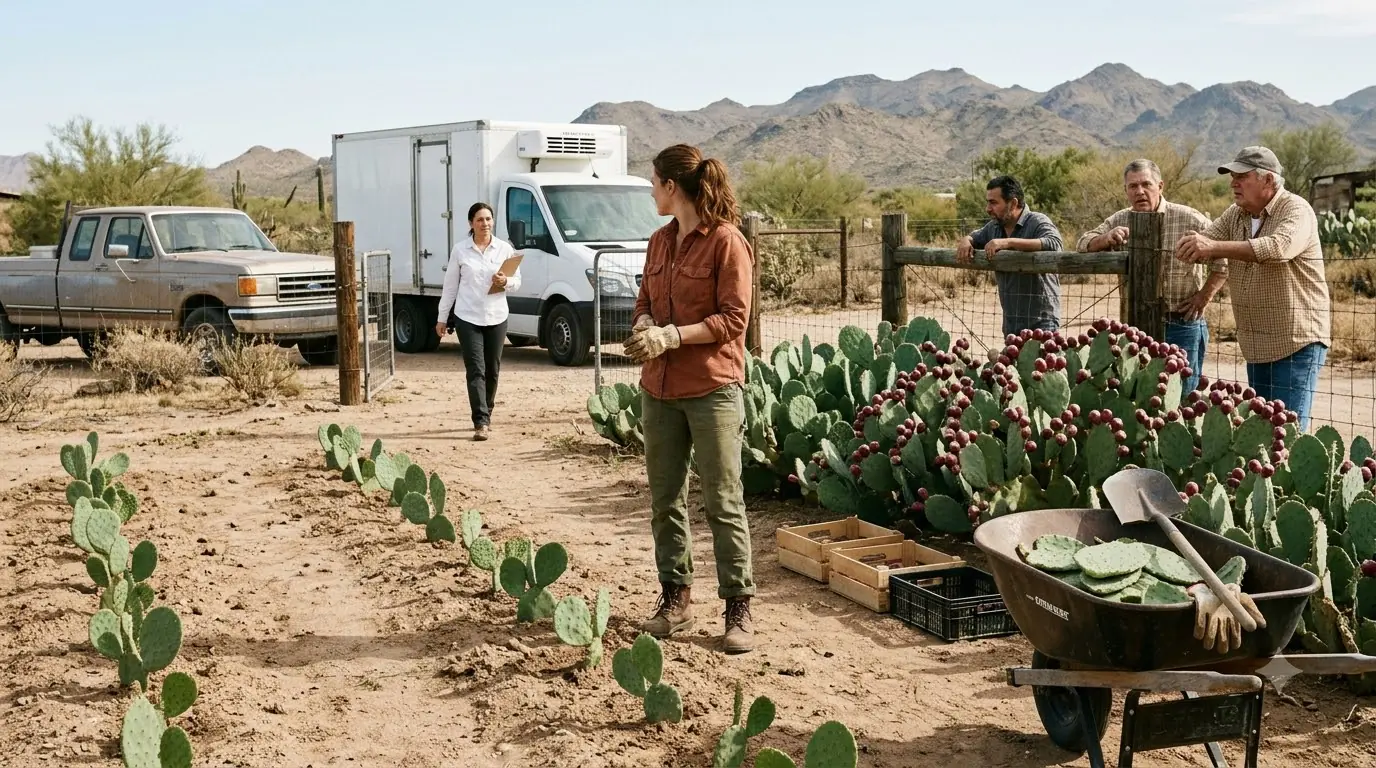
This morning he had brought an audience.
Emma kept both gloved hands around the pad in front of her and held it upright while she firmed loose soil around the shallow planting hole. Bright southern Arizona sunlight spread across the small farm until every ridge in the sandy ground seemed carved with a hard edge. Beyond the planted rows, the land looked nearly colorless except for mesquite, scrub, pale grass, and the distant rise of low mountains beneath a clean blue sky.
A wheelbarrow stood nearby with several unplanted pads, a shovel, and a pair of spare gloves. The metal tray had a dent from the day it rolled into a wash during a windstorm. Emma had never fixed the dent. It reminded her that almost everything on the place had been earned by surviving something.
Roy leaned against the boundary fence with one forearm over the top wire. He was close to sixty, broad through the middle, gray-haired beneath a faded cap, and permanently sun-browned across the face. Two neighboring farmers stood with him, both older than Emma by at least twenty years. Neither had ever been openly cruel to her, but both had laughed often enough when Roy did that she had stopped making distinctions.
Roy pointed toward the new cactus rows.
“You bought a desert just to plant more damn thorns?”
One of the neighbors chuckled. The other shook his head as if Emma had confirmed something disappointing about her generation.
Emma finished packing the soil before she stood. She brushed sand from the palms of her thick gloves and looked toward the fence. Her rust-colored work shirt was darkened between the shoulder blades from the heat. Fine dust had settled along the knees of her olive trousers and across the toes of her boots.
“I’m planting something that belongs here,” she said.
Roy barked another laugh and spread one hand toward the dry acreage as though presenting evidence to a jury. “Good luck finding anyone stupid enough to buy it.”
Emma looked at him for half a second longer, then turned away.
That disappointed him more than an argument would have.
She gripped the wheelbarrow handles and rolled it several feet to the side. The front wheel squeaked once in protest. Behind it, partly hidden until now by tools and fresh pads, stood an older patch of prickly pear that had been established months earlier. The plants were broad, healthy, and heavy with clusters of red-purple fruit. Beneath them sat shallow harvest crates, most empty now but a few carrying neatly arranged fruit padded with paper.