"You're going to lose every bushel in here."
Warren Pike spoke across the width of the doorway without raising his voice. The wind behind him was louder than he was. It drove through the narrow wooden slats, moved the loose husks beneath Casey Bennett's boots, and pulled a cold thread of air down the back of her coat. At this hour, before the sun had cleared the fields, the old corn crib seemed less like a building than a long wooden instrument built to let the winter play through it.
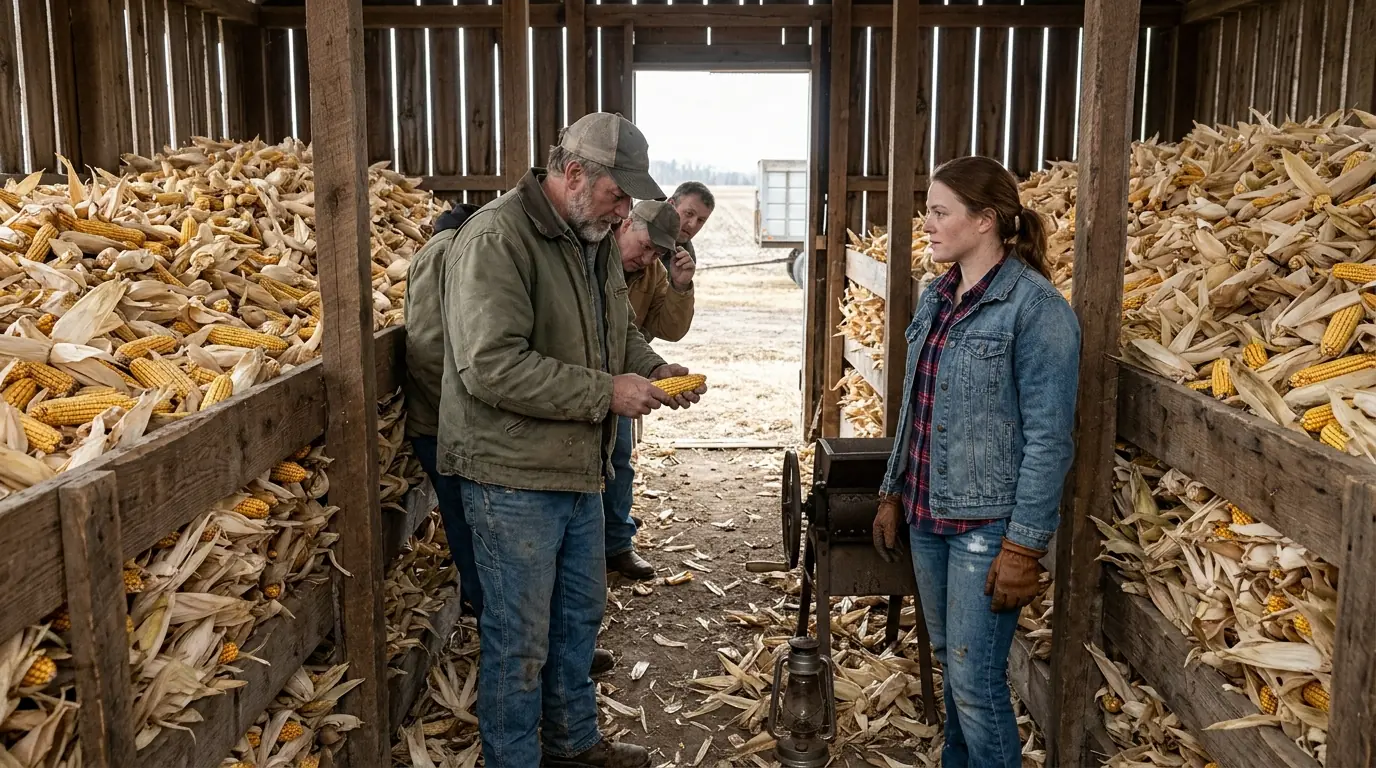
Casey did not answer immediately. She took an ear from the upper row, turned it in her hands, and pressed her thumbnail against a kernel. It resisted. The kernels clicked faintly when she bent the ear. No damp softness. No sour smell. No suspicious warmth in the pocket she had reached into a moment before. She put the ear back carefully, because it mattered to her that an inspection did not become another source of unnecessary damage.
Three men stood behind Warren. Leonard Baines had his arms crossed; his heavy jacket was powdered with dust from his own grain operation. The third man, a neighbor who had driven over with them, looked beyond Casey at the stacked ears, apparently searching for the problem he had been promised he would see. There was no visible disaster for any of them to examine. That did not change Warren's conclusion.
"You should have sold in November," Leonard said. "The elevator would have taken all of it, and you'd be finished. No shrink, no mice, no climbing around in a building your grandfather put up when my father was a boy."
"I know what the elevator offered." Casey pushed her gloves into her jacket pocket. She had taken them off to feel the ears properly. Her fingertips were beginning to ache.
"Then you know what you turned down."
"Yes."
"It's a decent price."
"It was."
Leonard waited for more. He was a man who could listen patiently to a running engine but hated a pause in an argument. "So this is a matter of principle?"
"It's a matter of having some corn left to sell later."
Warren stepped inside. He had been farming longer than Casey had been alive and was careful with other people's machinery, even when he thought they were using the wrong machinery. He touched one of the vertical posts, glanced at a patched roofline, and looked down the crib's length. "This might work through winter. I'm telling you, the trouble comes where you can't see it. You won't know there's a hot pocket until you smell it."
"Sometimes you can find one before that."
"Sometimes." He emphasized the word gently. "You've tied up a thousand bushels on a sometimes."
Roughly a thousand. Casey had entered the figure in her notebook after harvest, along with every load's condition and where each had gone. The number sounded more adventurous when spoken inside the crib. Outside the door it represented a useful part of a year's hard work. Inside, it was a physical weight of possibility: corn that could hold value, lose value, or become nearly worthless while she looked the other way.