The first thing Marin Ellis noticed was not the laughter.
It was the silence under the modern machine.
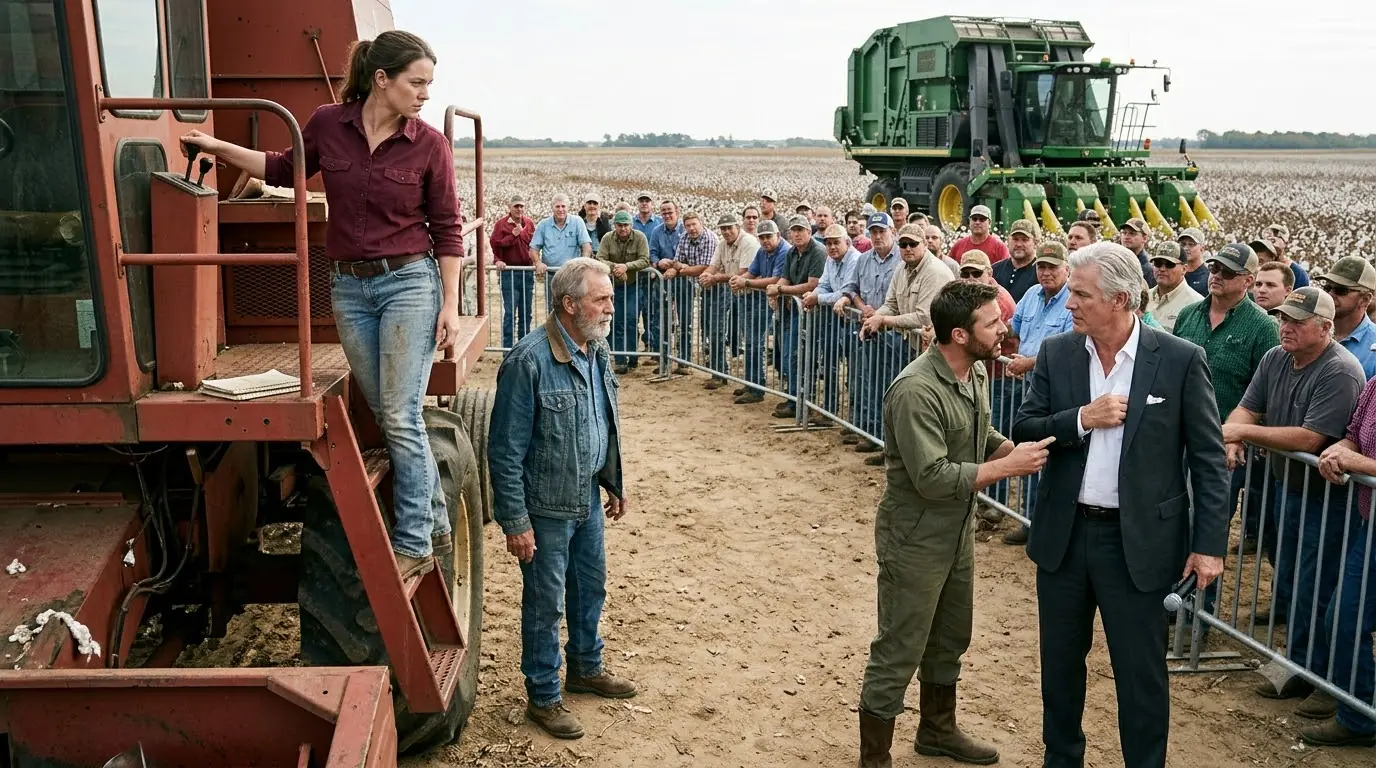
Out in the Mississippi Delta, silence around a cotton picker meant something had gone wrong. A machine that size was never truly quiet unless it had been shut down on purpose, and nobody shut down a six-row picker in the middle of a demonstration unless they had no other choice. The afternoon air still carried the weight of heat, dust, cotton lint, and engine smell, but beneath all of that there was a sharp absence where the steady mechanical confidence of new equipment was supposed to be.
The crowd felt it too.
A few dozen farmers stood behind a temporary barrier set up along the edge of the harvested rows. Most of them had come because they were curious. Some had come because they were desperate. Cotton had not been forgiving the last few years. Rain had become erratic, parts had become expensive, labor had become harder to count on, and every decision made in March seemed to come back and demand an answer in October. When a company promised a machine that could pick faster, cleaner, and cheaper, farmers showed up. They always showed up. Hope was expensive, but it remained the one thing most of them were still willing to finance.
Marin stood off to one side near the old two-row picker in the marked trial lane, her maintenance notebook warm in her hand. The machine beside her looked like something the crowd had already filed away as a joke. Its paint had long ago surrendered to the sun, its metal had the faded, tired look of equipment that had spent years earning its keep instead of standing around being admired, and its platform rails bore the rub marks of use rather than the polished finish of display. It was old enough to draw affectionate smiles from men who remembered their fathers running similar equipment, and dismissive grins from men who had recently borrowed too much money convincing themselves the future always had to be shiny.
Marin knew exactly what most of them saw when they looked at it.
They saw a relic.
They saw embarrassment.
They saw proof that she had not kept up.
What they did not see was that old machines told the truth. They told it in leaks, in vibration, in the way a gear caught or a bearing complained, in the smell of hot oil before failure, in the tiniest change in resistance under a hand that had learned the machine honestly. Old equipment had to be known. You could not bluff your way through it. You could not hide behind a software panel and a sales brochure. Either you understood the machine or you did not.
And Marin understood this one better than anyone alive.
She had spent three years bringing it back from the edge of the scrapyard.
Not restoring it for vanity. Not polishing it for nostalgia. Rebuilding it because she had no money for a replacement and no patience for being told that people like her were supposed to wait politely for better-funded men to decide whether she deserved decent equipment.