Warren Pike laughed before Clara Hayes even finished rolling the first burl across the barn floor.
The sound carried through the old woodworking barn in a way ordinary laughter should not have. It bounced from the rough timber beams, passed over stacked maple boards and cedar planks, and seemed to settle in the sawdust around Clara’s boots like one more thing she would have to sweep away later.
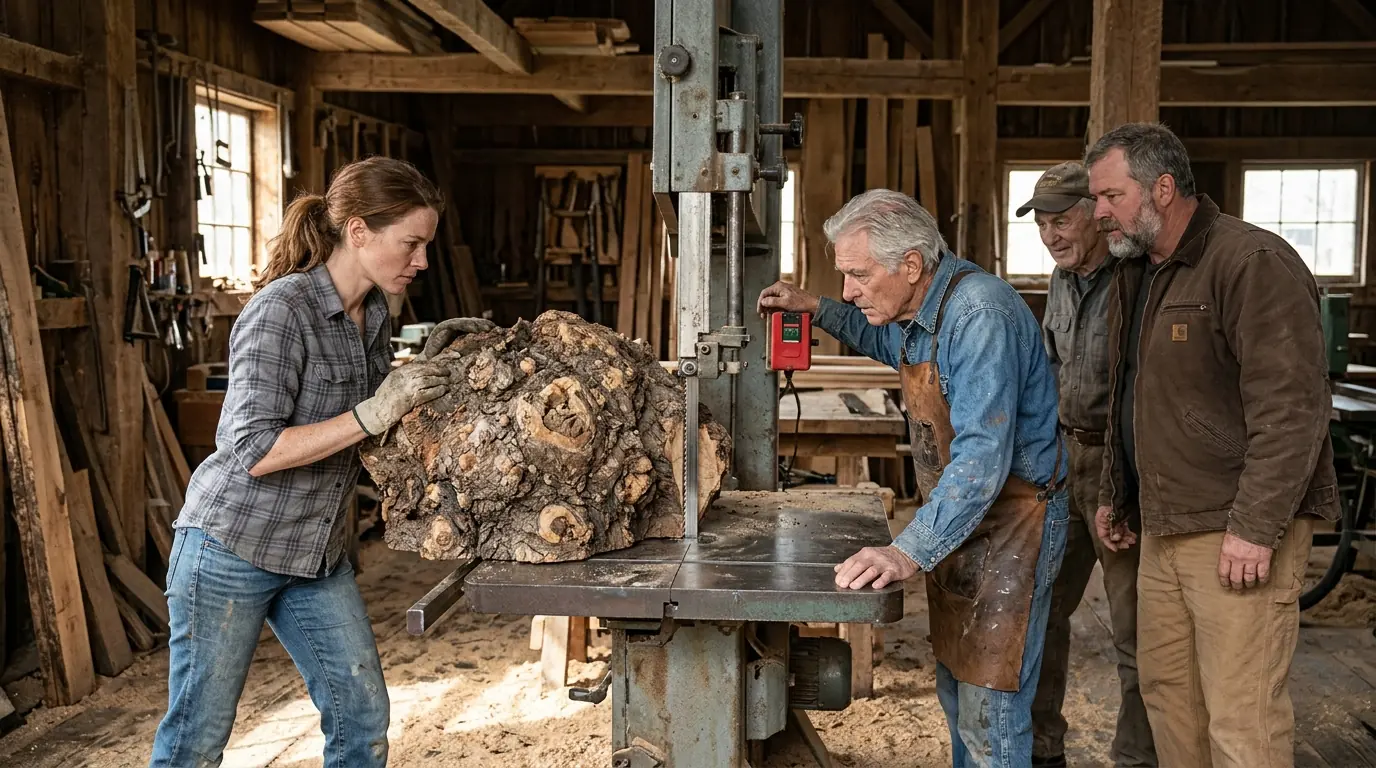
“You paid good money for the ugliest lumps this forest ever grew,” Warren said.
Two older farmers standing near the lumber rack laughed with him. One of them slapped his thigh. The other leaned forward to get a better look at the enormous maple burl resting on a low steel cart.
The thing was ugly. Clara could not deny that.
It was nearly four feet across in its widest direction, swollen into an irregular mass where the trunk of an old sugar maple had fought for decades against injury, fungus, weather, and whatever else had forced the tree to grow around itself. Rough bark covered most of it. Dirt packed into the cracks. Dead roots curled along one side like black knuckles. Several knots bulged beneath the bark, and a long dark ridge crossed the upper surface at an angle.
To Warren, it looked like firewood that had learned arrogance.
To Clara, it looked like a question.
She braced both gloved hands against it and pushed the cart another foot toward the enormous industrial bandsaw in the center of the barn.
“Then you won’t mind watching me cut one open,” she said.
Warren grinned. “That’s exactly why I stayed.”
Behind the saw stood Elias Crowe.
At seventy-two, Elias had the narrow shoulders and weathered hands of a man whose life had been spent removing small mistakes from expensive wood. His silver hair was combed straight back from a lined forehead. A cracked leather apron covered his stained denim shirt. He had been amused when Warren first arrived, though not for the same reason. Warren enjoyed the possibility that Clara had wasted money. Elias enjoyed the fact that she had been stubborn enough to bring the burl in anyway.
Now his expression had changed.
Not much.
Just enough for Clara to notice.
His blue eyes had settled on the long dark ridge crossing the burl.
He did not comment.
That made her more interested than if he had.
The barn belonged to Elias, technically, though he had been saying for seven years that he was “about to retire,” and nobody in the county believed him anymore. Crowe Woodworks had once been a proper cabinet shop with four employees, a finishing room, and orders stretching six months ahead. Those days were gone. The old clients had died, moved, or discovered factories willing to build walnut tables in a week for less than Elias charged for lumber.
Still, the barn remained.
So did the machines.
The giant bandsaw had been purchased used from a closed mill thirty years earlier. Its steel table was broad enough to support slabs that would have crushed the little shop saw Clara kept in her own shed. The upper wheel housing rose above Elias’s head. The blade ran in a vertical line, narrow and bright, disappearing through a scarred slot in the table.
When it ran, the whole machine seemed to inhale.
Clara had driven forty-three miles to use it.