The first gust came hard enough to lift the loose edge of the warehouse roof.
Metal boomed overhead. Dust streamed from a seam beneath the warped eaves, and a handful of dry leaves shot across the dirt yard like startled animals. Walter Briggs stood beside the enormous double doors, one weathered hand resting against a faded red plank, and waited for the noise to pass.
He was seventy-four years old, lean in the way men become when labor has worn away everything that does not help them continue, with a gray beard, short silver hair, and blue eyes that seldom wasted movement. His olive work jacket had been patched twice at the elbows. The brown plaid shirt beneath it was older than some of the equipment on the other side of the farmyard. His boots stood solid in the dirt, although the wind pushed at the brim of his canvas cap.
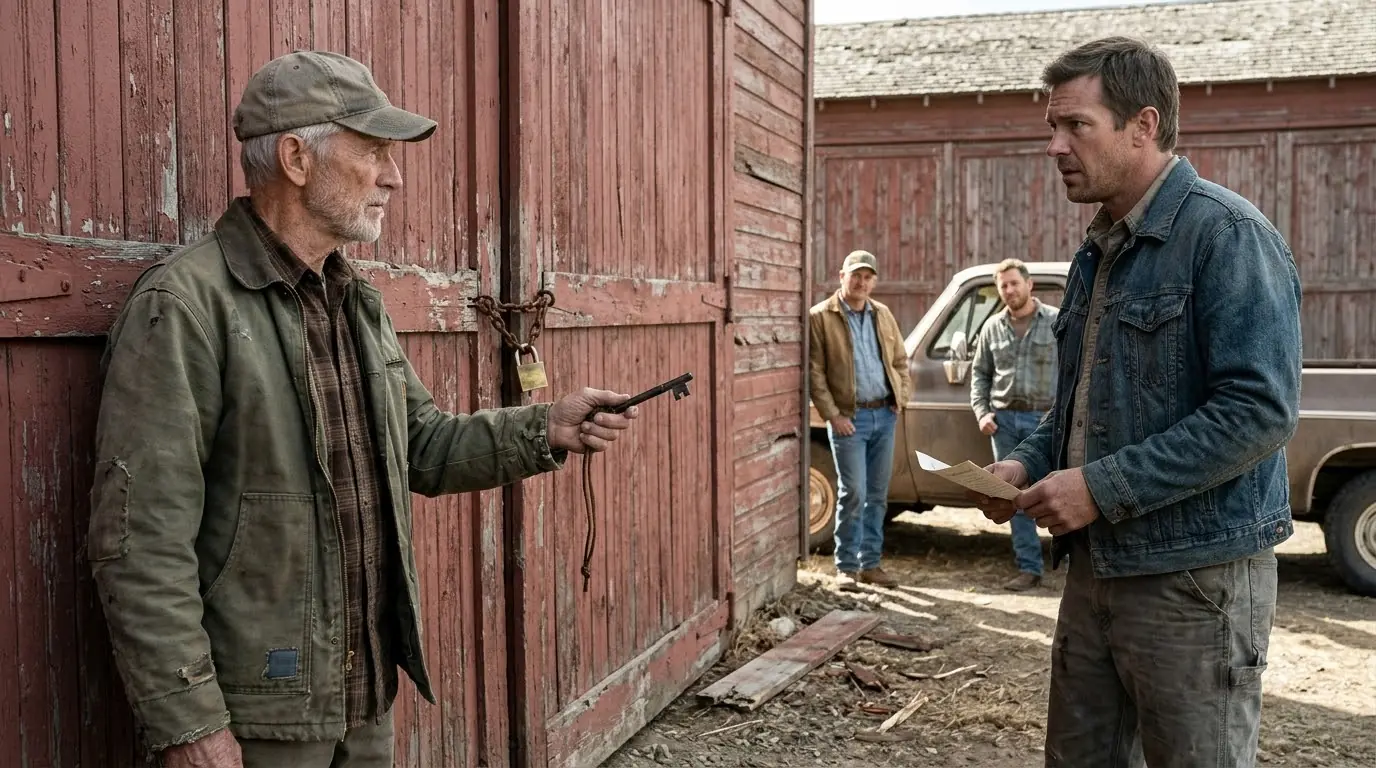
Across the yard, beside a dusty pickup, three neighboring farmers were laughing.
The tallest of them, Carl Mercer, had brought a demolition notice folded beneath his arm. He slapped it against one of the warehouse doors with a theatrical crack.
“One hard wind will bury this rotten shed.”
The other two laughed harder. Vernon Pike, who had a habit of kicking anything he considered worthless, struck a loose plank with the toe of his work boot. Rotten wood broke away and landed in the dust. Eddie Lawson shook his head with the weary delight of a man watching someone else make a costly mistake.
“Why are you so determined to save it, Walter?” Carl demanded. “You can't keep rotting lumber upright with stubbornness.”
Walter watched the broken plank settle. Then he looked at the notice.
He had known something like this would come. He simply had not expected the men to enjoy delivering it quite so much.
“You have no idea what it's protecting,” he said.
The words quieted them for a fraction of a second before Vernon began chuckling again.
“Then open it,” Carl said.
Walter reached beneath his shirt and drew out the large antique key that hung from a worn leather cord around his neck.
The laughter faltered.
The key was heavy, darkened by age, with an unusually long shaft and a wide bow rubbed smooth by years of handling. It was not the sort of key anyone could pick up in a hardware store. Walter had carried it close to his chest for so long that he sometimes forgot its weight was there, though he had never once forgotten what it meant.
He took the key in his right hand and crossed the last few steps to the rusted chain.
“Don't blame me when you understand,” he said.
Then he lifted the key toward the enormous brass padlock.
The truth was that Walter had been preparing for this moment since the summer he turned eighteen. He had just never believed it would arrive with three mocking neighbors, a government notice, and a wind trying to strip the roof from the oldest building on his farm.