Let me tell you about a girl named Hanna Vanderpool and a small dairy farm in the northeastern corner of Iowa in a stretch of country that most travelers passing through on Highway 52 never really see. It is hill country up there, not flat the way most people imagine Iowa. The glaciers missed that corner of the state during the last ice age and what they left behind is a landscape of soft green ridges, limestone bluffs, cold spring-fed creeks, and small family farms folded into the hollows between the hills.
They call it the driftless region. City people drive through and say it looks like a postcard. The people who farm it will tell you, if you give them time, that a postcard is something you look at once. A piece of land is something you read every morning of your life.
Hanna was eleven years old in the fall of 2008. Her family had been on that 280 acres since 1873 when her great-great-grandfather came over from a village called Odorp in the Netherlands and bought the original quarter section from a man who had gone broke trying to grow wheat on ground that was meant for grass and dairy cows.
Five generations of Vanderpools had milked cows on that ground. Her father, Joris Vanderpool, was thirty-eight years old that autumn and he was a quiet man even before his wife died. After she died, he became something quieter than quiet. He became a man who worked from four in the morning until full dark and spoke maybe twenty words a day, most of them to the cows.
The wife who died was named Annelise. She was forty-one years old. Pancreatic cancer took her in fourteen months, diagnosis to grave, between January of 2006 and April of 2007. She was buried on a Thursday in the small Lutheran cemetery on the ridge above the farm.
And the morning after the funeral, eleven-year-old Hanna Vanderpool walked into the kitchen, sat down at the table where her mother used to sit, and opened a brand new spiral notebook from the school supply drawer. On the first page, in careful childlike handwriting, she wrote the date. Then she wrote one sentence.
Today is the day I start writing things down so I do not forget what Mama taught me.
She did not show that notebook to her father. Her father at that time could not have looked at it. But she kept it.
And this is the part that matters. Hanna was not starting from nothing. Her mother had kept her own notebook since 1989 when she had married into the place at the age of twenty-three. Annelise had grown up two miles down the road on the Bergstrom farm. Her own mother had taught her to read the land before she could read a chapter book.
And Annelise, knowing for fourteen months that she was going to die, had spent every walkable afternoon of her last summer slowly, patiently walking those Vanderpool acres with her ten-year-old daughter, pointing things out, telling her what the dirt was doing, what the creeks were saying, what each field had done in each kind of year going back decades.
She had given Hanna her notebooks in March of 2007, three weeks before she died. There were eighteen of them, hardbound, lined, the kind you buy at the farm supply store in Decorah for two dollars and fifty cents.
Annelise had told her, sitting up against the pillows in the hospital bed they had set up in the front parlor, Hanna, you keep reading these. You keep walking the land. You keep writing it down. Land remembers everything, but only if somebody is paying attention.
Hanna was paying attention.
By the fall of 2008, eighteen months after her mother's death, she had walked every fence line on the Vanderpool farm with her mother's notebooks in a canvas bag over her shoulder, comparing what her mother had written about each field to what the field was doing now.
She had also walked, because her mother had asked her to, the fence line of the Larson farm to the east, 640 acres of rolling corn ground and pasture that belonged at that time to an older couple named Per and Margaret Larson, who had been friends of her grandparents and who let Hanna walk their land anytime she wanted to.
The first was the northwest ninety acres of the Larson farm. From the surface, they looked like ordinary cornfields, gently sloping toward a tree line. But underneath, less than fifteen feet down, ran a thin shelf of fractured limestone, riddled with karst voids, pockets of empty space where water had been dissolving rock for thousands of years.
In a wet spring, after the ground had been saturated for three or four days, those voids could collapse under heavy weight. Annelise had watched it happen in May of 1993, when a neighbor lost a tractor up to the axle in the lower corner. She had watched it happen again in April of 2004, eleven years between events, both years preceded by a wet March. The pattern was clear if you had been watching for it for twenty years.
The second was a small creek called Wagner's Creek that crossed the northeast corner of the Larson property. Most years that creek behaved normally, running south toward the Upper Iowa River. But every five to seven years during heavy spring snowmelt combined with a hard April rain, the creek's lower outlet would clog with debris, and the whole drainage would back up into a forty-acre low spot in the Larsons' northeast field.
Annelise had seen this happen in 1998 and again in 2003. Both times the water had stood for six to eight weeks. Both times the field had been useless that season.
And the third was a low area called Iron Hollow on the south end of the Larson place, about eighty acres of bottom ground where the groundwater carried unusually high levels of dissolved iron and manganese. In normal years, corn grew fine there. But in years with a late September frost, like 1997, like 2002, the cold stress combined with the mineral content caused the corn to curl and yellow in patches, dropping yields by as much as forty percent.
Annelise had figured out the connection by walking the same field every September for fifteen years.
That was the country to the east. That was what Hanna's mother had taught her.
And in October of 2008, four months after the financial markets collapsed and three months after Per Larson had a stroke that put him in a nursing home, the Larson farm went into foreclosure with a regional agricultural lender out of Des Moines called Sentinel Heartland Bank.
The bank took possession on a cold, wet Tuesday in November, and within two weeks they had announced that they were not going to sell the property. They were going to farm it themselves as a showcase operation.
The man in charge of the showcase was named Marshall Crane. He was forty-seven years old in the fall of 2008, vice president for agricultural assets at Sentinel Heartland, MBA from Northwestern University, fifteen years in agricultural lending, the specific confidence of a man who had reviewed a great many farm loans and had never personally turned over a row of dirt.
He drove out from Des Moines twice a month in a clean black Lexus, and he wore khaki pants that had been pressed, and pearl snap shirts that had been pressed, and he stood in the fields with his hands on his hips the way some men stand when they have decided a piece of land belongs to them.
Underneath Marshall was his senior agronomic consultant, Dr. Rebecca Lindquist, thirty-four years old, a PhD in soil science from Iowa State University, six years of field work on commercial corn operations in central Illinois and southern Iowa, smart, hard-working, competent, the way competent works when you are competent at the average.
She had done her doctoral field work on heavy black prairie soils. The Driftless was different country. She did not know yet how different.
Below Rebecca were four junior analysts, all with agronomy degrees from good schools. None of them with more than three years of practical experience. All of them young enough to believe that a clipboard and a soil sample beat a notebook and forty years of looking.
And there was one more, a young man named Samuel Beckman, twenty-eight years old, a junior credit officer at the bank who had been assigned to the showcase as a liaison. Samuel had grown up on a small dairy farm seven miles from the Vanderpool place. His parents still milked forty cows on it. He had taken the bank job because his back had given out at twenty-two and he could not handle the milking parlor anymore.
He had been with Sentinel for fourteen months. He had the kind of quiet that comes from a young man who knows he has been given something he did not earn and is determined to deserve it. He kept his mouth shut and his ears open.
By March of 2009, the Sentinel Showcase had moved in heavy equipment, including a new John Deere 9530 tractor that the bank's marketing department had photographed for the spring brochure, with Marshall Crane standing next to it in a stiff new Carhartt jacket.
They had planted intentions on the back of a yellow legal pad. They were going to put their best high-yield seed corn on the northwest ninety acres in a tight forty-thousand population planting that they planned to feature in the agricultural trade press. They were going to plant their premium showcase variety on the northeast forty as the visual centerpiece. And they were going to put eighty acres of a new drought-resistant hybrid in the south bottoms in Iron Hollow because the soil tests came back rich.
Hanna Vanderpool watched all of this from across the fence line. She was twelve years old that spring. She rode her bicycle the long way home from school sometimes so she could pass the old Larson place and see what they were doing. And what she saw concerned her.
So one Saturday morning in the first week of April 2009, she put her mother's eighteen notebooks and her own two notebooks in the canvas bag. And she added one loose page she had carefully traced from one of her mother's notebooks the night before, a hand-drawn map of the Larson farm with three small X's marked in pencil, each one labeled in Annelise's careful handwriting from May of 2003.
Hanna rode her bicycle four miles to the bankside office, which they had set up in the Larsons' old farmhouse. She leaned the bicycle against a fence post. She walked up the porch steps. She knocked on the door.
A young woman with a clipboard opened it. Hanna told her very politely that she would like to speak with the man who was in charge.
The young woman went and got Marshall Crane.
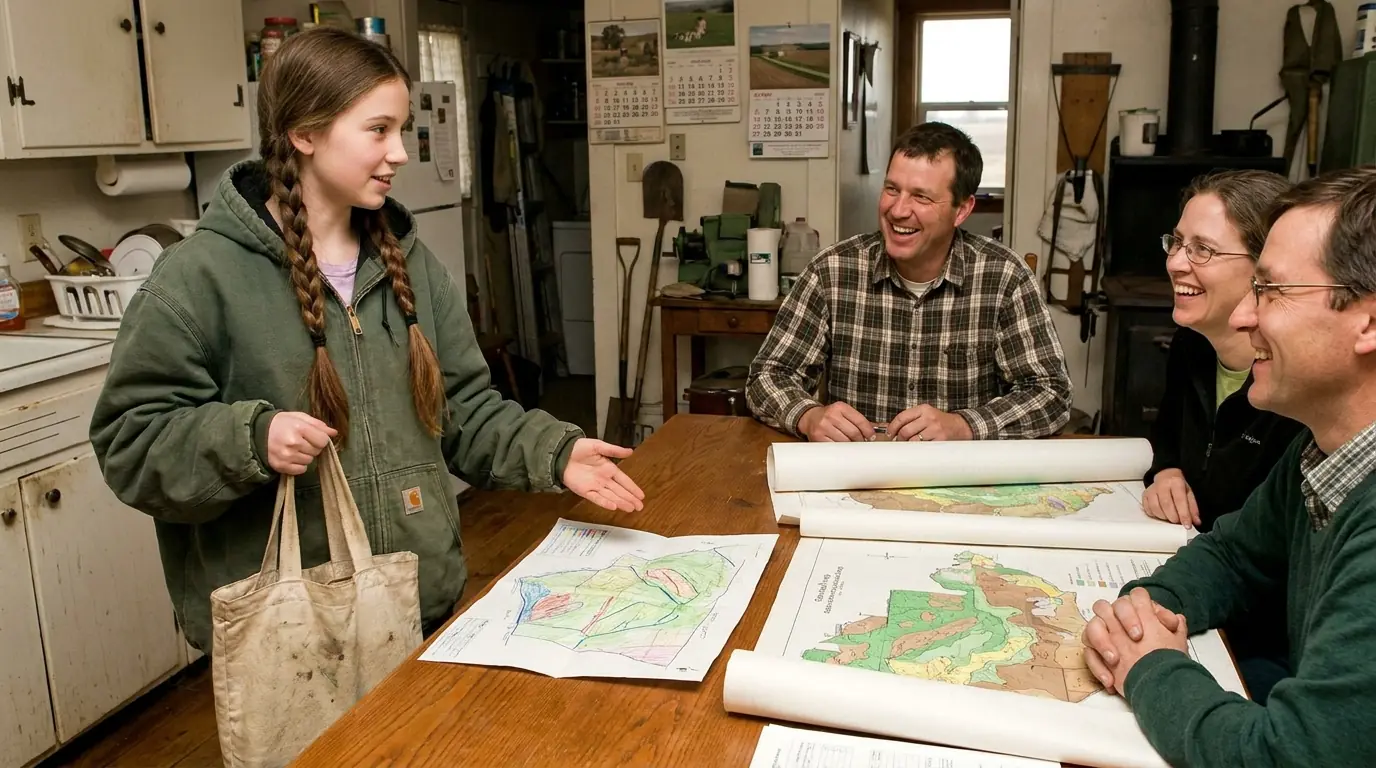
Marshall came to the door looking puzzled. He saw a twelve-year-old girl in a green Carhartt jacket two sizes too big for her with two long braids and her mother's old canvas bag over her shoulder. He smiled the smile that adults sometimes smile at children who have wandered into something serious by accident.
He invited her in. He asked if her parents knew she was there.
Hanna said her father was milking and would not be done until ten. She had ridden over on her own.
Dr. Rebecca Lindquist was at the kitchen table going over soil maps with two of the junior analysts. Samuel Beckman was sitting at the back of the room finishing a cup of coffee.
Marshall introduced the small visitor with a kind of indulgent warmth.
Folks, we have a young neighbor who has come to say hello.
Hanna did not smile back. She put the canvas bag on the kitchen table. She told them what she knew. She told it the way her mother had taught her to tell things, plainly, in order, with the dates.
She told them about the karst shelf under the northwest ninety acres and the wet spring cycle that had taken a tractor in 1993 and again in 2004. She told them about Wagner's Creek and how it backed up into the northeast corner every five to seven years and that the last time was six years ago, which meant this year was inside the window. She told them about Iron Hollow and the late frost connection that had cost the Larsons forty percent of that field's yield in 1997 and again in 2002.
She spoke for about eleven minutes. She did not raise her voice. She did not sound dramatic. She sounded like a child who was repeating things she had been told carefully by someone who loved her.
When she was done, Marshall Crane thanked her warmly. He said it was so wonderful that she had taken an interest. He said the bank had commissioned detailed soil surveys and water assessments from a respected firm in Cedar Rapids. He said the team had the property thoroughly evaluated.
Dr. Rebecca Lindquist looked at the twelve-year-old in the oversized jacket and she said, in the careful, gentle voice that adults use when they have decided not to take a child seriously, Sweetheart, this is so kind of you to come over. I can tell your mother taught you a lot, but we have geological surveys and soil maps from licensed professionals and we have to base our planning on those. Okay?
Hanna looked at her for a long moment. She did not say anything. Then she reached into her bag, took out the loose page she had traced from her mother's notebook, and laid it carefully on the kitchen table.
This was my mother's, she said. She drew it the year I was born. I just wanted to leave it here.
She picked up the canvas bag with the notebook still inside it. She walked out. She got on her bicycle. She rode home.
After she was gone, Marshall Crane glanced at the hand-drawn map on the table, half-smiled at Rebecca, and tossed it into the wastebasket under the sink. He went back to the soil survey. Rebecca poured another cup of coffee. The two junior analysts started laughing softly about the little farm girl with her grandma's map.
Samuel Beckman did not laugh. He waited until everyone had walked outside to look at the new tractor. Then he walked over to the wastebasket, took out the folded paper, smoothed it carefully, and slid it inside the back cover of his work notebook.
On the page next to it he wrote three lines in small, careful handwriting.
Karst voids NW90, wet spring collapse risk. Wagner's Creek NE corner, backflow event due this cycle. Iron Hollow South Bottoms, frost iron interaction risky in late frost years.
He did not show those lines to Marshall. He did not show them to Rebecca. He kept them in his notebook.
The spring of 2009 was wet. March came in with rain on the eighth, the ninth, and the eleventh. The fields were saturated by the second week.
On Tuesday, May fifth, after three more days of steady rain, Marshall Crane sent out the new John Deere 9530 tractor with one of the junior analysts at the wheel to begin disking the northwest ninety acres in preparation for planting.
The tractor was the centerpiece of the brochure. It had cost the bank three hundred forty thousand dollars. It was painted bright green and the photographer from the marketing department had taken pictures of it the previous week with the sun behind it.
The tractor made it about six hundred yards into the lower corner of the field, the corner that Hanna had marked with a small X on her mother's traced map, the corner that her mother had warned her about in the summer of 2006.
The front right wheel went into the ground first, then the left. The frame torqued sideways and the front axle snapped with a sound the analyst said later he had felt more than heard. The tractor sank to its axles. The void underneath had been opening slowly for who knows how long. The wet spring had done the last of the work.
It took eleven days to get the tractor out. They had to bring in a heavy recovery rig from a salvage operation in Waterloo. The axle replacement, the frame repair, the recovery operation, and the lost field time came to fifty-eight thousand dollars.
Marshall Crane stood at the edge of the field in his pressed khakis and watched the recovery rig work. And the look on his face was the look of a man who had not yet understood that this was the first thing, not the worst thing.
Rebecca Lindquist stood next to him with her clipboard and said the soil surveys had not flagged any subsidence risk. Samuel Beckman stood at the back of the small group and did not say anything at all.
Two weeks after the tractor incident, on the night of May nineteenth, a heavy spring storm came across the eastern Driftless, dropping four and a half inches of rain in about seven hours. The Upper Iowa River rose, Wagner's Creek rose, and the small culvert at the south end of the Larson property, which had been partially clogged with brush since the previous autumn and which nobody at the bank had thought to check, plugged completely.
The water in the creek backed up. By dawn on May twentieth, the entire northeast forty acres of the showcase, the field that had been planted three weeks earlier with the bank's premium showcase variety, the field where the marketing department had planned to film the centerpiece of the brochure, was underwater.
The water stood for seven weeks. The corn died inside the first week. The replanting window had closed by the time the field finally drained in early July. They put soybeans in late. The yield came in at almost nothing.
Total loss for the northeast forty was one hundred twelve thousand dollars in input costs, plus the complete loss of the marketing campaign that the bank had spent the better part of a year planning.
Marshall Crane drove out from Des Moines on a hot Friday at the end of June, walked the edge of the flooded field, stood on the small ridge where Hanna had stood with her mother in the summer of 2006, and said nothing for a long time.
Rebecca was not with him that day. She was already quietly beginning to wonder if she had missed something.
The summer of 2009 was strange across the upper Midwest. June was wet, July was cool, August was dry. The growing degree days were running ten percent behind normal by the end of August.
And on the night of September fourteenth, a cold front came down out of Manitoba and dropped temperatures across northeastern Iowa to twenty-nine degrees. It was a hard frost, three weeks earlier than the historical average.
The corn in most of the region took some damage. The corn in Iron Hollow, the eighty-acre bottom ground in the south end of the Larson place, took the kind of damage that only happens when cold stress meets mineralized groundwater.
By the time the field was combined in October, the yield came in at forty-seven bushels per acre against an expected one hundred ninety-five. The loss on those eighty acres alone was two hundred eighty thousand dollars.
When you added it all up, the tractor, the flood, the iron-stunted corn, Sentinel Heartland Bank had lost almost six hundred fifty thousand dollars on its showcase farm in the first growing season. The brochure had not been published. The trade press articles had not been written. The reporters had not been invited. The showcase was, quietly and embarrassingly, taken off the bank's website in early November.
Marshall Crane was not fired. He was reassigned to commercial real estate in the Cedar Rapids office. The Larson farm sat through the winter with no clear plan.
The woman who flew up from Des Moines to look at the wreckage in late January of 2010 was named Eleanor Ashby. She was sixty-four years old, senior regional director, twenty-nine years at Sentinel Heartland, a year and a half from her planned retirement.
She had grown up on a one hundred sixty acre dairy farm in Vernon County, Wisconsin. Her father had farmed it until he was seventy-six. She had paid her way through college milking cows at five in the morning before her eight o'clock classes.
And unlike most of the people in the corporate office in Des Moines, she had developed across twenty-nine years a very refined ability to tell the difference between bad luck and bad judgment.
She read the postmortem reports. She read the contributing factors. She asked questions that the reports did not answer. She asked Marshall Crane, when he came in to brief her, who the neighbors were.
Marshall told her there was a quiet dairy farmer named Vanderpool to the west.
Eleanor asked if anybody had spoken with him.
Marshall thought about it. Then he said, Well, his daughter came over once last spring. She brought some kind of family map.
He did not present it as significant.
Eleanor considered it very significant.
She asked Samuel Beckman, who had been pulled into the meeting to provide field notes, what he knew about the family.
Samuel Beckman opened his notebook. He turned to the page from April of 2009. He showed Eleanor the three lines. He showed her the folded hand-drawn map he had taken out of the wastebasket.
Three lines written by a junior credit officer ten months before the disaster. A map drawn in pencil in 2003 by a woman who had been dead for almost three years. Three X's that described with complete precision the three primary causes of the six hundred fifty thousand dollar loss that a team of qualified consultants had just spent five months documenting.
Eleanor Ashby looked at that page for a long time.
Then she asked Samuel to drive her out to the Vanderpool farm the next morning.
They drove out on a cold Saturday morning in the last week of January 2010. The roads in northeastern Iowa were dry, but the temperature was twelve degrees. Samuel Beckman drove. Eleanor Ashby sat in the passenger seat in a wool coat and a pair of plain leather boots that had seen real winters.
She did not say much on the drive. She watched the country go past, the white hills, the small valleys, the silos and red barns tucked into the hollows.
They turned into the Vanderpool place at a quarter past nine. The driveway was plowed clean. The farm was tidy in the way that a working farm is tidy, not pretty, but in order.
Joris Vanderpool was coming out of the milk house when they pulled up. He was a tall, lean man, dark-haired with early gray at the temples, wearing insulated coveralls and rubber boots with frozen droplets on them.
He stopped when he saw the car. His face did not change. He waited.
Eleanor got out. She walked across the yard. She said, Mr. Vanderpool, my name is Eleanor Ashby. I am with Sentinel Heartland Bank in Des Moines. My institution owes your daughter a debt. I have come to acknowledge it.
Joris looked at her for a long moment. Then he looked at Samuel, whom he half recognized as a Beckman boy from down the road. He looked back at Eleanor. He said, You had better come in then.
He opened the kitchen door.
Hanna was at the kitchen table doing homework. She was twelve years old, going on thirteen. She wore one of her mother's old wool sweaters, faded blue, the sleeves rolled up twice. Her braids were the same braids she had worn the previous April. She looked up when the three of them came in.
She did not look surprised. She did not look afraid. She closed her notebook and waited.
Eleanor sat down across from her. She did not speak for the first five minutes. She looked around the kitchen. She looked at the row of hardbound notebooks on the shelf above the sink. Twenty of them now, eighteen in one woman's handwriting and two in a child's.
She looked at the framed photograph on the wall above the table. Annelise Vanderpool standing in a hayfield in 1995, one hand resting on the head of a Holstein heifer, smiling at the camera.
She looked at Hanna. Hanna looked back at her steadily.
Then Eleanor said, Miss Vanderpool, I would like to know what you know. I would like to know it slowly, in your own time, in your own words.
Hannah looked at her father. Joris was standing by the kitchen door with his arms folded. He looked at his daughter for a long second. Something in his face that had not moved for almost three years moved a little. He nodded once.
Hanna turned back to Eleanor. She reached up and took the smallest of her mother's notebooks down from the shelf, the green one, the one her mother had given her last. She opened it to a page near the front. She began to talk.
She talked for almost two hours. She talked about the karst shelf and the wet spring cycle, and she read out the dates from her mother's notebook. May ninth, 1993. April twenty-third, 2004. She talked about Wagner's Creek and the way the debris built up at the lower culvert in autumn, and how nobody on the Larson place had ever cleaned that culvert because Per Larson had been too proud to ask for help once his arthritis got bad.
She talked about Iron Hollow and the frost pattern and the way the corn would yellow at the leaf base before it yellowed at the tips, which was how you knew it was the iron and not the cold alone.
Samuel Beckman sat at the end of the kitchen table and wrote everything down. Joris stood by the door and listened to his daughter speak as if he were hearing her voice for the first time.
When Hanna was done, Eleanor Ashby was quiet for a long stretch.
Then she said, Miss Vanderpool, what would it take to have access to this on a formal basis?
Joris answered before Hanna could. He said, She is twelve years old.
It was the first thing he had said since they sat down. He said it not angrily, but as a statement of fact, almost a warning.
Eleanor turned to him.
I know, Mr. Vanderpool. I do know. But she is the only voice this land has left right now. With your permission, the bank will pay her for her time on consulting terms into a trust account that will be hers when she is eighteen. And we will bring her every other older farmer in this county whose name she gives us, so she can learn from them, too. She will be learning. We will be learning from her. That is the arrangement I would like to make.
Hanna looked at her father. Joris looked at his daughter for a long second. Then he gave the second small nod of the morning.
Hanna looked back at Eleanor. She spoke for the first time since she had stopped reading from the notebook.
She said, One condition.
Eleanor said, Yes.
Hanna said, You have to listen. Not the way you listened in April.
Eleanor looked at the twelve-year-old girl across her mother's kitchen table. She said, Miss Vanderpool, that is exactly why I drove four hours this morning instead of asking Marshall Crane to give you a call.
Hanna considered her for a moment. Then she nodded once. She picked up the green notebook. She opened it to a fresh page. She said, All right. Let's start with the karst shelf.
The following season, 2010, Sentinel Heartland did three things differently on the Larson place.
They kept all heavy equipment off the northwest ninety acres until the ground had dried for a minimum of ten consecutive days, and Hanna walked the field with Samuel in late April to mark the soft spots with red flags.
They cleaned the lower culvert on Wagner's Creek in March, and they did not plant the northeast corner low spot at all, leaving it in a cover crop that they would graze with Samuel's father's heifers.
They planted Iron Hollow with a corn variety that was rated three days earlier on maturity, and they harvested it the second week of September, well before any frost risk.
The bank's loss on the Larson farm for the 2010 season was zero. Boring, which was exactly what they needed it to be.
Hanna rode her bicycle over to the Larson place two mornings a week through the summer. Samuel always had coffee ready, even though she did not drink coffee, and a glass of milk from her father's dairy in the refrigerator. She read their charts. She told them calmly what the charts did not show. She walked the field edges in June and read the wind. She walked them in August and read the corn.
She kept her notebooks. She kept up with her schoolwork. She kept her mother's sweater on cool mornings.
Nobody at the showcase office called her sweetheart anymore. They called her Miss Vanderpool.
The young analysts who had laughed about the little farm girl with her grandma's map had been quietly transferred to other accounts. Samuel Beckman was promoted to manage the property full-time.
He asked as one of his conditions that the bank pay for him to take Hanna to visit four older farmers across Winneshiek County over the course of the summer so that she could record what they knew before they died. The bank agreed.
In the office of Marshall Crane, three hundred miles away in Des Moines, in a building of glass and aluminum where Marshall now ran a quieter desk, there hung on the wall behind his chair a small framed thing.
He had asked Samuel, after the first quiet harvest, if he could have it. Samuel had asked Hanna. Hanna had thought about it for a day and a half. Then she had said yes on the condition that her mother's name go on the frame.
It was a piece of yellow legal paper folded once down the middle, the creases brown with age. A pencil-drawn outline of the Larson farm, three small X's, three labels in careful adult handwriting from May of 2003.
Sinkholes, keep heavy equipment off after rain. Wagner's backflow, do not plant the low northeast corner. Iron Hollow, risky in late frost years.
Below the map, on a small brass plate that the bank's framing shop had added, two names. Annelise Vanderpool, May 2003. And below it, Hanna Vanderpool, age twelve, April 2009.
That was the whole lesson, sitting right there on a wall in a glass building in Des Moines, in plain sight for anyone who had finally learned how to look at it.
On a shelf above the kitchen sink, eight miles down the road from the Larson place, there were now twenty-three notebooks, eighteen in one woman's handwriting, five in her daughter's. The fifth one had been started just that winter.
On the first page, in handwriting that was no longer childlike but had not yet become an adult's, were five words written carefully in pencil, the way her mother had taught her to write things that mattered.
Land remembers. We have to.