Dale Morris kicked dirt into Sadie Miller’s sixth row and laughed.
Not accidentally.
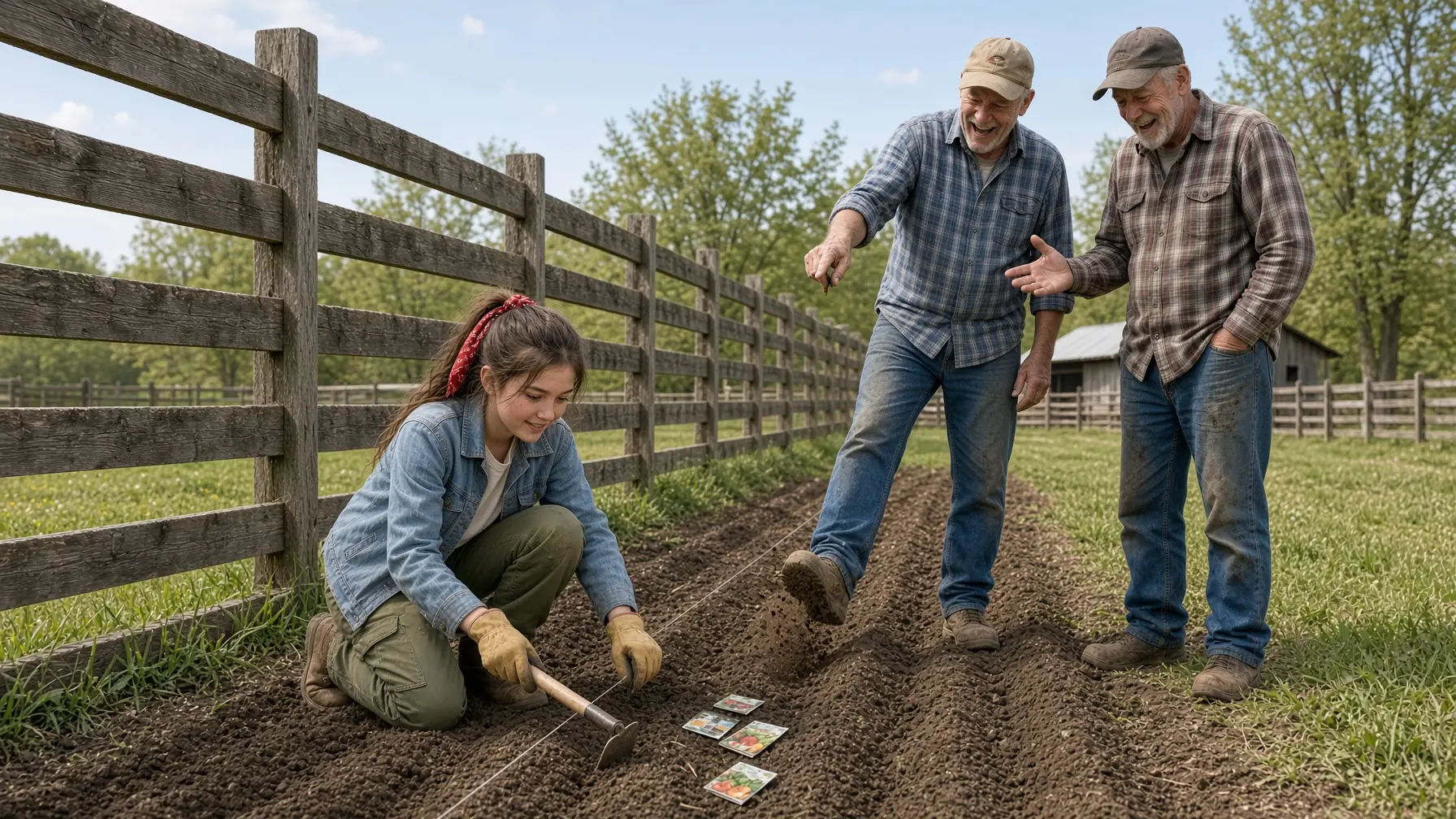
He deliberately dragged the toe of his boot through the fresh soil, collapsing nearly three feet of the narrow trench she had spent twenty minutes measuring.
“There.”
He pointed down at it.
“Improved it.”
Hank Turner laughed so hard he had to lean against the wooden fence.
Thirteen-year-old Sadie said nothing.
She set down the small packet of seeds in her hand.
Picked up the garden hoe.
And repaired the row.
Slowly.
Carefully.
Exactly eighteen inches from the one beside it.
Dale’s smile weakened.
“What is this, kid—a graveyard for seeds?”
Sadie stretched her measuring string again.
Six rows.
Exactly six.
Straight.
Parallel.
Running away from the old fence and into the south field.
Hank shook his head.
“Six weird trenches and she thinks she’s farming.”
He pointed toward the rows.
“Your granddad would've plowed this joke under.”
That made Sadie stop.
Not because the insult hurt.
Because Hank had accidentally said the funniest thing he could have said.
Sadie pressed one last seed into the soil with her gloved thumb.
Then covered it.
“He’s the reason I dug them.”
Dale frowned.
“For what?”
Sadie stood.
She brushed dirt from her olive-green work pants.
Then looked past both farmers.
Out across the field.
Forty acres of dull brown ground stretched toward a creek nearly half a mile away.
Nothing about it looked unusual.
Not yet.
Sadie gave them a tiny smile.
“You’ll see when the field changes.”
Dale stared at her.
Then burst out laughing again.
Sadie picked up her hoe.
Walked toward the barn.
And left the two men standing beside six narrow rows they were certain meant absolutely nothing.
By June, those rows would make both men stop their trucks in the middle of the road.
By July, Dale would be standing in the field with a shovel asking Sadie where to dig.
And by the end of summer, everyone in Miller County would understand why Samuel Miller had made his thirteen-year-old granddaughter promise never to plow the south field until she had planted six strange rows beside the fence.
Samuel Miller had been dead for four months.
Sadie still expected to hear him every morning.
The creak of his boots across the kitchen floor.
The cough before he drank his first coffee.
The old screen door slapping shut when he went outside before sunrise.
Grandpa Sam had lived seventy-eight years on Miller Farm.
He had been born there.
Raised two daughters there.
Buried one wife.
Broken three ribs.
Lost half a thumb to an auger when he was twenty-nine.
Survived two droughts, a tornado, one barn fire, and enough bad corn prices to stop believing farmers should ever say the words:
“This year looks easy.”
Sadie had followed him everywhere.
Not because anyone told her to.
Because Samuel answered questions.
Most adults eventually became tired of a child asking why.
Samuel usually answered with another question.
“Why do we plant this field first?”
“What direction does the wind come from?”
“Why are those soybeans yellow?”
“What happened here after the rain?”
“Why does that fence curve?”
“Look at the ground.”
That was Grandpa’s favorite instruction.
Look at the ground.
Sadie had heard it hundreds of times.
She never understood how important it was until the winter he died.
Miller Farm covered seventy-six acres in western Iowa.
Only fifty-four were tillable.
The best ground sat north of the farmhouse.
Dark soil.
Gentle slope.
Good drainage.
The worst ground sat south.
Everyone called it the South Forty even though the usable section was closer to thirty-eight acres.
For as long as Sadie could remember, something was wrong with it.
In wet springs, water stood between the rows.
Not everywhere.
Strange patches.
Long wet streaks.
Shallow pools that remained for days after surrounding ground had dried.
In dry summers, the same field behaved differently.
Some sections hardened like concrete.
Others stayed soft.
Corn turned yellow in bands.
Soybeans grew beautifully for fifty feet, then struggled for twenty, then recovered.
Samuel had stopped planting the worst twelve acres several years earlier.
Dale Morris rented neighboring land.
He told everyone the South Forty was simply bad dirt.
“Too much clay.”
Hank Turner blamed the creek.