“Give up, man. This land has no water. We’ve been here for years.”
Hank Doyle shouted the words from behind the fence, loud enough for every man under the faded “HOUSE SOLD” banner to hear. The afternoon sun beat down on the dry Texas field, turning the ground white and cracked beneath Mason Reed’s boots. Mason was kneeling in a shallow pit with a shovel in his blistered hands, sweat running down his jaw and dust stuck to his shirt. Behind Hank, three other farmers laughed like Mason had become the town’s entertainment.
Mason did not answer right away. He drove the shovel into the dirt again, but the blade struck hard ground and bounced back into his hands. The field around him looked dead in every direction, nothing but brittle weeds, broken fence posts, and a farmhouse with peeling paint standing far behind him. Anyone passing by would have believed Hank was right.
Mason had bought the property only three weeks earlier. The house had been empty for nine years, the well had been declared dry, and every neighbor called the place cursed. Even the realtor had lowered her voice when she showed him the paperwork, as if selling the land made her feel guilty. Mason still signed anyway because the old farm had once belonged to his grandfather’s brother, and something in him refused to let it disappear.
Hank Doyle owned the farm next door, a wide piece of land with cattle, irrigation tanks, and a clean metal gate. He had wanted Mason’s property for years, not because he believed it was valuable, but because he wanted the road frontage and the old barn. When Mason bought it first, Hank took it like a personal insult. From that day on, he came by almost every afternoon to laugh, criticize, and remind Mason that a desperate man had overpaid for dead dirt.
“You hear me, Mason?” Hank called again, folding his arms. “This field has been dry since before your boots learned how to walk.” The other men chuckled, and one of them spat into the dust. Mason pushed himself upright, breathing hard, his palms burning through the rough wooden handle. He looked at Hank and said, “Then maybe you spent years looking in the wrong place.”
That only made them laugh harder. Hank stepped closer to the fence, his sunburned face twisting with amusement. “Looking in the wrong place? Son, I watched three families try to farm that ground and walk away broke.” He pointed at the pit. “You’re not digging for water. You’re digging a grave for your pride.”
Mason looked down at the dry earth and said nothing. Pride had very little to do with it. He had not bought the farm because he wanted to impress anyone, and he had not started digging because he enjoyed humiliation. He was digging because of a folded paper his mother had given him two nights after the sale closed.
The paper had belonged to Mason’s grandfather, Elijah Reed. It was old, yellowed at the corners, and marked with faded pencil lines that looked almost useless at first glance. But Elijah had written one note across the bottom in his shaky hand: The spring was sealed near the east post after the flood of 1958. Water is still there if someone is stubborn enough to find it. Mason had read that sentence at least fifty times.
His mother, Grace Reed, did not ask him to believe it. She only sat at his kitchen table, placed the paper between them, and said, “Your grandfather wasn’t a man who wrote things down unless they mattered.” Mason remembered the way her fingers trembled when she touched the old map. “People laughed at him too, Mason. Sometimes laughter is just fear wearing a loud voice.”
That was why Mason kept digging. Not because he was certain, but because no one had ever saved a dying farm by agreeing with the men laughing at the fence. He had spent fourteen years working rented land, fixing other people’s equipment, and watching richer neighbors buy the fields his family once dreamed of owning. Now he had one piece of land with his name on the deed, and he was not ready to let mockery decide its future.
By the fourth week, the laughing had become routine. Hank brought coffee in the mornings and leaned against the fence like a man watching a slow failure. Some days, his brother Owen came with him. Other days, farmers from the road stopped their trucks just long enough to shake their heads.
Mason’s sister, Lila, came by one evening with sandwiches wrapped in foil. She found him sitting on an overturned bucket beside the pit, his shirt stiff with dust and his shoulders slumped forward. “You look like you fought the whole county,” she said. Mason took the sandwich and gave a tired smile. “Only the part of it standing by the fence.”
Lila looked toward Hank’s property, her expression tightening. “He’s enjoying this too much.” Mason nodded, chewing slowly. “He wanted this place.” Lila sat beside him on another bucket. “Then maybe he’s scared you’ll find something he missed.”
That thought stayed with Mason longer than he expected. Hank owned good land, good cattle, good trucks, and more respect in town than he deserved. But every time Mason dug, Hank came running like he could not stand to look away. A man truly certain there was no water would not need to keep saying it.
Two days later, Mason found the first sign. It was not water, not yet, but a line of dark clay beneath the pale crust. He dropped to his knees and scraped it with his fingers, feeling the difference immediately. The topsoil was hot and dead, but the clay below held a coolness that made his heart begin to pound. He worked until sunset, widening the pit one careful shovel at a time.
Hank saw the darker soil the next morning. His smile faded for half a second before he forced it back. “Clay doesn’t mean water,” he said, though no one had asked him. Mason wiped sweat from his forehead. “No, but it means this ground isn’t as empty as you thought.”
By noon, the pit was deep enough that Mason had to climb down into it. The walls were rough, cracked, and layered with different colors of earth, each one telling a history older than the men arguing above it. Mason’s back ached, his wrists throbbed, and every breath tasted like dust. Still, the deeper he went, the cooler the ground became.
A truck pulled up near the road, and Sheriff Tom Alvarez stepped out. He was not there on duty, only curious like everyone else, but his presence made Hank stand a little straighter. “Mason,” the sheriff called, “you doing all right down there?” Mason leaned on the shovel and looked up. “Still breathing.”
Sheriff Alvarez came closer and studied the pit. “That’s a lot of digging for one man.” Hank laughed under his breath. “That’s what I keep telling him.” The sheriff ignored Hank and looked at Mason. “You got someone checking that wall? Dry dirt can cave faster than wet sand.”
Mason nodded. “I’ll brace it tonight.” The sheriff’s concern was practical, not mocking, and that mattered. Before leaving, he handed Mason a bottle of water from his truck and said, “Stubborn doesn’t have to mean careless.” Mason took the bottle and thanked him.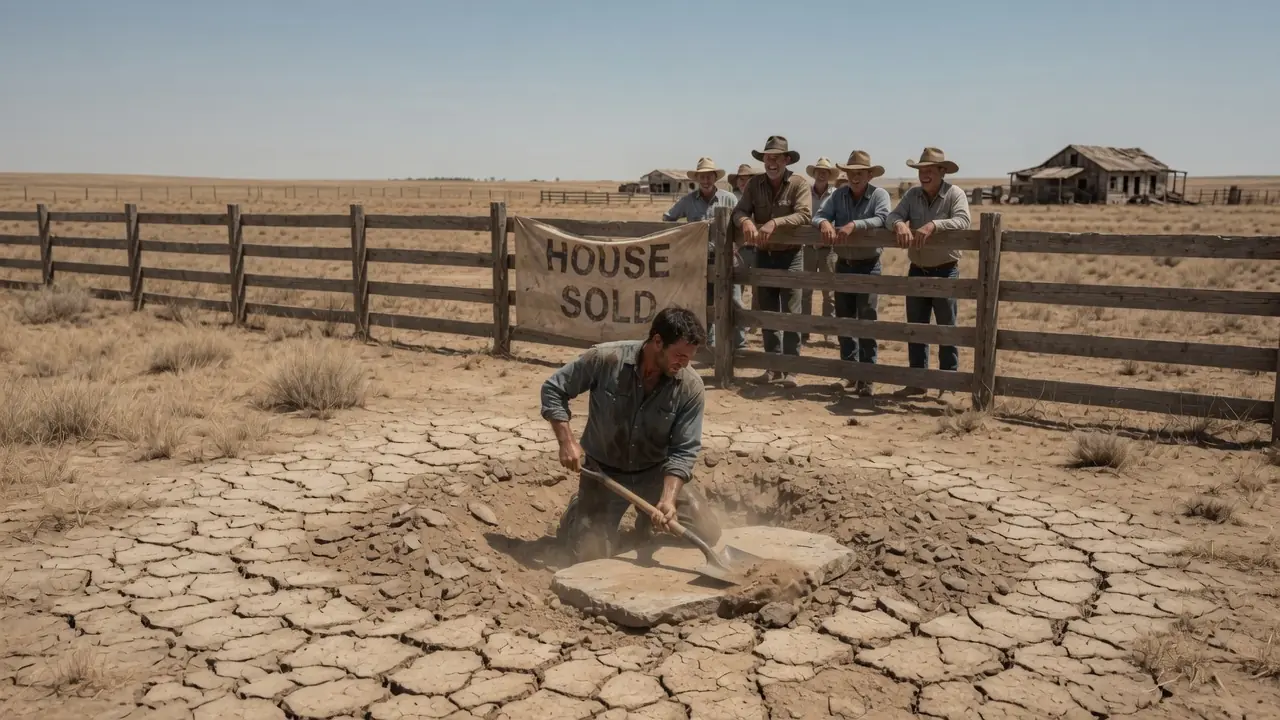
That night, Mason built supports from old barn lumber. He worked under a battery lamp while crickets sang in the weeds and the farmhouse stood dark behind him. The land seemed different at night, less dead and more like it was sleeping. Mason rested one hand against the dirt wall and whispered, “If you’re down there, I’m still coming.”
On Friday morning, the whole thing changed. Mason’s shovel struck something hard, not rock exactly, but flat and hollow beneath the clay. The sound traveled up the handle and into his arms. He froze, then struck the spot again more carefully.
Hank was already at the fence. “What’d you hit, Mason? Your common sense?” The men behind him laughed, but Mason barely heard them. He dropped the shovel and used both hands to scrape away the dirt. A rounded stone edge appeared, then another, forming a circle buried under decades of packed earth.
Mason’s breathing turned shallow. It was a cover, old and heavy, fitted over something man-made. The stone was cracked down one side, and mud had sealed the edges like cement. He climbed out of the pit, grabbed a pry bar, and climbed back in without looking at Hank.
The joking slowed as Mason worked the pry bar under the stone lip. Even Hank stopped talking when the stone shifted with a low grinding sound. Mason pushed with everything he had, his boots sliding in the dirt, his arms shaking from strain. The cover lifted just enough for cool air to breathe out from beneath it.
That was when the smell came up. Not rot, not dust, but damp stone and deep earth. Mason closed his eyes for one second because he knew that smell from childhood creek beds and old wells. Hank stepped away from the fence, his mouth slightly open.
Mason pushed harder. The stone cover cracked loose, tilted sideways, and dropped against the wall of the pit. Beneath it was a dark opening lined with old brick, half-filled with packed mud. For several seconds, nothing happened.
Then the dirt at the bottom began to darken. A slow bead of water pushed through the mud like the land was taking its first breath in years. Mason dropped to one knee, staring as another bead appeared, then another. The pit floor turned from dusty brown to deep black.
“No,” Hank whispered from the fence. Mason looked up at him, his face streaked with sweat and dirt. “Dry doesn’t mean dead, Hank.” The water spread around his boots, thin but real, and every man watching understood the laughter was over.
By the next hour, the seep had become a steady flow. Mason cleared mud from the old brick shaft, and water began rising faster, pooling at the bottom of the pit. Sheriff Alvarez returned with two county workers, and Lila arrived crying before she even reached the fence. Hank stood silent, arms hanging at his sides like he had forgotten what to do with them.
The county workers tested the flow and confirmed it was an old spring chamber, sealed after a flood and buried when the field shifted. Elijah Reed had been right. Mason sat on the ground beside the pit, too exhausted to celebrate properly, while Lila wrapped her arms around his shoulders. “You found it,” she whispered.
Mason stared at the water shining in the dirt. “No,” he said softly. “Grandpa did. I just believed him long enough.” Lila wiped her eyes and smiled. Across the fence, Hank turned away like the sight physically hurt him.
News traveled fast through Mill Creek. By the next morning, half the town knew water had risen from the farm everyone called worthless. Men who had laughed now arrived with quiet voices and careful compliments. Some pretended they had always thought Mason might find something, but Mason remembered faces better than words.
Hank came back three days later, alone this time. He stood by the fence without smiling, his hat low, his hands hooked over the top rail. Mason was setting up a pump line from the spring chamber to an old storage tank near the barn. The water ran clear now, cold enough to fog the metal pipe in the morning air.
“Mason,” Hank called. Mason did not stop working. “What do you need?” Hank cleared his throat. “I came to talk.” Mason tightened a clamp with a wrench. “Talk, then.”
Hank looked toward the spring, then toward the dead acres beyond it. “You got more water than that place needs.” Mason finally turned. “Maybe.” Hank shifted uncomfortably. “My west pasture’s been running low since June.”
There it was. Not an apology, not yet, but need. Mason looked at the man who had laughed at him for weeks and heard his own grandfather’s voice in memory. Water is deeper than shame. Mason wiped his hands slowly. “Are you asking for help, Hank?”
Hank’s face tightened. He was a proud man, but pride had very little use when cattle were thirsty. “I’m asking if we can make an arrangement.” Mason studied him for a long moment. “You mean after telling me I bought dead dirt and dug a grave for my pride?”
Hank looked away. “I said things.” Mason’s voice stayed calm. “You didn’t just say things. You brought an audience.” Hank’s jaw worked, and for the first time since Mason had bought the farm, the older man looked smaller than his reputation. “I was wrong.”
Mason waited. Hank swallowed hard. “I was wrong, and I was jealous.” The words seemed to cost him more than money would have. “I wanted this place because I thought I could take it cheap someday. Then you bought it, and I hated that I missed what was under my own nose.”
Mason looked toward the spring. The easy thing would have been to refuse him, to let Hank feel every ounce of the humiliation he had tried to pour on someone else. But Mason had not dug for revenge. He had dug for life, and life did not mean much if he became as small as the men who mocked him.
“I’ll sell you water for your west pasture at a fair price,” Mason said. Hank looked surprised. “You will?” Mason nodded. “With a written agreement, proper meter, and no games.” Hank removed his hat slowly. “Fair enough.”
Mason stepped closer to the fence. “But understand this, Hank. You don’t get to laugh at a man’s hope and then drink from it without remembering where it came from.” Hank lowered his eyes. “I’ll remember.” Mason believed him only halfway, but halfway was a beginning.
By late summer, Mason’s land began to change. The first green appeared around the spring outlet, small and fragile at first, then spreading in uneven patches across the field. Mason planted cover crop where the soil could hold it and repaired the old irrigation channels that earlier owners had abandoned. The farmhouse still needed paint, the barn still leaned, and the fences still sagged, but the place no longer looked dead.
Lila helped him on weekends. She brought her two daughters, Emma and Rose, who ran through the yard and shouted every time they saw frogs near the new water channel. Grace Reed visited too, walking slowly with her cane to the edge of the spring chamber. She touched the old brick lining and whispered, “Your grandfather would have stood right here smiling.”
Mason built a small wooden cover over the spring and carved Elijah Reed’s name into it. Below the name, he carved the sentence from the map: The water is deeper than shame. When people asked what it meant, Mason usually smiled and said, “It means don’t let loud people decide what quiet ground is worth.” The sentence spread around town faster than he expected.
By harvest season, Mason was not rich, but he was no longer desperate. He leased water carefully, planted wisely, and refused every offer from land buyers who suddenly thought his farm looked promising. One developer came from Dallas with a clean truck and a big check, explaining that the spring made the property attractive for a rural retreat. Mason listened politely, then pointed toward the field.
“That water didn’t come up so I could sell the land to people who only noticed it after it started shining,” he said. The developer laughed, thinking it was a negotiation tactic. Mason folded the offer and handed it back. “I’m keeping the farm.”
The next spring, the field that had been called dead carried rows of young vegetables, hay grass, and a small orchard Mason planted near the house. The soil still required work, and some sections might never fully recover, but enough had changed to prove the land had been waiting for someone patient. Mason’s hands remained rough and scarred, but now they worked with purpose instead of desperation. Every morning, he walked to the spring before breakfast just to hear it running.
Hank changed too, though not all at once. He stopped bringing men to laugh at the fence. He paid for his water on time, helped Mason repair a collapsed corner post after a storm, and once arrived with a trailer of hay when Mason’s truck broke down. Neither man pretended they were old friends, but respect began where mockery had ended.
One evening, Hank found Mason standing beside the spring cover as the sun dropped low over the fields. The water moved quietly through the channel, catching orange light on its surface. Hank leaned on the fence, silent for a while. Then he said, “I still hear myself saying this land had no water.”
Mason looked at him. “So do I.” Hank gave a bitter little smile. “I sounded like a fool.” Mason rested one hand on the carved wooden cover. “You sounded like a man who had stopped believing anything could change.”
Hank nodded slowly. “Maybe that’s worse.” Mason did not answer because he knew Hank was right. Foolishness could be corrected with proof, but hopelessness dug deeper roots. The spring had not only exposed water beneath dry ground; it had exposed what years of disappointment had done to everyone around it.
A year after Mason bought the farm, the town held a small summer market on his property. It started as Lila’s idea, just a few tables with vegetables, lemonade, and local bread. By noon, trucks lined the road, children played near the barn, and neighbors stood in the shade talking as if the farm had always been a place of gathering. Mason watched from the porch, overwhelmed by how quickly a place could return to life once people stopped calling it dead.
Grace sat beside him in a rocking chair, holding a paper cup of lemonade. “You know,” she said, “your grandfather used to say land listens.” Mason smiled. “What does that mean?” Grace looked out at the green field. “It means if people curse it long enough, they stop hearing what it’s trying to give.”
Mason thought about that for a long time. He thought of his shovel striking the buried stone, of Hank’s laughter fading into silence, and of water rising around his boots. He thought of all the years the spring had waited beneath cracked earth while men stood above it declaring the land worthless. Maybe the land had not been silent at all; maybe no one had been humble enough to listen.
Near sunset, Hank approached the porch with a crate of tomatoes from his own field. He looked awkward standing there, like a man still learning how to offer kindness without covering it in pride. “Figured these might sell,” he said. Mason took the crate and nodded. “Appreciate it.”
Hank looked toward the spring channel. “You did good with this place.” Mason studied him, hearing the apology hidden inside the compliment. “It wasn’t just me.” Hank looked at the carved words on the spring cover and gave a slow nod. “No, I suppose it wasn’t.”
That night, after everyone left, Mason walked the field alone. The “HOUSE SOLD” banner was long gone, folded and stored in the barn as a reminder. The pit had been rebuilt into a proper spring house, the dry ditch had become a narrow water channel, and the air smelled faintly of soil, grass, and summer. Mason stood where he had once knelt in humiliation and listened to the water moving in the dark.
He could still hear Hank’s old words if he tried. Give up, man. This land has no water. We’ve been here for years. But now the words sounded distant, almost harmless, swallowed by the steady running of the spring.
Mason understood then that the greatest victory had not been proving Hank wrong. It had not been the water contracts, the crops, the market, or the sudden respect from people who once laughed. The real victory was that Mason had refused to let dry seasons convince him the ground was finished. He had believed deeper than shame, deeper than mockery, and deep enough to find the life waiting underneath.