The heat over Dusty Creek shimmered like fire bent into air.
July 14th, 1883.
Noon sun. No wind. A silence so tight it felt ready to split.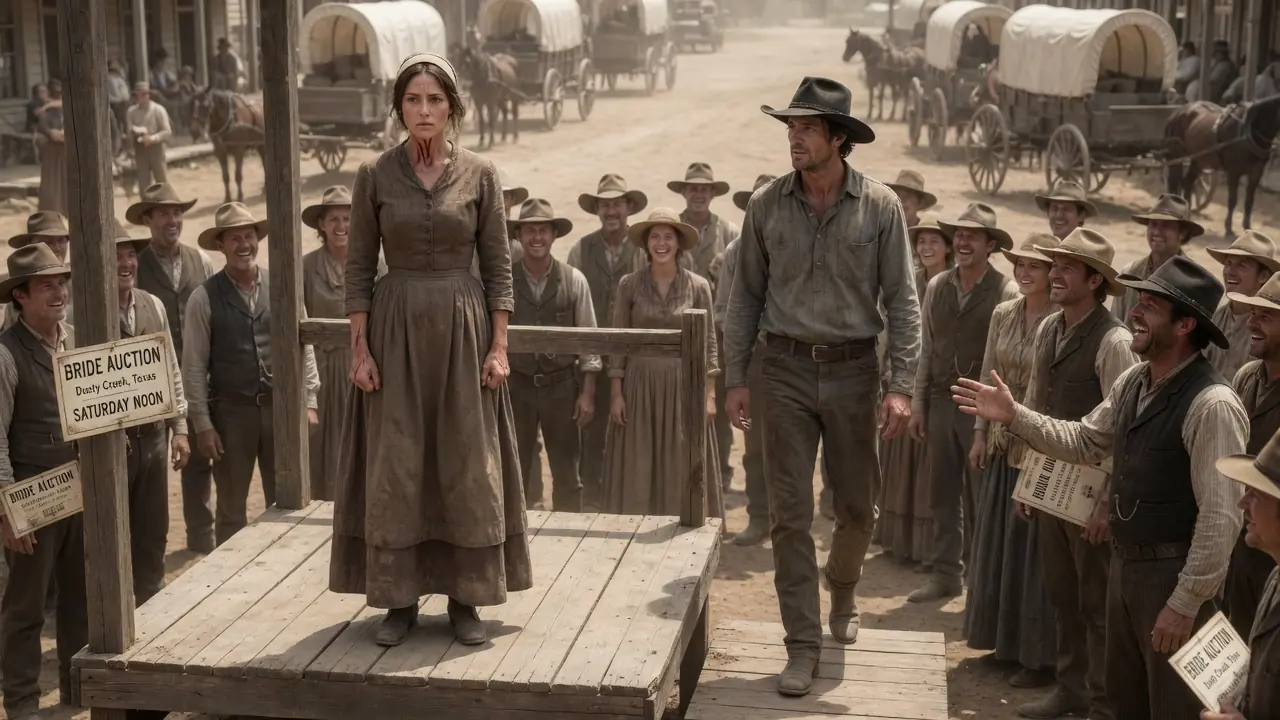
Then the laughter began.
Sharp.
Cruel.
Eager.
Annie Whitfield stood alone on the wooden platform while the dust settled around her boots. Twelve women had come to the bride auction. Eleven had walked away chosen.
Annie was the last one left.
She did not drop her eyes. She did not beg. She did not even flinch when a man spat tobacco at her feet and called her the same thing her own husband once had.
Damaged goods.
Her throat was dry as ash. Her hands trembled. Her knees felt ready to fold. But she stared straight ahead at the empty horizon, where heat danced off the tracks like water that was not real.
She held herself still even as the voices turned meaner.
“Why ain’t you married then?”
“Returned, that one.”
“Sent back barren as dry dirt.”
Gus Harmon, the coordinator, wiped sweat from his red face. He tried again, voice cracking under the heat and tension.
“Gentlemen, Miss Annie Whitfield here can read, can write, can cipher. She’s educated.”
“Then why is she standing up there like leftover stew?”
Laughter exploded again.
Annie kept breathing.
Slow.
Steady.
Controlled.
Her nails pressed into her palms until a warm sting gathered there. She did not look down. She would not give them the satisfaction.
“Well now,” Harmon cleared his throat. “Anyone?”
Silence.
Someone hollered, “Something’s wrong with that one in brown.”
“Wrong?”
“Returned defective.”
The words she had carried from Boston all the way to Texas.
She lifted her chin.
If she bent now, she would never stand straight again.
Then she heard it.
Bootsteps.
Firm.
Heavy.
Certain.
“I’ll take that one.”
The laughter vanished.
The air tightened.
A man stepped forward. Tall, lean, raw-boned. His shirt was worn but clean. His face was sun-cut and quiet. But his eyes, gray-green like sage after rain, did not crawl over her the way every other man’s eyes had.
He looked at her hands instead.
He saw the marks.
Marcus Boon, one of the biggest ranchers around, snorted next to him.
“Her? She’s broken merchandise, Brennan. Barren as dead stone.”
The name hit the crowd like a dropped hammer.
Elijah Brennan.
The widower.
The quiet one.
The man who lived half-wild on a lonely ranch north of town. The man who had not looked at another woman since his wife died five years ago.
He did not look at Boon.
He looked at Annie.
“Ma’am,” he said.
His voice was rough but steady.
Annie swallowed hard.
He shifted his hat, still watching her face.
“I ain’t offering romance. Just fair treatment, honest work, and a door that locks from the inside. You interested?”
Interested.
No one had asked her that in years.
Her heart hammered against her ribs.
“Why me?”
“You didn’t beg,” he said simply. “That’s enough.”
Boon shoved forward.
“Hold on. I already claimed her.”
Eli finally looked his way, eyes cold but calm.
“Did she accept?”
“She don’t get to.”
“Did she accept?”
Eli’s voice did not rise.
It did not need to.
The crowd shifted uneasily.
Boon’s jaw tightened.
“She’s damaged. She’s worthless.”
“Maybe,” Eli said. “Still not yours.”
Something hot and sharp filled Annie’s chest. Something like fear, but also something she had not felt in years.
Hope.
Gus Harmon wiped his sweating brow again.
“Well, Miss Whitfield, do you accept Mr. Brennan’s offer?”
Annie thought of the boarding house that pitied her. The whispers that would follow her everywhere. The shame she would choke on forever.
“Yes,” she said softly. “I don’t have anywhere better to be.”
Eli nodded once.
“Then let’s go.”
The whispers rose instantly.
“She actually went with him.”
“He’ll regret it.”
“She’s cursed.”
Annie ignored them. She stepped off the platform, stumbling when her skirt snagged. She caught herself on the railing before anyone could reach for her.
Eli did not grab her arm.
He did not guide her.
He only waited, steady and patient.
A man who respected decisions.
It felt unreal.
They walked through Dusty Creek together. Eyes followed them like arrows, judging, whispering, weighing her worth.
At the wagon, Annie hauled herself up using her own strength. Her palm stung as the dried marks cracked, but she did not stop.
Eli climbed in beside her, clicked his tongue, and the mules started forward.
Dusty Creek shrank behind them as they rolled into open prairie.
After a mile of silence, Annie said, “Boon won’t let this go.”
“Probably not,” Eli answered.
“You’ve made an enemy.”
“Had plenty before.”
“You don’t know what he’s capable of.”
“Don’t need to,” Eli said. “I know what I’m capable of.”
Annie stared at him, surprised by the quiet force in his voice.
“Why did you choose me?” she asked. “Not the young ones. Not the pretty ones.”
Eli kept his eyes on the trail.
“You stood there while they laughed. Didn’t bend. Didn’t cry. Didn’t plead. That’s strength.”
Her breath caught.
Strength.
No one had used that word about her in years.
Ahead, rolling hills stretched into forever. Cattle dotted the land like dark stones.
“Ranch is over that rise,” Eli said. “Ain’t much.”
Annie surprised herself.
“It’s perfect.”
He looked at her sharply, like he was not sure she meant it.
She did.
“House has a room with a bolt on the inside,” he said quietly.
“Built it last month for your bride?” she asked.
“For whoever needed it,” he answered.
She did not know what to say to that.
When she entered the small room he had made and saw the clean bed and the bolts on both doors, she touched them with shaking fingers.
A door that locked from the inside.
A door she controlled.
A freedom she had not tasted in years.
That night, lying awake in a strange bed on a strange ranch with a strange man across the hall, Annie listened to the quiet hum of her new life settling around her.
She was not sure what waited ahead, but for the first time in a long while, she did not feel completely abandoned.
She did not feel unwanted.
She felt chosen.
Annie woke before the sun, her heart pounding from a dream she could not hold on to.
For a moment, she did not know where she was.
Boston?
The boarding house?
The platform?
No.
The small bedroom smelled of cedar and dust. A thin curtain stirred in the early breeze. Somewhere beyond the wall, she heard steady footsteps, heavy, measured, familiar.
Eli Brennan.
The man who had chosen her when no one else would.
Annie sat on the edge of the bed and pressed her hands together. The cuts from yesterday still stung, thin lines of dried blood marking each palm.
She flexed her fingers.
She was still here.
Still alive.
Still standing.
She washed her face, fixed her hair, and stepped outside.
The ranch was waking up. Orange light crept over the hills, painting everything soft and gold. Cattle moved in the distance. Chickens scratched near the barn. A tin coffee pot steamed over a fire.
Samuel Chen, thin and sharp-eyed, sat on a crate with his arm in a sling, sipping coffee with his good hand. His wife, Martha, poured another cup and nodded toward Annie.
“Coffee?” Martha asked.
“Yes, please.”
Annie took the cup, grateful for its warmth.
Eli stepped around the corner of the barn, wiping his hands on a rag. His shirt sleeves were rolled up, showing strong forearms browned by sun.
His face looked different in morning light.
Less stone.
More man.
He nodded to her.
“Morning.”
“Morning,” Annie answered.
Her voice came out quieter than she meant.
“You sleep, Annie?” he asked.
“Some,” she lied.
Eli’s eyes flicked to hers. He seemed to see through the lie, but he let it pass.
“Got a long day,” he said. “Fence line needs checking. Chickens need tending. Garden needs help.”
He paused.
“If you’re up for it.”
“I am,” Annie said. “I’d rather work.”
“That’s what I figured.”
They finished breakfast in a silence that did not feel heavy. Just new.
Martha walked with Annie toward the garden, a patch of dry soil with a few struggling plants. The tomato vines sagged. The beans clung to life.
“Drought’s been hard,” Martha explained. “Everything’s dying.”
“It just needs care,” Annie said softly, touching the soil between her fingers. “Mulch, more shade, deeper watering. It can recover.”
Martha looked at her, eyebrows raised.
“You know gardens?”
“I know how to keep something alive when everything around it is trying to kill it,” Annie said quietly.
Martha nodded.
She understood more than she said.
They worked until sweat soaked Annie’s dress and grime streaked her arms. But the work felt good. Honest. Steady.
Every weed she pulled was a small victory. Every plant she supported was a whisper of hope.
By noon, she felt lighter than she had in months.
Eli returned from the north pasture, dust coating his boots and shirt. He stopped when he saw the garden.
“Looks better already,” he said.
“Still a long way to go,” Annie replied.
He studied her face the way he studied land.
Sharp.
Focused.
Learning.
“You look different.”
“Different how?”
“Less like someone waiting for the world to hit her again.”
Annie swallowed.
“Maybe because I’m too tired to expect anything.”
Eli’s mouth twitched like he might smile, but did not.
“Tired’s honest. Honest is good.”
They ate lunch together, cornbread and beans. Afterward, Annie washed dishes while Eli sharpened tools by the porch.
Every now and then, he glanced her way as if checking that she was really there. When she looked back, he did not look away.
That night, after supper, they sat on the porch together. The sky was full of stars, scattered like spilled salt.
Eli worked on a piece of leather. Annie mended a shirt she had found in the laundry.
The silence between them had changed.
It was not awkward now.
It felt shared.
After a long while, Eli spoke without looking up.
“Never thought I’d sit on this porch with someone again.”
“With your wife?” Annie asked softly.
His hands paused on the leather. He exhaled slowly.
“Miriam,” he said. “She died trying to give me a child. Baby didn’t make it either.”
“I’m sorry.”
“Yeah.”
He kept stitching.
“Me, too.”
Annie was not sure what to say. Grief felt like a language she understood too well.
“She loved this porch,” he added quietly. “Said it was the only place she could breathe.”
He glanced at Annie.
“Funny. You don’t look much like her, but sitting here with you feels familiar somehow.”
Warmth spread through Annie’s chest, unexpected and unsteady.
Before she could answer, Eli stood abruptly.
“Town tomorrow,” he said. “Need supplies. You should come.”
Annie froze.
Back to Dusty Creek.
People would stare, whisper, judge.
The memory of laughter on the platform clawed at her.
But she was not the same woman who had stood there yesterday.
Not quite.
“I’ll go,” she said.
Eli nodded once, approving, grateful, something in between.
“Get some sleep,” he said. “Tomorrow’s going to be rough.”
Dusty Creek was waiting for them.
The moment Annie stepped off the wagon, eyes locked on her from every direction. Men muttered. Women whispered. The humiliation from the platform washed over her, sharp as a fresh wound.
Eli stepped close, not touching, but near enough to steady her.
Inside the general store, four women stared openly. One in a silk dress stepped forward, lips curling.
Josephine Caldwell.
“I don’t believe we’ve met,” she said coolly. “But the whole town knows who you are.”
Annie kept her voice even.
“Do they?”
“Oh yes,” Josephine smirked. “You’re the leftover bride. The barren one. The woman not even her husband wanted.”
The words hit Annie like rocks thrown at her back. Old shame burned hot in her throat, but something stronger pushed back.
She lifted her chin.
“I don’t care what you think of me.”
Josephine blinked.
Annie stepped closer, her voice calm, cold, steady.
“I’ve been judged by better people than you. Your opinion has no value to me.”
A quiet hush rose from the other women.
Josephine’s face flushed.
“You little—”
“If you speak to me like that again,” Annie said, “I’ll simply tell everyone what I can see plain as day.”
“And what is that?” Josephine snapped.
“That you’re a bitter woman who can’t stand the thought of anyone else finding happiness.”
Gasps filled the room.
Even Josephine’s daughter, Charlotte, let out a startled laugh.
“Charlotte,” Josephine barked.
“Sorry, Mama.”
But Charlotte was not sorry. She was staring at Annie with something like admiration.
Humiliation darkened Josephine’s face.
“You’ll regret crossing me.”
“No,” Annie said. “I won’t.”
When the store door slammed behind Josephine, silence settled heavy and thick.
Eli approached Annie slowly, his expression unreadable.
Then he said quietly, “That was the finest thing I’ve seen in five years.”
A smile, small and real, tugged at Annie’s lips.
They loaded supplies in silence, but it was not uncomfortable.
Something had shifted between them.
Something important.
The ranch came into view as the sky burned orange. Annie exhaled, relieved to be away from town, but Martha ran toward them, face pale.
“Samuel’s gone,” she cried. “He went to the south pasture to check something. He didn’t come back.”
Eli was off the wagon before she finished.
“How long?”
“Three, maybe four hours.”
“Damn it.”
He grabbed his rifle.
“Martha, stay inside. Lock both doors.”
“Eli,” Annie stepped forward.
“No,” he said. “You stay, too.”
“You can’t go alone.”
He met her eyes.
“If something happened to Samuel, I need to know you’re safe.”
Before she could argue, he was on a mule and gone.
Annie watched him disappear over the hill, fear twisting tight in her chest.
Martha pulled her inside.
“We wait,” she said, voice shaking. “We just wait.”
Waiting became torture.
Minutes crawled.
Hours dragged.
The sun sank lower and lower.
Then hoofbeats thundered outside.
Martha grabbed a shotgun.
Annie grabbed a knife.
The door burst open.
Eli stumbled in carrying Samuel across his shoulders. Samuel’s shirt was soaked. His face was bruised. His arm bent wrong.
“Help me get him to the table,” Eli gasped.
They worked fast.
Annie stitched Samuel’s wound with steady hands honed by necessity. Eli set the broken arm while Martha cried silently.
Samuel screamed once before passing out again.
But when they were done, he was breathing.
Barely.
But breathing.
“Who did this?” Annie whispered.
Eli tossed a torn red bandana on the table.
“Boon’s men,” he said. “We can’t prove it yet, but we all know.”
Annie’s heart thudded painfully.
“This is my fault,” she said. “He hurt Samuel because of me.”
Eli grabbed her shoulders, forcing her to meet his eyes.
“No. This is on Boon, not on you. Don’t take blame that ain’t yours.”
Annie swallowed hard.
“Then what do we do?”
“We get proof,” Eli said.
“And if that fails?”
His voice dropped into something dark.
“We handle it ourselves.”
Night dragged heavy over the ranch.
Annie could not rest. Fear knotted her stomach. Every sound made her jump.
Near midnight, she heard low moaning through the wall.
Not pain.
A nightmare.
She pressed her ear to the boards.
“Miriam, I’m sorry. I’m sorry.”
A thud.
Silence.
Annie stepped back, heart aching.
Eli’s grief ran deep, carved by years of pain. She was not alone in her brokenness.
When dawn came, Annie was already dressed. She made coffee, cooked biscuits, anything to distract her mind.
Eli entered, face tired and damp from the pump.
“You didn’t sleep,” he said.
“Neither did you.”
He sat at the table. His eyes drifted to her cheek, as if he could see the bruise Josephine’s insult had left on her pride.
“You okay?”
“I will be.”
They ate in silence until Annie finally spoke.
“Last night I heard you.”
Eli froze.
“I’m not asking,” she said gently. “I just want you to know I heard.”
After a long moment, Eli exhaled.
“Happens most nights,” he said. “If it bothers you—”
“It doesn’t.”
He nodded once.
Something opened between them then.
Something soft.
Something real.
“You can call me Eli,” he said quietly.
Annie felt her chest warm.
“Then you should call me Annie.”
Eli’s eyes held hers.
“Annie,” he repeated softly.
The sound of her name in his mouth sent a strange warmth through her.
By afternoon, Annie had settled into the rhythm of ranch life. Cleaning the coop, tending the garden, repairing clothes, work that grounded her and made her feel useful.
When Eli returned from checking the fence line, he found her kneeling beside a dying squash vine.
“You ever stop working?” he asked.
“No,” Annie said. “Do you?”
He almost smiled again.
“Fair enough.”
They ate supper together, quiet, warm, comfortable. Later, they sat on the porch sewing leather and cloth as the stars came out.
Then Eli spoke.
“Never thought I’d do this again.”
“What?”
“Sit with someone.”
Annie’s breath caught.
“Why did you come to the depot yesterday? You said you weren’t looking.”
He stared into the darkness for a long time before answering.
“I got tired,” he said finally. “Tired of being alone with ghosts. Tired of talking to empty rooms.”
Annie understood that more than she wanted to.
“I know how that feels,” she whispered.
He looked at her.
Really looked.
“Maybe that’s why I chose you,” he said. “Maybe I saw someone who survived her own ghosts.”
Her heart thudded hard.
“Why did you really choose me?” she whispered.
He lifted his gaze to hers.
“You didn’t beg,” he repeated softly. “You held your ground even when the world tried to crush you. That’s the kind of strength a ranch needs.”
Annie felt tears prick her eyes. She blinked them away.
Before she could respond, a distant howl cut through the night.
Coyote.
Eli stood.
“Bed. Big day tomorrow.”
Annie rose too.
At her bedroom door, she paused.
“Eli,” she said softly.
He turned.
“Thank you for what you did at the depot.”
His jaw tightened. His voice softened.
“Wasn’t nothing.”
“It was everything,” she whispered.
He looked at her for a long heartbeat, then nodded and went to his room.
Annie closed her door and slid the bolt into place.
This time, she did not do it out of fear.
She did it because she had something worth protecting.
Because for the first time in years, she was beginning to hope.
Morning rose slow and silver over the Brennan ranch. A thin mist rested on the grass, and the world felt strangely quiet, as if holding its breath.
Annie stepped outside with a bucket in hand, ready to fetch water.
Eli was already at the corral saddling his horse. He looked different today.
Focused.
Steeled.
“Morning,” Annie said.
“Morning,” Eli replied.
He tightened the saddle strap.
“Boon’s been too bold. Yesterday was a warning. Today, he’ll push harder.”
Annie’s stomach tightened.
“What are you planning?”
“Riding into town.”
He threw the reins over the saddle horn.
“I’m going to speak with Sheriff Ford. Get him to act.”
“You think the sheriff will help?”
Eli paused. His eyes hardened.
“Ford don’t like Boon, but he’s scared of him. Still, it’s worth trying.”
“And if he won’t?”
Eli met her eyes, and Annie felt a cold ripple slide down her spine.
“Then we do things my way.”
Annie stepped closer.
“Eli, please be careful.”
He looked down at her, something soft flickering in those storm-colored eyes.
“You, too.”
He hesitated a moment, then added, “Lock the doors. Both bolts.”
She nodded.
Eli mounted and rode off, leaving a wake of dust behind him.
Hours passed.
Annie worked the garden, fed the chickens, cleaned the kitchen, and checked on Samuel, anything to keep her mind from spiraling. Martha helped where she could, but worry had her pacing the house and wringing her hands.
When Samuel woke briefly, he rasped, “Boon. It was Boon. Saw me fixing the fence. Said the land weren’t ours no more.”
Martha’s eyes filled with tears.
Annie squeezed her hand.
“Eli will handle it. He won’t let Boon hurt us again.”
But even as she said the words, fear twisted in her gut.
Near noon, dust rose in the distance.
Annie froze.
A single rider.
Eli.
But he was not alone.
Behind him, two riders trailed, tied together at the wrists, heads lowered in defeat.
Martha rushed outside.
“What is this?”
Eli dismounted, jaw locked tight.
“Proof.”
Annie stepped closer, trying to read his expression.
“What happened?”
“Ford wouldn’t help. Said he’d talked to Boon. That’s all. But these two confessed they were the ones who beat Samuel.”
Annie’s breath caught.
“Did they say Boon ordered it?”
“Yes.”
The two men glared at the ground, fear written in every line of their bodies.
Eli shoved one forward.
“They’re going to say it to Ford as well.”
Martha gasped.
“Will the sheriff arrest Boon?”
“No,” Eli said. “But once the town knows, Boon won’t be able to touch us without every eye watching.”
Eli turned to Annie.
His voice softened.
“We’re not done yet. We still need to confront him.”
Something cold tightened in her chest.
“We?”
“You’re part of this now,” he said. “Boon went after Samuel because of you, and he’ll keep coming until he understands he can’t scare you.”
Annie swallowed hard.
“I’m not strong enough to face him.”
“Yes,” Eli said quietly. “You are.”
Dusty Creek felt different this time.
Not because the people were different.
Because Annie was.
She had lived through the platform, through humiliation, through shame. That woman had been a cracked shell held together by fear.
But today, she stood straight-backed beside Eli Brennan.
The dusty street, the whispering townsfolk, the staring eyes, they did not crush her the way they once had.
Boon stood in front of his saloon, arms crossed, smirking as they approached.
“Well, well,” he drawled. “The leftover bride and the hermit cowboy.”
Eli did not react.
“Your men spoke.”
Boon’s smirk vanished.
“Spoke about what?”
“About what you ordered them to do to Samuel.”
A murmur rippled through the small crowd gathering nearby.
Boon barked a laugh.
“You think anyone’s going to believe a wild rancher and a returned bride over men who work for me?”
“I don’t care who believes,” Eli said. His voice was low, steady, dangerous. “You crossed a line.”
“And what are you going to do about it?” Boon sneered. “Shoot me in front of all these people?”
“No,” Eli said. “I’m going to let her speak.”
“Her?”
All eyes turned to Annie.
Her heart hammered.
Her palms trembled.
But she took a step forward.
Then another.
“Boon,” she said.
Her voice shook, but she kept talking.
“You humiliated me. You laughed at me. You told everyone I was worthless. And maybe I believed it once. But not anymore.”
Boon’s eyes narrowed.
“You think you’re something now?” he growled. “You think Brennan choosing you means you have worth?”
“It means I’m not afraid of you anymore,” Annie said. Her voice grew stronger. “It means I’m done letting men like you decide who I am.”
Whispers rose around them.
Some approving.
Some shocked.
Some uncertain.
Boon stepped forward, face reddening.
“You better watch your mouth.”
“No.”
Annie lifted her chin.
“You better watch yours.”
Gasps rippled through the crowd.
Boon grabbed her arm.
Before Annie could recoil, Eli had him pinned against the saloon wall, forearm pressed across Boon’s throat.
“You touch her again,” Eli said, voice low and deadly, “and I’ll bury you myself.”
“Let go,” Boon wheezed.
Eli did not move.
People whispered. Some stepped back. Some stepped closer.
The entire town was watching.
Annie placed a hand on Eli’s arm.
“Eli,” she said softly.
His jaw worked, rage tightening every line of his body, but her voice pierced through it.
Slowly, he released Boon.
Boon staggered, coughing, his face purple with fury.
He pointed at Annie.
“You’ll regret this, both of you.”
“No,” Annie said. “You will.”
Eli turned away.
Annie followed.
The crowd parted like water around them.
They did not look back.
Back at the ranch, the air felt lighter, cleaner. Samuel’s breathing had steadied. Martha hugged Annie tight, crying into her shoulder.
“You were so brave,” she whispered.
Annie did not feel brave.
Not exactly.
She felt exhausted, hollow, but also stronger, like she had stepped out of a cage she had not realized she had been in.
Later, after supper, Annie walked out to the porch. The sky was purple with dusk. She leaned against the railing and let the wind brush her face.
Eli stepped outside, stopping a few feet beside her.
“You did good today,” he said quietly.
“I thought I was going to fall apart.”
“But you didn’t.”
Annie looked at him.
“I didn’t, did I?”
“No,” Eli said. “You stood tall.”
Silence stretched between them.
Easy.
Warm.
Then Eli said something unexpected.
“I’m proud of you.”
Her breath caught.
“No one has ever said that to me before.”
“Then they weren’t paying attention.”
Annie’s chest tightened with something deep and aching.
“Eli, why do you care so much? You barely knew me.”
He looked out at the hills.
“I knew enough.”
“What did you know?”
“That you were alone,” he said softly. “Just like me.”
A pause.
“And that we didn’t have to stay that way.”
Annie swallowed.
“Are you saying…”
He turned to her, expression raw and open in a way she had never seen.
“I’m saying I’d like you to stay here. Not because you need shelter. Not because I bought you at an auction. But because I want you here.”
Her eyes filled with tears.
This time, she did not hide them.
“I want to stay,” she whispered. “But not as a burden and not out of survival. I want to stay because… because being here feels like the first time I’ve breathed in years.”
Eli stepped closer, not touching, but near enough that the warmth of him wrapped around her.
“You are not a burden,” he said. “And you are not leftover anything.”
Her tears fell.
He reached out and took her hand gently.
“You’re Annie. And you’re stronger than any woman I’ve met.”
“And you’re Eli,” she said, voice breaking. “And I’m tired of running from my life.”
He squeezed her hand.
“Then stop running,” he said softly. “Stay. Build something with me.”
Her heart felt like it was breaking and healing all at once.
“Eli,” she whispered. “Yes. I’ll stay.”
The wind rustled the porch boards.
A lantern flickered.
The world felt new.
Eli lifted her hand to his lips, pressed a gentle kiss to her knuckles, and said quietly, “Then that’s the start of everything.”
Annie leaned her head against his shoulder.
They stood like that until the stars came out bright and endless over Dusty Creek.
For the first time in a long time, Annie felt not like a leftover bride, but like a woman who had claimed her own life and found love waiting for her at the end of it.