“Henry, you out here arguing with the creek again?”
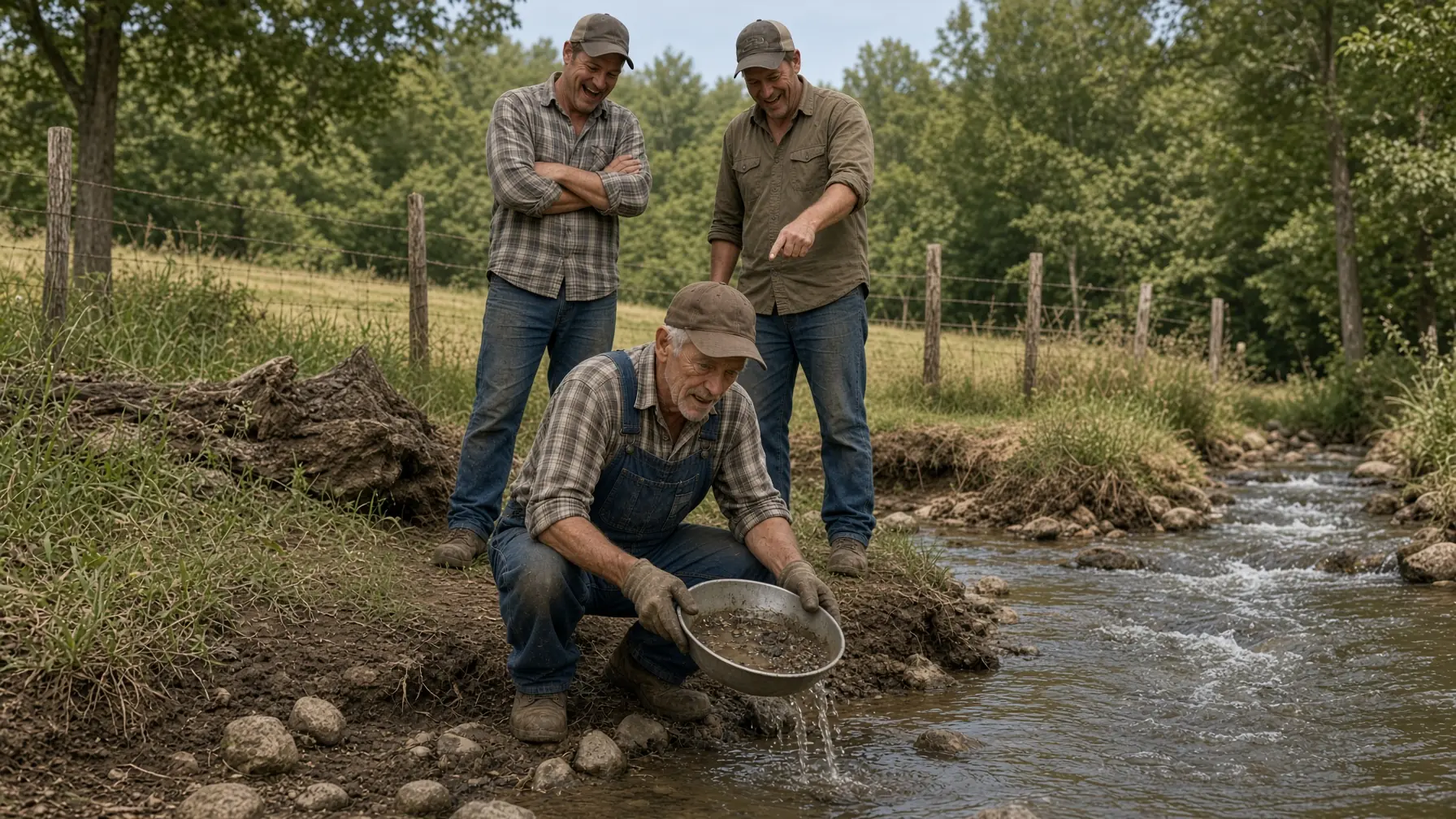
Tom Avery’s voice carried across the shallow water before Henry Cole bothered looking up.
Henry remained crouched beside the muddy bank, one boot planted on a flat stone and the other half sunk into wet sand.
In his hands was an old steel pan.
Nothing special.
No polished prospecting equipment.
No expensive sluice.
Just a dented pan Henry had found hanging behind the machine shed three days earlier.
Inside it sat a mixture of muddy water, black sand, pale gravel, and tiny broken pieces of creek stone.
Tom stopped several feet behind him.
His neighbor Russell Grant came with him.
Both men had apparently been repairing the fence between their properties when curiosity brought them down the hill.
Russell looked at Henry’s pan and laughed.
“Let him be.”
He kicked lightly at the mud.
“Old men need hobbies when the land stops talking back.”
Henry still did not turn around.
He dipped the pan into the creek.
Lifted it.
Shook once.
Then let the lighter material wash over the rim.
Tom folded his arms.
“How many afternoons you planning to waste down here?”
Henry tilted the pan again.
“It never stopped talking.”
Tom frowned.
“What?”
“The land.”
Henry gave the pan another careful shake.
“It never stopped talking.”
Russell smirked.
“Then what exactly did it just say?”
Henry stopped.
Something at the bottom of the pan had caught the light.
Not white.
Not silver.
Yellow.
Sharp.
Small.
But unmistakably different from every other grain surrounding it.
Henry tipped the pan once more.
The muddy water thinned.
Black sand gathered along one edge.
The yellow remained.
He reached down with one gloved finger.
Touched it.
It did not crumble.
Did not smear.
Did not change color.
Tom’s smile disappeared slightly.
Henry stared at the tiny piece.
Then looked toward the creek bank.
“It said I should’ve checked this bank years ago.”
Russell stepped closer.
“What is that?”
Henry did not answer.
Tom crouched.
“You think that's gold?”
Henry looked at him.
“I think I’m not saying anything until I know.”
Russell laughed again, but less confidently now.
“Gold.”
He shook his head.
“In Kentucky pasture creek.”
Henry looked back toward the pan.
“Didn't say Kentucky.”
Tom blinked.
“What?”
Henry smiled faintly.
“You've been calling my place Kentucky dirt for twenty years.”
Russell frowned.
“This is Tennessee.”
“Exactly.”
Tom rolled his eyes.
“You know what he means.”
Henry did.
They were in the eastern edge of Tennessee hill country, on a farm that had belonged to Henry’s family for nearly a century.
Not famous mining country.
Not somewhere men arrived with dredges and dreams.
It was pasture.
Corn.
Hay.
Cattle.
Clay soil.
Limestone.
Creeks that ran hard after storms and nearly disappeared during drought.
Henry had never once thought of the property as mineral land.
Until three days earlier.
That was when he repaired a collapsed section of fencing near the creek.
The old post hole exposed a band of unusually dark gravel beneath the clay.
Mixed through it were heavy black grains that stayed behind when rain washed everything else downhill.
Henry noticed because the pattern reminded him of something his father used to do.
Not mining.
Fishing sinkers.
Henry’s father, Samuel Cole, had once shown him how heavier materials settled behind rocks when current slowed.
“If you ever want to know where the heavy stuff goes,” Samuel had said, “watch where the water gets tired.”
Henry had been ten.
He remembered the sentence because it sounded foolish.
Water did not get tired.
Years later, he understood.
Current changed.
Heavy material settled.
Three days after finding the dark gravel, Henry took the old pan to the creek.
The first two attempts produced nothing.
Third, nothing.
Fourth, a piece of yellow mica that broke apart beneath his thumbnail.
Fifth, more black sand.
Now, on the seventh pan, something different sat in the bottom.
Tom reached toward it.
Henry pulled the pan away.
“Don't.”
Tom raised both hands.
“All right.”
Russell asked:
“What now?”
Henry looked uphill.