The first thing Clara Lynwood heard when she stepped onto the wooden platform at Red Hollow was laughter.
Not a polite chuckle.
Not nervous amusement.
It was the unmistakable sound of strangers deciding that another human being existed for their entertainment.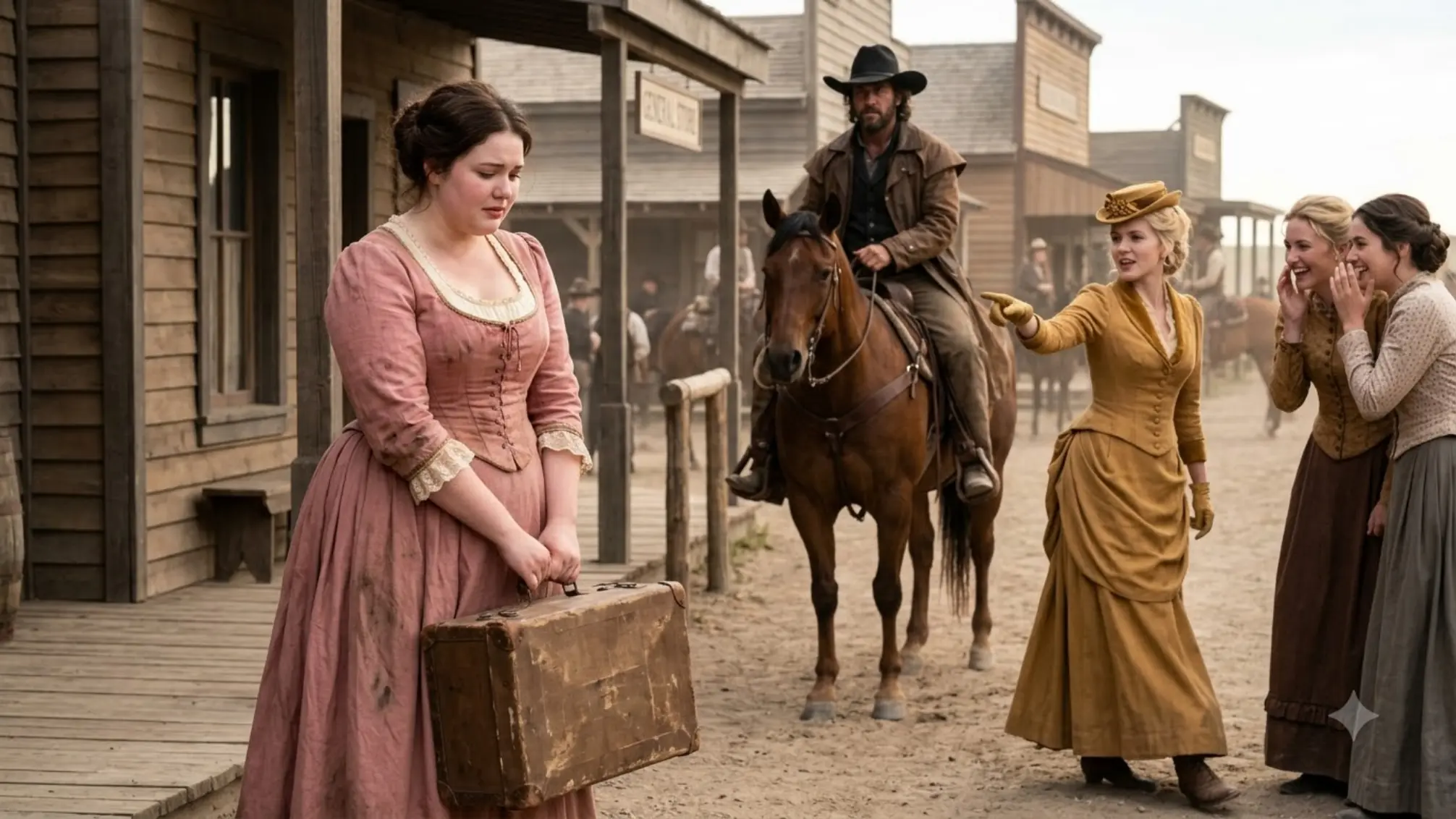
Clara stopped with one hand gripping the rail of the train car. Dust moved across the station platform beneath a merciless September sun, catching against the hem of the dusty-pink traveling dress she had worn for three exhausting days. Her dark-brown hair had begun the journey pinned neatly beneath her bonnet, but the heat and movement had loosened several curls around her soft round face.
Every pair of eyes seemed fixed on her.
Clara had spent twenty-four years learning what those looks meant.
Back in Philadelphia, she had learned to notice the glance that began at her face and slowly traveled downward. She knew the whisper hidden behind a fan, the sympathetic smile of an aunt, the cruel amusement of young men who assumed a large woman should feel grateful for any attention at all.
She had promised herself Red Hollow would be different.
That was why the laughter hurt so much.
Three young women stood near the edge of the street.
The loudest wore a mustard-yellow dress far too fine for an afternoon spent near a dusty railway station. She was blonde, slender, and beautiful in the conventional way Clara had been taught since childhood that she was not.
The woman pointed.
“So that’s her?”
Her friends laughed.
Clara kept her eyes lowered.
The blonde woman moved closer.
“You really crossed half the country thinking Ezekiel Boone would marry you?”
Clara’s fingers tightened around the handle of her battered brown trunk.
“I came because he asked me to.”
That made them laugh harder.
Another young woman covered her mouth.
“Maybe he didn’t know what he was getting.”
Clara’s cheeks burned.
She had written honestly.
At least she believed she had.
She had told Ezekiel that she was not delicate, not fashionable, and certainly not the kind of woman men usually turned around to admire on Philadelphia sidewalks. She had described herself as sturdy, capable, and accustomed to work.
He had answered that he wanted exactly that.
I need a wife who can work beside me, not decorate a parlor.
That sentence had convinced Clara to buy the ticket.
Now she wondered whether she had misunderstood everything.
The blonde woman took another step.
“You poor thing.”
The false sympathy was worse than outright cruelty.
“You should have stayed back east. Men out here need women who can ride, work, and keep up.”
Clara swallowed.
“I can work.”
The blonde’s smile widened.
“I’m sure you can.”
More laughter.
Clara looked toward the street.
Where was Ezekiel?
What if he had seen her through the station window and changed his mind?
What if the entire correspondence had been somebody’s joke?
Her eyes burned.
She refused to cry.
Not here.
Not for them.
The blonde woman pointed toward Clara’s trunk.
“You planning to drag that all the way to Boone Ranch yourself?”
Then a horse appeared at the far end of the street.
At first nobody noticed.
The rider moved slowly through the dust, his broad silhouette outlined against the late-afternoon sun. He wore a black frontier hat pulled low, a weathered brown leather coat, dark shirt, worn trousers, and boots carrying the pale dust of miles spent outside town.
The horse was a powerful brown gelding.
The man riding him was Ezekiel Boone.
Clara recognized him before anyone said his name.
His letters had never included a photograph, but there was something unmistakable about the way he occupied the saddle.
Quiet.
Controlled.
Unhurried.
The laughter continued until Ezekiel was close enough to hear every word.
His dark eyes moved from the laughing women to Clara.
He saw the way she gripped the trunk.
Saw the downward tilt of her face.
Saw the effort she was making not to cry.
Something changed in his expression.
The blonde woman finally noticed him.
“Ezekiel!”
Her voice became suddenly sweet.
“We were just meeting your bride.”
Ezekiel brought his horse to a stop.
Nobody spoke.
He dismounted.
The silence traveled outward until even people standing near the general store began watching.
Ezekiel walked toward Clara.
He did not look at the women.
That somehow embarrassed them more than anger would have.
He stopped directly in front of Clara and removed his hat.
“Clara Lynwood?”
She looked up.
“Yes.”
His face was rougher than she had imagined, shaped by weather and hard work. Dark hair curled against his collar. A scar crossed one eyebrow, and several days of beard shadow darkened his jaw.
But his eyes were gentle.
“I’m Ezekiel.”
“I know.”
Her voice almost broke.
He looked at her trunk.
“May I?”
Clara hesitated.
Then released the handle.
Ezekiel lifted the heavy trunk with both hands.
The blonde woman laughed nervously.
“Well, Ezekiel, we were simply wondering whether Miss Lynwood understood what ranch life requires.”
He finally looked at her.
“Did she ask you?”
The woman blinked.
“No.”
“Then why are you explaining it?”
Her smile vanished.
“We were only trying to help.”
Ezekiel looked toward Clara.
“Did they help?”
Clara surprised herself.
“No.”
His eyes returned to the women.
“Then we’re finished.”
He turned away.
The blonde’s face reddened.
“You can’t seriously mean to marry her.”
Ezekiel stopped.
The street seemed to hold its breath.
He slowly looked back.
“I rode here to collect my future wife.”
The woman crossed her arms.
“You haven’t even seen what she looks like until today.”
“I see her.”
The answer was simple.
Clara’s throat tightened.
The blonde scoffed.
“Ezekiel, people will talk.”
“They already do.”
He faced Clara again.
“They’re not coming home with us.”
That word settled over her.
Us.
Clara whispered, “They think you’ll regret this.”
Ezekiel looked directly into her eyes.
“I’ve regretted plenty of things.”
He took the trunk in one hand and extended the other.
“Coming here to meet you isn’t one of them.”
Clara stared at his hand.
Nobody had offered her dignity that day.
Not the conductor.
Not the station crowd.
Not the women who stood pointing.
This hard, quiet stranger simply stood there waiting.
Clara placed her hand in his.
His fingers closed gently around hers.
The women fell silent.
Ezekiel walked beside Clara toward his wagon, carrying the trunk himself.
Only when they had nearly reached it did Clara whisper, “Thank you.”
“For what?”
“For not laughing.”
Ezekiel stopped.
His expression hardened.
“You shouldn’t have to thank a man for basic decency.”
Clara looked away.
“In my experience, sometimes you do.”
He studied her for several seconds.
Then he lifted the trunk into the wagon bed.
“Your experience is going to change.”
Clara wanted desperately to believe him.
The ride toward Boone Ranch took almost an hour.
Red Hollow disappeared behind them, replaced by rolling grassland, scattered pine, and distant mountains beginning to glow beneath the lowering sun.
Clara sat with her hands folded tightly in her lap.
Ezekiel drove without speaking.
She wondered whether the silence meant disappointment.
Finally she could no longer stand it.
“Have you changed your mind?”
Ezekiel glanced toward her.
“About what?”
“Me.”
“No.”
The answer came so quickly that Clara almost laughed.
“You didn’t think about it.”
“I thought for four months.”
“You hadn’t seen me.”
“I read twelve letters.”
“That isn’t the same.”
“No.”
He pulled gently on the reins as they crossed a rough patch.
“But your letters told me more than somebody’s face would.”
Clara stared ahead.
“You wrote that you wanted someone strong.”
“I did.”
“And you think I am?”
Ezekiel’s eyes moved toward her hands.
“You traveled three days alone to marry a stranger in Montana.”
He looked at her.
“You stood on that platform while half the town behaved like fools and didn’t run back onto the train.”
His mouth almost formed a smile.
“I’d say you’re doing pretty well.”
Something inside Clara loosened.
They traveled another mile.
Then Ezekiel surprised her by stopping the wagon.
He turned toward her.
“I should tell you something before we reach the ranch.”
Clara’s stomach tightened.
“What?”
“I’m not good at talking.”
She blinked.
“That’s the warning?”
“It’s one of them.”
Despite herself, she smiled.
Ezekiel continued.
“I work too much. Forget meals. Leave tools where they shouldn’t be. I’ve spent most of the last eight years alone except for ranch hands and Sarah.”
“Sarah?”
“Widow who lives on the property. Helps with cooking. She’ll teach you whatever I can’t.”
“That sounds like most things involving a kitchen.”
Ezekiel almost smiled.
“Probably.”
He became serious again.
“And I’m not looking for a woman who pretends life here is easy.”
“I don’t expect easy.”
“You may hate it.”
“Then I’ll hate it honestly.”
That made him laugh.
It was quiet but real.
Clara realized she liked the sound.
Ezekiel released the brake.
The wagon moved again.
When they crested the final hill, Boone Ranch appeared below.
It was not impressive.
A weathered house sat near a barn surrounded by fencing. Chickens wandered through the yard. A narrow creek cut through a distant pasture. Smoke rose from a smaller cabin near the trees.
Clara stared.
Ezekiel waited.
He had seen other women react to isolation.
One had cried immediately.
Another had asked how far town was and requested to be taken back before sunset.
Clara examined everything for almost a minute.
Then she said, “The porch leans.”
Ezekiel looked at it.
“A little.”
“The barn roof needs work.”
“Yes.”
“That fence is missing two rails.”
“I know.”
She pointed toward the garden.
“Who planted those beans?”
“Sarah.”
Clara nodded thoughtfully.
“We’ll need more storage before winter.”
Ezekiel stared at her.
She looked over.
“What?”
“You’re planning.”
“Was I supposed to faint?”
“I don’t know.”
“Well, I don’t intend to.”
The wagon rolled downhill.
Sarah met them in the yard.
She was somewhere past fifty, thin, sharp-eyed, and dressed in an apron that looked as though it had survived several wars.
She studied Clara.
“You cook?”
“Yes.”
“Bread?”
“Yes.”
“Preserves?”
“Some.”
“Ride?”
Clara hesitated.
“Once.”
Sarah nodded.
“We’ll fix that.”
No laughter.
No pity.
Just evaluation.
Clara liked her immediately.
The first week nearly defeated her.
She woke before dawn.
Learned the temperament of a stove that seemed personally offended by eastern women.
Hauling water left her shoulders aching.
The chickens attacked her ankles.
Her first batch of biscuits could have been used as ammunition.
Sarah held one up.
“What is this?”
“A biscuit.”
“Against who?”
Clara glared.
Sarah smiled.
“Good. You’ve got temper. Use it on the dough.”
Slowly, Clara improved.
She learned the stove.
Learned which hens would peck.
Learned how Ezekiel liked his coffee.
Learned that he would forget lunch unless somebody physically put food in his hand.
Ezekiel began noticing her progress.
On the eighth morning, he ate half his breakfast before looking up.
“This is good.”
Clara nearly dropped the coffee pot.
“What?”
“The biscuits.”
She stared.
“You’ve eaten seven days of them without comment.”
“They weren’t good.”
Clara gasped.
Ezekiel’s eyes showed amusement.
“You could have told me.”
“Sarah already was.”
“You heard her?”
“Whole county heard her.”
Clara laughed.
The sound filled the small kitchen.
Ezekiel watched her.
Something moved quietly between them.
Neither mentioned it.
The following morning, Clara asked him to teach her to ride.
Ezekiel saddled Birdie, an old mare so patient she seemed offended by movement.
Clara attempted to mount.
Failed.
Tried again.
Failed worse.
On the third attempt she somehow ended hanging sideways from the saddle.
Ezekiel tried not to laugh.
Clara saw him.
“Don’t.”
“I didn’t say anything.”
“Your face did.”
“I can fix my face.”
“I doubt it.”
He helped her upright.
His hands settled briefly around her waist.
They both froze.
Clara’s face warmed.
Ezekiel stepped back immediately.
“Sorry.”
She adjusted her dress.
“You were keeping me from falling.”
“Yes.”
“That doesn’t require an apology.”
Their eyes met.
Neither spoke for a moment.
Then Sarah shouted from across the yard, “If you two are done staring, the horse is getting bored.”
Clara nearly died of embarrassment.
Ezekiel turned away smiling.
By the end of the month, she could ride without assistance.
By then the town’s laughter had become distant.
But trouble had not disappeared.
It arrived wearing polished boots and a charming smile.
Victor Boone was Ezekiel’s younger brother.
Where Ezekiel was rough, Victor was immaculate. His shirts were clean, his hair slicked perfectly, and his hands lacked the marks of hard ranch work.
He appeared one afternoon while Ezekiel was checking the north pasture.
Clara was hanging laundry.
“Mrs. Boone.”
Clara turned.
“We aren’t married yet.”
“Soon enough.”
Victor approached.
“I wanted to see how you were settling.”
“Fine.”
“Really?”
His eyes moved across the ranch.
“This place can be difficult.”
“I’ve noticed.”
“And my brother doesn’t make anything easier.”
Clara remained silent.
Victor continued.
“He’s proud.”
“So people keep telling me.”
“Pride is expensive.”
He lowered his voice.
“This ranch is struggling.”
Clara’s attention sharpened.
“Struggling how?”
“Last winter nearly broke it.”
“He didn’t mention that.”
“Of course not.”
Victor smiled.
“He wouldn’t want his future wife knowing she arrived aboard a sinking ship.”
Clara felt doubt enter her.
Victor saw it.
He continued.
“I’m only telling you because you deserve honesty.”
Sarah’s voice suddenly came from behind.
“Get away from her.”
Victor turned.
“Sarah.”
“Go poison somebody else.”
“I’m talking.”
“You’re slithering.”
His smile tightened.
Sarah moved between him and Clara.
“Go.”
Victor looked toward Clara.
“Ask Ezekiel about the books.”
Then he mounted his horse and left.
That evening Clara did exactly that.
Ezekiel sat across the table listening as she repeated Victor’s claims.
His jaw hardened.
“You believed him?”
“I don’t know you well enough yet to know who to believe.”
That hurt.
Clara saw it.
But Ezekiel did not become angry.
Instead, he stood.
“Wait.”
He returned carrying three large ledgers.
He placed them on the table.
“Then don’t believe anybody.”
Clara looked at the books.
“Read.”
For two hours, they examined every figure.
Victor had exaggerated.
The ranch was not wealthy, but neither was it failing.
Clara noticed something else.
“You’re carrying land you barely use.”
Ezekiel frowned.
“Where?”
“The rocky section north.”
“That was my father’s.”
“It’s still yours.”
“Yes.”
“And sentiment doesn’t feed cattle.”
He stared at her.
Clara expected anger.
Instead he laughed.
“You’ve been here three weeks and already started selling my ranch.”
“Our ranch eventually.”
The word stopped him.
Clara stopped too.
Their eyes met.
Ezekiel spoke quietly.
“Yes.”
“Our ranch.”
Thirteen days later, they married before a traveling judge.
The ceremony lasted minutes.
Sarah witnessed.
A ranch hand signed the paper.
Then everyone inconveniently disappeared, leaving Clara and Ezekiel standing alone.
Ezekiel cleared his throat.
“Well.”
Clara smiled.
“That was romantic.”
“I warned you.”
“You did.”
That night they shared the bedroom for the first time.
Nothing dramatic happened.
They lay beneath the blankets with nearly a foot of careful distance between them.
Neither slept.
Finally Ezekiel whispered, “You nervous?”
“No.”
“You’re breathing like a rabbit.”
Clara sighed.
“This is strange.”
“Yes.”
“We’re married.”
“Yes.”
“And we barely know what to say to each other.”
“Also yes.”
She laughed softly.
Ezekiel turned toward her.
“We’ll learn.”
Clara looked at him through the darkness.
“Together?”
“Together.”
That became their marriage.
Not sudden passion.
Not perfect romance.
Learning.
Work.
Patience.
Then came the accident.
In October, while checking fence alone, Clara’s horse spooked suddenly.
She fell hard.
Pain shot through her leg.
She could not stand.
Ezekiel found her and brought her home after carefully stabilizing the injury.
The doctor confirmed a clean break.
She would recover.
But somebody in town saw Ezekiel carrying Clara from the wagon with her damaged dress gathered away from the injured leg.
By the following morning, the truth had changed.
By afternoon, Victor had transformed an accident into scandal.
He suggested Ezekiel had behaved improperly.
People whispered.
The same town that had laughed when Clara arrived now eagerly invented another reason to judge her.
Ezekiel was furious.
Clara was worse.
“This ends now.”
She refused to hide.
When Red Hollow held a public meeting, Clara attended despite her injured leg.
She entered leaning on a crutch.
Victor stood near the front wearing his concerned expression.
He spoke first.
“It pains me to discuss family matters publicly.”
Clara almost laughed.
Victor described the accident through implication rather than accusation.
He spoke about propriety.
Standards.
Reputation.
Then Ezekiel stood.
“You want to accuse me of something?”
Victor raised his hands.
“I simply want clarity.”
Clara rose.
Every head turned.
“You want clarity?”
Her voice carried farther than she expected.
“I fell from a horse.”
She described everything.
The frightened animal.
The broken leg.
Ezekiel finding her.
The emergency splint.
The doctor.
Then she looked directly at Victor.
“My husband saved me.”
Silence.
“And you turned that into something ugly because you hate that your brother has a life you cannot control.”
Victor’s face changed.
“Careful.”
“No.”
Clara stepped forward on the crutch.
“You were careful. That’s how you’ve hidden yourself.”
Murmurs filled the hall.
She continued.
“You came to our ranch while Ezekiel was gone. Told me lies about money. Tried to make me afraid.”
“I was helping.”
“You were hoping I would leave.”
Victor’s expression cracked.
Clara saw it.
“So that’s it.”
“What?”
“You expected me to be weak.”
Victor laughed bitterly.
“Look at you.”
The insult escaped before he could stop it.
The room became still.
Clara smiled.
“There you are.”
Victor realized too late.
Clara continued.
“The concerned brother disappeared.”
People began watching him differently.
Ezekiel moved beside Clara.
Victor stared at them.
His anger finally broke through.
“You think this lasts?”
He pointed toward Clara.
“She is a desperate woman who crossed half the country because nobody else wanted her!”
Silence.
Clara felt the old wound open.
Philadelphia.
The station.
The laughter.
Then Ezekiel stepped forward.
“I wanted her.”
Victor stopped.
Ezekiel looked at Clara rather than his brother.
“I still do.”
Clara’s eyes filled.
Ezekiel faced the room.
“She came here when every reason told her not to.”
He nodded toward her crutch.
“She fell and got back up.”
Then toward Victor.
“She stood in front of every person who laughed at her and refused to become what they said she was.”
His voice softened.
“I don’t know what you people call beauty.”
He took Clara’s hand.
“But that’s what I call it.”
No one laughed now.
Not one person.
Victor left Red Hollow weeks later.
His reputation had collapsed beneath the weight of his own bitterness.
The marriage he tried to destroy became stronger.
Clara healed slowly.
Ezekiel sold the rocky northern acreage just as she had suggested.
The money gave them breathing room.
Winter came.
They survived together.
During one snowstorm, Ezekiel returned after dark nearly frozen from moving cattle into sheltered ground.
Clara met him with coffee and whiskey.
“You were worried,” he said.
“Of course.”
He looked almost pleased.
“Why?”
“Because you're my husband.”
As though that explained everything.
Perhaps it did.
Their marriage changed through that winter.
One night, Clara found Ezekiel sitting beside the bedroom window unable to sleep.
She sat beside him.
“You still waiting for something bad?”
“Yes.”
“So am I.”
He looked at her.
“You?”
“Every day.”
“You never act scared.”
“I act despite being scared.”
Clara took his rough hand.
“That is different.”
Ezekiel looked down at their joined fingers.
“You make me want things I stopped expecting.”
“Like what?”
“A future.”
Clara’s heart tightened.
She leaned closer.
“You already have one.”
“With you?”
“If you want it.”
He touched her cheek.
“I do.”
Their first true kiss came slowly.
Neither needed to rush.
They had spent months learning each other through labor, fear, arguments, meals, ledgers, storms, and quiet mornings.
The affection had already been built.
The kiss merely admitted it.
Spring arrived.
Then another surprise.
Clara discovered she was carrying their child.
She told Ezekiel after supper.
He froze.
“You’re sure?”
“Yes.”
“How do you feel?”
“Terrified.”
He exhaled.
“Good.”
Clara stared.
“Good?”
“Because I’m terrified too.”
She laughed.
Ezekiel knelt beside her.
His hand hovered over her stomach.
“May I?”
Clara placed it there.
Months later, he felt the baby kick for the first time.
His expression transformed.
“That’s our child.”
Clara smiled.
“Yes.”
Ezekiel kept his hand there for almost a minute.
“Our child.”
Hope Boone arrived in October.
She screamed immediately.
Ezekiel cried almost as quickly.
Clara pretended not to notice until she realized she was crying too.
They named the baby Hope because nothing else seemed more appropriate.
Years passed.
The Boone Ranch grew.
Clara took over the books and proved far better with numbers than Ezekiel.
He handled cattle and land.
She negotiated sales.
Together they expanded.
The people of Red Hollow who once mocked Clara gradually learned to seek her advice.
Some apologized.
Others simply changed their behavior.
Clara accepted both without forgetting.
Another child followed.
Then another.
The farmhouse expanded.
So did the family.
One evening years later, Clara stood outside watching Hope ride an old mare around the corral while Ezekiel leaned against the fence.
His beard had begun turning silver.
Clara’s injured leg still bothered her before storms.
Ezekiel looked toward her.
“You remember the station?”
“I try not to.”
“I do.”
“Why?”
He smiled.
“Because that’s the day I met the bravest woman I know.”
Clara laughed.
“I was trying not to cry.”
“Bravery isn’t not crying.”
He approached.
“It’s staying when people give you every reason to disappear.”
Clara rested her hands on his chest.
“Why did you choose me that day?”
“I didn’t.”
She frowned.
Ezekiel smiled.
“I chose you through the letters.”
His arms settled around her.
“At the station, I simply finally got to meet you.”
Clara looked toward the distant town.
“Those women thought you’d be embarrassed.”
“I was.”
She looked up sharply.
“By them.”
Clara smiled.
Ezekiel kissed her forehead.
Years later, when their children asked how their parents met, Ezekiel always told the story the same way.
He did not begin with the cruelty.
He began with a train arriving under a September sun.
He described a woman stepping down alone after traveling across half a continent because she had decided hope was worth the risk.
Then he told them about walking through a crowd and offering her his hand.
Hope once interrupted.
“Was Mama scared?”
Ezekiel looked toward Clara.
“Yes.”
Clara smiled.
“Terrified.”
“Then why did you go with Papa?”
Clara considered the question.
Because the answer was larger than romance.
Larger than Ezekiel.
Larger even than Montana.
She had spent years allowing other people to tell her what kind of life she deserved.
That day she finally stopped.
“I went with him,” Clara said, “because for the first time, someone looked at me without asking me to become smaller.”
Ezekiel reached across the table and took her hand.
Clara squeezed his fingers.
“And after that,” she continued, “I decided I would never make myself smaller for anyone again.”
That became the lesson their children remembered.
Not that cruel people disappeared.
They did not.
Not that hardship ended after love arrived.
It did not.
The lesson was that worth did not begin when someone else recognized it.
Clara had always possessed strength.
Ezekiel had simply been the first man to look long enough to see it.
And the town that once pointed at her learned something too.
The woman they had dismissed at the railway station became a rancher, businesswoman, wife, mother, and one of the most respected voices in Red Hollow.
The dusty-pink dress eventually wore out.
The battered trunk remained.
Clara kept it beneath the bedroom window for decades.
Whenever she looked at it, she remembered the frightened young woman gripping its handle while strangers laughed.
Then she remembered a horse coming down the street.
A quiet man dismounting.
A hand extended toward her.
And the four words that changed everything.
I came for you.