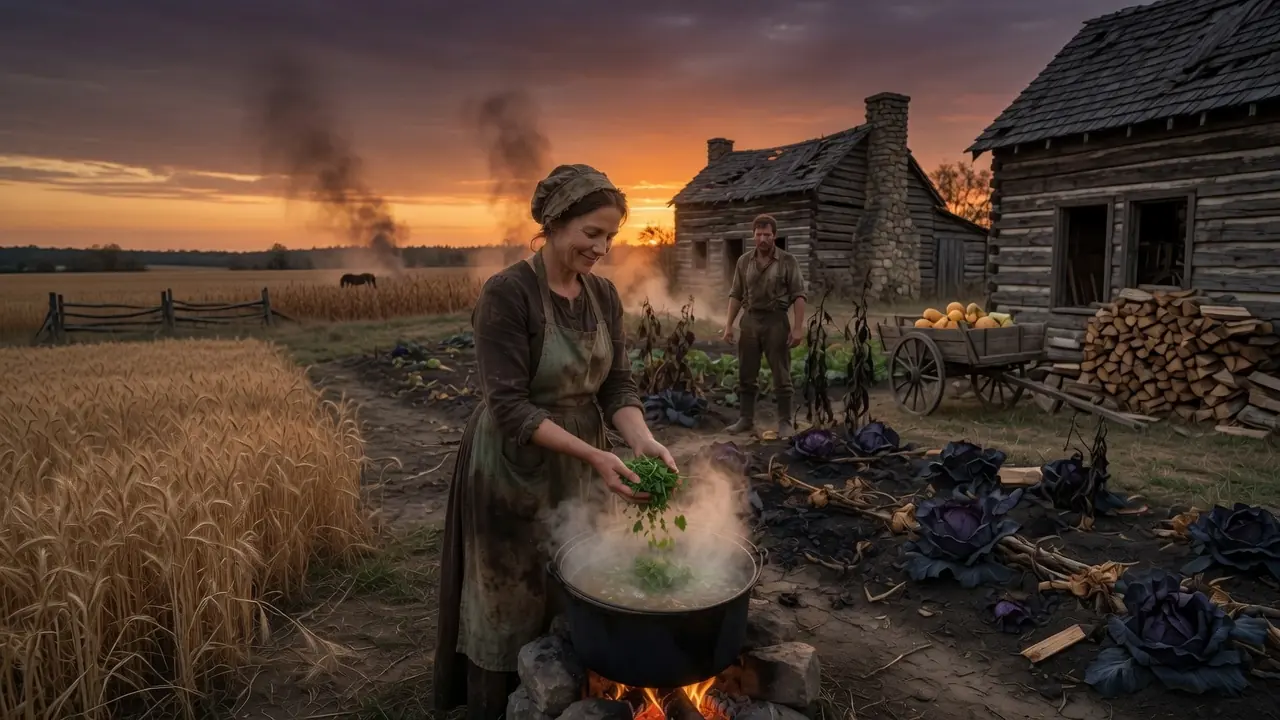
The evening sun burned low over Ash Hollow, turning the ruined fields the color of old copper. Clara Ashborne stood beside a black iron pot outside the cabin, dropping handfuls of wild greens into the boiling broth while steam curled around her face. Behind her, Elias stood in the garden with his hat hanging from one hand, staring at the cabbage rows he had planted with such pride. They were gone now, chewed down to black ribs by the beetles that had crossed the valley like a living storm.
For three full minutes, Elias did not speak. He only looked from the dead garden to his wife’s steaming pot, then back again, as if the world had rearranged itself while he was not watching. The potato rows were stripped clean, the beans hung like brown thread from their poles, and the squash vines lay flat against the dirt. But beside the creek fence, where Clara had gathered lamb’s quarters, nettles, purslane, and wild onions for years, the green things still stood untouched.
“Clara,” Elias said at last, his voice rough. “The beetles ate everything I planted.”
Clara did not turn around right away. She stirred the pot once, slowly, letting the wild onions rise through the broth. Her broad hands moved with the calm certainty of someone who had not been surprised by the disaster, only saddened by it. Then she looked over her shoulder and said, “Not everything, Elias. Only what men were proud of.”
The words struck him harder than anger would have. Elias looked down at his boots, sunk deep in the ruined soil, and felt shame climb up his throat. He had laughed too, not loudly, not cruelly like the women at church or the men outside the feed store, but quietly enough for Clara to hear. He had called her creek-bank food “weeds” because the neighbors did, and because a farmer wanted a wife who tended proper rows, not one who wandered through ditches with a basket on her arm.
Clara had never answered their mockery with much. She simply kept walking to the creek before sunrise, kept coming home with baskets full of green things Elias could not name. She dried some from the rafters, salted others in crocks, and cooked them into soups that smelled better than he expected. Still, when Mildred Boone said Clara looked like a lazy woman avoiding the garden, Elias had felt the sting of embarrassment before he felt the need to defend his wife.
That was what hurt him now. Not just the ruined crop, though the loss of it sat in his chest like a stone. What hurt was realizing Clara had been reading the land while he had been reading the neighbors’ faces. She had watched the toads disappear from the creek bed, heard the birds go quiet, noticed which plants the insects refused to touch. He had noticed only whether his rows looked straight enough for other men to admire.
Two weeks earlier, Clara had tried to warn him without saying the warning outright. “The creek is too quiet,” she had told him one morning, standing in the kitchen doorway with her basket on her hip. Elias had been oiling a hinge on the barn door, thinking about a broken plow tooth and a neighbor who had promised to lend him a mule team. “Creeks don’t talk, Clara,” he had said, and she had only looked at him for a long moment before walking away.
Now the silence of that morning came back to him. The creek had been quiet. The birds had disappeared from the fence line. Even the chickens had stayed close to the coop, scratching nervously in the dust while the valley held its breath. Clara had seen all of it, and no one had cared because the woman seeing it was the same woman they had already decided was foolish.
The first swarm arrived before noon. It came from the east, a dark crawling wave that made the field seem to move. Elias had run into the garden with a shovel, then a broom, then his bare hands, trying to beat back something that had no edge and no fear. By afternoon, every planted row on the Ashborne farm was stripped, and smoke rose from three neighboring fields where men had tried burning beetles out of the soil.
By sunset, the entire valley knew. Frank Henderson’s cabbages were gone. Ruth Henderson’s bean trellis stood empty. The Marsh family’s potatoes had vanished under the black shine of moving bodies. Every proud kitchen garden in Ash Hollow, every row that had been praised from the church steps and compared over fence lines, had been eaten down to dirt.
Only the wild things remained.
Clara lifted a wooden spoon and tasted the broth. “Needs salt,” she said.
“I’m not calm,” she said. “I’m working.”
That answer shamed him again, because he had mistaken her steadiness for indifference. Clara was not untouched by the ruin around them. Her face was tired, her hair had fallen loose from its knot, and her apron was stained from the greens she had washed in the creek. But while the valley panicked, she had done the one thing she had trained herself to do for years: she had found what could still feed people.
He stepped closer to the pot. The smell rose toward him, rich and earthy, carrying wild onion, nettle, and something lemon-sharp from the purslane. His stomach tightened, not from hunger alone, but from the memory of every time he had pushed away a bowl like this and asked if there was anything “real” to eat. Clara saw his face and turned back to the fire.
“You can say it,” she said.
Elias swallowed. “Say what?”
“That you laughed at this food while I was saving us.”
His mouth opened, then closed. There was no defense that did not make him smaller. The ruined garden behind him answered for her better than he could. Finally, Elias removed his hat completely and held it against his chest.
“I did,” he said. “I laughed because I was ashamed of what I didn’t understand.”
Clara’s hand paused on the spoon. It was the first honest sentence he had offered her in a long time. Not perfect, not enough, but honest. She looked at him, and for once he did not look away.
“Then eat first,” she said, lifting a bowl from the stump beside the fire. “And apologize after the valley survives.”
He took the bowl with both hands. The broth burned his fingers through the tin, but he did not complain. He ate standing beside the ruined garden while the sun dropped behind the ridge, and the first taste stopped him completely. It was not grass, not ditch water, not humiliation boiled into a pot. It was food, deep and warm, better than most suppers he had eaten from the respectable rows now lying dead behind him.
Clara watched him take the second spoonful. She did not smile. That almost made it harder. If she had gloated, Elias could have braced against it, but she gave him no easy enemy. Her face only carried the tired patience of a woman who had waited too long to be believed.
By full dark, the first neighbor came. Ruth Henderson appeared at the edge of the yard with two children clinging to her skirt and an empty flour sack twisted in her hands. Her face was pale beneath the dust, and her eyes moved from the dead garden to Clara’s steaming pot. Behind her, ten-year-old George stared at the bowl in Elias’s hands.
“Clara,” Ruth said, voice thin. “Frank says we still have oats enough for a week, maybe two. But the children saw the garden.” She stopped, pressing her lips together because fear had made speech difficult. “They know.”
Clara wiped her hands on her apron. “Bring them closer.”
Ruth hesitated, pride still fighting hunger even with her children beside her. The whole valley had mocked Clara, but Ruth had laughed too, especially when Mildred called the creek bank Clara’s “second pantry of nonsense.” Now Ruth stood in the yard like a woman who had walked barefoot over her own shame to get there.
Clara reached for another bowl. “I said bring them closer, Ruth. Children should not have to wait while grown people decide whether pride is edible.”
That broke something in Ruth’s face. She guided the children forward, and Clara filled their bowls first. George sniffed the broth suspiciously, then tasted it and looked startled in spite of himself. His little sister ate without questions, because small children were wiser than adults when hunger sat near them.
Ruth accepted her bowl last. Her hands trembled around it. “Is it really safe?”
Clara looked at her steadily. “I have eaten these plants since before I married Elias. I know what I picked, where it grew, and what not to touch.” Her voice softened slightly. “I will teach you, if you are willing to learn.”
Ruth lowered her eyes. “I’m willing.”
The next morning, Ruth came back with all four Henderson children. Clara took them to the creek bank while Elias followed at a distance, carrying baskets and saying little. The valley still smelled of crushed leaves and beetle musk, and every garden they passed looked wounded. But along the creek, the wild food grew thick in the neglected places, as if it had been waiting for someone to stop calling it worthless.
Clara knelt in the gravel and showed them purslane first. “Round leaves, reddish stems, sour taste,” she said, pinching a piece between her fingers. “This one is easy to know. If you are hungry, easy matters.”
George crouched beside her. “It grows all over our fence line.”
“Yes.”
“My pa pulls it up every spring.”
“Most men pull up what they don’t know how to use.”
Elias heard that from behind her and felt it land exactly where it should. He said nothing, but when Clara handed him a bundle, he placed it gently into the basket instead of tossing it aside. Ruth noticed. So did Clara, though she did not turn to acknowledge it.
By the end of the week, three more women had come. By the end of the second, there were eight families walking the creek banks in the mornings. Clara taught them lamb’s quarters, wild onion, nettles, and watercress. She showed them how to harvest without destroying the root, how to dry leaves over rafters, how to salt purslane in crocks, and how to cook nettles long enough to take the sting out.
The children learned fastest. They did not carry the same shame adults did. They loved being told the ditch was a pantry, the fence line a shelf, the creek bank a garden no beetle had planted or claimed. George Henderson began mapping patches on scraps of paper, marking where the best wild onions grew and where the nettles came back thicker after careful cutting.
The men were slower.
Frank Henderson stayed away for ten days, sending Ruth and the children while pretending to repair a fence that did not need repair. Bert Marsh said no family of his would eat ditch greens, though his wife came anyway with her shawl pulled over her hair. Others waited to see whether anyone got sick. Pride, Clara learned, could starve quietly for a long time before it knocked.
Elias changed in smaller ways at first. He carried baskets without being asked. He stopped glancing toward Mildred Boone’s upper field. He tasted each soup Clara made and asked what was in it. One evening, after she hung bundles of lamb’s quarters from the rafters, he stood beneath them and said, “Teach me which one is which.”
Clara looked at him for a long moment. “You want to know?”
“Yes.”
“Because you believe me, or because winter is coming?”
Elias lowered his head. “Both. But the first should have come sooner.”
That answer was good enough to begin with. She handed him a bundle of nettles and showed him the serrated edges, the fine hairs, the way the plant lost its sting when handled correctly and cooked well. Elias listened like a man listening to a sermon he had mocked before realizing it might save his soul. Clara taught him without softness, but also without revenge.
By late August, Clara’s kitchen became the busiest place in Ash Hollow. Women came with baskets, children came with questions, and sometimes men stood awkwardly at the door pretending they had only stopped by to speak with Elias. Clara cooked soups, dumplings, greens, and flatbreads stretched with seeds she had dried. Every pot that steamed on her stove weakened one more laugh that had once been aimed at her.
That was when Mildred Boone began to watch.
Mildred had mocked Clara for years from church steps, garden fences, and the communal well. She was a narrow woman with sharp eyes and a voice that could make gossip sound like civic duty. While other families began admitting Clara had been right, Mildred grew colder. It was one thing for Clara to be useful in a crisis; it was another for the valley to start admiring her.
The trouble came when little Thomas Pierce fell sick. He was eleven, feverish, and unable to keep food down for three days. His mother, Delia, was half-mad with worry, and the doctor could not arrive from Dunning until Tuesday. Before anyone knew what had caused the fever, Mildred began whispering that Thomas had eaten something from Clara’s creek lessons.
By Sunday, the rumor had reached Clara’s door. Ruth brought it with a face full of apology and fear. “Mildred says it might have been mushrooms,” she said. “Or the wrong plant. She isn’t naming anything, just saying the timing looks bad.”
Clara set down the bundle she was tying. “Thomas never came to my creek lessons.”
“His sister did.”
“And did his sister bring him mushrooms?”
Ruth looked away. “No one knows.”
“That means no.”
But rumors did not need roots as deep as truth. They only needed enough loose soil to spread. Two families stopped coming the next day. Agnes Morrison returned a crock of pickled purslane, claiming her husband thought they should wait until things were “settled.” By Wednesday, someone had slipped a note under Clara’s door.
Your weeds made the Pierce boy sick. Stop before you hurt another child.
Elias found her standing in the kitchen with the paper in her hand. He read it once, and anger tightened his whole face. “I’ll go to every house in this valley if I have to.”
“And say what?” Clara asked. “That frightened people are being frightened?”
“They’re lying about you.”
“They are looking for a reason the world is cruel,” she said. “I am convenient.”
His anger broke into helplessness. “You have been feeding them.”
“I know.”
“They came to you with empty bowls.”
“I know.”
“And now they repay you with this?”
Clara folded the note carefully. “People who need help do not always become better people while receiving it. Sometimes they become ashamed. Sometimes shame looks for someone else to blame.”
The doctor arrived on Tuesday and ended the medical question in one sentence. Thomas Pierce had summer fever, the same sickness that had passed through the valley two years earlier, following the low drainage near the creek. It had nothing to do with Clara’s food. The boy needed water, rest, and cool cloths; he would recover by Friday.
The truth should have ended everything. It did not.
Truth often arrives slower than suspicion and leaves less noise behind. Some families returned immediately, apologizing with baskets in hand and lowered eyes. Others waited, embarrassed by how quickly they had stepped away. Mildred said less in public, but her silence had edges.
Then Frank Henderson did something no one expected. He stood at the communal well on a crowded Wednesday morning and removed his hat. “My family has eaten Clara Ashborne’s food since the beetles came,” he said, loud enough for everyone drawing water to hear. “My children are healthy because of what she taught them. If any man here doubts her, he can come eat at my table before he lets his pride starve his own blood.”
The well went silent.
Ruth told Clara about it that afternoon, talking so fast she barely breathed. Clara listened with her hands folded in her lap, and when Ruth finished, Clara looked toward the window where Elias was mending a basket on the porch. The man who had once feared neighbors laughing at him had gone out and found another man willing to defend his wife before them.
That night, Clara and Elias ate quietly at the kitchen table. The soup between them was made of nettles, wild onions, and the last of a smoked ham bone. Elias reached across the table and took her hand. His palm was rough, warm, and hesitant.
“I should have stood beside you long before Frank did,” he said.
“Yes,” Clara answered.
He nodded because he deserved no softer reply.
“But you are standing now,” she added.
His fingers tightened around hers. “I am.”
By October, frost silvered the valley, and every family in Ash Hollow counted what they had stored. The respectable gardens had failed, but root cellars now held crocks of salted purslane, bundles of dried lamb’s quarters, sacks of wild seeds, and jars of greens Clara had taught them to preserve. It was not abundance. It was not comfort. But it was survival.
Winter came hard. Snow closed the north road twice, and the creek froze by December. Meals grew thinner, but children still ate. Clara’s teaching kitchen stayed open through the cold months, with women gathering twice a week to learn what could be made from what remained. Elias led men along fence lines when weather allowed, showing them the plants he had once called weeds.
Mildred Boone came to Clara’s door near the end of winter. She stood on the porch with her hands stiff at her sides and her mouth pressed thin. For once, she did not look ready to judge. She looked tired.
“I was wrong,” Mildred said.
Clara waited.
“I was afraid of you,” Mildred continued. “Not because you were dangerous. Because you knew something I didn’t, and people started needing you for it.” Her face tightened. “I said things I should not have said.”
“Yes,” Clara said.
Mildred swallowed. “I am sorry.”
Clara looked past her toward the frozen fields. She thought of the note under the door, the returned crocks, the families who had walked away, and the children who had still needed feeding. Forgiveness was not the same as forgetting. But winter had taught her that carrying bitterness required energy, and energy was better spent on life.
“The knowledge is still here,” Clara said. “If you want to learn, come Tuesday.”
Mildred blinked. “You would teach me?”
“I am not feeding this valley because everyone deserves me,” Clara said. “I am doing it because children deserve supper.”
Mildred lowered her eyes. “Tuesday, then.”
Spring came late but green. The beetles did not return, and the valley replanted its proper gardens with careful hope. But something had changed. Alongside cabbages and potatoes, families now watched fence lines, creek banks, and disturbed soil. Children pointed out lamb’s quarters before their mothers did. Men who had once laughed at ditch greens carried baskets without being told.
One morning in June, Elias found Clara by the creek. She was kneeling near the water, cutting watercress with the same calm hands that had carried them through ruin. The sun rose behind her, lighting the loosened strands of hair around her face. For a moment, Elias simply stood and watched the woman he had married and had taken too long to understand.
Clara looked up. “Are you going to stand there, or help?”
He smiled faintly and came down the bank. “Frank wants you to teach a class for the men next week.”
“The men want a class?”
“They say it’s practical knowledge.”
Clara laughed softly. “That is what they call it now?”
“That is what they call it now.”
She handed him a bunch of watercress. He took it with care, studying it the way she had taught him. The creek moved around their boots, steady and indifferent, carrying sunlight over stones older than the valley’s pride.
“I was ashamed of the wrong thing,” Elias said.
Clara did not answer immediately.
He looked at her. “I was ashamed of people laughing at you. I should have been ashamed that I didn’t know enough to stand beside you.”
This time, Clara’s face softened. “You know now.”
“Yes,” he said. “And I will keep knowing.”
Together, they filled the basket. The proper gardens behind them were growing again, neat and green and respectable. But along the creek, the wild food rose just as strong, no longer invisible to the people who had nearly starved beside it.
Clara carried the basket home on her arm as she had always done. The difference was that now Elias walked beside her, carrying another.