"Hey, sweetheart," his voice boomed across the polished floor.
"What's your call sign, mop lady?" The group of senior officers surrounding him erupted in laughter.
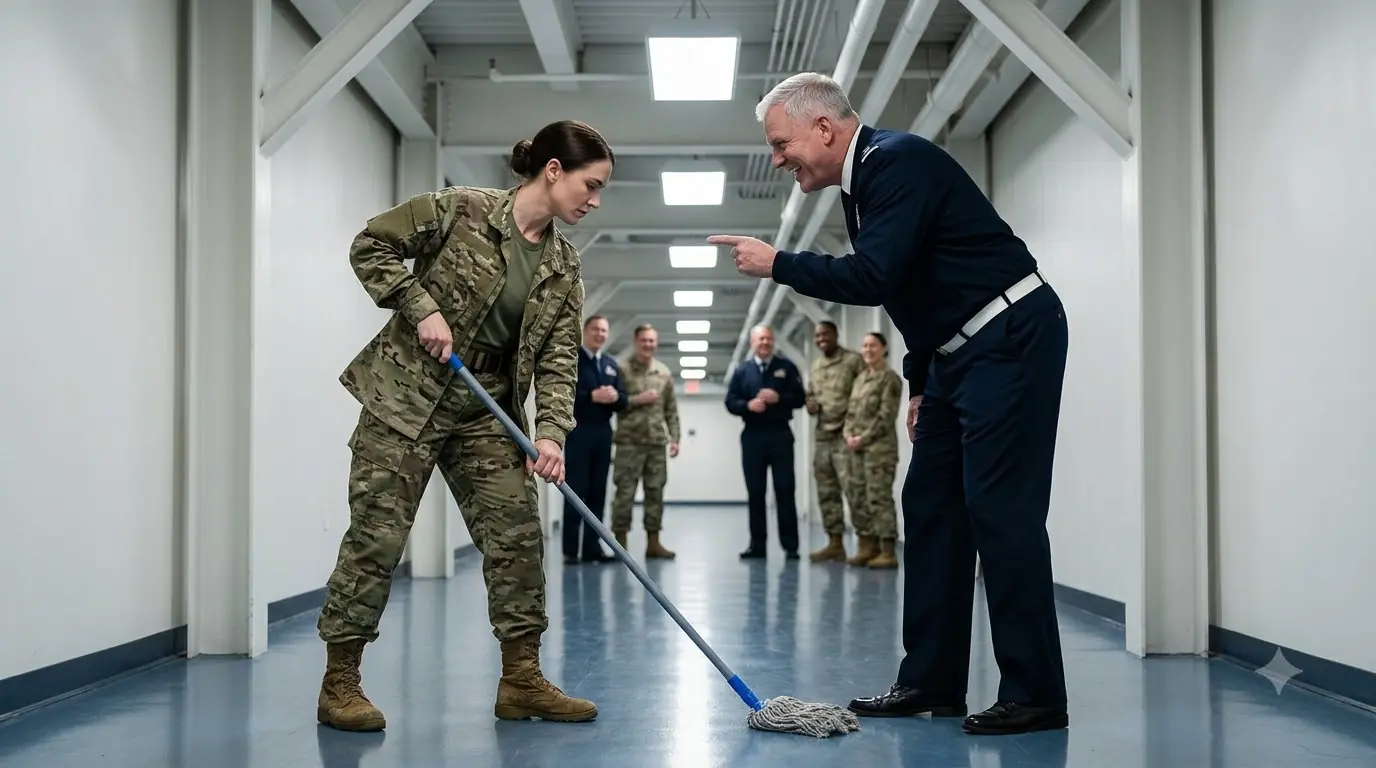 Commander Victoria Hayes smirked. Lieutenant James Park crossed his arms with a satisfied grin, and Chief Rodriguez practically doubled over.
More than forty personnel filled the corridor, including SEALs, training instructors, and administrative staff, and all of them turned to watch. The woman they were mocking did not look up.
Small, perhaps five feet four inches tall, and wearing a standard maintenance uniform that hung loosely on her frame, she continued pushing her mop across the floor in steady, methodical strokes. Her dark hair was pulled back into a simple ponytail. Nothing about her suggested she was anything other than what she appeared to be: another invisible worker keeping the base clean. But Master Sergeant Tommy Walsh, standing near the equipment checkout counter, felt ice slide down his spine. He had seen that stance before. The way she held the mop, the placement of her grip, the angle of her shoulders, and the distribution of her weight were wrong for cleaning. They were right for something else entirely. "Come on, don't be shy," Hendricks pressed, stepping closer. "Everyone here has a call sign. What's yours? Squeegee? Floor Wax?" More laughter rippled through the crowd. The woman finally paused. She straightened slowly, and for less than a second, something flickered across her face. It was not anger or embarrassment. It was something colder, something that made Walsh's hand move unconsciously toward his sidearm. Then it was gone. She lowered her head and returned to mopping. Yet in the next twenty minutes, everything they thought they knew about her would be shattered. Walsh watched as the woman's eyes swept the corridor in a pattern he recognized immediately: left corner, high right corner, low center mass, exits, and potential threats. She repeated the scan in three-second intervals, perfect tactical observation drilled so deeply into an operator that it became as automatic as breathing. She was not looking for dirt on the floor. She was maintaining awareness of every person, every movement, and every possible danger in the environment. Commander Hayes noticed Walsh's attention and misinterpreted it entirely. "Sergeant, are you defending the help now?" Her voice carried the particular cruelty of someone who had fought hard for her position and resented anyone she perceived as weak. "Maybe she needs a strong man to speak for her." The woman's jaw tightened almost imperceptibly. Still, she said nothing. Lieutenant Park pushed away from the wall where he had been lounging. "Actually, I'm curious now." He gestured toward the weapons rack visible through the nearby armory window. "Hey, maintenance lady. Since you're cleaning our facilities, maybe you can tell us what those are called." He pointed at three rifles mounted in sequence. The woman looked up slowly. Her dark brown eyes, unremarkable at first glance, focused on the weapons with an intensity that made Walsh's breath catch. When she spoke, her voice was quiet but clear. "M4 carbine with an ACOG optic. M16A4 with standard iron sights. HK416 with an EOTech holographic sight." Park's smirk faltered. Those were not civilian descriptions. They were proper military designations. "Lucky guess," Rodriguez sneered as he stepped forward. He was a thickset man accustomed to using his size to intimidate. "Probably heard some jarhead use those words." As if to punctuate his dismissal, he deliberately kicked over her mop bucket. Gray water spread across the polished floor. What happened next occurred so fast that several witnesses would later argue about the exact sequence. The bucket tipped, and a metal clipboard fell from a nearby desk toward the spreading water. The woman moved. Her hand shot out and caught the clipboard six inches above the floor. She did not fumble for it. She plucked it cleanly from the air with the kind of hand-eye coordination that required thousands of hours of training, the kind of reflexes that could mean the difference between life and death when a grenade rolled into a fighting position. The corridor went quiet for three full seconds. Then Hendricks laughed again, but the sound was forced. "Good catch. Maybe you should try out for the softball team." Young Corporal Anderson, a member of the maintenance crew and the only person who had tried to befriend the quiet woman during her six months on the base, stepped forward. "Admiral, sir, with respect, maybe we should—" "Corporal," Hendricks said without even looking at him, "did someone ask for your input?" "No, sir." "Then keep your mouth shut." Hendricks turned back toward the woman, who had already retrieved a second mop and was cleaning the spilled water with the same methodical efficiency she brought to everything. "You know what? I'm curious about something. You have all-access clearance. That's unusual for maintenance." Without pausing in her work, she reached into her pocket and produced her badge. The magnetic strip gleamed beneath the fluorescent lights. Level Five clearance. Full base access, including restricted training areas. Park snatched the badge from her hand and examined it closely. "How does a cleaner get Level Five?" "Background check cleared six months ago," she replied evenly. "You can verify it with security." From the second-floor medical office, Dr. Emily Bradford watched the scene unfold with growing unease. She had treated this woman twice, once for a scraped knuckle and once for what appeared to be an old shoulder injury acting up. Both times, the woman had demonstrated an unusually high pain tolerance and an encyclopedic knowledge of field medicine. Bradford had noted it in her personal log but had not thought much of it. Now, watching the predatory circle of senior officers close around the small maintenance worker, she felt every instinct warning her that something was very wrong. Hendricks was warming to his game. He could feel the crowd's attention and the weight of his recent promotion. He had spent twenty years clawing his way up through the SEAL command structure, and now he finally had the respect he believed he deserved. This was his base, his command, and his moment. "Tell you what, sweetheart. Since you seem to know so much about our weapons, why don't you explain the proper maintenance procedure for that M4 you identified? It shouldn't be too hard for someone with all-access clearance, right?" The woman set down her mop. She walked to the armory window and pointed at the rifle without touching it. "The barrel requires cleaning every two hundred to three hundred rounds, more frequently in desert environments because of sand infiltration. The bolt carrier group should be cleaned and lubricated at least every five hundred rounds. The gas tube requires inspection, but not cleaning unless a malfunction occurs. The buffer spring should be replaced every five thousand rounds or when there is a failure to return to battery. Magazine springs are the most common point of failure and should be rotated regularly." Park's expression shifted from smugness to uncertainty. That was almost word for word from the armorer's manual. "Anyone can memorize words," he said, although his voice had lost its edge. She turned to face him directly for the first time. "Would you like a practical demonstration?" "Sure." Hendricks waved toward the armory sergeant. "Bring that M4 out here. Let's see what the help knows about weapon handling." The armory sergeant, a grizzled staff sergeant named Collins who had been quietly watching the exchange, hesitated. "Sir, regulations require—" "I'm aware of the regulations, Sergeant. Bring the weapon." Collins retrieved the M4, cleared it with practiced efficiency, locked the bolt to the rear, and placed it on the counter between them. He was visibly uncomfortable with the entire situation, but he could not ignore a direct order from an admiral. The woman approached the rifle. Her hands moved before Walsh could fully process what he was seeing. The weapon came apart in a blur of controlled motion. The upper receiver separated from the lower. The bolt carrier group came out, followed by the firing pin, bolt, charging handle, and buffer spring. Every component was laid out in perfect sequence in 11.7 seconds. Walsh knew the exact time because he had checked his watch without realizing it. The SEAL qualification standard was fifteen seconds. The special operations standard was thirteen. Only Tier One operators consistently broke twelve. She reassembled the rifle in 10.2 seconds. The corridor became absolutely silent. Even Hendricks stopped smiling. Lieutenant Commander James Brooks, a SEAL team instructor arriving for his shift, stopped dead in the corridor entrance. He had seen that disassembly speed only once before, in a classified briefing about Force Recon selection standards. His eyes narrowed as he studied the small woman calmly returning the weapon to Sergeant Collins. "Lucky," Park finally said. "Probably practices that party trick at home." "Would you like me to do it blindfolded?" she asked. There was no arrogance in her voice, no challenge, only a factual question. Before anyone could answer, Colonel Marcus Davidson arrived with his inspection team and three Pentagon observers conducting a quarterly facility review. He took one look at the crowd, the weapon, the wet floor, and the woman in maintenance coveralls, and his expression darkened. "What exactly is going on here?" "Just some entertainment, Colonel," Hendricks said smoothly. "The maintenance worker was showing off a few skills." Davidson's eyes swept the scene with the practiced assessment of a career officer. He saw the kicked bucket, the wet floor, and the circle of smirking senior officers surrounding one small woman. His lips thinned. "And this seemed like an appropriate use of command time?" "With respect, sir, we were simply—" "I didn't ask for your justification, Admiral. I asked what was going on." Davidson turned his attention toward the woman. "Your name and position." She met his eyes calmly. "Sarah Chen. Maintenance crew. Six months on base." "And you have weapons-handling certification because?" "Previous employment, sir." "What previous employment?" "I'd prefer not to say, sir." Rodriguez stepped forward, sensing an opportunity. "Colonel, I think we should verify her credentials. This is starting to smell like stolen valor. Some people like to play dress-up with skills they don't actually have." Sarah's expression did not change, but Walsh saw her shoulders shift almost imperceptibly into a more balanced stance. Combat ready. She appeared not even to realize she had done it. "Fine," Davidson said. "Someone call security. Let's verify the credentials she's so reluctant to discuss." While they waited, Hayes circled closer, her instinct for social dominance taking over. "You know what I think? I think you're one of those groupies who hangs around bases trying to get attention from real operators. Maybe you dated some enlisted man who taught you a few tricks, and now you think you're special." Petty Officer Jake Morrison, a recent SEAL graduate who had been watching in uncomfortable silence, noticed something the senior officers had missed. Sarah's breathing pattern had not changed once during the entire confrontation. Four counts in, four-count hold, four counts out, four-count hold. Box breathing, the stress-management technique they had spent weeks learning during BUD/S, and she was doing it automatically. Security arrived with Sarah's full personnel file. The officer in charge, a senior chief named Williams, looked confused as he read it. "Ma'am, your file shows all certifications current: advanced weapons handling, tactical medicine, combat driving, close-quarters combat, survival, evasion, resistance, and escape. This is an operator's qualification sheet, not maintenance." "Are they all legitimate?" Davidson asked. "Yes, sir. All verified through proper channels. Her background check was cleared by Naval Intelligence. No flags, no issues." "But her employment record only goes back six months," Rodriguez protested. "What was she doing before that?" Williams flipped through the pages. "The file doesn't say, Chief. It only shows that she was cleared for employment after a full background investigation." "That's not standard," Hayes said. "You don't receive Level Five clearance and this qualification list without a service record. Where is her service record?" "Not in this file, ma'am." Hendricks saw an opportunity to regain control. "Then I propose a practical test. The combat simulation range is available. If Miss Chen is truly qualified for all these certifications, she should be able to demonstrate competency. If she can't, we file a report for falsifying credentials." Brooks stepped forward. "Admiral, I'm not sure that's—" "Are you questioning my judgment, Commander?" Brooks met his superior's eyes and calculated the risk. "No, sir." "Good. Miss Chen, you're invited to the range. Consider it a professional development opportunity." Hendricks's smile returned. He had turned public humiliation into official business. "Unless you'd like to admit now that your credentials are questionable." Sarah looked at him for a long moment. "Sure." The word hung in the air like a grenade with the pin pulled. The group moved en masse toward the combat training facility, a small army of observers swept up in the promise of spectacle. Word spread through the base with the speed of wildfire. By the time they reached the range, the observation gallery held more than fifty personnel, including SEALs in training, instructors, administrative staff, and civilian contractors who had heard that something unusual was happening. The range master, a grizzled SEAL senior chief named Kowalski, met them at the entrance. "Admiral, we need proper safety briefings if you're bringing in someone untrained." "She has qualifications," Hendricks cut him off. "Set up the standard operator assessment." Kowalski looked at Sarah carefully, and something in his expression shifted. He had been doing this job for fifteen years. He knew what a fraud looked like. The woman standing calmly in maintenance coveralls while more than fifty people gathered to watch her fail did not look like one. "Yes, sir. What level of difficulty?" "Let's start simple. Static target shooting. Then we'll escalate if she's actually competent." Hendricks gestured toward the weapons. "Choose your weapon, Miss Chen." The armory offered standard training weapons: M4 carbines, M9 pistols, and SIG Sauer P226s. Sarah walked past all of them and stopped at the secure locker in the back. "May I?" Kowalski raised his eyebrows but nodded. Sarah opened the locker and removed a Barrett M82A1 .50-caliber anti-materiel rifle. It weighed nearly thirty pounds unloaded. Park laughed. "You cannot be serious. That thing weighs almost as much as you do." Sarah lifted it with proper carry technique, distributing the weight perfectly across her frame, and walked to the firing line. The rifle looked absurdly large in her hands. Several people in the gallery pulled out their phones, anticipating a viral video of someone's humiliation. Walsh closed his eyes briefly. He had fired a Barrett only once in his career. The recoil had bruised his shoulder for a week. "Target distance?" Sarah asked. "Eight hundred meters," Hendricks replied generously. It was an extremely difficult shot with that weapon for anyone other than a specialized marksman, and he believed he was giving her enough rope to hang herself publicly. Sarah loaded a single round, settled into the prone position, and looked through the scope. Her breathing slowed. Ten seconds passed, then fifteen. She read the wind, calculated the drop, and measured every variable. The shot cracked like thunder. Eight hundred meters downrange, the center of the target erupted. Kowalski checked through the spotting scope. "Dead center." Hendricks's jaw tightened. "Different distance. Make it twelve hundred meters. Three more shots." Sarah adjusted for wind, range, and the slight change in elevation. Three shots followed. Three perfect hits. When she stood, there was no strain on her face and no visible discomfort from the recoil, only calm professional efficiency. Hayes had gone pale. "Where did you serve?" Hayes demanded. "What unit?" "I said I would prefer not to discuss my previous employment." "That is no longer an option," Davidson said. His voice had lost its dismissive edge. He was beginning to understand that he was watching something significant. "Those shots were not luck. That is trained skill at an extremely high level." Morrison leaned toward Brooks. "Sir, her breathing. She's still using box breathing. She has not broken the pattern once." Brooks nodded slowly. He was assembling the same pieces as everyone else, and he did not like the picture that was taking shape. "Admiral," Brooks said, "I strongly recommend that we stop this demonstration." "And do what, Commander? Let her walk away without explaining how a maintenance worker shoots like a scout sniper?" Hendricks's ego had taken full control. "Miss Chen, pistol transition drill. Let's see whether you are as good with a sidearm." Kowalski set up the drill reluctantly. It was a Mozambique pattern: two rounds to center mass and one to the head on multiple targets under time pressure. The SEAL standard was three seconds for three targets. Sarah picked up an M9, checked it with the automatic precision of someone who had performed the movement thousands of times, and stepped to the line. "Ready," Kowalski called. "Set. Go." The shots came so quickly that they nearly blended together. Nine rounds. Three targets. Perfect shot placement on all three. The timer displayed 0.9 seconds. Someone in the gallery whispered, "That's impossible." Dr. Bradford had come down from her office, drawn by the crowd. She stood at the back of the gallery, watching with growing certainty. She had seen those hands before while treating Sarah's injuries. They were marked by old scars in specific patterns: rope burns across the palms, defensive scars along the forearms, and calluses formed by years of weapons handling. Bradford had completed part of her residency at Walter Reed. She knew what combat trauma looked like, and she knew what an operator's hands looked like. Park, desperate to regain ground, stepped forward. "All right. Shooting drills are one thing. Let's see how you handle CQB. Close-quarters battle. Room clearing." Kowalski set up the kill house, a mock facility with multiple rooms, doors, corners, and rapidly changing scenarios. Targets appeared randomly, some hostile and some civilian. The drill tested decision-making under pressure, tactical movement, and threat assessment. Even experienced SEALs sometimes failed it. Sarah walked to the entry point. She paused for a moment, studying the layout, and then nodded. The drill activated. What happened next would be reviewed on video for hours by increasingly bewildered tactical instructors. Sarah cleared the facility using movement patterns that were not standard Navy or Army doctrine. They were more efficient, minimizing exposure while maximizing coverage. She identified and engaged twelve hostile targets while avoiding eight civilians, completing the course in forty-one seconds. The current base record was fifty-seven. Sergeant First Class Davis, the simulation operator, froze the footage and replayed it three times. "That isn't SEAL CQB. It isn't Army. It isn't even Delta." "Then what is it?" someone asked. Davis shook his head slowly. "I've only seen movement like that once, in a training video from Quantico. Force Recon." The gallery became silent again. Hayes stepped down from the observation area, her face a mask of confusion, anger, and something that might have been fear. "You need to tell us who you are. This is not a game anymore." Before Sarah could answer, the base public-address system crackled to life. "Medical emergency, CQB training area. Medical emergency, CQB training area. All qualified personnel respond." Rodriguez, watching from near the armory, allowed himself a small smile. He had arranged the emergency as a staged training accident designed to embarrass Sarah one final time. He had convinced a junior SEAL to fake an injury that would appear to require immediate trauma intervention. She would fail, be exposed as a fraud, and Rodriguez would be vindicated. Everyone rushed toward the training area. A young SEAL petty officer named Collins, Rodriguez's co-conspirator, lay on the ground clutching his chest and simulating a tension pneumothorax. The symptoms appeared convincing: difficulty breathing and uneven chest rise. Sarah knelt beside him in one smooth motion. Her hands moved across his chest, checking and assessing. She looked up at Bradford, who had arrived with the emergency medical kit. "Fourteen-gauge needle." Bradford's eyes widened. Needle decompression was the correct treatment for a true tension pneumothorax, but it was an advanced and invasive procedure. "You know how to perform it?" Bradford asked. "Yes." Sarah took the needle and located the anatomical landmark with her fingers. Then she stopped. Her eyes narrowed. She pressed more firmly against Collins's chest, checked his breathing again, studied his eyes, and noticed the slight nervousness there. "Stand up," Sarah said quietly. "I—I can't. I need—" "Stand up." Her voice carried a command authority that made Collins obey before his brain caught up. He stood, breathing perfectly normally. "Bad acting," Sarah said to the room. "A real tension pneumothorax would present with signs that are absent here. His airway is centered, his breathing pattern is inconsistent with the injury, and his pupils show no response to severe pain or oxygen deprivation." She handed the needle back to Bradford and turned toward Rodriguez. "Did you arrange this?" The chief's face turned red. "I don't know what you're—" "You wanted me to perform an invasive procedure on a healthy person so you could accuse me of assault." Her voice remained calm, but something cold had settled beneath it. "Clever. It almost worked." Bradford stepped forward. "Chief Rodriguez, if this young man is not actually injured, we need to have a serious conversation about the misuse of emergency medical resources." A radio interrupted them with the base commander's voice. "All personnel be advised. Incoming VIP. General Robert Thornton, Commanding General, Second Marine Division, arriving for an unannounced inspection. All section heads report to the main briefing room in fifteen minutes." The crowd began to disperse as personnel rushed to prepare for the general's arrival, but Hendricks was not finished. "Miss Chen, this conversation is not over. You will report to my office at 1500 hours and provide a full accounting of your background and qualifications." She met his eyes. "With respect, Admiral, I do not report to you. I am a civilian contractor, not active duty." "Then consider it a request, one you would be wise to honor if you want to keep your job." Sarah nodded once. "1500 hours. Your office." As the crowd dispersed, Walsh approached her cautiously. "Ma'am, I don't know who you are, but you may want a JAG representative present at that meeting." She looked at him carefully, and for a moment her expression softened. "Thank you, Sergeant. I appreciate the advice." "Can I ask you something off the record?" "You can ask." "The tattoo on your shoulder. I saw it when your collar shifted. That is not a random design, is it?" Her face became carefully blank. "I need to get back to work." She walked away, leaving Walsh standing in the corridor, more certain than ever that he had witnessed something significant, something that was about to explode in ways none of them could predict. In his office, Rodriguez began making calls in an attempt to verify Sarah's background through unofficial channels. He had friends in different units, people who owed him favors. If she was a fraud, he would expose her. If she was not, that possibility frightened him more than he wanted to admit. Hayes sat in her office replaying footage of Sarah clearing the kill house. She watched the movement patterns repeatedly, studying the efficiency and precision. This was not someone who had dated an operator and learned a few tricks. This was someone who had done the work in places where mistakes meant death. Hayes had spent her entire career fighting to be taken seriously as a female operator. She had endured relentless pressure to earn her position. Now, a quiet maintenance worker had appeared and moved at a level Hayes could barely comprehend. Park sat in the armory methodically cleaning his personal weapon and trying to process what he had seen. He had taught weapons handling for eight years and knew the best of the best. Sarah had performed at a level he had encountered only among operators whose names appeared in classified briefings, not on maintenance rosters. At exactly 1500 hours, Sarah Chen walked into Admiral Hendricks's office. She had changed into clean maintenance coveralls, and her hair remained in its simple ponytail. She looked small and unremarkable, completely out of place in the richly appointed command office. Hendricks sat behind his desk, flanked by Hayes and Davidson. Park stood near the door with his arms crossed. Rodriguez lingered in the corner, waiting for his moment. "Sit," Hendricks ordered. Sarah remained standing. "I prefer to stand, sir." "That was not a request." "With respect, Admiral, I am not active-duty military. You cannot give me orders." His jaw tightened. This was not how he had expected the meeting to begin. "Fine. Stand. But you will explain your background, your qualifications, and why you are working in maintenance when you clearly possess specialized training." "I would prefer not to discuss my previous employment." "And I would prefer not to have a mystery operative working on my base without full disclosure." Hendricks leaned forward. "Here is what I think. I think you washed out of whatever program you were in. Maybe you couldn't handle the pressure." "Maybe you failed the psychological evaluation. Now you're clinging to whatever skills you retained and trying to feel important by impressing people." Something flickered across Sarah's face for an instant and disappeared. "Or maybe," Hayes added sharply, "you were never actually in a program. Maybe you're a very good actress who studied operators, learned the language, practiced the movements, and tried to pass yourself off as something you're not." "Stolen valor," Rodriguez said from the corner. "It's a crime. We could have you arrested." Sarah's phone buzzed. She glanced at a message from a contact labeled only Papa. Three words appeared on the screen: Proud of you. She allowed herself the smallest smile before returning her attention to the officers around her. "Call security," Davidson suggested. "Let's resolve this officially. Full background investigation and a polygraph if necessary." Park pushed away from the wall. "I'll make the call." Before he reached the phone, Chief Warrant Officer Kim burst through the door, slightly out of breath. "Sir, forgive the interruption, but I have the search results you requested." "This had better be good, Kim," Hendricks growled. "You asked me to run a deep background check on Sarah Chen." Kim held up a tablet, his face pale. "Sir, I found several things, but there is a problem." "What problem?" "The file is classified. Extremely classified. I only obtained partial access because General Thornton authorized the search after he heard what was happening. I need O-6 clearance at minimum to open the full record." The room became very still. Davidson stood. "I have O-6 clearance. Let me see the tablet." Kim handed it over reluctantly. Davidson read the screen. His expression moved through confusion, shock, disbelief, and finally something like horror. His hand began to shake. "This cannot be right," he whispered. "What does it say?" Hendricks demanded. Davidson looked at Sarah as if he were seeing her for the first time. When he spoke, his voice was thick with emotion. "I served with your father in Fallujah. The second battle, November 2004. Master Sergeant Richard Chen. He never told me. He couldn't have told me." "Told you what?" Hayes stepped forward, trying to see the screen. Davidson turned the tablet so they could all read it. The classification header was bright red: TOP SECRET/SCI. Below it appeared a personnel file. At the top, in bold letters, were the words: CHEN, SARAH. CAPTAIN, UNITED STATES MARINE CORPS. FORCE RECONNAISSANCE. The room seemed to tilt. "No," Hendricks said flatly. "That's not possible. Force Recon doesn't take—" He stopped, but the damage was done. "Doesn't take women?" Sarah asked quietly. "They do now. They have for years. You would know that if you followed Marine Corps developments outside the SEAL community." "Force Recon is one thing," Rodriguez said, his voice turning desperate. "It still does not explain the skill level we saw. That was—" "Keep reading," Davidson said. His face had gone gray. Kim opened the next section. The mission history listed seventy-three successful operations across twelve years, with locations that remained classified. A list of commendations continued for pages: four Navy Crosses, six Bronze Stars, seven Purple Hearts, and dozens of other medals and citations. At the bottom of the record, a stark line appeared: STATUS: PRESUMED KILLED IN ACTION. HELMAND PROVINCE. AUGUST 2019. "She's dead," Park said without thinking. "The file says she's dead." "Presumed KIA," Sarah corrected. "It means they did not recover a body. It means I spent forty-seven days alone behind enemy lines before reaching friendly forces. It means the Marine Corps declared me dead because statistically no one survives that long in that terrain under those conditions." Hayes backed against the wall. Her face had gone ashen. "You are actually Captain Sarah Chen." "Call sign," Davidson said, still studying the record. "The file will not load your call sign. That portion is redacted." "It would be," Sarah replied. "Call signs tied to certain operations remain classified." Hendricks became very still. "Ghost Unit," he whispered. "You were Ghost Unit." "I don't know what you're talking about, Admiral." "Don't." His voice sounded hollow. "I have seen the briefings. There have been only twenty-three Ghost Unit operators in the history of Marine Force Recon. You are one of them." He looked as if he might be sick. Rodriguez slumped against the wall. He had physically intimidated and attempted to frame a superior officer, not just any officer, but an operator from one of the most secretive units in the military. His career was not merely endangered. He could face formal charges. Kim opened another section. "Sir, there is more. This explains why she is here working in maintenance." He read aloud. "Status change: voluntary retirement. Compassionate leave granted. Father, Master Sergeant Richard Chen, United States Marine Corps, retired, suffered traumatic brain injury in February 2020. Subject requested discharge to provide full-time care." He continued, "Request granted with honors. Current residence: Virginia Beach. Current employment: civilian contractor, Naval Amphibious Base Little Creek Maintenance Division. Cleared for Level Five access because of previous service and continuing security clearance." The pieces fell into place. Sarah had not been hiding from failure or pretending to be something she was not. She was at Little Creek because her father needed her, the man who had raised her, served twenty-five years in the Marine Corps, and been wounded in Fallujah. Davidson looked at her. "How long does he have?" Sarah's mask cracked slightly. "The doctors say six months, perhaps less." "And you have been here for six months." "Yes, sir." The silence stretched. Hayes covered her mouth, tears running down her face. Park turned away, unable to meet Sarah's eyes. Rodriguez looked as though he wanted the floor to open beneath him. Hendricks rose slowly. Every trace of his earlier swagger was gone. "Captain Chen, I—" He could not find the words. "It's fine, Admiral," Sarah said. "It is not fine. Nothing about this is fine. I mocked you. I called you—" He could not bring himself to repeat the words. "You didn't know." "That is not an excuse." Hendricks straightened. "I owe you an apology, a real one, in front of the same people who witnessed my conduct." "That is not necessary." "Yes, it is," Davidson said. "Captain, with respect, it is absolutely necessary. What happened today cannot be ignored. We need to make it right." A knock interrupted them. A junior officer looked into the room. "Sorry to interrupt, sir, but General Thornton requests that Admiral Hendricks, Colonel Davidson, and Captain Chen report to the commanding officer's briefing room immediately." Sarah's expression shifted toward resignation. "He read the file." "Yes, ma'am. He requested your presence specifically." They walked through the base corridors in a strange procession. Word had spread. The mysterious maintenance worker was Force Recon, Ghost Unit, and decorated beyond belief. Personnel stopped and stared. Some stood at attention as she passed, while others raised phones before security personnel ordered them to put the devices away. By the time they reached the briefing room, a crowd had gathered outside. Walsh was there with Morrison and Brooks, Dr. Bradford, and dozens of others who had either witnessed the confrontation or heard about it secondhand. General Robert Thornton stood at the head of the briefing table. He was a tall man in his late fifties, with the weathered face of someone who had spent decades in combat zones. When Sarah entered, he came to attention and rendered a full formal salute, holding it until she returned it. The gesture struck everyone in the room. A two-star general had saluted first, an act of respect that transcended rank. "Captain Chen," Thornton said, formal but warm, "it is an honor to meet you in person. Your reputation precedes you, although I wish the circumstances were different." "Sir." Sarah stood at attention, every inch the Marine officer despite her maintenance coveralls. Thornton turned toward Hendricks. "Admiral, I have reviewed the incident reports from today. I have multiple witnesses, video footage, and statements from personnel who believed something was deeply wrong with the way events unfolded. Would you care to explain?" Hendricks's face was pale. "Sir, I had no knowledge of Captain Chen's background or service record. The way she presented—" "The way she presented," Thornton interrupted coldly, "was as a civilian employee doing her job. She took that job to remain near her dying father, a man who served this country for twenty-five years and earned his retirement through blood and sacrifice. You decided that the appropriate response was to mock her publicly, question her credentials, and force her to demonstrate capabilities she clearly wished to keep private." "Sir, I—" "I am not finished, Admiral." Thornton's command presence filled the room. "Do you know why Captain Chen's call sign is classified? Do you understand why Ghost Unit designations remain in sealed files?" Hendricks shook his head. "Because operators at that level make enemies. Real enemies. Nation-state threats and terrorist organizations would pay millions for their identities. Captain Chen's face, real name, and location were protected information. Today, you forced her to expose her capabilities in front of more than fifty people, several of whom recorded the event on personal devices." The implications settled over the room. Sarah's safety had been compromised, and so had her father's, all because of ego and entertainment. "Sir," Sarah said, "with respect, the operational-security concerns can be managed. I understood some risk when I chose to work here. Today's events were unfortunate, but not necessarily catastrophic." "That is generous of you, Captain," Thornton replied. "Too generous. But it raises a question. Why this base? You could have taken a consulting position anywhere and earned six figures. Instead, you chose minimum-wage maintenance work." "Proximity to Portsmouth Naval Medical Center," she said. "It has the best traumatic-brain-injury specialists in the region. My father receives treatment there twice each week. This base is twelve minutes from the hospital and fifteen minutes from our apartment. The decision was simple." Davidson spoke, his voice rough with emotion. "Sir, if I may, I served with Master Sergeant Chen in Fallujah. He was my platoon sergeant and saved my life twice. I had no idea his daughter was—" He gestured helplessly. "I should have known. I should have recognized her." "No one was supposed to recognize her, Colonel," Thornton said. "That was the point." He pulled out a chair. "Captain, please sit. The rest of you as well. We need to discuss what happens next." They sat around the table: an admiral, a colonel, a two-star general, and a woman in maintenance coveralls who outranked many of them in every way that mattered. Thornton displayed a file on the briefing-room screen. "I received a call approximately thirty minutes ago from Joint Special Operations Command. They are aware of today's incident, and they know that Captain Chen's cover has been compromised. They are offering several options." "Sir, I do not want to return to active duty," Sarah said immediately. "My father—" "I know, Captain. They know. Every option accounts for that." He advanced the presentation. "Option one: full identity-protection protocol. New name, new location, and new employment. Your father would be relocated to a medical facility near whichever base you choose. All care would be covered." "That would disrupt his treatment schedule," Sarah said. "His physicians at Portsmouth understand his case. Starting over with new providers could cost him months he does not have." "Understood. Option two: enhanced security at your current location. Armed protective detail, surveillance, countermeasures, and active threat monitoring. You could continue your current employment, but the security footprint would destroy any sense of normal life." "My father already struggles with memory and cognition. Security teams and changing protocols would confuse and frighten him." Thornton nodded. "Option three, which I personally recommend, is that you accept a training-instructor position here at Little Creek. You would have an official title, recognition of your rank and experience, and appropriate pay. You would work with SEAL candidates and Force Recon students, teaching advanced skills. The hours would be flexible enough to preserve your father's care schedule, and your presence here would have a legitimate public explanation." Sarah considered it. "Teaching would expose me to hundreds of students. Any one of them could compromise operational security." "True, but they would be vetted personnel with clearances. Frankly, Captain, your operational security has already been compromised. The question is how we manage that reality, not whether we can preserve a fiction that has already been destroyed." Hayes spoke in a subdued voice. "Sir, if Captain Chen accepts an instructor position, I would like to request assignment as her liaison officer. I owe her. I need to make amends for today." "Noted, Commander. Captain Chen would have final approval of that assignment." Thornton looked back at Sarah. "You do not have to decide now. Take twenty-four hours and speak with your father if his condition permits. JSOC needs an answer by 1600 tomorrow." "I understand, sir." "Good. Now, regarding the other participants in today's events." Thornton's gaze moved around the room. "Admiral Hendricks, you will deliver a formal apology at tomorrow morning's base-wide formation. You will explain that you were unaware of Captain Chen's history and that your conduct fell below the standard expected of officers." "You will also enroll in a mandatory respectful-leadership course. Questions?" "No, sir." "Commander Hayes, you will make the same apology at the same formation. You will also write a personal letter to Captain Chen explaining exactly how your behavior contradicted the values you claim to represent. That letter will be reviewed by your commanding officer and placed in your personnel file." Hayes swallowed. "Yes, sir." "Colonel Davidson, you are assigned as Captain Chen's primary point of contact for any need involving her father's care or her own security. You served with Master Sergeant Chen. You know what he sacrificed. Make certain his daughter has everything she needs." "Sir, it would be my honor." Thornton's voice turned cold. "Chief Rodriguez, you staged a false medical emergency designed to embarrass Captain Chen and potentially implicate her in an assault. You intimidated a superior officer and conducted unauthorized background investigations. You are confined to quarters pending formal court-martial proceedings. Security will escort you from this briefing." Rodriguez's face turned gray. Two security personnel entered and stood on either side of him. As they led him away, he looked back at Sarah. "I'm sorry," he whispered. "I didn't know." "You didn't care," Sarah said quietly. "That was the problem." The door closed behind him. The room felt larger and emptier. Park raised a hand tentatively. "Sir, what about me? I participated in the mocking and the challenges." "Yes, you did, Lieutenant. You also recognized skill when you saw it, even if you resisted admitting it. If Captain Chen accepts the instructor position, you will assist her with weapons-training classes. Consider it an opportunity to learn from someone who has used these skills in combat rather than only on a range." "Yes, sir." Thornton stood. "Walsh, Morrison, Brooks, and Dr. Bradford, you are here because you either defended Captain Chen or recognized that something was wrong. That has been noted and is appreciated. Dismissed." The others filed out, leaving Sarah alone with Thornton. Once the door closed, his formal bearing softened. "Off the record, Captain, how are you really doing?" Sarah drew a breath. "Honestly, sir, I'm tired. My father has good days and bad days. On good days, he remembers me. On bad days, he thinks I am my mother, who died when I was twelve." "The physicians say the injury is progressing. Every week, he loses a little more." "I'm sorry." "He was always proud of my service. He showed people my commendations even when he was not supposed to discuss them. Now he cannot remember most of it. Sometimes he asks when I am deploying, and I have to remind him that I retired. It breaks his heart every time, as though he is hearing it for the first time." Her voice remained steady, but her eyes were bright. "So no, sir. I don't want active duty, security details, or a relocated identity. I want the time I have left with him to feel as normal as possible." "Then we will make that happen," Thornton said gently. "And Captain, caring for your father is as important as any mission you ever completed. Do not let anyone tell you otherwise." "Thank you, sir." "One more thing. Your call sign. The file will not load it, but Hendricks mentioned Ghost Unit and looked terrified. I have been in this profession for thirty-five years, and there are operations I still lack clearance to see. I assume your call sign is connected to some of them." She met his eyes. "I would prefer not to discuss it, sir." "Fair enough. If you ever decide you need to talk, my door is open. We take care of our own, including those who do not ask for help." Sarah stood and saluted. Thornton returned it crisply. As she turned to leave, he called after her. "Captain, for what it is worth, Force Recon made the right choice when they selected you, and the Marine Corps lost a remarkable officer when you retired." Sarah paused. "The Corps did not lose me, sir. I'm still a Marine, just in a different way." Outside the briefing room, Walsh, Morrison, Brooks, Bradford, and dozens of others waited. They came to attention when she emerged. Some saluted. Others watched with expressions of awe, respect, and in a few cases, shame. Corporal Anderson stepped forward. "Ma'am, I wanted to say I'm sorry. I should have defended you more strongly." "You stood up when it mattered, Corporal. That takes courage. Do not apologize for doing the right thing." Morrison approached next. "Captain, I'm a new SEAL graduate and still learning, but watching how you handled everything today taught me more about professionalism than six months of training." Sarah nodded. "Being a good operator is not about how many push-ups you can do, Petty Officer. It is about keeping your head when everyone around you is losing theirs. Remember that." Dr. Bradford stepped forward. "I reviewed your medical history with General Thornton's authorization. The injuries you sustained during those forty-seven days in Helmand were extensive. The fact that you are walking, functioning, and working is remarkable. If you need anything medically or otherwise, please do not hesitate." "I appreciate that, Doctor." Brooks drew her aside as the crowd began to disperse. "Captain, about three weeks ago, I saw you in the maintenance break room speaking what I thought was Pashto. I almost reported it as suspicious. Now I realize you probably speak several languages, and that was normal for you." Sarah allowed herself a small smile. "Eight languages, actually. I was speaking with an Afghan translator who assisted my unit during several operations. He reached the United States with his family and lives in Richmond. I check on him occasionally." Brooks shook his head. "You are an extraordinary combination of lethal operator and genuinely good person. It is humbling." The following morning at 0800 hours, more than eight hundred personnel assembled on the parade ground in dress uniforms. At the front, Admiral Hendricks stood at a podium with his expression carefully composed, although his discomfort was obvious. Sarah stood to one side in proper Marine Corps utilities with captain's bars. The uniform was crisp despite having remained in storage for more than a year. She had resisted wearing it, but Thornton had insisted that earned respect deserved visible recognition. Hendricks cleared his throat. "Yesterday, I made a serious error in judgment. I publicly mocked and challenged a civilian employee of this base. I made assumptions about her character and capability based on her position and appearance. I subjected her to unnecessary tests intended to humiliate her, created a hostile work environment, and violated every principle of leadership I claim to uphold." His voice was steady, but each word visibly cost him. "What I did not know, and what I should have taken the time to understand, was that this woman is Captain Sarah Chen, United States Marine Corps, retired, a Force Recon operator with twelve years of distinguished service, seventy-three successful missions, and more combat decorations than most of us will ever see. She took a maintenance position at this base for one reason: to remain close to her father, a retired Marine who requires specialized medical care." The formation became so quiet that the wind could be heard crossing the parade ground. "Captain Chen had no obligation to prove herself to me or to anyone else. Her service record speaks for itself. Yet she endured my mockery with grace and professionalism, demonstrating more leadership in her silence than I showed with all my words." Hendricks looked directly at Sarah. "Captain, I offer my sincere and unreserved apology. My behavior was inexcusable. I failed to meet the standards expected of an officer and a gentleman. I failed to honor the values of respect and dignity that should guide military service. I am deeply sorry." He stepped away. Hayes approached the podium, pale but determined. "Captain Chen," she began, her voice carrying across the parade ground, "I spent years fighting to be recognized as a capable operator in a male-dominated field. I endured harassment, discrimination, and constant questioning of my abilities. Yesterday, the moment I possessed authority, I inflicted the same treatment on another woman." Her voice cracked. "I made assumptions based on your appearance and position. I questioned your legitimacy. I was cruel. I did to you exactly what others did to me, and I have no excuse for that hypocrisy." "You completed twelve years of combat operations I can barely imagine, and I treated you as if you were nothing. I am ashamed, and I am sorry." Hayes saluted. Sarah returned it crisply. Hayes held the salute for a long moment before lowering her hand. General Thornton took the podium. "This base will learn from yesterday's events. We will implement new protocols governing how we treat all personnel, regardless of rank or position. Maintenance, administration, security, and combat forces all serve a vital role in our mission. We will not again judge a person's worth by appearance or job title." He gestured for Sarah to join him. She stepped forward, and eight hundred people came to attention at once. The thunder of boots striking the ground echoed across the parade field. "Captain Chen has agreed to accept a training-instructor position at this facility," Thornton announced. "She will work with our most advanced candidates and teach the kinds of real-world skills that come only from experience. Those selected for her courses should regard it as both an honor and the most demanding training of their careers." Applause began somewhere in the ranks and spread quickly. Within seconds, the entire formation was clapping and cheering. Some senior noncommissioned officers, men and women who had deployed repeatedly and seen the worst combat could offer, had tears in their eyes. Sarah looked across the hundreds of faces. For the first time in a long while, she felt something beyond grief and exhaustion. She felt pride, not in her record or decorations, but in the possibility of passing her knowledge to the next generation. "Thank you," she said simply. "I look forward to working with you." Three weeks later, Sarah stood inside the advanced-tactics facility facing twenty of the base's strongest SEAL candidates. They watched her with a mixture of awe and nervousness. She had become a legend in their minds: the Ghost Unit operator who had survived forty-seven days alone in hostile territory and then surrendered her career to care for her father. "Forget every impressive thing you've heard about me," she told them. "It does not matter. What matters is what you learn in this room. I am not here to tell war stories or show off. I am here to teach you how to survive when everything goes wrong, because it will go wrong." "Plans fail, equipment breaks, and people die. When that happens, the only thing standing between you and a body bag is your training." She moved to the center of the mat. "Real combat is not like the movies. It is not clean or heroic. It is chaos, fear, and making the best decision possible with incomplete information in three seconds or less. Most of you will never face the situations I am going to describe." "If you are fortunate, you never will. But if you do, I want you to walk away. I want you to return to your families. That is why I am here." Morrison raised his hand. "Ma'am, how did you survive forty-seven days alone in Helmand Province?" Sarah considered the question. "I will tell you, but not as a story of triumph. Treat it as a lesson in preparation meeting opportunity." She displayed a map. "Operation Crimson Eagle, August 15, 2019. My team inserted into this valley to capture a high-value target. The intelligence was wrong. We walked into an ambush. Three were killed immediately, two were wounded, and I was the only person still mobile." Her voice remained professional, but every word carried weight. "I had two choices. I could try to fight through and retrieve the bodies, which would almost certainly have killed me, or I could evade, survive, and ensure someone made it home to tell their families what happened. I chose survival." She moved through images of the terrain. "During the first week, I traveled only at night, covering approximately three kilometers each night. I ate insects and anything else I could find. I lost thirty pounds in four weeks and narrowly avoided three hostile patrols because I had studied their movement patterns during previous operations. Knowledge saved my life." The room remained completely silent. "During the third week, a shrapnel wound became badly infected. I had no antibiotics and almost no medical supplies. I improvised treatment from what was available and kept moving. In the fifth week, I found a dry riverbed leading toward friendly territory and followed it for eighteen days. On day forty-seven, I stumbled into a forward operating base manned by Army Rangers who believed they were seeing a ghost." She looked directly at Morrison. "I survived because of three things. First, I never stopped thinking. Panic kills. Second, I used every skill I had ever learned, no matter how small it once appeared." "Terrain, weather, food sources, field medicine, and enemy patterns all mattered. Third, I had a reason to survive. My father and the families of my team needed someone to come home and tell the story." She turned off the screen. "Skills matter. Knowledge matters. Having a reason to fight matters most. Find your reason before you deploy. Hold on to it when everything becomes dark, and let it pull you home." The weeks became months. Sarah settled into her new role, teaching advanced combat techniques, survival, and tactical decision-making. Her students were among the best in the military, and she pushed them harder than any instructor they had encountered. Hayes remained true to her word and served as Sarah's liaison. Their relationship began awkwardly, burdened by guilt and resentment, but slowly developed into mutual respect. Hayes learned humility, while Sarah learned to accept assistance without interpreting it as pity. Park became her assistant instructor. To his surprise, he learned more in three months with Sarah than during eight years of teaching on his own. She possessed insights born from real experience, knowledge that could not be obtained from a manual or a simulation. Walsh visited often. He shared stories from operations he had participated in and compared notes with someone who had served at the highest level. He once told Sarah about a night in Fallujah when a Force Recon operator called Nightfox had pulled his team from an impossible situation. Sarah listened without confirming or denying anything. Rodriguez faced court-martial and received a dishonorable discharge. The verdict was read in the same briefing room where Sarah's identity had been revealed. She attended not because she wanted revenge, but because she wanted him to understand that choices carried consequences. He apologized again. Sarah accepted the apology and then watched him leave in civilian clothing, his career over. Davidson became a steady presence, checking weekly on Richard Chen's care and ensuring that every medical need was addressed. He brought photographs from Fallujah, from the deployment during which Richard had served as his platoon sergeant. On Richard's good days, the images awakened memories, and his face brightened with recognition. Sarah would sit beside him for hours, listening to stories she had heard many times and never tired of hearing. Dr. Bradford coordinated with Portsmouth Naval Medical Center to provide the best possible care. She personally reviewed treatment plans, medication changes, and therapy schedules. When Sarah tried to thank her, Bradford dismissed it gently. "Your father served for twenty-five years. This is the least we can do." Morrison became one of Sarah's most dedicated students. He absorbed every lesson, asked intelligent questions, and demonstrated the persistence that reminded her why she had chosen to teach. When he completed advanced training and received his assignment to a SEAL team, he asked Sarah to pin on his new insignia. She did so, feeling a surge of pride that surprised her with its intensity. Five months after the confrontation in the corridor, Sarah left the training facility late one evening. Her encrypted phone vibrated. She looked at the display and felt her stomach tighten. UNKNOWN OPERATOR. PRIORITY ALPHA. She stepped into an empty office and answered. "Chen." The voice on the line was digitally altered. "Nightfox, this is Phantom Actual. We know you are retired. We know you made promises to your family, but we have a situation requiring Ghost Unit expertise." "I am not available for operations." "Three operators are missing in hostile territory. We have a seventy-two-hour window. You are the closest asset with the required skill set." A pause followed. "We are not ordering you. We are asking." Sarah closed her eyes. "What is the situation?" "Intelligence suggests they are held in a compound you infiltrated during Operation Cerberus in 2017. You understand the terrain and their methods. Without you, estimated extraction probability is nineteen percent. With you, it rises to sixty-eight percent." Sarah thought of her father. His good days were becoming less frequent, and the doctors had revised their estimate to three or four months. Every remaining moment with him was precious. But three operators were missing. They were someone's sons, daughters, spouses, and friends. They had served and sacrificed, and they deserved the chance to come home. "How long do I have to decide?" "Wheels up in four hours. Volunteer only. Your choice, Captain." She ended the call and stood in the dark office for a long time. Through the window, she could see lights illuminating the parade ground where she had received the public apology and the training facilities where she now taught. She could also see the corridor where everything had begun. Her phone vibrated again. This time it was a message from her father's care facility. Your father is asking for you. He is having a good evening. He remembers everything. Sarah looked at both messages, the call to war and the call to family. It was an impossible choice with no perfect answer, only the answer she could live with. She opened her father's contact and typed: Papa, I'm on my way. Do you want to tell me about your deployments tonight? His response arrived almost immediately. Yes. And you can tell me about yours. My memory is sharp today. I remember everything you did and everything you became. I am so proud of you, Xiao Bao. Xiao Bao. Little treasure. The name he had called her since childhood. Her eyes burned. She typed another message, this one to Phantom Actual. Negative on field deployment. I can provide a complete tactical briefing on the compound, updated intelligence from my 2017 operation, and recommendations for operators from my current student roster. Available for immediate consultation. The response arrived thirty seconds later. Understood. Briefing-room coordinates sent. Thank you, Nightfox. Your information will save lives. Sarah locked her phone and left the office. Walsh waited near the exit as if he had known she would be working late. "Everything all right, Captain?" "Yes, Sergeant. I'm going to Portsmouth to see my father." "Good. Those moments matter more than anything else." She paused. "Sergeant, may I ask you something? That night in Fallujah when Nightfox pulled your team out, what did you learn?" Walsh considered it. "That the best operators are rarely the loudest ones. The people who save lives and make the real difference are usually quiet. They are the ones no one sees coming. It took me years to understand that, but I understand it now." "Thank you, Sergeant." Sarah drove to Portsmouth Naval Medical Center, took the elevator to the fourth floor, and walked down the familiar hallway to her father's room. He sat upright in bed, looking through the window at the evening sky. When she entered, his face filled with recognition. "There is my girl. My warrior daughter." Sarah sat beside him and took his hand. "Hi, Papa." "I had a clear day today. I remembered everything. Your mother, your childhood, your service, all of it." His eyes were brighter and sharper than they had been in weeks. "The nurses told me you are teaching at Little Creek and that they know who you are now." "Yes. It has been good. Different, but good." "You gave up so much to take care of me." "Papa, no." "Let me say this while I remember, while I can." He tightened his hand around hers. "You were the best of us. Better than me and better than any Marine I served beside. You walked away from all of it to be here with me." "Family first. You taught me that." "I also taught you about duty, service, and the weight of capability." He studied her intently. "There will be times when they call and need something only you can provide. I want you to know that if you need to answer, I understand. Your mother would understand." "We raised you to be a warrior. Do not stop being one because you are afraid of losing me." "I'm not afraid of losing you, Papa. I'm afraid I won't be here when—" "I know. But listen to me. Real warriors know when to fight and when to hold position. You are exactly where you need to be. Teaching, passing on what you know, and being with family is not retreat. It is victory." They sat together as the sun set, speaking about Fallujah and Helmand, her mother and his service, and the choices they had made. Richard told deployment stories and added details he had never shared before. Sarah told him about missions she had never discussed, things that were still classified but that she needed him to know. "I want you to remember something," he said as the evening deepened. "Real warriors do not advertise. They do not need parades or recognition. They do the job because it needs to be done, and then they go home to the people they love. You have done the job, Xiao Bao." "You have earned your peace. Do not let anyone take it from you." "I won't, Papa." "Promise me that when I am gone, and it will not be long now, you will live. Do not merely survive. Live, laugh, love, and find joy. You have earned that." "I promise." Richard smiled with satisfaction and settled into his pillows. Within minutes, he was asleep, his breathing steady and peaceful. Sarah remained with him throughout the night, holding his hand and memorizing every detail of his face. Two weeks later, Master Sergeant Richard Chen, United States Marine Corps, retired, died peacefully in his sleep with his daughter beside him. The funeral was held at Arlington National Cemetery with full military honors. General Thornton delivered the eulogy. Hundreds of Marines attended, including people who had served with Richard, people he had trained, and people whose lives he had changed. Sarah stood beside the grave in dress blues, a uniform she had not worn since retirement, and accepted the folded flag with steady hands. She did not cry during the service. Afterward, however, when she stood alone at the grave while the sun lowered over the white headstones, she allowed the tears to come. They were not tears of regret or anger. They were tears of gratitude for the time they had shared, for the lessons he had taught, and for the man he had been. Walsh found her there an hour later. He said nothing and simply stood beside her in silence. Eventually, others joined them: Morrison, Brooks, Bradford, Hayes, and Park, a small honor guard of people who understood what she had sacrificed and wanted her to know she was not alone. "He was proud of you," Walsh said at last. "Anyone could see that." "I hope so." "I know he was. I visited him about a month ago. He talked about you for two hours. He said you were the finest Marine he had ever known and that you represented everything the Corps was supposed to be." Sarah managed a small smile. "Thank you for telling me." They stood together until darkness began to fall. One by one, the others left, until Sarah remained alone. She placed her palm against the cold marble headstone. "Semper Fi, Papa. Until we meet again." Then she turned and walked away, leaving the warrior's grave behind but carrying his spirit with her. Her encrypted phone vibrated with another message from Phantom Actual. It was another request for consultation, another opportunity to serve without returning to the field. This time, Sarah regarded it differently. It was not a betrayal of her promise to her father, but a way of fulfilling it. He had told her to live, and living could include using her abilities, sharing her knowledge, and making a difference without surrendering herself again. She replied: Available for remote tactical consultation. Provide briefing materials upon request. The answer arrived immediately. Understood. Thank you, Nightfox. Your guidance has saved twelve operators during the last four months. We are grateful. Twelve lives. Twelve people who had returned to their families because she shared what she knew. That mattered. Sarah moved into an apartment that was larger and farther from the hospital. The base offered housing, but she declined. She needed room to breathe, grieve, and discover who she was now that her father was gone and her identity was known. One evening, she made tea and sat on the balcony overlooking Virginia Beach. In the distance, the base lights illuminated the training facilities where she had taught and the corridor where her life had changed. Tomorrow she would return to teaching and continue advising JSOC when her expertise could save lives. Tonight, she simply remembered. She remembered deployments and firefights, coming home to her father's smile, and the moment Admiral Hendricks asked for her call sign and unknowingly set her life on a new path. Her encrypted phone vibrated again. The number was one she had not seen in four years. The message was brief. NIGHTFOX. OPERATION BROKEN ARROW REQUIRES GHOST UNIT ACTIVATION. THREE OPERATORS CONFIRMED KIA. MISSION PARAMETERS REQUIRE YOUR SPECIFIC SKILL SET. THIS IS NOT A CONSULTATION REQUEST. THIS IS RECALL TO ACTIVE DUTY UNDER EXECUTIVE ORDER 732-ALPHA. REPORT TO ANDREWS AIR FORCE BASE AT 0600 HOURS, DATE PLUS TWO. FAILURE TO REPORT WILL BE CONSIDERED DESERTION UNDER UCMJ ARTICLE 85. ACKNOWLEDGE RECEIPT. Sarah stared at the screen for a full minute. Executive Order 732-Alpha authorized compulsory reactivation of personnel with critical skills during a national-security emergency. It had been invoked only eleven times in military history. This was the twelfth. She could fight the order. She could involve attorneys and argue that her retirement was permanent, her service obligation complete. But three operators were dead, and the mission required Ghost Unit expertise. Something had gone catastrophically wrong at the highest level. She thought about her father's words: real warriors know when to fight and when to hold position. She thought about the promise to live and find peace. She also thought about the twelve operators whose lives her consultations had saved and about the students she had trained. Her fingers hovered over the phone. She could acknowledge the order and become Nightfox once more, or she could refuse, face court-martial, and stand on the principle that the life she had built belonged to her. Another message appeared, this one from General Thornton. Captain Chen, I have been briefed on the recall order. You have options. JAG is prepared to challenge it if that is what you choose. Your service has been extraordinary, and you have earned your retirement. Whatever you decide, the Corps stands with you. A third message came from Morrison. Ma'am, I don't know what is happening, but the base is on alert. Whatever you need, I am here. A fourth came from Walsh. Nightfox rumors are spreading. If they are calling you back, the situation is bad. But you owe them nothing more. You have already given enough. Sarah set down the phone and went to her closet. Behind her civilian clothes and teaching uniforms sat a sealed duffel bag. She had packed it on the day she retired and told herself she would never open it again. Inside were her combat utilities, specialized gear, and the tools of her former life. Her hand touched the zipper, paused, and withdrew. She returned to the balcony and typed a response. Message received and understood. I formally request replacement by an alternate Ghost Unit operator. I completed twelve years of active duty, earned honorable retirement, and fulfilled my service obligation. I am willing to provide complete tactical briefing and remote operational support, but I am not available for field deployment. She sent it before she could second-guess herself. The response arrived within thirty seconds. REQUEST DENIED. NO ALTERNATE OPERATOR POSSESSES THE REQUIRED SKILL SET FOR THIS MISSION. THREAT LEVEL CLASSIFIED ABOVE TOP SECRET. EXECUTIVE ORDER 732-ALPHA PERMITS NO EXCEPTIONS. YOU HAVE FORTY-EIGHT HOURS TO REPORT. NONCOMPLIANCE WILL RESULT IN A FEDERAL ARREST WARRANT. Sarah closed her eyes. This was the call her father had warned her about, the duty that had never truly ended. For a fleeting moment, she considered disappearing. She had the skills to vanish, assume another identity, and live outside the system. But doing so would betray everything she had believed and everything Richard Chen had taught her. Marines did not run. Warriors did not hide. She opened her eyes and looked toward the base lights. Tomorrow she would have to decide. Tonight, she still possessed forty-seven hours and twenty-three minutes of freedom. Her phone rang. The caller identification showed BLOCKED. Sarah answered. "Captain Chen." The voice was male, older, and carried the weight of decades in command. "This is Admiral James Patterson, commander of Joint Special Operations Command. I authorized your recall." "Sir." "I know what I am asking. I read your entire file, including the sealed sections. I know about Helmand Province, your father, and everything you sacrificed. You have earned retirement many times over." "Then why recall me, sir?" "Three days ago, a joint task force attempted to extract a high-value intelligence asset from a compound in northern Syria. The mission failed. Three operators were killed, two were wounded, and the asset remains trapped. We have seventy-two hours before the asset is moved beyond our reach. If the intelligence falls into hostile hands, operational security across the Middle East theater could be catastrophically compromised." Sarah's tactical mind began working despite her resistance. "Why does the mission require Ghost Unit specifically?" "The compound is a converted monastery built into a cliff. It has three heavily defended approaches. A standard assault carries an estimated ninety-percent casualty rate. During Operation Cerberus in 2017, you infiltrated that compound through a route no one else knew existed. You entered, neutralized six targets, recovered critical intelligence, and left without detection." "The only other person who knew the route was your spotter. He was killed in Afghanistan in 2020." Sarah remembered the monastery, the cliff, and an impossible infiltration that had required three days of preparation and sixteen hours of climbing. "The route requires very specific physical characteristics," Patterson continued. "A small frame, a high strength-to-weight ratio, and advanced technical-climbing skills. We screened every active Ghost Unit and Force Recon operator. No one else meets the physical profile and holds the necessary certification. You are five feet four inches tall and approximately one hundred twenty-five pounds." "Some sections of the route cannot accommodate a larger operator. Reconnaissance confirms that limitation." "Sir, I have not completed technical climbing in more than a year." "A training facility is ready. You would receive forty-eight hours of refresher work from the best instructors in the military, followed by insertion in seventy-two hours." Sarah remained silent. "Who is the asset?" "Classified unless you accept the mission." "Then I cannot make an informed decision." Patterson paused. When he spoke again, his voice was heavy. "The asset is Lieutenant James Park." Sarah's breath caught. Park had mocked her in the corridor, questioned her legitimacy, and challenged her skill. Later, he had become her assistant instructor, learned humility, and transformed into a capable officer. He had deployed to Syria three months earlier with a specialized task force. "He is alive for now," Patterson said. "Wounded but mobile. He is holding in the monastery's lower levels with the extracted intelligence. Hostile forces know he is there and are bringing specialized breach teams. Our window is closing." "You are telling me one of my students is trapped, and you need me to extract him through a route only I know." "Yes, Captain. That is exactly what I am telling you." Sarah closed her eyes and saw Park on the day he completed her advanced course. He had told her that she made him a better operator and a better man. Now he was trapped in a Syrian monastery waiting for rescue that might never come. "If I do this, I want guarantees," she said. "I extract Park and return the intelligence. Then my recall ends, and I return to permanent retired status without further obligation." "You have my word. One mission, then you are done." "I want it in writing. Official orders specifying one-time reactivation and immediate return to retirement upon mission completion." "You will receive them within the hour." "I also want my choice of team. I will not enter that compound with operators I do not know." "The team is already assembled." "Then disassemble it, sir. I want Morrison, Walsh if he is cleared, and two operators of my choosing from my current student roster. Otherwise, I do not go." Patterson remained silent for ten seconds. "Done. Submit the roster within six hours. But Morrison is young and relatively inexperienced. Are you certain?" "He is ready. I trained him, and I know what he can do." "Six hours for the roster. Briefing at Andrews in forty-eight hours. Captain, thank you. Park is a good man. He deserves a chance." "Yes, sir. He does." The call ended. Sarah sat in the darkness, feeling the weight of her decision settle across her shoulders like familiar armor. She had tried to leave war behind. She had retired honorably, cared for her father, and built a new life. Yet the warrior's path held one more turn, one more mission, and one more impossible task. Sarah sent messages to Morrison, Walsh, and two of her strongest students: a female Force Recon operator named Chen, no relation, and a SEAL named Rodriguez, also unrelated to the disgraced chief. Each message was identical. This is Captain Chen. I need you for a classified operation. High risk. Volunteer only. If interested, respond within one hour. No questions until briefing. All four accepted within minutes. Sarah opened her laptop and began building the tactical plan. She reviewed the monastery, cliff face, and infiltration route she had believed she would never use again. Satellite imagery, recent reconnaissance, and intelligence reports filled the screen. By sunrise, she had completed the plan: approach, climbing timeline, contingencies, internal route, extraction alternatives, and failure scenarios. She sent it to Patterson with a note. Mission viable. Estimated success probability: seventy-three percent. Recommend insertion during new-moon phase in six days for maximum darkness. Specialized equipment list attached. The response arrived twenty minutes later. PLAN APPROVED. NEW-MOON INSERTION CONFIRMED. EQUIPMENT REQUISITION AUTHORIZED. REPORT TO ANDREWS AT 0600 TOMORROW FOR TEAM BRIEFING AND CLIMBING REFRESHER. GODSPEED, NIGHTFOX. Sarah closed the laptop and finally allowed herself to absorb what she had agreed to. One final mission. One impossible task. One final chance to prove that Ghost Unit operators did not leave people behind. Her phone vibrated with a message from Brooks. Heard you were recalled. Want to talk? She replied: Not much to say. Duty called. I answered. That is what Marines do. His response came immediately. Your father would be proud. Sarah hoped so. She hoped so more than she could express. The following morning, Sarah arrived at Andrews Air Force Base at 0500, one hour early. She had packed her duffel, secured her apartment, and left instructions with her attorney regarding her belongings if she failed to return. The briefing room sat deep within a classified section of the base. Morrison, Walsh, Chen, and Rodriguez were already present when she entered, along with Thornton, Patterson, intelligence analysts, and mission planners. Morrison stood. "Ma'am." "At ease, Petty Officer. On this mission, every member of the team carries equal responsibility." She set down her gear and faced the room. "I assume everyone signed the nondisclosure agreements and received the classification briefing." They nodded. "Good. Here is the situation." She displayed satellite imagery of the monastery. "This is the target, a former monastery converted into a fortified compound and controlled by a hostile force whose identity remains restricted. Three days ago, a joint task force attempted to extract a high-value asset. Lieutenant James Park is now trapped in the lower levels with critical intelligence." Morrison's expression changed. Park had been his instructor and mentor. Now he was the mission objective. "A conventional assault is suicide," Sarah continued. "The compound has three heavily defended approaches, but there is a fourth route." She enlarged the cliff face. "I used this climbing line in 2017. It is technical, dangerous, and requires specific skills. That is why we are here." Walsh studied the image. "Ma'am, what is the vertical distance? Eight hundred feet?" "Eight hundred forty-seven feet. Three sections overhang, and one traverse extends fifty-three feet with almost no protection. We will climb at night, carrying combat loads, under a strict timeline." Chen, the female Force Recon operator, leaned forward. "Weather window?" "The new moon gives us darkness in six days, but a storm system may enter the area during insertion. We have a twelve-hour window to climb, enter the compound, extract Park, and descend before sunrise." Rodriguez asked the critical question. "What happens if we miss the window?" "We will be trapped inside hostile territory after daylight with every enemy unit in the area searching for us. The extraction aircraft departs at 0630 whether we are aboard or not. If we miss it, we face escape and evasion across approximately seventy miles of hostile ground." The room went quiet. Patterson stood. "I will not mislead you. This mission has the highest risk profile of any operation I have authorized. Lieutenant Park is running out of time, and the intelligence he protects could save hundreds of lives. Captain Chen has the plan. You have six days to prepare, and each of you has one final opportunity to withdraw without penalty." No one moved. "Outstanding." Patterson nodded toward Sarah. "Captain, they are yours." For six days, Sarah pushed the team harder than she had ever pushed students. They climbed until their fingers tore and their muscles shook, repeating movements until every transition became automatic. She drilled the monastery's layout, contingency routes, emergency signals, and succession procedures if she was killed. On the fourth day, Morrison approached her after a punishing session. "Ma'am, may I ask something?" "Of course." "Why did you choose me? I am the youngest and least experienced person on this team." Sarah studied him. "Because during the advanced tactical course, I watched you fail twelve times. Every time, you stood up, determined what went wrong, and attempted it again with a better method. This mission does not need the operator with the longest record. It needs the one who will not quit when everything fails, and it will fail, Morrison. It always does." "I will not let you down." "I know. That is why you are here." On the sixth day, the team boarded a C-130 bound for the staging area. As the aircraft lifted away, Sarah studied the people who had placed their lives in her hands: Morrison's youthful determination, Walsh's steady professionalism, Chen's quiet competence, and Rodriguez's focused intensity. They were her team now, her responsibility, and her mission. The flight lasted eight hours. They landed at a forward operating base in a location Sarah was not authorized to know, transferred to helicopters, and inserted beneath darkness five miles from the monastery. The approach took three hours across rocky terrain that seemed designed to break ankles. At 0230, they reached the base of the cliff. Sarah looked upward at the rock vanishing into darkness and, for one moment, felt doubt. It had been years. What if her timing had faded? What if the skill she trusted was no longer sharp enough? Then she remembered Park's face in the corridor, his contempt, apology, and eventual transformation into someone worth risking everything to save. She clipped into the rope, checked her equipment, and began climbing. The first three hundred feet went smoothly. The rock remained solid, and the holds were where she remembered them. Behind her, the team climbed steadily with controlled breathing and efficient movement. Then they reached the first overhang. The rock projected outward at a severe angle, requiring the climbers to move laterally while nearly suspended beneath it. In daylight with light equipment it would have been difficult. At night under combat load, it approached impossible. "Hold position," Sarah whispered over the radio. "I am crossing first to establish the traverse line." She moved onto the overhang. Her fingers found shallow holds, her boots pressed against narrow irregularities, and her core supported the combined weight of her body and equipment. Halfway across, her right hand slipped. For one breathless instant, she hung by three points of contact with her gear pulling her toward the void. Training replaced thought. She shifted her hips, found another hold, and continued with mechanical precision. Two minutes later, she reached the far side and secured the line. "Traverse line established. Cross one at a time." Morrison crossed first. His movements carried the controlled aggression Sarah had taught him. He completed the section in ninety seconds, breathing hard but stable. Chen crossed next with smooth, deliberate control. Walsh followed, conserving energy and avoiding every unnecessary movement. Rodriguez went last. Twenty feet into the traverse, Rodriguez's foot slipped. He swung wide and struck the rock face. Sarah heard his grunt over the radio, but he maintained his grip, recovered his position, and completed the section. They continued through four hundred, five hundred, and six hundred feet. Every pitch became harder, consuming strength and time. At seven hundred feet, they reached the crux: a fifty-three-foot horizontal traverse along a ledge so narrow that each climber had to move sideways with a vertical wall against the chest and an open drop behind. A conventional safety line could not be placed. One mistake meant death. Sarah went first again. She moved with the precision of someone who had crossed the section before and understood exactly how close she was to disaster. Thirty feet. Forty. Fifty. Her right foot found the small platform marking the end, and she released a full breath for the first time in several minutes. "Traverse complete. Come one at a time. Do not rush. A fall here ends the mission." Morrison crossed faster than Sarah preferred, his youth visible in the urgency of his movement, but his strength and balance carried him through. Chen tested every foothold before transferring weight. Walsh moved with an almost casual calm born from experience. Rodriguez began last. Twenty feet in, a fragment of rock broke beneath his boot. He froze against the wall, breathing in controlled bursts. Sarah could not reach him. Any attempt to assist directly might pull both of them from the ledge. "Rod," she said quietly over the radio. "You are all right. Reset your foot. There is a hold six inches to your left." He found it and continued. At forty feet, he looked down. Sarah saw the change in his posture, the sudden tension and slight lean away from the wall. "Eyes on the rock. Nothing exists except the next foot placement. Move." He moved. Fifty feet. Fifty-two. Fifty-three. Rodriguez reached the platform, and Sarah pulled him the final inches to secure ground. "Good," she said. "Now we climb." The final one hundred forty-seven feet were technical but manageable. At 0415, they reached a concealed cave entrance marking the infiltration point, thirty minutes ahead of schedule. Sarah checked her weapon and confirmed that everyone remained mission capable. Then she led the team into hidden passages inside the monastery. The intelligence had been accurate. The tunnels were empty and apparently forgotten by the compound's current occupants. The team moved in darkness with night-vision equipment, following a mental map Sarah had carried for eight years. Every turn appeared where she remembered it. Every passage led where it should until they reached the chamber that once connected to the lower levels. The route was blocked by a recent collapse. Sarah studied the rubble. Six hours remained until sunrise, and retreating to another route would consume time they did not possess. "Ma'am?" Morrison asked, waiting for direction. Sarah examined the edges of the collapse and found a narrow opening near the top where the rocks had not fully settled. It was perhaps eighteen inches wide. "I am going through," she said. "If the passage remains open on the other side, we will widen the gap. If it does not, we abort and attempt an alternate route." Walsh looked at the opening. "Captain, that gap is barely—" "I know. I am the only person small enough to fit. Hold position." Sarah removed her vest and most of her gear, keeping only her weapon and radio. Even without the equipment, the opening looked impossible. But Park was on the other side, and operators did not leave their people behind. She entered the gap. Sharp rock pressed against her shoulders, ribs, hips, and skull. She emptied her lungs and flattened herself as much as possible, inching forward. For a claustrophobic moment, she became trapped, unable to move forward or backward, with the weight of the mountain pressing around her. Then her fingertips found purchase beyond the narrowest point. She pulled. Something shifted. She pulled again, ignoring the stone scraping her shoulders and back. Her head emerged, followed by her shoulders and torso. She fell onto the far side and landed hard on ancient stone, breathing in short gasps. "I'm through," she reported. "The passage continues. We can open the gap from this side. Stand by." Using carefully placed breaching charges, she widened the opening enough for the team to pass. The controlled blast remained muffled within the stone. One by one, the others crawled through, recovered their gear, and followed her deeper into the monastery. At 0507, they reached the lower level where Park was believed to be holding. Sarah gave the agreed recognition signal: three taps, pause, two taps. The answer came at once: two taps, pause, three taps. Sarah opened a concealed door and found Park inside a narrow maintenance alcove. His injured leg was wrapped in improvised bandages, and his rifle covered the approach. Exhaustion and pain had hollowed his eyes. "Captain Chen," he said, sounding as though he could not believe what he saw. "They said you might come, but I didn't think—I mean, you're retired." "I'm here, Lieutenant. Can you walk?" "Yes, ma'am. The leg is bad, but I can move. I have the intelligence, everything they sent us to recover." He held up a small encrypted drive. "Twelve operators died for this. I was not going to let it fall into enemy hands." "Good man. We are leaving now. Can you climb?" His face lost color. "The cliff route, ma'am? With this leg—" "I did not ask whether it would be easy. I asked whether you can do it." Park met her eyes and saw the same determination she had shown in the corridor eighteen months earlier. "Yes, ma'am. I can do it." They retraced their route through the monastery. Park limped but maintained the pace, using adrenaline and training to push through pain. They reached the cave entrance as the sky began to lighten. The time was 0547. Only forty-three minutes remained before the extraction window closed. "We have to move faster," Sarah said. "The ascent required one hour and forty-five minutes. We have forty-three minutes to descend. We use controlled rappel wherever possible. No hesitation and no mistakes." They rigged the ropes and secured Park inside a support harness that allowed the team to manage his descent. Then they began moving down the cliff at a speed that would have alarmed any conventional climbing instructor. Two hundred feet below the cave, dawn exposed their position to a hostile patrol. Gunfire struck the rock around them. "Incoming fire!" Walsh shouted. "We are exposed." Sarah calculated in less than a second. They could not climb back into the monastery and could not remain suspended on the cliff. The only option was to descend directly into fire faster than the patrol could adjust. "Combat descent," she ordered. "Morrison and Chen, suppress. Walsh and Rodriguez, move Park. I am going first to clear the landing zone." Sarah kicked away from the rock and descended in long controlled bounds while Morrison and Chen fired from above to disrupt the hostile patrol. Rounds struck near her position. One grazed her thigh, and another tore through the fabric near her shoulder without striking flesh. She reached the ground, rolled, came up behind her weapon, and engaged the immediate threat with precise controlled fire. "Landing zone clear. Descend now." The team came down in rapid controlled drops with Park between Walsh and Rodriguez. Once on the ground, they formed a defensive perimeter and moved toward the extraction point at a tactical run. Sarah took the lead. Morrison and Chen covered the rear. Park moved between Rodriguez and Walsh. The extraction helicopter was inbound, its rotors audible in the distance. Between the team and the landing zone lay three hundred meters of open terrain and an unknown number of hostile fighters drawn by the gunfire. "Captain," Walsh said over the radio, "movement on the left. At least two squads converging." "Keep moving. Morrison and Chen, prepare to break contact. I will hold them while you get Park to the aircraft." "Ma'am, no," Morrison began. "That is an order, Petty Officer. Get Park aboard. The intelligence he carries is more important than any one of us. Move." They moved. Sarah took cover behind a formation of boulders with visibility over the approaching fighters. She engaged methodically, keeping them from flanking the team. The helicopter touched down. Sarah watched the others load Park while the crew chief signaled that they had thirty seconds before lifting off to avoid concentrated fire. Sarah emptied her last rifle magazine, transitioned to her sidearm, and ran. Rounds struck the ground behind her. Voices shouted close enough to be heard beneath the rotor wash. Twenty meters. Fifteen. Ten. Five. She dove through the open door as the aircraft rose. Walsh and Morrison caught her and pulled her inside. Rounds struck the armored fuselage as the helicopter climbed away, but they were airborne. Sarah lay on the deck, breathing hard while the adrenaline drained from her body. Medics worked on Park's leg. Her team was battered, exhausted, and bleeding from minor injuries, but everyone was alive. She keyed her radio. "Mission complete. Asset secure. Intelligence recovered. No friendly personnel killed." Patterson's voice answered. "Outstanding work, Nightfox. Welcome home." The flight to friendly territory lasted four hours. Sarah used the time to begin the mission report, debrief her team, and absorb what had happened. She had returned to the field and completed the impossible one more time. Now, finally, it was over. At the forward operating base, an officer waited with official documents. Sarah read every line carefully. They terminated her temporary recall and restored her permanent retired status with full honors. Patterson had kept his word. Sarah signed the papers, returned them, and walked away from active military service for the second and final time. Morrison caught up with her near the transport aircraft. "Ma'am, serving with you was the greatest honor of my life. The way you led us and refused to quit, even when the mission seemed impossible, is what I will remember for the rest of my career." Sarah studied the young operator he had become. "You did well, Petty Officer. All of you did. Be proud of that." "Will you come back to teach?" She considered the question. "I don't know. Perhaps I have earned the right to discover who I am when I am not Nightfox. Maybe I get to be Sarah for a while." "I hope you find that, ma'am. You deserve it." Two weeks later, Sarah stood in her Virginia Beach apartment looking at a stack of job offers. Military consulting companies, defense contractors, and government agencies offered enormous salaries for her expertise. She set all of them aside, opened her laptop, and created a blank document. Chapter One: What They Do Not Tell You About Being a Warrior. If she could no longer serve through field operations, she could serve through teaching and writing. She could pass along the lessons accumulated during twelve years of war and help others understand what service actually required. Her encrypted phone vibrated. She had kept it in case someone needed her. The message came from Park. Ma'am, I am back stateside and the leg is healing. I wanted to thank you properly. You had earned your retirement and did not have to come for me, but you came anyway. Semper Fi, Captain. If you ever need anything, I am here. Sarah smiled and replied. You would have done the same for me, Lieutenant. That is what we do. Take care of the leg. The Corps needs officers like you. A second message appeared from an unknown number. Captain Chen, this is the Secretary of Defense. I am writing to inform you that you have been selected to receive the Medal of Honor for your actions during Operation Broken Arrow. A ceremony is planned at the White House in six weeks. Attendance is requested but not compulsory. I hope you will attend. The country should know what you did. Sarah stared at the message. The Medal of Honor was the country's highest military decoration, the recognition that carried more weight than all the others. Accepting it publicly, however, would expose her identity and could endanger other operators serving in classified roles. She thought of her father and his pride in her service. She thought of the people killed before Park escaped with the intelligence. She thought of Morrison, Walsh, Chen, and Rodriguez, the team that trusted her to lead them through the impossible. Then she typed her response. Mr. Secretary, I am honored by this recognition, but I must respectfully decline a public presentation. Ghost Unit operators do not receive public commendations. Our work remains classified and our identities protected. Accepting the award publicly could compromise operational security for personnel currently serving in similar roles. I hope you understand. The reply came thirty minutes later. I understand, Captain. Your decision reinforces why you were selected. The medal will be entered into your record as a classified commendation. The highest levels of government know what you accomplished. Your service will not be forgotten. Sarah closed the laptop and walked onto the balcony. Sunset spread over Virginia Beach in orange and red, while the base lights glowed in the distance. They illuminated the training center where she had taught, the corridor where everything had changed, and the parade field where she had been honored. Her phone vibrated one final time. Walsh had sent a message. Captain, I heard you declined the public Medal of Honor ceremony. That is the most Ghost Unit decision imaginable. Your father would be proud. We are all proud. Enjoy retirement. You earned it. Sarah smiled and set the phone down. For the first time in twenty years, she had no mission pending, no objective awaiting completion, and no enemy to engage. She had time: time to write, time to heal, and time to discover who Sarah Chen was when she was not Nightfox. The wind carried the scent of salt water and distant storms. Elsewhere in the world, other operators prepared for other missions. The warrior's path continued, as it always would. But for Sarah Chen, Captain, United States Marine Corps, Force Recon, Ghost Unit Seven, retired, the war was finally over. Real warriors did not advertise. They completed the work, saved the lives that needed saving, and returned to the people they loved. They knew when to fight and when to hold position. They understood that sometimes the greatest act of courage was choosing peace over glory, family over fame, and life over legend. Sarah Chen had fought. She had served. She had sacrificed. Now, finally, she was free to live. The sun disappeared over Virginia Beach, and Nightfox watched the darkness arrive without fear, at peace and free.The sharp crack of Admiral Hendricks's laughter echoed through the main corridor of Naval Amphibious Base Little Creek, cutting through the usual hum of activity like a blade. "Hey, sweetheart," his voice boomed across the polished floor. "What's your call sign, mop lady?" The group of senior officers surrounding him erupted in laughter.
Commander Victoria Hayes smirked. Lieutenant James Park crossed his arms with a satisfied grin, and Chief Rodriguez practically doubled over. More than forty personnel filled the corridor, including SEALs, training instructors, and administrative staff, and all of them turned to watch.
The woman they were mocking did not look up. Small, perhaps five feet four inches tall, and wearing a standard maintenance uniform that hung loosely on her frame, she continued pushing her mop across the floor in steady, methodical strokes. Her dark hair was pulled back into a simple ponytail. Nothing about her suggested she was anything other than what she appeared to be: another invisible worker keeping the base clean.
But Master Sergeant Tommy Walsh, standing near the equipment checkout counter, felt ice slide down his spine. He had seen that stance before. The way she held the mop, the placement of her grip, the angle of her shoulders, and the distribution of her weight were wrong for cleaning. They were right for something else entirely.
"Come on, don't be shy," Hendricks pressed, stepping closer. "Everyone here has a call sign. What's yours? Squeegee? Floor Wax?" More laughter rippled through the crowd.
The woman finally paused. She straightened slowly, and for less than a second, something flickered across her face. It was not anger or embarrassment. It was something colder, something that made Walsh's hand move unconsciously toward his sidearm.
Then it was gone. She lowered her head and returned to mopping. Yet in the next twenty minutes, everything they thought they knew about her would be shattered.
Walsh watched as the woman's eyes swept the corridor in a pattern he recognized immediately: left corner, high right corner, low center mass, exits, and potential threats. She repeated the scan in three-second intervals, perfect tactical observation drilled so deeply into an operator that it became as automatic as breathing. She was not looking for dirt on the floor. She was maintaining awareness of every person, every movement, and every possible danger in the environment.
Commander Hayes noticed Walsh's attention and misinterpreted it entirely. "Sergeant, are you defending the help now?" Her voice carried the particular cruelty of someone who had fought hard for her position and resented anyone she perceived as weak. "Maybe she needs a strong man to speak for her."
The woman's jaw tightened almost imperceptibly. Still, she said nothing.
Lieutenant Park pushed away from the wall where he had been lounging. "Actually, I'm curious now." He gestured toward the weapons rack visible through the nearby armory window. "Hey, maintenance lady. Since you're cleaning our facilities, maybe you can tell us what those are called."
He pointed at three rifles mounted in sequence. The woman looked up slowly. Her dark brown eyes, unremarkable at first glance, focused on the weapons with an intensity that made Walsh's breath catch.
When she spoke, her voice was quiet but clear. "M4 carbine with an ACOG optic. M16A4 with standard iron sights. HK416 with an EOTech holographic sight."
Park's smirk faltered. Those were not civilian descriptions. They were proper military designations.
"Lucky guess," Rodriguez sneered as he stepped forward. He was a thickset man accustomed to using his size to intimidate. "Probably heard some jarhead use those words."
As if to punctuate his dismissal, he deliberately kicked over her mop bucket. Gray water spread across the polished floor.
What happened next occurred so fast that several witnesses would later argue about the exact sequence. The bucket tipped, and a metal clipboard fell from a nearby desk toward the spreading water. The woman moved.
Her hand shot out and caught the clipboard six inches above the floor. She did not fumble for it. She plucked it cleanly from the air with the kind of hand-eye coordination that required thousands of hours of training, the kind of reflexes that could mean the difference between life and death when a grenade rolled into a fighting position.
The corridor went quiet for three full seconds. Then Hendricks laughed again, but the sound was forced. "Good catch. Maybe you should try out for the softball team."
Young Corporal Anderson, a member of the maintenance crew and the only person who had tried to befriend the quiet woman during her six months on the base, stepped forward. "Admiral, sir, with respect, maybe we should—"
"Corporal," Hendricks said without even looking at him, "did someone ask for your input?"
"No, sir."
"Then keep your mouth shut."
Hendricks turned back toward the woman, who had already retrieved a second mop and was cleaning the spilled water with the same methodical efficiency she brought to everything. "You know what? I'm curious about something. You have all-access clearance. That's unusual for maintenance."
Without pausing in her work, she reached into her pocket and produced her badge. The magnetic strip gleamed beneath the fluorescent lights. Level Five clearance. Full base access, including restricted training areas.
Park snatched the badge from her hand and examined it closely. "How does a cleaner get Level Five?"
"Background check cleared six months ago," she replied evenly. "You can verify it with security."
From the second-floor medical office, Dr. Emily Bradford watched the scene unfold with growing unease. She had treated this woman twice, once for a scraped knuckle and once for what appeared to be an old shoulder injury acting up. Both times, the woman had demonstrated an unusually high pain tolerance and an encyclopedic knowledge of field medicine.
Bradford had noted it in her personal log but had not thought much of it. Now, watching the predatory circle of senior officers close around the small maintenance worker, she felt every instinct warning her that something was very wrong.
Hendricks was warming to his game. He could feel the crowd's attention and the weight of his recent promotion. He had spent twenty years clawing his way up through the SEAL command structure, and now he finally had the respect he believed he deserved. This was his base, his command, and his moment.
"Tell you what, sweetheart. Since you seem to know so much about our weapons, why don't you explain the proper maintenance procedure for that M4 you identified? It shouldn't be too hard for someone with all-access clearance, right?"
The woman set down her mop. She walked to the armory window and pointed at the rifle without touching it.
"The barrel requires cleaning every two hundred to three hundred rounds, more frequently in desert environments because of sand infiltration. The bolt carrier group should be cleaned and lubricated at least every five hundred rounds. The gas tube requires inspection, but not cleaning unless a malfunction occurs. The buffer spring should be replaced every five thousand rounds or when there is a failure to return to battery. Magazine springs are the most common point of failure and should be rotated regularly."
Park's expression shifted from smugness to uncertainty. That was almost word for word from the armorer's manual.
"Anyone can memorize words," he said, although his voice had lost its edge.
She turned to face him directly for the first time. "Would you like a practical demonstration?"
"Sure." Hendricks waved toward the armory sergeant. "Bring that M4 out here. Let's see what the help knows about weapon handling."
The armory sergeant, a grizzled staff sergeant named Collins who had been quietly watching the exchange, hesitated. "Sir, regulations require—"
"I'm aware of the regulations, Sergeant. Bring the weapon."
Collins retrieved the M4, cleared it with practiced efficiency, locked the bolt to the rear, and placed it on the counter between them. He was visibly uncomfortable with the entire situation, but he could not ignore a direct order from an admiral.
The woman approached the rifle. Her hands moved before Walsh could fully process what he was seeing.
The weapon came apart in a blur of controlled motion. The upper receiver separated from the lower. The bolt carrier group came out, followed by the firing pin, bolt, charging handle, and buffer spring. Every component was laid out in perfect sequence in 11.7 seconds.
Walsh knew the exact time because he had checked his watch without realizing it. The SEAL qualification standard was fifteen seconds. The special operations standard was thirteen. Only Tier One operators consistently broke twelve.
She reassembled the rifle in 10.2 seconds. The corridor became absolutely silent. Even Hendricks stopped smiling.
Lieutenant Commander James Brooks, a SEAL team instructor arriving for his shift, stopped dead in the corridor entrance. He had seen that disassembly speed only once before, in a classified briefing about Force Recon selection standards. His eyes narrowed as he studied the small woman calmly returning the weapon to Sergeant Collins.
"Lucky," Park finally said. "Probably practices that party trick at home."
"Would you like me to do it blindfolded?" she asked. There was no arrogance in her voice, no challenge, only a factual question.
Before anyone could answer, Colonel Marcus Davidson arrived with his inspection team and three Pentagon observers conducting a quarterly facility review. He took one look at the crowd, the weapon, the wet floor, and the woman in maintenance coveralls, and his expression darkened.
"What exactly is going on here?"
"Just some entertainment, Colonel," Hendricks said smoothly. "The maintenance worker was showing off a few skills."
Davidson's eyes swept the scene with the practiced assessment of a career officer. He saw the kicked bucket, the wet floor, and the circle of smirking senior officers surrounding one small woman. His lips thinned.
"And this seemed like an appropriate use of command time?"
"With respect, sir, we were simply—"
"I didn't ask for your justification, Admiral. I asked what was going on."
Davidson turned his attention toward the woman. "Your name and position."
She met his eyes calmly. "Sarah Chen. Maintenance crew. Six months on base."
"And you have weapons-handling certification because?"
"Previous employment, sir."
"What previous employment?"
"I'd prefer not to say, sir."
Rodriguez stepped forward, sensing an opportunity. "Colonel, I think we should verify her credentials. This is starting to smell like stolen valor. Some people like to play dress-up with skills they don't actually have."
Sarah's expression did not change, but Walsh saw her shoulders shift almost imperceptibly into a more balanced stance. Combat ready. She appeared not even to realize she had done it.
"Fine," Davidson said. "Someone call security. Let's verify the credentials she's so reluctant to discuss."
While they waited, Hayes circled closer, her instinct for social dominance taking over. "You know what I think? I think you're one of those groupies who hangs around bases trying to get attention from real operators. Maybe you dated some enlisted man who taught you a few tricks, and now you think you're special."
Petty Officer Jake Morrison, a recent SEAL graduate who had been watching in uncomfortable silence, noticed something the senior officers had missed. Sarah's breathing pattern had not changed once during the entire confrontation. Four counts in, four-count hold, four counts out, four-count hold. Box breathing, the stress-management technique they had spent weeks learning during BUD/S, and she was doing it automatically.
Security arrived with Sarah's full personnel file. The officer in charge, a senior chief named Williams, looked confused as he read it.
"Ma'am, your file shows all certifications current: advanced weapons handling, tactical medicine, combat driving, close-quarters combat, survival, evasion, resistance, and escape. This is an operator's qualification sheet, not maintenance."
"Are they all legitimate?" Davidson asked.
"Yes, sir. All verified through proper channels. Her background check was cleared by Naval Intelligence. No flags, no issues."
"But her employment record only goes back six months," Rodriguez protested. "What was she doing before that?"
Williams flipped through the pages. "The file doesn't say, Chief. It only shows that she was cleared for employment after a full background investigation."
"That's not standard," Hayes said. "You don't receive Level Five clearance and this qualification list without a service record. Where is her service record?"
"Not in this file, ma'am."
Hendricks saw an opportunity to regain control. "Then I propose a practical test. The combat simulation range is available. If Miss Chen is truly qualified for all these certifications, she should be able to demonstrate competency. If she can't, we file a report for falsifying credentials."
Brooks stepped forward. "Admiral, I'm not sure that's—"
"Are you questioning my judgment, Commander?"
Brooks met his superior's eyes and calculated the risk. "No, sir."
"Good. Miss Chen, you're invited to the range. Consider it a professional development opportunity." Hendricks's smile returned. He had turned public humiliation into official business. "Unless you'd like to admit now that your credentials are questionable."
Sarah looked at him for a long moment. "Sure."
The word hung in the air like a grenade with the pin pulled.
The group moved en masse toward the combat training facility, a small army of observers swept up in the promise of spectacle. Word spread through the base with the speed of wildfire. By the time they reached the range, the observation gallery held more than fifty personnel, including SEALs in training, instructors, administrative staff, and civilian contractors who had heard that something unusual was happening.
The range master, a grizzled SEAL senior chief named Kowalski, met them at the entrance. "Admiral, we need proper safety briefings if you're bringing in someone untrained."
"She has qualifications," Hendricks cut him off. "Set up the standard operator assessment."
Kowalski looked at Sarah carefully, and something in his expression shifted. He had been doing this job for fifteen years. He knew what a fraud looked like. The woman standing calmly in maintenance coveralls while more than fifty people gathered to watch her fail did not look like one.
"Yes, sir. What level of difficulty?"
"Let's start simple. Static target shooting. Then we'll escalate if she's actually competent." Hendricks gestured toward the weapons. "Choose your weapon, Miss Chen."
The armory offered standard training weapons: M4 carbines, M9 pistols, and SIG Sauer P226s. Sarah walked past all of them and stopped at the secure locker in the back.
"May I?"
Kowalski raised his eyebrows but nodded. Sarah opened the locker and removed a Barrett M82A1 .50-caliber anti-materiel rifle. It weighed nearly thirty pounds unloaded.
Park laughed. "You cannot be serious. That thing weighs almost as much as you do."
Sarah lifted it with proper carry technique, distributing the weight perfectly across her frame, and walked to the firing line. The rifle looked absurdly large in her hands. Several people in the gallery pulled out their phones, anticipating a viral video of someone's humiliation.
Walsh closed his eyes briefly. He had fired a Barrett only once in his career. The recoil had bruised his shoulder for a week.
"Target distance?" Sarah asked.
"Eight hundred meters," Hendricks replied generously. It was an extremely difficult shot with that weapon for anyone other than a specialized marksman, and he believed he was giving her enough rope to hang herself publicly.
Sarah loaded a single round, settled into the prone position, and looked through the scope. Her breathing slowed. Ten seconds passed, then fifteen. She read the wind, calculated the drop, and measured every variable.
The shot cracked like thunder. Eight hundred meters downrange, the center of the target erupted.
Kowalski checked through the spotting scope. "Dead center."
Hendricks's jaw tightened. "Different distance. Make it twelve hundred meters. Three more shots."
Sarah adjusted for wind, range, and the slight change in elevation. Three shots followed. Three perfect hits.
When she stood, there was no strain on her face and no visible discomfort from the recoil, only calm professional efficiency. Hayes had gone pale.
"Where did you serve?" Hayes demanded. "What unit?"
"I said I would prefer not to discuss my previous employment."
"That is no longer an option," Davidson said. His voice had lost its dismissive edge. He was beginning to understand that he was watching something significant. "Those shots were not luck. That is trained skill at an extremely high level."
Morrison leaned toward Brooks. "Sir, her breathing. She's still using box breathing. She has not broken the pattern once."
Brooks nodded slowly. He was assembling the same pieces as everyone else, and he did not like the picture that was taking shape.
"Admiral," Brooks said, "I strongly recommend that we stop this demonstration."
"And do what, Commander? Let her walk away without explaining how a maintenance worker shoots like a scout sniper?" Hendricks's ego had taken full control. "Miss Chen, pistol transition drill. Let's see whether you are as good with a sidearm."
Kowalski set up the drill reluctantly. It was a Mozambique pattern: two rounds to center mass and one to the head on multiple targets under time pressure. The SEAL standard was three seconds for three targets.
Sarah picked up an M9, checked it with the automatic precision of someone who had performed the movement thousands of times, and stepped to the line.
"Ready," Kowalski called. "Set. Go."
The shots came so quickly that they nearly blended together. Nine rounds. Three targets. Perfect shot placement on all three.
The timer displayed 0.9 seconds.
Someone in the gallery whispered, "That's impossible."
Dr. Bradford had come down from her office, drawn by the crowd. She stood at the back of the gallery, watching with growing certainty. She had seen those hands before while treating Sarah's injuries.
They were marked by old scars in specific patterns: rope burns across the palms, defensive scars along the forearms, and calluses formed by years of weapons handling. Bradford had completed part of her residency at Walter Reed. She knew what combat trauma looked like, and she knew what an operator's hands looked like.
Park, desperate to regain ground, stepped forward. "All right. Shooting drills are one thing. Let's see how you handle CQB. Close-quarters battle. Room clearing."
Kowalski set up the kill house, a mock facility with multiple rooms, doors, corners, and rapidly changing scenarios. Targets appeared randomly, some hostile and some civilian. The drill tested decision-making under pressure, tactical movement, and threat assessment. Even experienced SEALs sometimes failed it.
Sarah walked to the entry point. She paused for a moment, studying the layout, and then nodded.
The drill activated.
What happened next would be reviewed on video for hours by increasingly bewildered tactical instructors. Sarah cleared the facility using movement patterns that were not standard Navy or Army doctrine. They were more efficient, minimizing exposure while maximizing coverage.
She identified and engaged twelve hostile targets while avoiding eight civilians, completing the course in forty-one seconds. The current base record was fifty-seven.
Sergeant First Class Davis, the simulation operator, froze the footage and replayed it three times. "That isn't SEAL CQB. It isn't Army. It isn't even Delta."
"Then what is it?" someone asked.
Davis shook his head slowly. "I've only seen movement like that once, in a training video from Quantico. Force Recon."
The gallery became silent again.
Hayes stepped down from the observation area, her face a mask of confusion, anger, and something that might have been fear. "You need to tell us who you are. This is not a game anymore."
Before Sarah could answer, the base public-address system crackled to life.
"Medical emergency, CQB training area. Medical emergency, CQB training area. All qualified personnel respond."
Rodriguez, watching from near the armory, allowed himself a small smile. He had arranged the emergency as a staged training accident designed to embarrass Sarah one final time. He had convinced a junior SEAL to fake an injury that would appear to require immediate trauma intervention. She would fail, be exposed as a fraud, and Rodriguez would be vindicated.
Everyone rushed toward the training area. A young SEAL petty officer named Collins, Rodriguez's co-conspirator, lay on the ground clutching his chest and simulating a tension pneumothorax. The symptoms appeared convincing: difficulty breathing and uneven chest rise.
Sarah knelt beside him in one smooth motion. Her hands moved across his chest, checking and assessing. She looked up at Bradford, who had arrived with the emergency medical kit.
"Fourteen-gauge needle."
Bradford's eyes widened. Needle decompression was the correct treatment for a true tension pneumothorax, but it was an advanced and invasive procedure.
"You know how to perform it?" Bradford asked.
"Yes."
Sarah took the needle and located the anatomical landmark with her fingers. Then she stopped. Her eyes narrowed.
She pressed more firmly against Collins's chest, checked his breathing again, studied his eyes, and noticed the slight nervousness there.
"Stand up," Sarah said quietly.
"I—I can't. I need—"
"Stand up."
Her voice carried a command authority that made Collins obey before his brain caught up. He stood, breathing perfectly normally.
"Bad acting," Sarah said to the room. "A real tension pneumothorax would present with signs that are absent here. His airway is centered, his breathing pattern is inconsistent with the injury, and his pupils show no response to severe pain or oxygen deprivation."
She handed the needle back to Bradford and turned toward Rodriguez. "Did you arrange this?"
The chief's face turned red. "I don't know what you're—"
"You wanted me to perform an invasive procedure on a healthy person so you could accuse me of assault." Her voice remained calm, but something cold had settled beneath it. "Clever. It almost worked."
Bradford stepped forward. "Chief Rodriguez, if this young man is not actually injured, we need to have a serious conversation about the misuse of emergency medical resources."
A radio interrupted them with the base commander's voice. "All personnel be advised. Incoming VIP. General Robert Thornton, Commanding General, Second Marine Division, arriving for an unannounced inspection. All section heads report to the main briefing room in fifteen minutes."
The crowd began to disperse as personnel rushed to prepare for the general's arrival, but Hendricks was not finished.
"Miss Chen, this conversation is not over. You will report to my office at 1500 hours and provide a full accounting of your background and qualifications."
She met his eyes. "With respect, Admiral, I do not report to you. I am a civilian contractor, not active duty."
"Then consider it a request, one you would be wise to honor if you want to keep your job."
Sarah nodded once. "1500 hours. Your office."
As the crowd dispersed, Walsh approached her cautiously. "Ma'am, I don't know who you are, but you may want a JAG representative present at that meeting."
She looked at him carefully, and for a moment her expression softened. "Thank you, Sergeant. I appreciate the advice."
"Can I ask you something off the record?"
"You can ask."
"The tattoo on your shoulder. I saw it when your collar shifted. That is not a random design, is it?"
Her face became carefully blank. "I need to get back to work."
She walked away, leaving Walsh standing in the corridor, more certain than ever that he had witnessed something significant, something that was about to explode in ways none of them could predict.
In his office, Rodriguez began making calls in an attempt to verify Sarah's background through unofficial channels. He had friends in different units, people who owed him favors. If she was a fraud, he would expose her. If she was not, that possibility frightened him more than he wanted to admit.
Hayes sat in her office replaying footage of Sarah clearing the kill house. She watched the movement patterns repeatedly, studying the efficiency and precision. This was not someone who had dated an operator and learned a few tricks. This was someone who had done the work in places where mistakes meant death.
Hayes had spent her entire career fighting to be taken seriously as a female operator. She had endured relentless pressure to earn her position. Now, a quiet maintenance worker had appeared and moved at a level Hayes could barely comprehend.
Park sat in the armory methodically cleaning his personal weapon and trying to process what he had seen. He had taught weapons handling for eight years and knew the best of the best. Sarah had performed at a level he had encountered only among operators whose names appeared in classified briefings, not on maintenance rosters.
At exactly 1500 hours, Sarah Chen walked into Admiral Hendricks's office. She had changed into clean maintenance coveralls, and her hair remained in its simple ponytail. She looked small and unremarkable, completely out of place in the richly appointed command office.
Hendricks sat behind his desk, flanked by Hayes and Davidson. Park stood near the door with his arms crossed. Rodriguez lingered in the corner, waiting for his moment.
"Sit," Hendricks ordered.
Sarah remained standing. "I prefer to stand, sir."
"That was not a request."
"With respect, Admiral, I am not active-duty military. You cannot give me orders."
His jaw tightened. This was not how he had expected the meeting to begin.
"Fine. Stand. But you will explain your background, your qualifications, and why you are working in maintenance when you clearly possess specialized training."
"I would prefer not to discuss my previous employment."
"And I would prefer not to have a mystery operative working on my base without full disclosure." Hendricks leaned forward. "Here is what I think. I think you washed out of whatever program you were in. Maybe you couldn't handle the pressure."
"Maybe you failed the psychological evaluation. Now you're clinging to whatever skills you retained and trying to feel important by impressing people."
Something flickered across Sarah's face for an instant and disappeared.
"Or maybe," Hayes added sharply, "you were never actually in a program. Maybe you're a very good actress who studied operators, learned the language, practiced the movements, and tried to pass yourself off as something you're not."
"Stolen valor," Rodriguez said from the corner. "It's a crime. We could have you arrested."
Sarah's phone buzzed. She glanced at a message from a contact labeled only Papa. Three words appeared on the screen: Proud of you.
She allowed herself the smallest smile before returning her attention to the officers around her.
"Call security," Davidson suggested. "Let's resolve this officially. Full background investigation and a polygraph if necessary."
Park pushed away from the wall. "I'll make the call."
Before he reached the phone, Chief Warrant Officer Kim burst through the door, slightly out of breath. "Sir, forgive the interruption, but I have the search results you requested."
"This had better be good, Kim," Hendricks growled.
"You asked me to run a deep background check on Sarah Chen." Kim held up a tablet, his face pale. "Sir, I found several things, but there is a problem."
"What problem?"
"The file is classified. Extremely classified. I only obtained partial access because General Thornton authorized the search after he heard what was happening. I need O-6 clearance at minimum to open the full record."
The room became very still.
Davidson stood. "I have O-6 clearance. Let me see the tablet."
Kim handed it over reluctantly. Davidson read the screen. His expression moved through confusion, shock, disbelief, and finally something like horror.
His hand began to shake.
"This cannot be right," he whispered.
"What does it say?" Hendricks demanded.
Davidson looked at Sarah as if he were seeing her for the first time. When he spoke, his voice was thick with emotion.
"I served with your father in Fallujah. The second battle, November 2004. Master Sergeant Richard Chen. He never told me. He couldn't have told me."
"Told you what?" Hayes stepped forward, trying to see the screen.
Davidson turned the tablet so they could all read it. The classification header was bright red: TOP SECRET/SCI.
Below it appeared a personnel file. At the top, in bold letters, were the words:
CHEN, SARAH. CAPTAIN, UNITED STATES MARINE CORPS. FORCE RECONNAISSANCE.
The room seemed to tilt.
"No," Hendricks said flatly. "That's not possible. Force Recon doesn't take—"
He stopped, but the damage was done.
"Doesn't take women?" Sarah asked quietly. "They do now. They have for years. You would know that if you followed Marine Corps developments outside the SEAL community."
"Force Recon is one thing," Rodriguez said, his voice turning desperate. "It still does not explain the skill level we saw. That was—"
"Keep reading," Davidson said. His face had gone gray.
Kim opened the next section. The mission history listed seventy-three successful operations across twelve years, with locations that remained classified. A list of commendations continued for pages: four Navy Crosses, six Bronze Stars, seven Purple Hearts, and dozens of other medals and citations.
At the bottom of the record, a stark line appeared:
STATUS: PRESUMED KILLED IN ACTION. HELMAND PROVINCE. AUGUST 2019.
"She's dead," Park said without thinking. "The file says she's dead."
"Presumed KIA," Sarah corrected. "It means they did not recover a body. It means I spent forty-seven days alone behind enemy lines before reaching friendly forces. It means the Marine Corps declared me dead because statistically no one survives that long in that terrain under those conditions."
Hayes backed against the wall. Her face had gone ashen. "You are actually Captain Sarah Chen."
"Call sign," Davidson said, still studying the record. "The file will not load your call sign. That portion is redacted."
"It would be," Sarah replied. "Call signs tied to certain operations remain classified."
Hendricks became very still. "Ghost Unit," he whispered. "You were Ghost Unit."
"I don't know what you're talking about, Admiral."
"Don't." His voice sounded hollow. "I have seen the briefings. There have been only twenty-three Ghost Unit operators in the history of Marine Force Recon. You are one of them."
He looked as if he might be sick.
Rodriguez slumped against the wall. He had physically intimidated and attempted to frame a superior officer, not just any officer, but an operator from one of the most secretive units in the military. His career was not merely endangered. He could face formal charges. Kim opened another section.
"Sir, there is more. This explains why she is here working in maintenance."
He read aloud. "Status change: voluntary retirement. Compassionate leave granted. Father, Master Sergeant Richard Chen, United States Marine Corps, retired, suffered traumatic brain injury in February 2020. Subject requested discharge to provide full-time care."
He continued, "Request granted with honors. Current residence: Virginia Beach. Current employment: civilian contractor, Naval Amphibious Base Little Creek Maintenance Division. Cleared for Level Five access because of previous service and continuing security clearance."
The pieces fell into place. Sarah had not been hiding from failure or pretending to be something she was not. She was at Little Creek because her father needed her, the man who had raised her, served twenty-five years in the Marine Corps, and been wounded in Fallujah.
Davidson looked at her. "How long does he have?"
Sarah's mask cracked slightly. "The doctors say six months, perhaps less."
"And you have been here for six months."
"Yes, sir."
The silence stretched. Hayes covered her mouth, tears running down her face. Park turned away, unable to meet Sarah's eyes. Rodriguez looked as though he wanted the floor to open beneath him.
Hendricks rose slowly. Every trace of his earlier swagger was gone. "Captain Chen, I—"
He could not find the words.
"It's fine, Admiral," Sarah said.
"It is not fine. Nothing about this is fine. I mocked you. I called you—" He could not bring himself to repeat the words.
"You didn't know."
"That is not an excuse." Hendricks straightened. "I owe you an apology, a real one, in front of the same people who witnessed my conduct."
"That is not necessary."
"Yes, it is," Davidson said. "Captain, with respect, it is absolutely necessary. What happened today cannot be ignored. We need to make it right."
A knock interrupted them. A junior officer looked into the room. "Sorry to interrupt, sir, but General Thornton requests that Admiral Hendricks, Colonel Davidson, and Captain Chen report to the commanding officer's briefing room immediately."
Sarah's expression shifted toward resignation. "He read the file."
"Yes, ma'am. He requested your presence specifically."
They walked through the base corridors in a strange procession. Word had spread. The mysterious maintenance worker was Force Recon, Ghost Unit, and decorated beyond belief. Personnel stopped and stared. Some stood at attention as she passed, while others raised phones before security personnel ordered them to put the devices away.
By the time they reached the briefing room, a crowd had gathered outside. Walsh was there with Morrison and Brooks, Dr. Bradford, and dozens of others who had either witnessed the confrontation or heard about it secondhand.
General Robert Thornton stood at the head of the briefing table. He was a tall man in his late fifties, with the weathered face of someone who had spent decades in combat zones. When Sarah entered, he came to attention and rendered a full formal salute, holding it until she returned it.
The gesture struck everyone in the room. A two-star general had saluted first, an act of respect that transcended rank.
"Captain Chen," Thornton said, formal but warm, "it is an honor to meet you in person. Your reputation precedes you, although I wish the circumstances were different."
"Sir." Sarah stood at attention, every inch the Marine officer despite her maintenance coveralls.
Thornton turned toward Hendricks. "Admiral, I have reviewed the incident reports from today. I have multiple witnesses, video footage, and statements from personnel who believed something was deeply wrong with the way events unfolded. Would you care to explain?"
Hendricks's face was pale. "Sir, I had no knowledge of Captain Chen's background or service record. The way she presented—"
"The way she presented," Thornton interrupted coldly, "was as a civilian employee doing her job. She took that job to remain near her dying father, a man who served this country for twenty-five years and earned his retirement through blood and sacrifice. You decided that the appropriate response was to mock her publicly, question her credentials, and force her to demonstrate capabilities she clearly wished to keep private."
"Sir, I—"
"I am not finished, Admiral." Thornton's command presence filled the room. "Do you know why Captain Chen's call sign is classified? Do you understand why Ghost Unit designations remain in sealed files?"
Hendricks shook his head.
"Because operators at that level make enemies. Real enemies. Nation-state threats and terrorist organizations would pay millions for their identities. Captain Chen's face, real name, and location were protected information. Today, you forced her to expose her capabilities in front of more than fifty people, several of whom recorded the event on personal devices."
The implications settled over the room. Sarah's safety had been compromised, and so had her father's, all because of ego and entertainment.
"Sir," Sarah said, "with respect, the operational-security concerns can be managed. I understood some risk when I chose to work here. Today's events were unfortunate, but not necessarily catastrophic."
"That is generous of you, Captain," Thornton replied. "Too generous. But it raises a question. Why this base? You could have taken a consulting position anywhere and earned six figures. Instead, you chose minimum-wage maintenance work."
"Proximity to Portsmouth Naval Medical Center," she said. "It has the best traumatic-brain-injury specialists in the region. My father receives treatment there twice each week. This base is twelve minutes from the hospital and fifteen minutes from our apartment. The decision was simple."
Davidson spoke, his voice rough with emotion. "Sir, if I may, I served with Master Sergeant Chen in Fallujah. He was my platoon sergeant and saved my life twice. I had no idea his daughter was—" He gestured helplessly. "I should have known. I should have recognized her."
"No one was supposed to recognize her, Colonel," Thornton said. "That was the point."
He pulled out a chair. "Captain, please sit. The rest of you as well. We need to discuss what happens next."
They sat around the table: an admiral, a colonel, a two-star general, and a woman in maintenance coveralls who outranked many of them in every way that mattered.
Thornton displayed a file on the briefing-room screen. "I received a call approximately thirty minutes ago from Joint Special Operations Command. They are aware of today's incident, and they know that Captain Chen's cover has been compromised. They are offering several options."
"Sir, I do not want to return to active duty," Sarah said immediately. "My father—"
"I know, Captain. They know. Every option accounts for that."
He advanced the presentation. "Option one: full identity-protection protocol. New name, new location, and new employment. Your father would be relocated to a medical facility near whichever base you choose. All care would be covered."
"That would disrupt his treatment schedule," Sarah said. "His physicians at Portsmouth understand his case. Starting over with new providers could cost him months he does not have."
"Understood. Option two: enhanced security at your current location. Armed protective detail, surveillance, countermeasures, and active threat monitoring. You could continue your current employment, but the security footprint would destroy any sense of normal life."
"My father already struggles with memory and cognition. Security teams and changing protocols would confuse and frighten him."
Thornton nodded. "Option three, which I personally recommend, is that you accept a training-instructor position here at Little Creek. You would have an official title, recognition of your rank and experience, and appropriate pay. You would work with SEAL candidates and Force Recon students, teaching advanced skills. The hours would be flexible enough to preserve your father's care schedule, and your presence here would have a legitimate public explanation."
Sarah considered it. "Teaching would expose me to hundreds of students. Any one of them could compromise operational security."
"True, but they would be vetted personnel with clearances. Frankly, Captain, your operational security has already been compromised. The question is how we manage that reality, not whether we can preserve a fiction that has already been destroyed."
Hayes spoke in a subdued voice. "Sir, if Captain Chen accepts an instructor position, I would like to request assignment as her liaison officer. I owe her. I need to make amends for today."
"Noted, Commander. Captain Chen would have final approval of that assignment." Thornton looked back at Sarah. "You do not have to decide now. Take twenty-four hours and speak with your father if his condition permits. JSOC needs an answer by 1600 tomorrow."
"I understand, sir."
"Good. Now, regarding the other participants in today's events." Thornton's gaze moved around the room. "Admiral Hendricks, you will deliver a formal apology at tomorrow morning's base-wide formation. You will explain that you were unaware of Captain Chen's history and that your conduct fell below the standard expected of officers."
"You will also enroll in a mandatory respectful-leadership course. Questions?"
"No, sir."
"Commander Hayes, you will make the same apology at the same formation. You will also write a personal letter to Captain Chen explaining exactly how your behavior contradicted the values you claim to represent. That letter will be reviewed by your commanding officer and placed in your personnel file."
Hayes swallowed. "Yes, sir."
"Colonel Davidson, you are assigned as Captain Chen's primary point of contact for any need involving her father's care or her own security. You served with Master Sergeant Chen. You know what he sacrificed. Make certain his daughter has everything she needs."
"Sir, it would be my honor."
Thornton's voice turned cold. "Chief Rodriguez, you staged a false medical emergency designed to embarrass Captain Chen and potentially implicate her in an assault. You intimidated a superior officer and conducted unauthorized background investigations. You are confined to quarters pending formal court-martial proceedings. Security will escort you from this briefing."
Rodriguez's face turned gray. Two security personnel entered and stood on either side of him.
As they led him away, he looked back at Sarah. "I'm sorry," he whispered. "I didn't know."
"You didn't care," Sarah said quietly. "That was the problem."
The door closed behind him. The room felt larger and emptier.
Park raised a hand tentatively. "Sir, what about me? I participated in the mocking and the challenges."
"Yes, you did, Lieutenant. You also recognized skill when you saw it, even if you resisted admitting it. If Captain Chen accepts the instructor position, you will assist her with weapons-training classes. Consider it an opportunity to learn from someone who has used these skills in combat rather than only on a range."
"Yes, sir."
Thornton stood. "Walsh, Morrison, Brooks, and Dr. Bradford, you are here because you either defended Captain Chen or recognized that something was wrong. That has been noted and is appreciated. Dismissed."
The others filed out, leaving Sarah alone with Thornton. Once the door closed, his formal bearing softened.
"Off the record, Captain, how are you really doing?"
Sarah drew a breath. "Honestly, sir, I'm tired. My father has good days and bad days. On good days, he remembers me. On bad days, he thinks I am my mother, who died when I was twelve."
"The physicians say the injury is progressing. Every week, he loses a little more."
"I'm sorry."
"He was always proud of my service. He showed people my commendations even when he was not supposed to discuss them. Now he cannot remember most of it. Sometimes he asks when I am deploying, and I have to remind him that I retired. It breaks his heart every time, as though he is hearing it for the first time."
Her voice remained steady, but her eyes were bright. "So no, sir. I don't want active duty, security details, or a relocated identity. I want the time I have left with him to feel as normal as possible."
"Then we will make that happen," Thornton said gently. "And Captain, caring for your father is as important as any mission you ever completed. Do not let anyone tell you otherwise."
"Thank you, sir."
"One more thing. Your call sign. The file will not load it, but Hendricks mentioned Ghost Unit and looked terrified. I have been in this profession for thirty-five years, and there are operations I still lack clearance to see. I assume your call sign is connected to some of them."
She met his eyes. "I would prefer not to discuss it, sir."
"Fair enough. If you ever decide you need to talk, my door is open. We take care of our own, including those who do not ask for help."
Sarah stood and saluted. Thornton returned it crisply.
As she turned to leave, he called after her. "Captain, for what it is worth, Force Recon made the right choice when they selected you, and the Marine Corps lost a remarkable officer when you retired."
Sarah paused. "The Corps did not lose me, sir. I'm still a Marine, just in a different way."
Outside the briefing room, Walsh, Morrison, Brooks, Bradford, and dozens of others waited. They came to attention when she emerged. Some saluted. Others watched with expressions of awe, respect, and in a few cases, shame.
Corporal Anderson stepped forward. "Ma'am, I wanted to say I'm sorry. I should have defended you more strongly."
"You stood up when it mattered, Corporal. That takes courage. Do not apologize for doing the right thing."
Morrison approached next. "Captain, I'm a new SEAL graduate and still learning, but watching how you handled everything today taught me more about professionalism than six months of training."
Sarah nodded. "Being a good operator is not about how many push-ups you can do, Petty Officer. It is about keeping your head when everyone around you is losing theirs. Remember that."
Dr. Bradford stepped forward. "I reviewed your medical history with General Thornton's authorization. The injuries you sustained during those forty-seven days in Helmand were extensive. The fact that you are walking, functioning, and working is remarkable. If you need anything medically or otherwise, please do not hesitate."
"I appreciate that, Doctor."
Brooks drew her aside as the crowd began to disperse. "Captain, about three weeks ago, I saw you in the maintenance break room speaking what I thought was Pashto. I almost reported it as suspicious. Now I realize you probably speak several languages, and that was normal for you."
Sarah allowed herself a small smile. "Eight languages, actually. I was speaking with an Afghan translator who assisted my unit during several operations. He reached the United States with his family and lives in Richmond. I check on him occasionally."
Brooks shook his head. "You are an extraordinary combination of lethal operator and genuinely good person. It is humbling."
The following morning at 0800 hours, more than eight hundred personnel assembled on the parade ground in dress uniforms. At the front, Admiral Hendricks stood at a podium with his expression carefully composed, although his discomfort was obvious.
Sarah stood to one side in proper Marine Corps utilities with captain's bars. The uniform was crisp despite having remained in storage for more than a year. She had resisted wearing it, but Thornton had insisted that earned respect deserved visible recognition.
Hendricks cleared his throat. "Yesterday, I made a serious error in judgment. I publicly mocked and challenged a civilian employee of this base. I made assumptions about her character and capability based on her position and appearance. I subjected her to unnecessary tests intended to humiliate her, created a hostile work environment, and violated every principle of leadership I claim to uphold."
His voice was steady, but each word visibly cost him.
"What I did not know, and what I should have taken the time to understand, was that this woman is Captain Sarah Chen, United States Marine Corps, retired, a Force Recon operator with twelve years of distinguished service, seventy-three successful missions, and more combat decorations than most of us will ever see. She took a maintenance position at this base for one reason: to remain close to her father, a retired Marine who requires specialized medical care."
The formation became so quiet that the wind could be heard crossing the parade ground.
"Captain Chen had no obligation to prove herself to me or to anyone else. Her service record speaks for itself. Yet she endured my mockery with grace and professionalism, demonstrating more leadership in her silence than I showed with all my words."
Hendricks looked directly at Sarah. "Captain, I offer my sincere and unreserved apology. My behavior was inexcusable. I failed to meet the standards expected of an officer and a gentleman. I failed to honor the values of respect and dignity that should guide military service. I am deeply sorry."
He stepped away. Hayes approached the podium, pale but determined.
"Captain Chen," she began, her voice carrying across the parade ground, "I spent years fighting to be recognized as a capable operator in a male-dominated field. I endured harassment, discrimination, and constant questioning of my abilities. Yesterday, the moment I possessed authority, I inflicted the same treatment on another woman."
Her voice cracked. "I made assumptions based on your appearance and position. I questioned your legitimacy. I was cruel. I did to you exactly what others did to me, and I have no excuse for that hypocrisy."
"You completed twelve years of combat operations I can barely imagine, and I treated you as if you were nothing. I am ashamed, and I am sorry."
Hayes saluted. Sarah returned it crisply. Hayes held the salute for a long moment before lowering her hand.
General Thornton took the podium. "This base will learn from yesterday's events. We will implement new protocols governing how we treat all personnel, regardless of rank or position. Maintenance, administration, security, and combat forces all serve a vital role in our mission. We will not again judge a person's worth by appearance or job title."
He gestured for Sarah to join him. She stepped forward, and eight hundred people came to attention at once. The thunder of boots striking the ground echoed across the parade field.
"Captain Chen has agreed to accept a training-instructor position at this facility," Thornton announced. "She will work with our most advanced candidates and teach the kinds of real-world skills that come only from experience. Those selected for her courses should regard it as both an honor and the most demanding training of their careers."
Applause began somewhere in the ranks and spread quickly. Within seconds, the entire formation was clapping and cheering. Some senior noncommissioned officers, men and women who had deployed repeatedly and seen the worst combat could offer, had tears in their eyes.
Sarah looked across the hundreds of faces. For the first time in a long while, she felt something beyond grief and exhaustion. She felt pride, not in her record or decorations, but in the possibility of passing her knowledge to the next generation.
"Thank you," she said simply. "I look forward to working with you."
Three weeks later, Sarah stood inside the advanced-tactics facility facing twenty of the base's strongest SEAL candidates. They watched her with a mixture of awe and nervousness. She had become a legend in their minds: the Ghost Unit operator who had survived forty-seven days alone in hostile territory and then surrendered her career to care for her father.
"Forget every impressive thing you've heard about me," she told them. "It does not matter. What matters is what you learn in this room. I am not here to tell war stories or show off. I am here to teach you how to survive when everything goes wrong, because it will go wrong."
"Plans fail, equipment breaks, and people die. When that happens, the only thing standing between you and a body bag is your training."
She moved to the center of the mat. "Real combat is not like the movies. It is not clean or heroic. It is chaos, fear, and making the best decision possible with incomplete information in three seconds or less. Most of you will never face the situations I am going to describe."
"If you are fortunate, you never will. But if you do, I want you to walk away. I want you to return to your families. That is why I am here."
Morrison raised his hand. "Ma'am, how did you survive forty-seven days alone in Helmand Province?"
Sarah considered the question. "I will tell you, but not as a story of triumph. Treat it as a lesson in preparation meeting opportunity."
She displayed a map. "Operation Crimson Eagle, August 15, 2019. My team inserted into this valley to capture a high-value target. The intelligence was wrong. We walked into an ambush. Three were killed immediately, two were wounded, and I was the only person still mobile."
Her voice remained professional, but every word carried weight. "I had two choices. I could try to fight through and retrieve the bodies, which would almost certainly have killed me, or I could evade, survive, and ensure someone made it home to tell their families what happened. I chose survival."
She moved through images of the terrain. "During the first week, I traveled only at night, covering approximately three kilometers each night. I ate insects and anything else I could find. I lost thirty pounds in four weeks and narrowly avoided three hostile patrols because I had studied their movement patterns during previous operations. Knowledge saved my life."
The room remained completely silent.
"During the third week, a shrapnel wound became badly infected. I had no antibiotics and almost no medical supplies. I improvised treatment from what was available and kept moving. In the fifth week, I found a dry riverbed leading toward friendly territory and followed it for eighteen days. On day forty-seven, I stumbled into a forward operating base manned by Army Rangers who believed they were seeing a ghost."
She looked directly at Morrison. "I survived because of three things. First, I never stopped thinking. Panic kills. Second, I used every skill I had ever learned, no matter how small it once appeared."
"Terrain, weather, food sources, field medicine, and enemy patterns all mattered. Third, I had a reason to survive. My father and the families of my team needed someone to come home and tell the story."
She turned off the screen. "Skills matter. Knowledge matters. Having a reason to fight matters most. Find your reason before you deploy. Hold on to it when everything becomes dark, and let it pull you home."
The weeks became months. Sarah settled into her new role, teaching advanced combat techniques, survival, and tactical decision-making. Her students were among the best in the military, and she pushed them harder than any instructor they had encountered.
Hayes remained true to her word and served as Sarah's liaison. Their relationship began awkwardly, burdened by guilt and resentment, but slowly developed into mutual respect. Hayes learned humility, while Sarah learned to accept assistance without interpreting it as pity.
Park became her assistant instructor. To his surprise, he learned more in three months with Sarah than during eight years of teaching on his own. She possessed insights born from real experience, knowledge that could not be obtained from a manual or a simulation.
Walsh visited often. He shared stories from operations he had participated in and compared notes with someone who had served at the highest level. He once told Sarah about a night in Fallujah when a Force Recon operator called Nightfox had pulled his team from an impossible situation. Sarah listened without confirming or denying anything.
Rodriguez faced court-martial and received a dishonorable discharge. The verdict was read in the same briefing room where Sarah's identity had been revealed. She attended not because she wanted revenge, but because she wanted him to understand that choices carried consequences.
He apologized again. Sarah accepted the apology and then watched him leave in civilian clothing, his career over.
Davidson became a steady presence, checking weekly on Richard Chen's care and ensuring that every medical need was addressed. He brought photographs from Fallujah, from the deployment during which Richard had served as his platoon sergeant. On Richard's good days, the images awakened memories, and his face brightened with recognition.
Sarah would sit beside him for hours, listening to stories she had heard many times and never tired of hearing. Dr. Bradford coordinated with Portsmouth Naval Medical Center to provide the best possible care. She personally reviewed treatment plans, medication changes, and therapy schedules.
When Sarah tried to thank her, Bradford dismissed it gently. "Your father served for twenty-five years. This is the least we can do."
Morrison became one of Sarah's most dedicated students. He absorbed every lesson, asked intelligent questions, and demonstrated the persistence that reminded her why she had chosen to teach. When he completed advanced training and received his assignment to a SEAL team, he asked Sarah to pin on his new insignia.
She did so, feeling a surge of pride that surprised her with its intensity.
Five months after the confrontation in the corridor, Sarah left the training facility late one evening. Her encrypted phone vibrated. She looked at the display and felt her stomach tighten.
UNKNOWN OPERATOR. PRIORITY ALPHA.
She stepped into an empty office and answered. "Chen."
The voice on the line was digitally altered. "Nightfox, this is Phantom Actual. We know you are retired. We know you made promises to your family, but we have a situation requiring Ghost Unit expertise."
"I am not available for operations."
"Three operators are missing in hostile territory. We have a seventy-two-hour window. You are the closest asset with the required skill set."
A pause followed. "We are not ordering you. We are asking."
Sarah closed her eyes. "What is the situation?"
"Intelligence suggests they are held in a compound you infiltrated during Operation Cerberus in 2017. You understand the terrain and their methods. Without you, estimated extraction probability is nineteen percent. With you, it rises to sixty-eight percent."
Sarah thought of her father. His good days were becoming less frequent, and the doctors had revised their estimate to three or four months. Every remaining moment with him was precious.
But three operators were missing. They were someone's sons, daughters, spouses, and friends. They had served and sacrificed, and they deserved the chance to come home.
"How long do I have to decide?"
"Wheels up in four hours. Volunteer only. Your choice, Captain."
She ended the call and stood in the dark office for a long time. Through the window, she could see lights illuminating the parade ground where she had received the public apology and the training facilities where she now taught. She could also see the corridor where everything had begun.
Her phone vibrated again. This time it was a message from her father's care facility.
Your father is asking for you. He is having a good evening. He remembers everything.
Sarah looked at both messages, the call to war and the call to family. It was an impossible choice with no perfect answer, only the answer she could live with.
She opened her father's contact and typed: Papa, I'm on my way. Do you want to tell me about your deployments tonight?
His response arrived almost immediately. Yes. And you can tell me about yours. My memory is sharp today. I remember everything you did and everything you became. I am so proud of you, Xiao Bao.
Xiao Bao. Little treasure. The name he had called her since childhood.
Her eyes burned. She typed another message, this one to Phantom Actual.
Negative on field deployment. I can provide a complete tactical briefing on the compound, updated intelligence from my 2017 operation, and recommendations for operators from my current student roster. Available for immediate consultation.
The response arrived thirty seconds later.
Understood. Briefing-room coordinates sent. Thank you, Nightfox. Your information will save lives.
Sarah locked her phone and left the office. Walsh waited near the exit as if he had known she would be working late.
"Everything all right, Captain?"
"Yes, Sergeant. I'm going to Portsmouth to see my father."
"Good. Those moments matter more than anything else."
She paused. "Sergeant, may I ask you something? That night in Fallujah when Nightfox pulled your team out, what did you learn?"
Walsh considered it. "That the best operators are rarely the loudest ones. The people who save lives and make the real difference are usually quiet. They are the ones no one sees coming. It took me years to understand that, but I understand it now."
"Thank you, Sergeant."
Sarah drove to Portsmouth Naval Medical Center, took the elevator to the fourth floor, and walked down the familiar hallway to her father's room. He sat upright in bed, looking through the window at the evening sky.
When she entered, his face filled with recognition. "There is my girl. My warrior daughter."
Sarah sat beside him and took his hand. "Hi, Papa."
"I had a clear day today. I remembered everything. Your mother, your childhood, your service, all of it." His eyes were brighter and sharper than they had been in weeks. "The nurses told me you are teaching at Little Creek and that they know who you are now."
"Yes. It has been good. Different, but good."
"You gave up so much to take care of me."
"Papa, no."
"Let me say this while I remember, while I can." He tightened his hand around hers. "You were the best of us. Better than me and better than any Marine I served beside. You walked away from all of it to be here with me."
"Family first. You taught me that."
"I also taught you about duty, service, and the weight of capability." He studied her intently. "There will be times when they call and need something only you can provide. I want you to know that if you need to answer, I understand. Your mother would understand."
"We raised you to be a warrior. Do not stop being one because you are afraid of losing me."
"I'm not afraid of losing you, Papa. I'm afraid I won't be here when—"
"I know. But listen to me. Real warriors know when to fight and when to hold position. You are exactly where you need to be. Teaching, passing on what you know, and being with family is not retreat. It is victory."
They sat together as the sun set, speaking about Fallujah and Helmand, her mother and his service, and the choices they had made. Richard told deployment stories and added details he had never shared before. Sarah told him about missions she had never discussed, things that were still classified but that she needed him to know.
"I want you to remember something," he said as the evening deepened. "Real warriors do not advertise. They do not need parades or recognition. They do the job because it needs to be done, and then they go home to the people they love. You have done the job, Xiao Bao."
"You have earned your peace. Do not let anyone take it from you."
"I won't, Papa."
"Promise me that when I am gone, and it will not be long now, you will live. Do not merely survive. Live, laugh, love, and find joy. You have earned that."
"I promise."
Richard smiled with satisfaction and settled into his pillows. Within minutes, he was asleep, his breathing steady and peaceful. Sarah remained with him throughout the night, holding his hand and memorizing every detail of his face.
Two weeks later, Master Sergeant Richard Chen, United States Marine Corps, retired, died peacefully in his sleep with his daughter beside him.
The funeral was held at Arlington National Cemetery with full military honors. General Thornton delivered the eulogy. Hundreds of Marines attended, including people who had served with Richard, people he had trained, and people whose lives he had changed.
Sarah stood beside the grave in dress blues, a uniform she had not worn since retirement, and accepted the folded flag with steady hands. She did not cry during the service. Afterward, however, when she stood alone at the grave while the sun lowered over the white headstones, she allowed the tears to come.
They were not tears of regret or anger. They were tears of gratitude for the time they had shared, for the lessons he had taught, and for the man he had been.
Walsh found her there an hour later. He said nothing and simply stood beside her in silence. Eventually, others joined them: Morrison, Brooks, Bradford, Hayes, and Park, a small honor guard of people who understood what she had sacrificed and wanted her to know she was not alone.
"He was proud of you," Walsh said at last. "Anyone could see that."
"I hope so."
"I know he was. I visited him about a month ago. He talked about you for two hours. He said you were the finest Marine he had ever known and that you represented everything the Corps was supposed to be."
Sarah managed a small smile. "Thank you for telling me."
They stood together until darkness began to fall. One by one, the others left, until Sarah remained alone.
She placed her palm against the cold marble headstone. "Semper Fi, Papa. Until we meet again."
Then she turned and walked away, leaving the warrior's grave behind but carrying his spirit with her.
Her encrypted phone vibrated with another message from Phantom Actual. It was another request for consultation, another opportunity to serve without returning to the field.
This time, Sarah regarded it differently. It was not a betrayal of her promise to her father, but a way of fulfilling it. He had told her to live, and living could include using her abilities, sharing her knowledge, and making a difference without surrendering herself again.
She replied: Available for remote tactical consultation. Provide briefing materials upon request.
The answer arrived immediately. Understood. Thank you, Nightfox. Your guidance has saved twelve operators during the last four months. We are grateful.
Twelve lives. Twelve people who had returned to their families because she shared what she knew. That mattered.
Sarah moved into an apartment that was larger and farther from the hospital. The base offered housing, but she declined. She needed room to breathe, grieve, and discover who she was now that her father was gone and her identity was known.
One evening, she made tea and sat on the balcony overlooking Virginia Beach. In the distance, the base lights illuminated the training facilities where she had taught and the corridor where her life had changed. Tomorrow she would return to teaching and continue advising JSOC when her expertise could save lives.
Tonight, she simply remembered. She remembered deployments and firefights, coming home to her father's smile, and the moment Admiral Hendricks asked for her call sign and unknowingly set her life on a new path.
Her encrypted phone vibrated again. The number was one she had not seen in four years.
The message was brief.
NIGHTFOX. OPERATION BROKEN ARROW REQUIRES GHOST UNIT ACTIVATION. THREE OPERATORS CONFIRMED KIA. MISSION PARAMETERS REQUIRE YOUR SPECIFIC SKILL SET. THIS IS NOT A CONSULTATION REQUEST.
THIS IS RECALL TO ACTIVE DUTY UNDER EXECUTIVE ORDER 732-ALPHA. REPORT TO ANDREWS AIR FORCE BASE AT 0600 HOURS, DATE PLUS TWO. FAILURE TO REPORT WILL BE CONSIDERED DESERTION UNDER UCMJ ARTICLE 85. ACKNOWLEDGE RECEIPT.
Sarah stared at the screen for a full minute. Executive Order 732-Alpha authorized compulsory reactivation of personnel with critical skills during a national-security emergency. It had been invoked only eleven times in military history. This was the twelfth.
She could fight the order. She could involve attorneys and argue that her retirement was permanent, her service obligation complete. But three operators were dead, and the mission required Ghost Unit expertise. Something had gone catastrophically wrong at the highest level.
She thought about her father's words: real warriors know when to fight and when to hold position. She thought about the promise to live and find peace. She also thought about the twelve operators whose lives her consultations had saved and about the students she had trained.
Her fingers hovered over the phone. She could acknowledge the order and become Nightfox once more, or she could refuse, face court-martial, and stand on the principle that the life she had built belonged to her.
Another message appeared, this one from General Thornton.
Captain Chen, I have been briefed on the recall order. You have options. JAG is prepared to challenge it if that is what you choose. Your service has been extraordinary, and you have earned your retirement. Whatever you decide, the Corps stands with you.
A third message came from Morrison. Ma'am, I don't know what is happening, but the base is on alert. Whatever you need, I am here.
A fourth came from Walsh. Nightfox rumors are spreading. If they are calling you back, the situation is bad. But you owe them nothing more. You have already given enough.
Sarah set down the phone and went to her closet. Behind her civilian clothes and teaching uniforms sat a sealed duffel bag. She had packed it on the day she retired and told herself she would never open it again.
Inside were her combat utilities, specialized gear, and the tools of her former life. Her hand touched the zipper, paused, and withdrew.
She returned to the balcony and typed a response.
Message received and understood. I formally request replacement by an alternate Ghost Unit operator. I completed twelve years of active duty, earned honorable retirement, and fulfilled my service obligation. I am willing to provide complete tactical briefing and remote operational support, but I am not available for field deployment.
She sent it before she could second-guess herself.
The response arrived within thirty seconds.
REQUEST DENIED. NO ALTERNATE OPERATOR POSSESSES THE REQUIRED SKILL SET FOR THIS MISSION. THREAT LEVEL CLASSIFIED ABOVE TOP SECRET. EXECUTIVE ORDER 732-ALPHA PERMITS NO EXCEPTIONS. YOU HAVE FORTY-EIGHT HOURS TO REPORT. NONCOMPLIANCE WILL RESULT IN A FEDERAL ARREST WARRANT.
Sarah closed her eyes. This was the call her father had warned her about, the duty that had never truly ended.
For a fleeting moment, she considered disappearing. She had the skills to vanish, assume another identity, and live outside the system. But doing so would betray everything she had believed and everything Richard Chen had taught her. Marines did not run. Warriors did not hide.
She opened her eyes and looked toward the base lights. Tomorrow she would have to decide. Tonight, she still possessed forty-seven hours and twenty-three minutes of freedom.
Her phone rang. The caller identification showed BLOCKED.
Sarah answered. "Captain Chen."
The voice was male, older, and carried the weight of decades in command. "This is Admiral James Patterson, commander of Joint Special Operations Command. I authorized your recall."
"Sir."
"I know what I am asking. I read your entire file, including the sealed sections. I know about Helmand Province, your father, and everything you sacrificed. You have earned retirement many times over."
"Then why recall me, sir?"
"Three days ago, a joint task force attempted to extract a high-value intelligence asset from a compound in northern Syria. The mission failed. Three operators were killed, two were wounded, and the asset remains trapped. We have seventy-two hours before the asset is moved beyond our reach. If the intelligence falls into hostile hands, operational security across the Middle East theater could be catastrophically compromised."
Sarah's tactical mind began working despite her resistance. "Why does the mission require Ghost Unit specifically?"
"The compound is a converted monastery built into a cliff. It has three heavily defended approaches. A standard assault carries an estimated ninety-percent casualty rate. During Operation Cerberus in 2017, you infiltrated that compound through a route no one else knew existed. You entered, neutralized six targets, recovered critical intelligence, and left without detection."
"The only other person who knew the route was your spotter. He was killed in Afghanistan in 2020."
Sarah remembered the monastery, the cliff, and an impossible infiltration that had required three days of preparation and sixteen hours of climbing.
"The route requires very specific physical characteristics," Patterson continued. "A small frame, a high strength-to-weight ratio, and advanced technical-climbing skills. We screened every active Ghost Unit and Force Recon operator. No one else meets the physical profile and holds the necessary certification. You are five feet four inches tall and approximately one hundred twenty-five pounds."
"Some sections of the route cannot accommodate a larger operator. Reconnaissance confirms that limitation."
"Sir, I have not completed technical climbing in more than a year."
"A training facility is ready. You would receive forty-eight hours of refresher work from the best instructors in the military, followed by insertion in seventy-two hours."
Sarah remained silent. "Who is the asset?"
"Classified unless you accept the mission."
"Then I cannot make an informed decision."
Patterson paused. When he spoke again, his voice was heavy. "The asset is Lieutenant James Park."
Sarah's breath caught.
Park had mocked her in the corridor, questioned her legitimacy, and challenged her skill. Later, he had become her assistant instructor, learned humility, and transformed into a capable officer. He had deployed to Syria three months earlier with a specialized task force.
"He is alive for now," Patterson said. "Wounded but mobile. He is holding in the monastery's lower levels with the extracted intelligence. Hostile forces know he is there and are bringing specialized breach teams. Our window is closing."
"You are telling me one of my students is trapped, and you need me to extract him through a route only I know."
"Yes, Captain. That is exactly what I am telling you."
Sarah closed her eyes and saw Park on the day he completed her advanced course. He had told her that she made him a better operator and a better man. Now he was trapped in a Syrian monastery waiting for rescue that might never come.
"If I do this, I want guarantees," she said. "I extract Park and return the intelligence. Then my recall ends, and I return to permanent retired status without further obligation."
"You have my word. One mission, then you are done."
"I want it in writing. Official orders specifying one-time reactivation and immediate return to retirement upon mission completion."
"You will receive them within the hour."
"I also want my choice of team. I will not enter that compound with operators I do not know."
"The team is already assembled."
"Then disassemble it, sir. I want Morrison, Walsh if he is cleared, and two operators of my choosing from my current student roster. Otherwise, I do not go."
Patterson remained silent for ten seconds. "Done. Submit the roster within six hours. But Morrison is young and relatively inexperienced. Are you certain?"
"He is ready. I trained him, and I know what he can do."
"Six hours for the roster. Briefing at Andrews in forty-eight hours. Captain, thank you. Park is a good man. He deserves a chance."
"Yes, sir. He does."
The call ended. Sarah sat in the darkness, feeling the weight of her decision settle across her shoulders like familiar armor.
She had tried to leave war behind. She had retired honorably, cared for her father, and built a new life. Yet the warrior's path held one more turn, one more mission, and one more impossible task.
Sarah sent messages to Morrison, Walsh, and two of her strongest students: a female Force Recon operator named Chen, no relation, and a SEAL named Rodriguez, also unrelated to the disgraced chief.
Each message was identical.
This is Captain Chen. I need you for a classified operation. High risk. Volunteer only. If interested, respond within one hour. No questions until briefing.
All four accepted within minutes.
Sarah opened her laptop and began building the tactical plan. She reviewed the monastery, cliff face, and infiltration route she had believed she would never use again. Satellite imagery, recent reconnaissance, and intelligence reports filled the screen.
By sunrise, she had completed the plan: approach, climbing timeline, contingencies, internal route, extraction alternatives, and failure scenarios. She sent it to Patterson with a note.
Mission viable. Estimated success probability: seventy-three percent. Recommend insertion during new-moon phase in six days for maximum darkness. Specialized equipment list attached.
The response arrived twenty minutes later.
PLAN APPROVED. NEW-MOON INSERTION CONFIRMED. EQUIPMENT REQUISITION AUTHORIZED. REPORT TO ANDREWS AT 0600 TOMORROW FOR TEAM BRIEFING AND CLIMBING REFRESHER. GODSPEED, NIGHTFOX.
Sarah closed the laptop and finally allowed herself to absorb what she had agreed to. One final mission. One impossible task. One final chance to prove that Ghost Unit operators did not leave people behind.
Her phone vibrated with a message from Brooks. Heard you were recalled. Want to talk?
She replied: Not much to say. Duty called. I answered. That is what Marines do.
His response came immediately. Your father would be proud.
Sarah hoped so. She hoped so more than she could express.
The following morning, Sarah arrived at Andrews Air Force Base at 0500, one hour early. She had packed her duffel, secured her apartment, and left instructions with her attorney regarding her belongings if she failed to return.
The briefing room sat deep within a classified section of the base. Morrison, Walsh, Chen, and Rodriguez were already present when she entered, along with Thornton, Patterson, intelligence analysts, and mission planners.
Morrison stood. "Ma'am."
"At ease, Petty Officer. On this mission, every member of the team carries equal responsibility."
She set down her gear and faced the room. "I assume everyone signed the nondisclosure agreements and received the classification briefing."
They nodded.
"Good. Here is the situation."
She displayed satellite imagery of the monastery. "This is the target, a former monastery converted into a fortified compound and controlled by a hostile force whose identity remains restricted. Three days ago, a joint task force attempted to extract a high-value asset. Lieutenant James Park is now trapped in the lower levels with critical intelligence."
Morrison's expression changed. Park had been his instructor and mentor. Now he was the mission objective.
"A conventional assault is suicide," Sarah continued. "The compound has three heavily defended approaches, but there is a fourth route."
She enlarged the cliff face. "I used this climbing line in 2017. It is technical, dangerous, and requires specific skills. That is why we are here."
Walsh studied the image. "Ma'am, what is the vertical distance? Eight hundred feet?"
"Eight hundred forty-seven feet. Three sections overhang, and one traverse extends fifty-three feet with almost no protection. We will climb at night, carrying combat loads, under a strict timeline."
Chen, the female Force Recon operator, leaned forward. "Weather window?"
"The new moon gives us darkness in six days, but a storm system may enter the area during insertion. We have a twelve-hour window to climb, enter the compound, extract Park, and descend before sunrise."
Rodriguez asked the critical question. "What happens if we miss the window?"
"We will be trapped inside hostile territory after daylight with every enemy unit in the area searching for us. The extraction aircraft departs at 0630 whether we are aboard or not. If we miss it, we face escape and evasion across approximately seventy miles of hostile ground."
The room went quiet.
Patterson stood. "I will not mislead you. This mission has the highest risk profile of any operation I have authorized. Lieutenant Park is running out of time, and the intelligence he protects could save hundreds of lives. Captain Chen has the plan. You have six days to prepare, and each of you has one final opportunity to withdraw without penalty."
No one moved.
"Outstanding." Patterson nodded toward Sarah. "Captain, they are yours."
For six days, Sarah pushed the team harder than she had ever pushed students. They climbed until their fingers tore and their muscles shook, repeating movements until every transition became automatic. She drilled the monastery's layout, contingency routes, emergency signals, and succession procedures if she was killed.
On the fourth day, Morrison approached her after a punishing session. "Ma'am, may I ask something?"
"Of course."
"Why did you choose me? I am the youngest and least experienced person on this team."
Sarah studied him. "Because during the advanced tactical course, I watched you fail twelve times. Every time, you stood up, determined what went wrong, and attempted it again with a better method. This mission does not need the operator with the longest record. It needs the one who will not quit when everything fails, and it will fail, Morrison. It always does."
"I will not let you down."
"I know. That is why you are here."
On the sixth day, the team boarded a C-130 bound for the staging area. As the aircraft lifted away, Sarah studied the people who had placed their lives in her hands: Morrison's youthful determination, Walsh's steady professionalism, Chen's quiet competence, and Rodriguez's focused intensity.
They were her team now, her responsibility, and her mission.
The flight lasted eight hours. They landed at a forward operating base in a location Sarah was not authorized to know, transferred to helicopters, and inserted beneath darkness five miles from the monastery.
The approach took three hours across rocky terrain that seemed designed to break ankles. At 0230, they reached the base of the cliff. Sarah looked upward at the rock vanishing into darkness and, for one moment, felt doubt.
It had been years. What if her timing had faded? What if the skill she trusted was no longer sharp enough?
Then she remembered Park's face in the corridor, his contempt, apology, and eventual transformation into someone worth risking everything to save. She clipped into the rope, checked her equipment, and began climbing.
The first three hundred feet went smoothly. The rock remained solid, and the holds were where she remembered them. Behind her, the team climbed steadily with controlled breathing and efficient movement.
Then they reached the first overhang. The rock projected outward at a severe angle, requiring the climbers to move laterally while nearly suspended beneath it. In daylight with light equipment it would have been difficult. At night under combat load, it approached impossible.
"Hold position," Sarah whispered over the radio. "I am crossing first to establish the traverse line."
She moved onto the overhang. Her fingers found shallow holds, her boots pressed against narrow irregularities, and her core supported the combined weight of her body and equipment. Halfway across, her right hand slipped.
For one breathless instant, she hung by three points of contact with her gear pulling her toward the void. Training replaced thought. She shifted her hips, found another hold, and continued with mechanical precision.
Two minutes later, she reached the far side and secured the line. "Traverse line established. Cross one at a time."
Morrison crossed first. His movements carried the controlled aggression Sarah had taught him. He completed the section in ninety seconds, breathing hard but stable.
Chen crossed next with smooth, deliberate control. Walsh followed, conserving energy and avoiding every unnecessary movement. Rodriguez went last.
Twenty feet into the traverse, Rodriguez's foot slipped. He swung wide and struck the rock face. Sarah heard his grunt over the radio, but he maintained his grip, recovered his position, and completed the section.
They continued through four hundred, five hundred, and six hundred feet. Every pitch became harder, consuming strength and time.
At seven hundred feet, they reached the crux: a fifty-three-foot horizontal traverse along a ledge so narrow that each climber had to move sideways with a vertical wall against the chest and an open drop behind. A conventional safety line could not be placed. One mistake meant death.
Sarah went first again. She moved with the precision of someone who had crossed the section before and understood exactly how close she was to disaster.
Thirty feet. Forty. Fifty.
Her right foot found the small platform marking the end, and she released a full breath for the first time in several minutes.
"Traverse complete. Come one at a time. Do not rush. A fall here ends the mission."
Morrison crossed faster than Sarah preferred, his youth visible in the urgency of his movement, but his strength and balance carried him through. Chen tested every foothold before transferring weight. Walsh moved with an almost casual calm born from experience.
Rodriguez began last. Twenty feet in, a fragment of rock broke beneath his boot.
He froze against the wall, breathing in controlled bursts. Sarah could not reach him. Any attempt to assist directly might pull both of them from the ledge.
"Rod," she said quietly over the radio. "You are all right. Reset your foot. There is a hold six inches to your left."
He found it and continued. At forty feet, he looked down.
Sarah saw the change in his posture, the sudden tension and slight lean away from the wall. "Eyes on the rock. Nothing exists except the next foot placement. Move."
He moved.
Fifty feet. Fifty-two. Fifty-three.
Rodriguez reached the platform, and Sarah pulled him the final inches to secure ground.
"Good," she said. "Now we climb."
The final one hundred forty-seven feet were technical but manageable. At 0415, they reached a concealed cave entrance marking the infiltration point, thirty minutes ahead of schedule.
Sarah checked her weapon and confirmed that everyone remained mission capable. Then she led the team into hidden passages inside the monastery.
The intelligence had been accurate. The tunnels were empty and apparently forgotten by the compound's current occupants. The team moved in darkness with night-vision equipment, following a mental map Sarah had carried for eight years.
Every turn appeared where she remembered it. Every passage led where it should until they reached the chamber that once connected to the lower levels.
The route was blocked by a recent collapse.
Sarah studied the rubble. Six hours remained until sunrise, and retreating to another route would consume time they did not possess.
"Ma'am?" Morrison asked, waiting for direction.
Sarah examined the edges of the collapse and found a narrow opening near the top where the rocks had not fully settled. It was perhaps eighteen inches wide.
"I am going through," she said. "If the passage remains open on the other side, we will widen the gap. If it does not, we abort and attempt an alternate route."
Walsh looked at the opening. "Captain, that gap is barely—"
"I know. I am the only person small enough to fit. Hold position."
Sarah removed her vest and most of her gear, keeping only her weapon and radio. Even without the equipment, the opening looked impossible. But Park was on the other side, and operators did not leave their people behind.
She entered the gap. Sharp rock pressed against her shoulders, ribs, hips, and skull. She emptied her lungs and flattened herself as much as possible, inching forward.
For a claustrophobic moment, she became trapped, unable to move forward or backward, with the weight of the mountain pressing around her. Then her fingertips found purchase beyond the narrowest point.
She pulled. Something shifted. She pulled again, ignoring the stone scraping her shoulders and back.
Her head emerged, followed by her shoulders and torso. She fell onto the far side and landed hard on ancient stone, breathing in short gasps.
"I'm through," she reported. "The passage continues. We can open the gap from this side. Stand by."
Using carefully placed breaching charges, she widened the opening enough for the team to pass. The controlled blast remained muffled within the stone. One by one, the others crawled through, recovered their gear, and followed her deeper into the monastery.
At 0507, they reached the lower level where Park was believed to be holding. Sarah gave the agreed recognition signal: three taps, pause, two taps.
The answer came at once: two taps, pause, three taps.
Sarah opened a concealed door and found Park inside a narrow maintenance alcove. His injured leg was wrapped in improvised bandages, and his rifle covered the approach. Exhaustion and pain had hollowed his eyes.
"Captain Chen," he said, sounding as though he could not believe what he saw. "They said you might come, but I didn't think—I mean, you're retired."
"I'm here, Lieutenant. Can you walk?"
"Yes, ma'am. The leg is bad, but I can move. I have the intelligence, everything they sent us to recover." He held up a small encrypted drive. "Twelve operators died for this. I was not going to let it fall into enemy hands."
"Good man. We are leaving now. Can you climb?"
His face lost color. "The cliff route, ma'am? With this leg—"
"I did not ask whether it would be easy. I asked whether you can do it."
Park met her eyes and saw the same determination she had shown in the corridor eighteen months earlier. "Yes, ma'am. I can do it."
They retraced their route through the monastery. Park limped but maintained the pace, using adrenaline and training to push through pain.
They reached the cave entrance as the sky began to lighten. The time was 0547. Only forty-three minutes remained before the extraction window closed.
"We have to move faster," Sarah said. "The ascent required one hour and forty-five minutes. We have forty-three minutes to descend. We use controlled rappel wherever possible. No hesitation and no mistakes."
They rigged the ropes and secured Park inside a support harness that allowed the team to manage his descent. Then they began moving down the cliff at a speed that would have alarmed any conventional climbing instructor.
Two hundred feet below the cave, dawn exposed their position to a hostile patrol. Gunfire struck the rock around them.
"Incoming fire!" Walsh shouted. "We are exposed."
Sarah calculated in less than a second. They could not climb back into the monastery and could not remain suspended on the cliff. The only option was to descend directly into fire faster than the patrol could adjust.
"Combat descent," she ordered. "Morrison and Chen, suppress. Walsh and Rodriguez, move Park. I am going first to clear the landing zone."
Sarah kicked away from the rock and descended in long controlled bounds while Morrison and Chen fired from above to disrupt the hostile patrol. Rounds struck near her position. One grazed her thigh, and another tore through the fabric near her shoulder without striking flesh.
She reached the ground, rolled, came up behind her weapon, and engaged the immediate threat with precise controlled fire.
"Landing zone clear. Descend now."
The team came down in rapid controlled drops with Park between Walsh and Rodriguez. Once on the ground, they formed a defensive perimeter and moved toward the extraction point at a tactical run.
Sarah took the lead. Morrison and Chen covered the rear. Park moved between Rodriguez and Walsh.
The extraction helicopter was inbound, its rotors audible in the distance. Between the team and the landing zone lay three hundred meters of open terrain and an unknown number of hostile fighters drawn by the gunfire.
"Captain," Walsh said over the radio, "movement on the left. At least two squads converging."
"Keep moving. Morrison and Chen, prepare to break contact. I will hold them while you get Park to the aircraft."
"Ma'am, no," Morrison began.
"That is an order, Petty Officer. Get Park aboard. The intelligence he carries is more important than any one of us. Move."
They moved.
Sarah took cover behind a formation of boulders with visibility over the approaching fighters. She engaged methodically, keeping them from flanking the team.
The helicopter touched down. Sarah watched the others load Park while the crew chief signaled that they had thirty seconds before lifting off to avoid concentrated fire.
Sarah emptied her last rifle magazine, transitioned to her sidearm, and ran.
Rounds struck the ground behind her. Voices shouted close enough to be heard beneath the rotor wash.
Twenty meters. Fifteen. Ten. Five.
She dove through the open door as the aircraft rose. Walsh and Morrison caught her and pulled her inside. Rounds struck the armored fuselage as the helicopter climbed away, but they were airborne.
Sarah lay on the deck, breathing hard while the adrenaline drained from her body. Medics worked on Park's leg. Her team was battered, exhausted, and bleeding from minor injuries, but everyone was alive.
She keyed her radio. "Mission complete. Asset secure. Intelligence recovered. No friendly personnel killed."
Patterson's voice answered. "Outstanding work, Nightfox. Welcome home."
The flight to friendly territory lasted four hours. Sarah used the time to begin the mission report, debrief her team, and absorb what had happened.
She had returned to the field and completed the impossible one more time. Now, finally, it was over.
At the forward operating base, an officer waited with official documents. Sarah read every line carefully. They terminated her temporary recall and restored her permanent retired status with full honors.
Patterson had kept his word.
Sarah signed the papers, returned them, and walked away from active military service for the second and final time.
Morrison caught up with her near the transport aircraft. "Ma'am, serving with you was the greatest honor of my life. The way you led us and refused to quit, even when the mission seemed impossible, is what I will remember for the rest of my career."
Sarah studied the young operator he had become. "You did well, Petty Officer. All of you did. Be proud of that."
"Will you come back to teach?"
She considered the question. "I don't know. Perhaps I have earned the right to discover who I am when I am not Nightfox. Maybe I get to be Sarah for a while."
"I hope you find that, ma'am. You deserve it."
Two weeks later, Sarah stood in her Virginia Beach apartment looking at a stack of job offers. Military consulting companies, defense contractors, and government agencies offered enormous salaries for her expertise.
She set all of them aside, opened her laptop, and created a blank document.
Chapter One: What They Do Not Tell You About Being a Warrior.
If she could no longer serve through field operations, she could serve through teaching and writing. She could pass along the lessons accumulated during twelve years of war and help others understand what service actually required.
Her encrypted phone vibrated. She had kept it in case someone needed her.
The message came from Park.
Ma'am, I am back stateside and the leg is healing. I wanted to thank you properly. You had earned your retirement and did not have to come for me, but you came anyway. Semper Fi, Captain. If you ever need anything, I am here.
Sarah smiled and replied.
You would have done the same for me, Lieutenant. That is what we do. Take care of the leg. The Corps needs officers like you.
A second message appeared from an unknown number.
Captain Chen, this is the Secretary of Defense. I am writing to inform you that you have been selected to receive the Medal of Honor for your actions during Operation Broken Arrow. A ceremony is planned at the White House in six weeks. Attendance is requested but not compulsory. I hope you will attend. The country should know what you did.
Sarah stared at the message. The Medal of Honor was the country's highest military decoration, the recognition that carried more weight than all the others. Accepting it publicly, however, would expose her identity and could endanger other operators serving in classified roles.
She thought of her father and his pride in her service. She thought of the people killed before Park escaped with the intelligence. She thought of Morrison, Walsh, Chen, and Rodriguez, the team that trusted her to lead them through the impossible.
Then she typed her response.
Mr. Secretary, I am honored by this recognition, but I must respectfully decline a public presentation. Ghost Unit operators do not receive public commendations. Our work remains classified and our identities protected. Accepting the award publicly could compromise operational security for personnel currently serving in similar roles. I hope you understand.
The reply came thirty minutes later.
I understand, Captain. Your decision reinforces why you were selected. The medal will be entered into your record as a classified commendation. The highest levels of government know what you accomplished. Your service will not be forgotten.
Sarah closed the laptop and walked onto the balcony. Sunset spread over Virginia Beach in orange and red, while the base lights glowed in the distance. They illuminated the training center where she had taught, the corridor where everything had changed, and the parade field where she had been honored.
Her phone vibrated one final time. Walsh had sent a message.
Captain, I heard you declined the public Medal of Honor ceremony. That is the most Ghost Unit decision imaginable. Your father would be proud. We are all proud. Enjoy retirement. You earned it.
Sarah smiled and set the phone down.
For the first time in twenty years, she had no mission pending, no objective awaiting completion, and no enemy to engage. She had time: time to write, time to heal, and time to discover who Sarah Chen was when she was not Nightfox.
The wind carried the scent of salt water and distant storms. Elsewhere in the world, other operators prepared for other missions. The warrior's path continued, as it always would.
But for Sarah Chen, Captain, United States Marine Corps, Force Recon, Ghost Unit Seven, retired, the war was finally over.
Real warriors did not advertise. They completed the work, saved the lives that needed saving, and returned to the people they loved. They knew when to fight and when to hold position.
They understood that sometimes the greatest act of courage was choosing peace over glory, family over fame, and life over legend.
Sarah Chen had fought. She had served. She had sacrificed.
Now, finally, she was free to live.
The sun disappeared over Virginia Beach, and Nightfox watched the darkness arrive without fear, at peace and free.