Knox County, Indiana — April 1992.
“Look at him.”
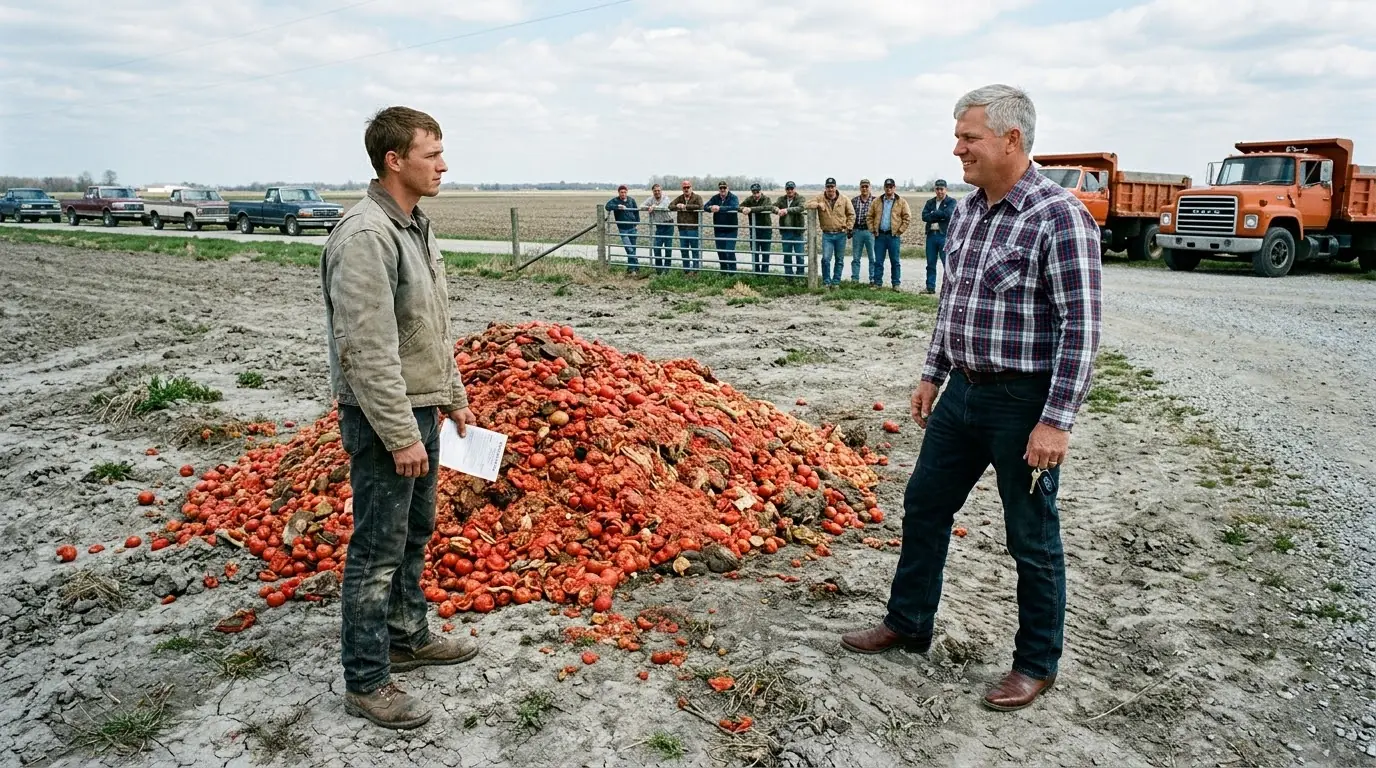
Arthur Vance stood beside his new pickup truck, one hand covering his nose and the other pointing across County Road 7.
“Praying to a pile of rot.”
The farmers around him laughed.
They had to raise their voices over the hydraulic groan of another dump truck lifting its steel bed toward the gray April sky.
A thick crimson slurry rolled out.
Crushed tomato skins.
Seeds.
Pulp.
Fermented juice.
Industrial processing waste that had been sitting inside cannery holding tanks long enough to smell like something had died underneath the earth.
It landed with a wet, heavy slap.
Then spread across the cracked gray clay.
Arthur shook his head.
“That stench is going to run off every neighbor you've got.”
More laughter.
Twenty-two-year-old Cole Evans said nothing.
He stood at the edge of his five acres in a faded canvas jacket and grease-stained boots, watching truck after truck unload what nearly everyone in Knox County considered garbage.
By noon, forty-eight commercial dump trucks had entered the property.
By three o’clock, approximately fifty tons of fermenting tomato waste covered sections of the abandoned clay parcel.
By sunset, twenty-two formal complaints had reached the county courthouse.
People gathered along the gravel shoulder with handkerchiefs pressed over their noses.
Deputy Sheriff Miller had to park his cruiser partly across the access lane to keep angry neighbors from walking into the field.
One farmer shouted:
“You letting him turn farmland into a landfill now?”
Another yelled:
“That isn't farmland!”
“That’s the point!”
Arthur Vance laughed louder than anyone.
Arthur farmed nearly six thousand acres.
Hybrid Roma tomatoes.
Computer-controlled irrigation.
Commercial fertilizers.
Chemical fungicides.
Modern harvesting equipment.
His tomatoes went into supermarket supply chains across several states.
Cole owned five acres nobody wanted.
Heavy alkaline clay.
Hard enough in summer that a shovel could bounce off it.
The parcel had sat fallow for fifteen years.
A farm appraiser had once written the agricultural value in the report as effectively zero.
Arthur pointed toward the steaming red field.
“The boy has finally lost his mind.”
Cole kept watching the trucks.
Arthur stepped closer to the road.
“The cannery was looking at twenty thousand dollars just to haul that sludge away properly.”
He turned toward the crowd.
“And they found one fool willing to take it for free.”
The farmers laughed.
Arthur raised his voice.
“Hey, Cole!”
Cole finally looked over.
“You planning on raising tomatoes?”
A pause.
Arthur grinned.
“Or maggots?”
The crowd erupted.
Cole looked at the field once more.
Then quietly answered:
“Tomatoes.”
That made them laugh even harder.
By Friday, the Knox County Herald had given the property a name.
THE GREAT TOMATO LANDFILL OF KNOX COUNTY
Someone nailed a copy of the newspaper to Cole’s fence post.
He left it there.
The township trustee arrived that afternoon carrying a yellow citation.
“You have thirty days.”
Cole read it.
“If this material is not cleared, treated, or incorporated in a manner acceptable to the county, we can send equipment out here ourselves.”
Cole looked at him.
“And bill me.”
“Yes.”
“How much?”
The trustee sighed.
“You don't want to find out.”
Cole signed the receipt.
Folded it once.
Put it in his pocket.
The trustee studied him.
“You really aren't going to tell me why you did this?”
“No, sir.”
“Everybody thinks the cannery took advantage of you.”
Cole looked toward the field.
“Maybe they did.”
The trustee waited.
Cole said nothing else.
By the end of April, almost everyone in the county had reached the same conclusion.
Young farmer.
Worthless land.
No money.
No experience.
A corporation needed somewhere cheap to dump processing waste, and Cole Evans had been foolish enough to say yes.
They laughed through April.
They shook their heads through May.
None of them knew Cole had been waiting almost eleven years for exactly this opportunity.
The idea had begun with his grandmother.
Dr. Clara Evans had never owned a large farm.
She never appeared on television.