"YOU PAID A THOUSAND BUCKS FOR THIS JUNK?!"
Roy Harlan's voice traveled across the cold Iowa field before the boy could finish reading the number on his measuring tape. Three older farmers stood behind Roy near a white flatbed pickup, their laughter carrying over fifty abandoned steel plows arranged in crooked rows. The plows had tall, spoked iron wheels, bent handles, and layers of rust that made their original paint impossible to identify. Some leaned into the mud. Others stood on their own with the stubborn dignity of things that had once been useful and were now too heavy to move.
Twelve-year-old Noah Carter knelt beside the nearest plow. He wore a faded blue denim jacket, ordinary jeans darkened at the knees, and brown cowboy boots with mud packed around the soles. His light-brown hair fell into his eyes when he leaned forward. A small notebook lay open on a dry piece of board beside him, and a yellow measuring tape stretched across one iron wheel.
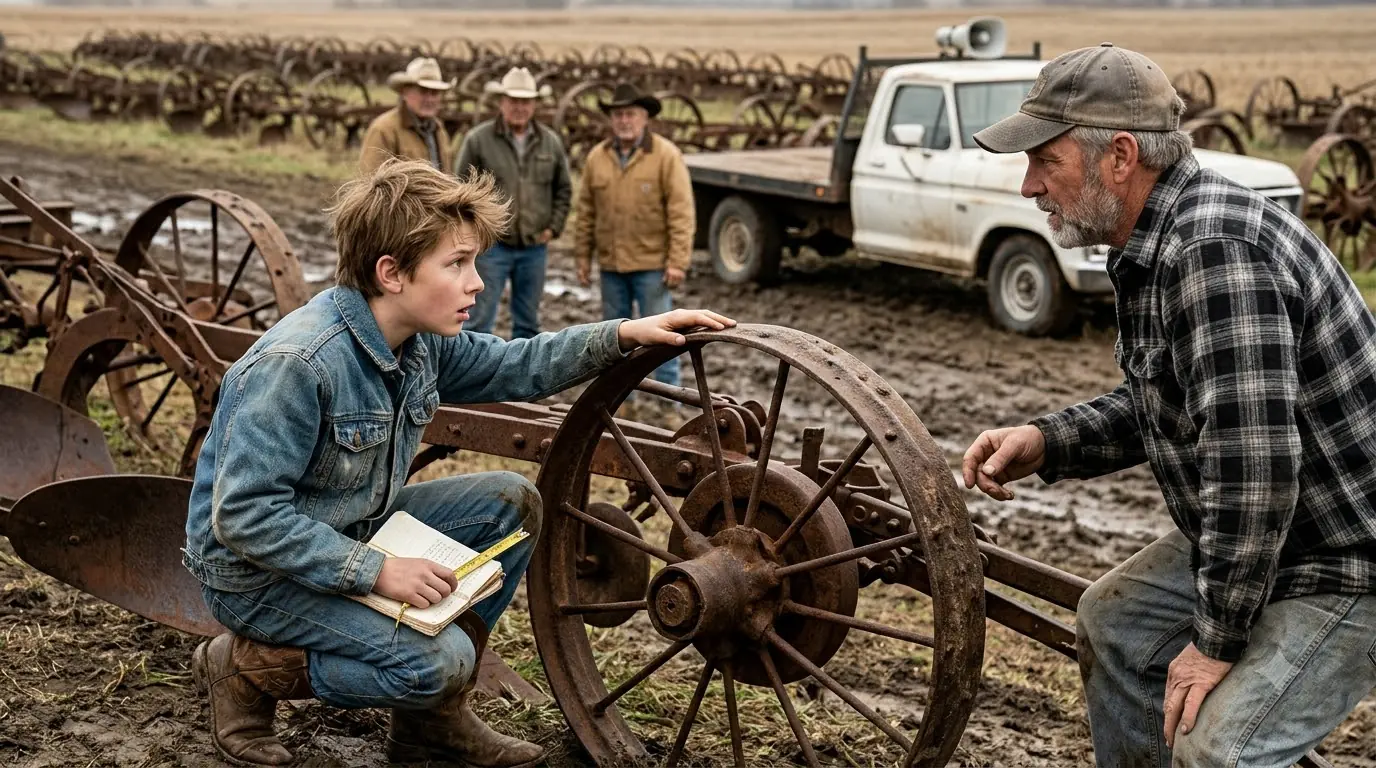
Roy stepped closer, his black plaid shirt straining over a broad stomach. He was fifty-eight, with a gray beard and the weathered confidence of a man who had bought and sold farm equipment longer than Noah had been alive. He nudged the rusty wheel with his boot. It rattled against its frame and stopped with a long metallic groan.
"You'll never sell a single one," Roy said. "Not one."
The men laughed again. Noah drew the tape back into its case and looked up. He had heard the judgment all morning, first in whispers, then in jokes, and finally from Roy at full volume. He had promised himself he would not answer. Yet the old farmer's boot was still against the wheel Noah had just measured, and something about that casual disrespect broke his patience.
"You're wrong," he said.
Roy smiled broadly. "Then prove it, son."
Noah did not rise. He returned to the wheel, turning it slowly by hand. Rust grated against rust, and one spoke passed beneath his fingers, followed by another. He watched the center rather than the rim. His expression changed. He let the wheel settle, opened his notebook, and ran one dirty finger down a column of figures he had copied the previous night.
For the first time that afternoon, Roy stopped laughing.
"What did you find?" he demanded.
Noah studied the central hub without answering. He had spent nearly every dollar he possessed on a field of objects nobody wanted. Until that moment, he had been afraid the men might be right. Now he was afraid of something else entirely: that what he was beginning to notice would matter more than he understood.
Three days earlier, the plows had been only a rumor.
Noah heard about them while sitting at the Carter kitchen table on a rainy evening, listening to his father speak with a neighbor about an equipment sale. His father, Ben Carter, had come home with wet boots and a worried expression. The family farm was small enough that machinery purchases always required a conversation, even used machinery, and Noah had learned to recognize the tone his parents used when something might cost money they could not spare.
"Fifty plows," the neighbor said. "All steel. Old walking and riding types, some so rusted you couldn't tell one model from another. They've been sitting out in a field for years."